-
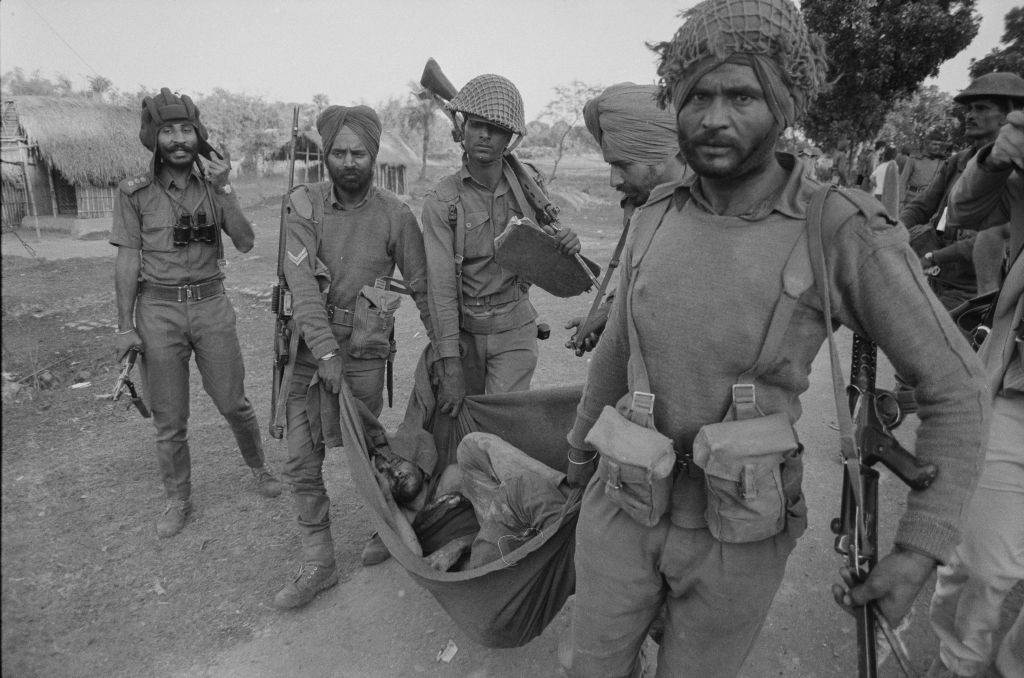
On the evening of 10 December 1971, as Indian forces crossed the Meghna River and closed in on Dhaka, the White House Situation Room sent a message to the Commander in Chief, Pacific (CINCPAC). It began a sequence of orders that culminated, four days later, in the movement of a U.S. carrier task group toward the Bay of Bengal. Although widely labelled “Task Force 74” in later accounts, contemporaneous records vary: some U.S. documents simply describe it as a carrier group detached from the Seventh Fleet, while Indian and Soviet-era sources apply labels inconsistently. What is undisputed is the political…
-

Introduction: The Funeral of Equidistance On the morning of August 9, 1971, in the gilded halls of New Delhi’s Rashtrapati Bhavan, the Indian Minister of External Affairs, Swaran Singh, and the Soviet Foreign Minister, Andrei Gromyko, affixed their signatures to a document titled the Treaty of Peace, Friendship, and Cooperation. To the casual observer of international law, the text might have appeared as a standard diplomatic instrument—a framework for cultural exchange, trade normalization, and scientific collaborationCollaboration Full Description:The cooperation of local governments, police forces, and citizens in German-occupied countries with the Nazi regime. The Holocaust was a continental crime, reliant on…
-

The dramatic narrative of the Space Race is often told through its spectacular successes and failures: SputnikSputnik The first artificial Earth satellite, launched by the Soviet Union. Its successful orbit shattered the narrative of American technological superiority, triggering a crisis of confidence in the West and initiating the race to militarize space. Sputnik was a metal sphere that signaled a geopolitical earthquake. For the West, the “beep-beep” signal received from orbit was not a scientific triumph, but a terrifying proof that the Soviet Union possessed the rocket technology to deliver nuclear warheads to American soil. It instantly dissolved the geographical security…
-
On October 4, 1957, a polished sphere of aluminum, no larger than a beach ball, began its elliptical journey around the Earth. From its antennae emanated a steady, repetitive beep-beep-beep—a sound that was, for millions, both scientifically wondrous and politically terrifying. The Soviet Union’s launch of Sputnik 1Sputnik 1 Full Description:The world’s first artificial satellite, launched by the Soviet Union on October 4, 1957. A small aluminum sphere emitting radio pulses, its successful orbit triggered the “Sputnik Crisis” in the United States, shattering the illusion of Western technological superiority and officially initiating the Space Race. Critical Perspective:Sputnik was less a…
-
Operation Condor was one of the bloodiest chapters in the history of the Cold War, a transnational terrorist consortium where South American military regimes collaborated to hunt, torture, and disappear their political opponents across borders. The image is one of a distinctly Latin American horror, orchestrated by generals in Santiago, Buenos Aires, and Montevideo. Yet, hovering over this entire apparatus is a persistent, haunting question: what did the United States, the hemispheric superpower and self-proclaimed beacon of democracy, know and do? The story of U.S. involvement is not one of simple, direct command but of a complex and damning complicity.…
-
When the Korean War erupted on 25 June 1950, few could have foreseen just how rapidly events would spiral. In barely a few months, the North Korean People’s Army (KPA) would drive deep into the south, consigning most of the Republic of Korea (ROK) to collapse, and forcing United Nations (UN) and South Korean forces into a barely tenable defensive “beachhead” in the southeast. This article examines that first phase in detail — how North Korea planned and executed its lightning offensive, why the South Korean military disintegrated so swiftly, how UN/ROK forces clung on at the Pusan PerimeterPusan Perimeter…
-
The Korean War, which erupted in a blaze of artillery and infantry assaults on June 25, 1950, is often mistakenly viewed as a sudden conflict. In reality, it was the violent culmination of a five-year political and ideological schism that fractured the Korean Peninsula. This division was not the result of ancient ethnic hatreds or a natural geographical boundary, but a direct consequence of the power vacuum left by the collapse of the Japanese Empire and the ensuing Cold War rivalry between the United States and the Soviet Union. The 38th parallel38th Parallel Full Description: An arbitrary latitude line chosen…
-
Table of Contents Introduction: An Alliance of Convenience and Ideology In the stark binary of the Cold War, the struggle against apartheidApartheid Full Description: An Afrikaans word meaning “apartness.” It refers to the system of institutionalized racial segregation and discrimination that governed South Africa. It was a totalizing legal framework that dictated where people could live, work, and travel based on their racial classification. Apartheid was not merely social prejudice; it was a sophisticated economic and legal machine designed to maintain white minority rule. It involved the complete spatial separation of the races, the banning of mixed marriages, and the denial…
-
A familiar narrative following the dissolution of the USSR is that Cold War ended because Western capitalism triumphed over a backward, inefficient communist system. But what if the real story is about an empire buckling under the weight of its own military spending—a lesson with stark relevance for today? In the early 1990s, a wave of triumphalism swept the West. The Soviet Union had vanished, seemingly without the apocalyptic violence that accompanied the fall of other empires. The narrative was seductive: Reagan’s tough stance and the inherent superiority of free markets had consigned Marxism-Leninism to the “ash heap of history.”…
