-

In the latest Explaining History Podcast episode, the discussion explores neocolonialism, revealing how the decline of formal empires led to neoliberalism’s rise. By analyzing historical imperial practices, it highlights the exploitation of Global South resources and labor, illustrating how capitalist elites shifted focus inward to maintain wealth amidst changing global dynamics.
-

The establishment of Special Economic Zones (SEZs) in 1980 marked China’s decisive engagement with global capitalism. Strategically located near Hong Kong, Macau, and Taiwan, zones like Shenzhen and Xiamen utilized the “Bamboo Network” of the Chinese diaspora to attract capital and technology while containing “ideological pollution.” Functioning as laboratories for market reforms—including land auctions and labor commodification—these zones overcame fierce conservative resistance through Deng Xiaoping’s political protection. The SEZs created a successful hybrid model of state-led export industrialization, transforming China’s coastal geography and providing the blueprint for the nation’s rise as the “workshop of the world.”
-
A familiar narrative following the dissolution of the USSR is that Cold War ended because Western capitalism triumphed over a backward, inefficient communist system. But what if the real story is about an empire buckling under the weight of its own military spending—a lesson with stark relevance for today? In the early 1990s, a wave of triumphalism swept the West. The Soviet Union had vanished, seemingly without the apocalyptic violence that accompanied the fall of other empires. The narrative was seductive: Reagan’s tough stance and the inherent superiority of free markets had consigned Marxism-Leninism to the “ash heap of history.”…
-
Date: September 17, 2025 Author: The Explaining History Podcast Table of Contents Introduction: A Treatise for Our Times In the final years of his life, the esteemed historian Tony Judt penned a powerful and moving lament. His book, Ill Fares the Land, is more than a historical analysis; it is a poignant treatise on the perceived death of social democracy and the subsequent ruination wrought by neoliberalism. Judt writes not as a detached academic, but as a concerned citizen mourning the loss of a collective ideal—the post-war consensus that sought to build a more equitable society through state intervention and…
-
Ongoing and invisible crimes against humanity What comes to mind when you hear the term “economic sanctions”? For many, it sounds like a clean, non-violent, and measured response to a rogue nation’s behaviour. It’s often presented by news outlets and politicians as a firm but fair disciplinary tool—the global community taking away a misbehaving country’s toys. It’s the civilized alternative to bombs and bullets. But what if this perception is completely wrong? What if the sanitized language of foreign policy masks a brutal reality of unimaginable structural violence? A landmark study from the world-renowned medical journal, The Lancet, has pulled back…
-
The 1930s Great Depression was a cataclysmic economic crisis. By 1932–33 industrial output and trade had collapsed worldwide, unemployment soared (over 20% in the US at its peak) and thousands of banks failed. Traditional “classical” economics – with its faith in self-correcting markets and the gold standard – had offered no relief. In fact, economists like Barry Eichengreen argue that adherence to gold constrained policy response: central banks could not expand the money supply freely because they were bound by fixed exchange rates . Only when Britain finally abandoned gold in September 1931 did policy-makers feel freed. As Keynes himself…
-
Introduction The European Union (EU) has often been seen as a vehicle for promoting a particular brand of economic policy across the continent – one grounded in market orthodoxy or neoliberal principles. From the early 1990s to the present, EU institutions and treaties have increasingly emphasized fiscal discipline, market liberalization, and monetary stability as foundational tenets of economic governance. This shift became especially pronounced with the Maastricht Treaty of 1992, which many observers view as a turning point marking the EU’s embrace of neoliberal economic doctrine . Maastricht embodied a transition away from the post-war social democratic model – which…
-
The Birth of Bretton Woods and the Post-War Development Model In July 1944, as World War II neared its end, world leaders gathered in Bretton Woods, New Hampshire to design a new international economic order. The result was the creation of the Bretton Woods Institutions – primarily the International Monetary Fund (IMF) and the World Bank – tasked with stabilizing the global economy and financing reconstruction and development . Under the original Bretton Woods system, exchange rates were fixed to the US dollar (and indirectly to gold), and the IMF’s role was to help countries overcome short-term balance-of-payments problems while…
-
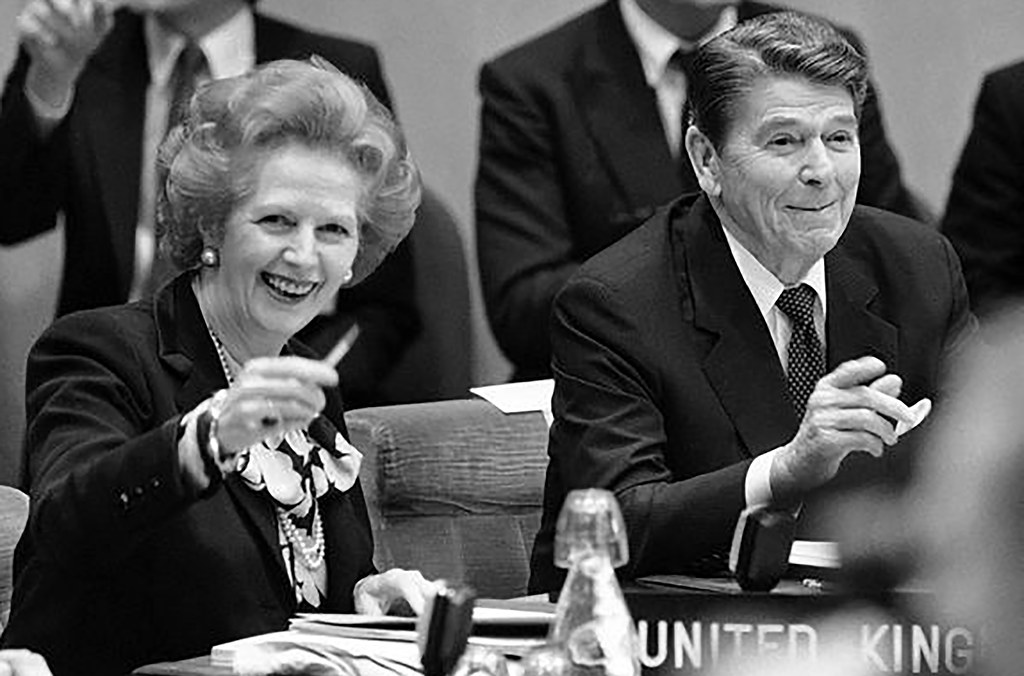
From the 1970s onwards, a wave of free-market ideology reshaped economies, governments, and societies around the world. Known as neoliberalism, this framework prioritized deregulation, privatization, austerity, and the retreat of the welfare state. This guide brings together a series of essays exploring how neoliberalism emerged, how it shaped the modern world, and why it is increasingly challenged today. From Thatcher and Reagan to the IMF and populist backlash, this collection examines both the rise and the unraveling of neoliberal orthodoxy. Origins and Global Adoption What Is Neoliberalism? A Primer on Market Rule Neoliberalism is a political and economic ideology that…
-
Introduction The term neoliberalism emerged in the mid-20th century as an effort to revive and revise classical liberalism in the face of economic crises and totalitarian regimes. Early neoliberals sought a “third way” between laissez-faire capitalism and state socialism, combining belief in free markets with a framework of legal and social institutions. A seminal moment came at the 1938 Walter Lippmann Colloquium in Paris, where German economist Alexander Rüstow and others coined “neoliberalism” to signify an active, rule-based market economy (rather than the old laissez-faire model) . In practice this meant free trade and private enterprise, but with a role…