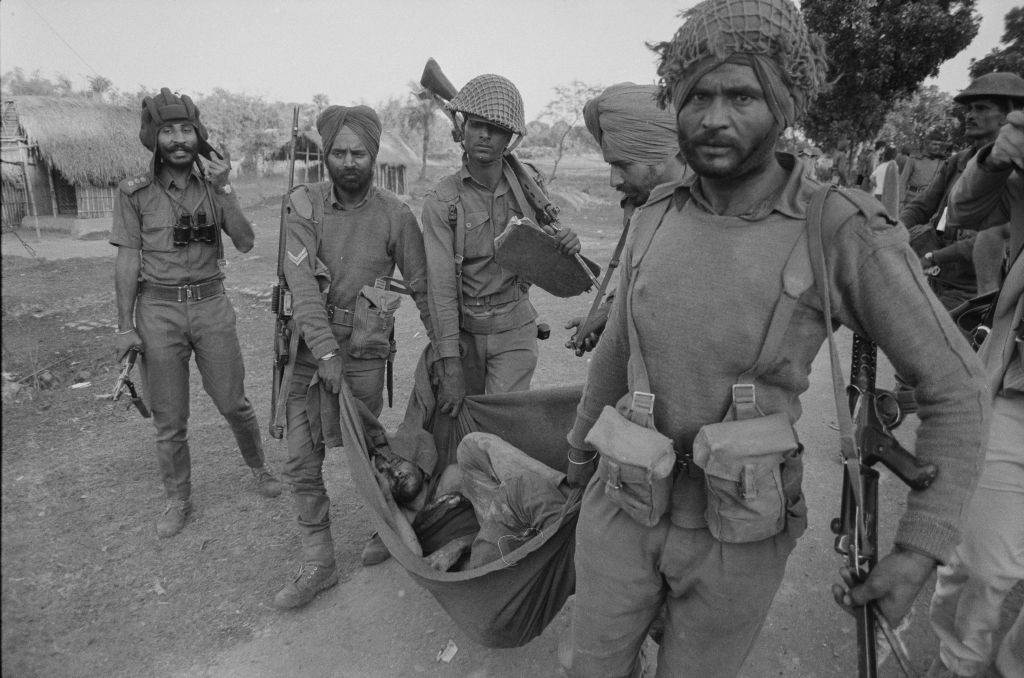

On the evening of 10 December 1971, as Indian forces crossed the Meghna River and closed in on Dhaka, the White House Situation Room sent a message to the Commander in Chief, Pacific (CINCPAC). It began a sequence of orders that culminated, four days later, in the movement of a U.S. carrier task group toward the Bay of Bengal.
Although widely labelled “Task Force 74” in later accounts, contemporaneous records vary: some U.S. documents simply describe it as a carrier group detached from the Seventh Fleet, while Indian and Soviet-era sources apply labels inconsistently. What is undisputed is the political significance of the deployment.
The public justification—that the force was a contingency for evacuating U.S. citizens—was threadbare. Evacuations had already been conducted by British and Canadian aircraft. The real purpose was coercive diplomacy: to signal support for Pakistan, to restrain India, and to reassure China that the United States would stand by its allies at a moment when Washington was preparing for Nixon’s opening to Beijing.
For several tense days in mid-December, the regional war threatened to entangle the superpowers. As the USS Enterprise (CVN-65) approached the eastern Indian Ocean, Soviet vessels shadowed it. Indian decision-makers weighed the danger. And the Nixon administration, caught between collapsing Pakistani defenses and mounting frustration, sought leverage that military reality could not deliver.
This article re-examines the logic, risks, and long-term consequences of the U.S. naval move—not as a mythologised drama of nuclear brinkmanship, but as a misjudged attempt at coercion undertaken at the limits of American power.
Escalation in Washington: The WSAG and the Search for Leverage
The crisis atmosphere inside the Washington Special Actions Group (WSAG) helps explain why the United States reached for so risky a tool. By the second week of December, the Nixon administration recognised that the Pakistani position in the East was untenable. The “Tilt” toward Pakistan had failed to deter India, the UN Security Council was paralysed by Soviet vetoes, and reports reaching the White House suggested India might continue operations into West Pakistan.
Some of these assessments were poorly sourced. Later reconstructions sometimes refer to “a CIA source inside the Indian cabinet,” but open documentation points more broadly to intelligence fears—shared by Nixon and Kissinger—that India might expand the war rather than to any single, definitive source. What is clear from transcripts and memoranda is that Nixon viewed the conflict through a Cold War lens: an Indian victory, backed by Soviet arms and by the August 1971 Indo-Soviet Treaty, looked to him like a strategic setback engineered by Moscow.
The approaching U.S.–China rapprochement compounded this anxiety. If the U.S. allowed a Soviet-aligned India to dismantle a longstanding American partner, would Beijing judge Washington to be weak? These concerns coloured WSAG meetings on 8–9 December, where Nixon pressed for options that might “scare” New Delhi—language whose tone is supported by various tapes, even if precise phrasing differs across published transcripts.
Ground intervention was impossible; U.S. forces were tied down in Vietnam. That left naval power. The Enterprise battle group, already in the Gulf of Tonkin, could be moved quickly. On 10 December, it was detached for refuelling and preparations.
On 13–14 December, the group passed through the Strait of Malacca.
On 15 December, it entered the Bay of Bengal area.
The objective was psychological rather than operational: to force India to pause and thereby preserve West Pakistan.
The “Hammer”: Composition and Symbolism of the Carrier Group
At the centre of the group was the USS Enterprise, the world’s first nuclear-powered carrier, supported by destroyers, escorts, and the amphibious assault ship USS Tripoli. These vessels carried aircraft and weapons consistent with U.S. naval practice of the era, including nuclear-capable systems, though specific loadouts during the crisis remain classified. Soviet vessels following the task group likewise carried missiles that, in general, had nuclear-capable variants.
However, despite its size, the group’s operational limitations were real: it was initially positioned too far south to conduct sustained sorties over Bengal without logistics support, and there was no feasible scenario in which Marines could meaningfully intervene on the ground. The power of the force was largely symbolic—and it was intended to be.
Its chosen route—through the Malacca Strait—signalled the U.S. intention to operate freely in the Indian Ocean, a region where India increasingly saw itself as the primary power.
New Delhi’s Response: Calm Calculation
India was aware of the movement of the carrier group through intelligence monitoring and diplomatic channels. In public, Prime Minister Indira Gandhi expressed defiance; in private, she and senior advisers such as P. N. Haksar and D. P. Dhar judged that actual U.S. strikes were extremely unlikely. Any such attack would risk domestic backlash in the United States, international condemnation, and a direct Soviet response under the Indo-Soviet Treaty.
India’s military therefore accelerated the campaign in East Pakistan, determined to complete operations before the American group could affect the situation. The Indian Navy, led by Admiral S. M. Nanda, maintained its blockade of East Pakistan. Later memoirs describe his instructions in stark terms—hold position, avoid provocation, but resist if attacked—though these accounts should be understood as retrospective recollections rather than formally documented rules of engagement.
India did not flinch. It gambled, correctly, that the U.S. would not escalate.
The Soviet Countermove: Shadowing, Not Showdown
The Soviet Union, bound by the August 1971 treaty, tracked the U.S. group and dispatched vessels from its Pacific Fleet. The exact composition of the Soviet force is debated in open sources, but it included surface ships and submarines capable of threatening U.S. carriers.
A widely repeated anecdote claims Soviet submarines deliberately surfaced in the Bay of Bengal as a visible warning. While evocative, this scene is not strongly supported in the primary record; most serious accounts describe persistent shadowing rather than overt surfacing gestures. What matters is the strategic effect: the U.S. group was monitored by Soviet units with the apparent capacity to respond if India were attacked.
Some later Indian and Russian accounts assert that Soviet commanders were prepared to engage if U.S. forces struck Indian positions. Archival evidence does not confirm explicit orders to that effect, but the logic of the treaty and the posture of the Soviet fleet made escalation a real risk.
The crisis now carried the shadow of a U.S.–Soviet naval confrontation—exactly what Nixon hoped to avoid.
Failure of Coercion
By the time the U.S. group entered the Bay of Bengal on 15 December, the war was virtually decided. Indian forces were at the gates of Dhaka; Pakistani troops were exhausted and surrounded; Chinese intervention had not materialized.
The carrier group offered no viable military options. It arrived too late to influence operations, and any strike on India would have risked Soviet retaliation. When General A. A. K. Niazi surrendered on 16 December, the crisis ended abruptly.
The U.S. task group remained in the area until January 1972, then returned to Vietnam—its political objectives unmet, its deployment widely criticised in India and viewed even within the U.S. bureaucracy as ill-judged.
Aftershocks: Perception, Autonomy, and the Nuclear Question
The episode left a long imprint on Indian strategic thinking. The sense that India had faced coercive pressure from a superpower—however limited the actual risk—became a potent memory in strategic debates. Indian writers sometimes use the phrase “Enterprise syndrome” to describe the conviction that only genuine strategic autonomy can prevent external intimidation, though the term is more rhetorical than doctrinal.
India’s nuclear program did not begin in 1971; its roots lay in China’s 1964 test and long-standing security concerns. However, the 1971 crisis reinforced arguments within Delhi that only a credible deterrent could prevent future coercion. When India conducted its first nuclear test in May 1974, the broader context included the experiences of 1962, 1965, 1971, and the geopolitics of great-power pressure—not solely the Enterprise, but with the episode functioning as a symbolic example of strategic vulnerability.
Conclusion: The Limits of Naval Power
The carrier group’s voyage stands as a reminder that military force cannot compensate for flawed political assumptions. The Nixon administration attempted to revive a form of gunboat diplomacy at a moment when the regional balance—and India’s treaty with Moscow—rendered such coercion ineffective.
The deployment neither saved Pakistan nor altered India’s campaign. Instead, it deepened Indian mistrust of Washington, reinforced Indo-Soviet ties, and contributed to a long-term strategic conversation in Delhi about autonomy and deterrence.
The USS Enterprise sailed into the Indian Ocean as a symbol of American power. It left as a symbol of the limits of that power when it collides with regional resolve, shifting alliances, and the hard facts of geography and timing. The Bay of Bengal crisis remains a study in how misjudged escalation can reverberate far beyond the moment, shaping strategic cultures for decades to come.

Leave a Reply