
Introduction
At 2:00 p.m. on September 22, 1980, Iraqi fighter jets swept low over Tehran’s Mehrabad Airport and ten other Iranian air bases. The sudden air strike, launched without warning, marked the beginning of a conflict that would last nearly eight years, claim between 500,000 and 1.5 million lives, and reshape the political landscape of the Middle East . By the time the guns finally fell silent in August 1988, neither side had achieved its war aims, no borders had changed, and both governments remained in power. It was, as one analyst observed, a war that ended precisely where it began—but with a million dead in between .
The Iran-Iraq War was the longest conventional conflict of the twentieth century . It was also among the most brutal. Iraqi forces employed chemical weapons against Iranian troops and civilians with impunity, killing tens of thousands. Iranian commanders sent waves of teenage volunteers—some as young as twelve—across minefields, clearing paths with their bodies for regular troops to advance. Both sides targeted civilian populations in “wars of the cities.” Both attacked oil tankers in the Persian Gulf, drawing foreign navies into the conflict and nearly provoking a superpower confrontation .
For the Islamic Republic of Iran, barely one year old when the war began, the conflict was nothing less than an existential crisis. It unified a revolutionary regime that had been fracturing along political and ideological lines. It provided the crucible in which the Islamic Revolutionary Guard Corps (IRGC) was forged into a military and economic powerhouse. It entrenched the narrative of martyrdom and sacrifice that would become central to the republic’s legitimacy. And it left deep wounds—physical, psychological, and political—that continue to shape Iranian society today.
This article examines the Iran-Iraq War from the Iranian perspective: its origins in revolutionary ideology and regional rivalry, its conduct through eight years of grinding attrition, and its enduring consequences for the Islamic Republic.
Saddam Hussein’s Calculations
Iraqi President Saddam Hussein launched the invasion for reasons that were simultaneously strategic, ideological, and personal. At the strategic level, the Shatt al-Arab waterway—the confluence of the Tigris and Euphrates rivers forming Iraq’s only outlet to the Persian Gulf—had been a source of tension between the two countries for decades. A 1975 agreement, the Algiers Accord, had settled the border along the thalweg (deepest point) of the waterway in exchange for Iran’s cessation of support for Kurdish rebels in northern Iraq. Saddam had signed the agreement under duress, when Iran’s military—equipped and trained by the United States—was regionally dominant. He never accepted it .
The 1979 Iranian Revolution changed the strategic calculus dramatically. The new Islamic Republic purged the Shah’s officer corps, canceled major weapons contracts with the United States, and severed its military’s ties with Western trainers. Overnight, Iran’s armed forces were transformed from the region’s most powerful into a chaotic, factionalized collection of revolutionary committees and demoralized regular units. Iraqi intelligence concluded that Iran was ripe for the taking .
Ideologically, the revolution posed a direct threat to Saddam’s regime. Khomeini made no secret of his desire to “export” the Islamic Revolution to neighboring countries, particularly Iraq, with its Shia majority ruled by a Sunni-dominated Ba’athist government. Iraqi Shia clerics, inspired by Khomeini’s success, had begun organizing against the regime. For Saddam, a man who tolerated no dissent, this was intolerable. The war, he calculated, would both eliminate the revolutionary threat and position him as the defender of the Arab nation against Persian expansionism .
Saddam also harbored territorial ambitions beyond the Shatt al-Arab. He laid claim to Khuzestan, Iran’s oil-rich southwestern province, which he called “Arabistan” in reference to its Arab population. Capturing Khuzestan would give Iraq control over Iran’s primary oil fields and refineries, crippling the Iranian economy and funding Saddam’s regional ambitions .
The timing seemed perfect. Iran was diplomatically isolated, militarily weakened, and politically chaotic. Saddam expected a swift victory—perhaps three weeks, his generals predicted—followed by the collapse of the revolutionary regime and its replacement by a government more amenable to Iraqi interests .
Iran’s Revolutionary Zeal
If Saddam miscalculated the ease of victory, he also underestimated the resilience of Iran’s revolutionary fervor. The Islamic Republic, whatever its internal divisions, possessed something Iraq lacked: a population mobilized by ideological conviction and a leadership willing to sacrifice that population in staggering numbers.
Khomeini framed the war not as a territorial dispute but as an existential struggle between Islam and infidelity, between the oppressed (mostazafin) and the oppressors (mostakberin). Saddam was cast as the agent of American imperialism, the “infidel Ba’athist” seeking to crush God’s government. To fight and die in this war was not merely patriotic duty but religious obligation, a path to martyrdom and paradise .
This framing resonated deeply. The revolution had mobilized millions of Iranians who felt betrayed by the Shah’s Westernization and inspired by Khomeini’s vision of Islamic justice. When Iraq invaded, those same millions rallied to the regime’s defense. The war, far from toppling Khomeini, consolidated his authority and silenced his domestic critics.
The Course of the War: 1980-1988
Phase One: Iraqi Invasion and Iranian Resistance (September 1980 – May 1982)
Iraq’s initial invasion achieved rapid territorial gains. Iraqi forces captured Khorramshahr, Iran’s largest port city, after bitter urban fighting that left much of the city in ruins. They pushed into Khuzestan, seizing territory along a 300-mile front and laying siege to the key cities of Abadan and Susangerd .
But the expected collapse did not materialize. Iranian forces, though disorganized, fought tenaciously. Revolutionary Guards and volunteer Basij militiamen compensated for their lack of training with religious zeal and willingness to die. By early 1981, Iran had stabilized the front lines and begun launching counteroffensives.
The turning point came in March 1982. In Operation Fath al-Mubin (“Unveiling Victory”), Iranian forces broke the siege of Susangerd. A month later, Operation Bayt al-Muqaddas (“Jerusalem”) recaptured Khorramshahr after twenty-five days of fierce fighting . The battle cost thousands of Iranian lives, but it expelled Iraqi forces from almost all occupied Iranian territory. By June 1982, Saddam announced that Iraq would withdraw its remaining forces and accept a ceasefire .
Phase Two: Iran’s Invasion and the War of Attrition (June 1982 – 1988)
At this moment, Khomeini faced a fateful choice. Accept Saddam’s ceasefire offer would end the war with Iran’s territory restored—a clear victory. But the revolutionary leadership, flush with success and convinced that God was on their side, chose to continue fighting. Their goal now was not merely to expel Iraq but to overthrow Saddam’s regime and, perhaps, to carry the revolution to Baghdad .
In July 1982, Iranian forces crossed into Iraq, launching Operation Ramadan al-Mubarak toward the southern city of Basra. The invasion was a disaster. Iraqi forces, now defending their own territory, had prepared extensive defensive positions. The anticipated uprising by Iraq’s Shia population never materialized; Iraqi Shia, whatever their grievances against Saddam, were not eager to be liberated by Persian invaders. Iranian human-wave attacks crashed against Iraqi defenses with horrific casualties and negligible territorial gains .
This pattern would repeat for the next six years. Iran launched massive offensives—Operation Wal-Fajr (Dawn) in 1983, Operation Khaybar in 1984, Operation Badr in 1985—each sending tens of thousands of Iranian troops against Iraqi fortifications. Each achieved little beyond the accumulation of corpses .
The human cost was staggering. Iranian commanders, particularly in the IRGC, relied on human-wave tactics that employed Basij volunteers—often elderly men and teenage boys—as shock troops. These volunteers, promised paradise if they fell, marched across minefields to clear paths for regular forces. They advanced chanting “Allahu Akbar” into machine-gun fire. An estimated 100,000 Basij died in the war, many of them children .
The International Dimension
Iran’s decision to continue the war proved strategically catastrophic. By invading Iraq, Iran transformed itself from victim to aggressor in international eyes, forfeiting the sympathy it might have enjoyed. The Arab states of the Persian Gulf, terrified by the prospect of revolutionary Iran’s victory, threw their support behind Saddam. Saudi Arabia and Kuwait provided Iraq with between $25 and $50 billion in loans and grants . Egypt and Jordan supplied military equipment. The Gulf Cooperation Council, formed in 1981, functioned in part as a bulwark against Iranian expansion.
The superpowers also tilted toward Iraq. The Soviet Union, initially neutral, shifted decisively after Iran cracked down on the pro-Soviet Tudeh Party in 1983. Between 1984 and 1987, Moscow sold approximately $11.5 billion in military supplies to Iraq, compared to just $5 million to Iran . France became Saddam’s second-largest supplier, providing $4.5 billion in advanced weaponry including Mirage fighters and Exocet missiles .
The United States, despite its official neutrality, also supported Iraq. Washington removed Iraq from its list of state sponsors of terrorism in 1982, reestablished diplomatic relations in 1984, and provided Saddam with satellite imagery of Iranian troop positions . The Reagan administration’s tilt toward Baghdad was driven by a simple calculus: containing revolutionary Iran outweighed any concerns about Saddam’s brutality.
This international support gave Iraq decisive advantages. By the mid-1980s, Iraq was spending approximately $44 billion on foreign military purchases, compared to Iran’s $12 billion . Iraq could replenish its losses; Iran could not.
The Iran-Contra Affair
There was, however, a bizarre exception to this pattern. Between 1985 and 1986, senior officials in the Reagan administration secretly facilitated arms sales to Iran—the country they were publicly arming Iraq against. The proceeds were illegally diverted to fund Contra rebels in Nicaragua, producing the Iran-Contra scandal that nearly destroyed Reagan’s presidency .
The arms-for-hostages deal was driven by two motivations: securing the release of American hostages held in Lebanon by Iranian-backed groups, and a fantasy that “moderates” in Tehran could be cultivated. In practice, the operation accomplished little. Iran received perhaps $30 million in weapons—a fraction of what Iraq received—and the hostages were eventually replaced by new captives. When the scheme was exposed in November 1986, it produced a political firestorm in Washington and deepened Iranian suspicion of American intentions .
The Tanker War and American Intervention
By 1984, both sides had begun attacking oil tankers in the Persian Gulf, seeking to cripple each other’s economies. The “Tanker War” escalated steadily. Iran, lacking Iraq’s air power, relied on mines and small boats to harass shipping. Iraq attacked tankers loading at Iran’s Kharg Island terminal .
The attacks on Gulf shipping drew foreign powers into the conflict. In 1987, Kuwait—which had supported Iraq throughout the war—requested American protection for its tankers. The Reagan administration agreed, “reflagging” Kuwaiti vessels with American flags and providing naval escorts .
The U.S. Navy’s presence in the Gulf led to direct confrontation with Iranian forces. In April 1988, after an American frigate struck a mine, U.S. forces destroyed two Iranian oil platforms and sank several Iranian warships. The most catastrophic incident occurred on July 3, 1988, when the USS Vincennes, a guided-missile cruiser operating in Iranian waters, shot down Iran Air Flight 655, killing all 290 passengers and crew. Washington claimed the Vincennes mistook the civilian airliner for an attacking F-14 fighter; Tehran, unsurprisingly, believed the attack was deliberate .
Chemical Warfare
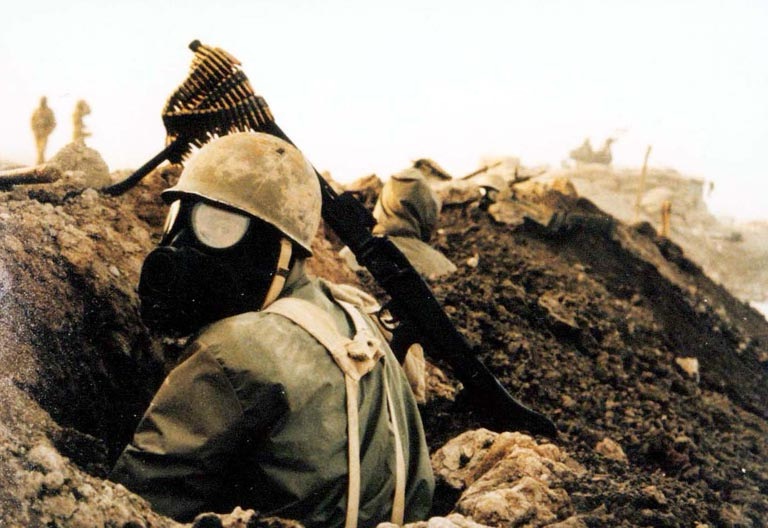
The Iran-Iraq War witnessed the most extensive use of chemical weapons since World War I. Iraq employed chemical agents—including mustard gas and the nerve agents tabun and sarin—on at least 100 occasions, killing or injuring approximately 100,000 Iranians .
Chemical weapons were used systematically to break Iranian human-wave attacks. Defenseless against these agents, Iranian troops died by the thousands, choking on their own fluids or suffering horrific burns. Iraq also used chemical weapons against civilians, most notoriously in the March 1988 attack on the Kurdish town of Halabja, where an estimated 5,000 people were killed .
The international community’s response was muted. The United Nations investigated and confirmed Iraqi use of chemical weapons, but no serious sanctions were imposed. Washington, eager to see Iran defeated, blocked strong action at the Security Council. The message to Saddam was unmistakable: chemical weapons were an acceptable tool of war .
The War’s End: “Drinking Poison”
By 1988, Iran was exhausted. The economy was in ruins. Oil revenues had collapsed. Casualties had reached catastrophic levels. The population, once enthusiastic, was increasingly war-weary. And the United States had effectively entered the war on Iraq’s side.
In April 1988, Iraq launched a series of offensives that recaptured the Faw Peninsula and pushed Iranian forces back from the border. With American naval forces engaging Iranian ships in the Gulf and the Vincennes shooting down the civilian airliner in July, Tehran faced the prospect of a two-front war against both Iraq and the United States .
On July 18, 1988, Iran accepted United Nations Security Council Resolution 598, which called for an immediate ceasefire. Khomeini’s public statement revealed the depth of his anguish: “Taking this decision was more deadly than drinking poison. I submitted myself to God’s will and drank this drink for his satisfaction” .
The ceasefire took effect on August 20, 1988. After eight years, the war ended exactly where it had begun—with no territorial changes, no regime change, and no resolution of the underlying conflicts.
The Human Cost
The war’s human toll remains disputed but staggering. Conservative estimates suggest 500,000 dead; higher estimates approach 1.5 million . Iran suffered approximately 300,000 military dead and hundreds of thousands more wounded, many permanently disabled by chemical weapons. The Basij, the volunteer militia, lost an estimated 100,000 fighters, including thousands of children.
The economic cost was equally devastating. Iran’s oil infrastructure was badly damaged; production did not return to pre-war levels for years. The government had spent billions on the war effort, draining resources from development and social services. Entire cities—Khorramshahr, Abadan, Susangerd—lay in ruins.
But the psychological and political costs were perhaps most enduring. The war seared itself into Iranian national consciousness as the “Sacred Defense” (Defa-e Moqaddas)—a foundational myth of sacrifice, martyrdom, and resistance against a world in arms. Martyrs’ cemeteries became pilgrimage sites. Wartime posters depicting young Basijis marching toward paradise became iconic images. The narrative of victimhood and heroic resistance became central to the Islamic Republic’s legitimacy .
Consequences: The War’s Legacy
The Consolidation of Revolutionary Institutions
The war transformed the Islamic Republic’s institutions. The IRGC, which began as an ideological militia tasked with protecting the revolution, emerged as a conventional military force with its own army, navy, air force, and intelligence apparatus. Its commanders—men like Mohsen Rezaei, the IRGC chief throughout most of the war—gained battlefield experience and political influence. After the war, the IRGC expanded into the economy, taking over reconstruction projects and building the industrial and financial empire that makes it today the most powerful institution in Iran .
The Basij, the volunteer militia, became a permanent feature of Iranian society—a reservoir of ideological loyalty and a tool for social control. In the postwar decades, Basijis would be deployed against domestic dissent as readily as against foreign enemies.
The Radicalization of Iranian Foreign Policy
The war deepened Iranian suspicion of the international community. The world had watched Iraq use chemical weapons with impunity. The United States had actively supported Saddam while shooting down a civilian airliner. The Arab states had funded and armed Iran’s enemy. These experiences reinforced the revolutionary narrative that Iran stood alone against a hostile world, and that self-reliance was the only path to survival.
Iran’s postwar foreign policy—its support for Shia militias in Iraq, Hezbollah in Lebanon, and the Assad regime in Syria—can be traced partly to lessons learned during the war. The IRGC, which had gained experience projecting power through proxies and irregular forces, would apply those lessons across the region.
The Postwar Transition
Khomeini died in June 1989, less than a year after accepting the ceasefire. His successor, Ali Khamenei, lacked Khomeini’s revolutionary charisma and religious authority. The postwar era would be dominated by pragmatic figures like Akbar Hashemi Rafsanjani, who prioritized reconstruction and economic development over revolutionary export .
But the war’s legacy endured. A generation of Iranians had come of age in the trenches, and their experiences shaped postwar politics. Veterans of the Sacred Defense occupied key positions in government, security, and the economy. The values of sacrifice and martyrdom remained central to official discourse. And the bitterness of eight years of futile, bloody stalemate left deep wounds that would resurface in subsequent decades.
The Iraqi Reckoning
For Iraq, the war’s legacy was equally profound—and ultimately catastrophic. Saddam emerged from the conflict with his regime intact and his ambitions undiminished, but with an economy bankrupted by war debts to Kuwait and Saudi Arabia. His demand that Kuwait forgive these debts, coupled with territorial ambitions, led to the August 1990 invasion of Kuwait—and the Gulf War that followed .
The same Western powers that had supported Saddam against Iran now mobilized to destroy his military. The 1991 war, the sanctions that followed, and the 2003 invasion that toppled his regime can all be traced, in part, to the regional destabilization wrought by the Iran-Iraq War.
Conclusion: The War That Never Ended
The Iran-Iraq War ended in 1988, but its effects continue to reverberate. The IRGC, forged in the war’s crucible, now projects Iranian power across the Middle East. The narrative of Sacred Defense remains central to the Islamic Republic’s legitimacy, invoked at every anniversary and commemorated in endless monuments, murals, and state media. The chemical weapons victims still suffer, their damaged lungs and eyes a living reminder of the war’s brutality. The families of martyrs still receive state stipends and social prestige.
For Iranians who lived through it, the war was a national trauma—a grinding, wasteful, seemingly endless conflict that consumed their youth, their loved ones, and their hopes. For the regime, it was the crisis that saved the revolution, unifying a fractious population behind a leadership that had seemed, only months before the invasion, on the verge of collapse. Both perspectives are true, and both continue to shape Iranian politics and society.
In August 1988, when Khomeini drank his cup of poison and accepted peace, he ended the fighting but not the war’s consequences. Those consequences—institutional, ideological, psychological—live on. The Iran-Iraq War may be over, but it has never really ended.
Further Reading
· Khomeini, Ruhollah. Islamic Government: Governance of the Jurist. 1970. Khomeini’s key ideological text, which shaped the revolutionary vision that the war was fought to defend.
· Ostovar, Afshon. Vanguard of the Imam: Religion, Politics, and Iran’s Revolutionary Guards. Oxford University Press, 2016. The definitive study of the IRGC, with extensive coverage of its wartime evolution .
· Hiro, Dilip. The Longest War: The Iran-Iraq Military Conflict. Routledge, 1991. A comprehensive military and political history.
· Khaji, Ali, ed. Defense Health Bibliography, The Period of the Iran Iraq War, Vol.2, English Articles. Defense Health Research Center, 2023. A medical bibliography documenting the health consequences of the war, including chemical weapons effects .
· Moosavi, Amir. Dust That Never Settles: Literary Afterlives of the Iran-Iraq War. Stanford University Press, 2025. A recent study examining how Iranian and Iraqi writers have represented the war’s legacy in fiction .
· Pelletiere, Stephen C. The Iran-Iraq War: Chaos in a Vacuum. Praeger, 1992. A scholarly analysis of the war’s conduct and consequences.
Listen & Learn: Related Podcast Collections
Explore these curated episode collections to go deeper on the history behind this article:

Leave a Reply