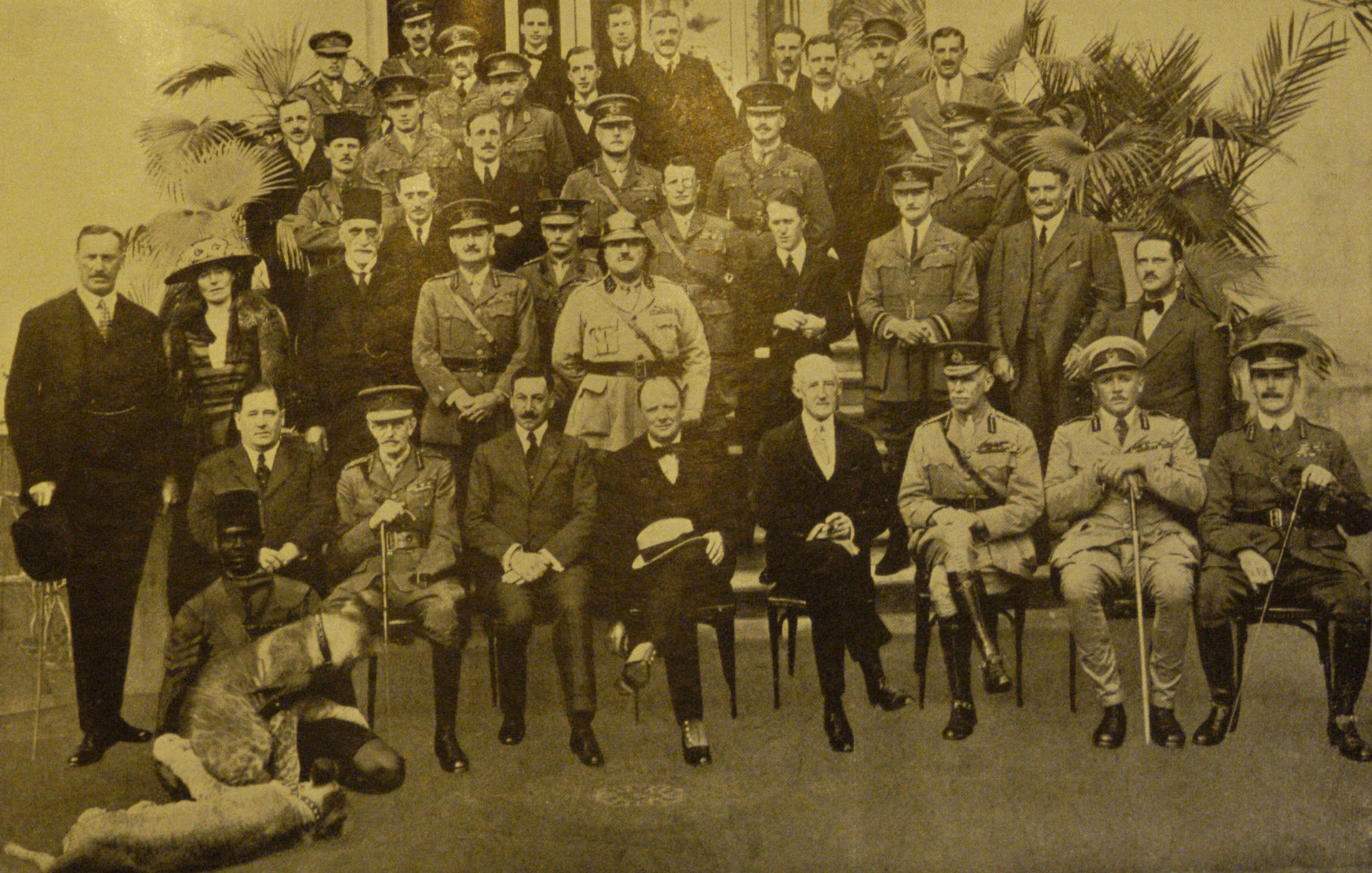

Introduction: The “Forty Thieves” at the Semiramis Hotel
On March 12, 1921, a convoy of official vehicles arrived at the Semiramis Hotel on the banks of the Nile in Cairo. Emerging from the cars was a gathering of British officials that arguably represented the greatest concentration of imperial expertise ever assembled in one location. At the center of the group was Winston Churchill, the newly appointed Secretary of State for the Colonies. Flanking him were figures who had already passed into the realm of legend: T.E. Lawrence (“Lawrence of Arabia”), Gertrude Bell (the “Uncrowned Queen of Iraq”), Sir Percy Cox (High Commissioner of Mesopotamia), and Air Marshal Sir Hugh Trenchard.
This summit, which Churchill jokingly referred to as a gathering of “The Forty Thieves,” was convened to address an urgent crisis of empire. The British position in the Middle East was hemorrhaging money and legitimacy. The post-war settlement devised at San Remo in 1920 was struggling to take hold. In Mesopotamia (Iraq), a massive tribal revolt the previous year had shaken British control to its foundations. In Palestine, sectarian tensions were exposing the contradictions of the mandate. The British public, exhausted by the Great War and facing an economic slump at home, was demanding that the government cut its losses and withdraw from its expensive Arab commitments.
Churchill’s mission at the Cairo Conference was to find a way to maintain British strategic hegemony “on the cheap.” He needed to slash the budget of the Middle East occupation while securing the vital imperial lifelines: the air route to India and the oil fields of Mosul. The solution devised over ten days in Cairo would fundamentally reshape the political geography of the region. It involved the installation of the Hashemite family as client kings and, most consequentially, the fabrication of the modern state of Iraq.
By amalgamating three distinct Ottoman provinces—Mosul, Baghdad, and Basra—into a single unitary kingdom, the conference participants solidified a nation-state structure that made economic and strategic sense to London, but little demographic sense on the ground. This article analyzes the mechanics of the Cairo Conference, the “Sharifian Solution” to the leadership vacuum, and the long-term consequences of merging Kurds, Sunnis, and Shias into one fragile political entity policed by air power.
The Crisis of Empire: 1920–1921
To understand why the Cairo Conference was necessary, one must appreciate the scale of the challenges facing Britain in the preceding year. 1920 was meant to be the year British rule was formalized; instead, it was the year it nearly unraveled.
In Mesopotamia, the announcement that Britain had accepted the mandate contributed to the “Great Iraqi Revolution.” This was a significant national uprising involving Shia tribes of the mid-Euphrates, guided by the grand clerics of Najaf and Karbala, and Sunni nationalists in Baghdad. They cut railway lines, besieged British garrisons, and effectively paralyzed the administration.
Suppression of the revolt required a massive deployment of British and Indian troops. The financial cost was staggering: contemporaries estimated the expense of the Mesopotamian occupation in 1920 at tens of millions of pounds, a sum that provoked outrage in a Britain struggling with post-war debt.
This sparked a furious political backlash in London. The “Anti-Waste” campaign, spearheaded by press barons, ran headlines demanding Britain withdraw from Mesopotamia. They argued that the government was squandering blood and treasure on ungrateful deserts while the domestic economy stagnated.
When Churchill took over the Colonial Office in February 1921, he was tasked by Prime Minister David Lloyd George with a clear objective: drastically reduce the cost of the Middle East garrisons or face the political necessity of withdrawal. Churchill, a believer in the strategic importance of the region (particularly for oil), sought to change the method of control rather than abandon it.
The “Sharifian Solution”
The primary political problem facing Britain was a lack of legitimacy. Direct British rule was unpopular; the British needed a local façade behind which they could operate. They required an Arab king who commanded enough respect to pacify the tribes but remained dependent on British support.
The solution proposed by T.E. Lawrence and strongly supported by Churchill was the “Sharifian Solution.” This involved utilizing the sons of Sharif Hussein of Mecca, the leader of the wartime Arab Revolt. The Hashemite family had been Britain’s wartime allies, but their political fortunes had waned. The French had expelled Faisal bin Hussein from Damascus in July 1920, leaving him a king without a kingdom. Meanwhile, his brother, Abdullah, was in Transjordan threatening to march on Syria, a move that risked a diplomatic crisis with France.
At Cairo, and in subsequent meetings in Jerusalem, the British devised a dynastic arrangement to solve both the leadership vacuum in Iraq and the instability in Transjordan:
- Faisal for Iraq: Faisal was widely respected by Arab nationalists. Lawrence and Bell argued that he was the only figure with the prestige to unite the fractured Iraqi society. Churchill agreed to offer him the throne of Iraq.
- Abdullah for Transjordan: To divert Abdullah from attacking the French, Churchill offered him a provisional emirate in the territory east of the Jordan River. This created a buffer state between British Palestine and the desert, satisfying Abdullah’s ambition while maintaining peace with France.
This decision formalized the administrative separation of the Palestine mandate into two entities: Palestine (west of the river) and Transjordan (east of the river).
The Structure of Iraq: The Three Vilayets
While the selection of a king was a political maneuver, the definition of his kingdom was a profound act of state-building. The entity we now know as Iraq did not exist as a single political unit under the Ottoman Empire. The region was administered as three separate vilayets (provinces), each with a distinct geographic and demographic orientation.
- The Vilayet of Basra: Located in the south, this province had a large Shia Arab population. Its economy was maritime, oriented toward the Persian Gulf and trade with British India.
- The Vilayet of Baghdad: Located in the center, it was ethnically mixed and served as the administrative hub.
- The Vilayet of Mosul: Located in the north, this province was geographically distinct. It was mountainous and contained a large Kurdish population, with economic links to Anatolia and Syria.
The debate among British policymakers—which had been ongoing before Cairo—centered on whether to amalgamate these three provinces into a single state. Arguments had been made for keeping Basra separate as a British protectorate to secure the oil refinery at Abadan, or for leaving Mosul autonomous to avoid conflict with Turkey.
However, the proponents of a unified state, led by Sir Percy Cox and Gertrude Bell, prevailed. Their arguments were strategic and economic:
- Economic Viability: A state based only on Baghdad would be landlocked. It needed the port of Basra for exports and the grain of Mosul for food security.
- Strategic Defense: The flat plains of Baghdad were indefensible. The state needed the mountains in the north (Mosul) to provide a natural frontier.
- The Question of Balance: Some British officials argued that including the Kurds and Sunnis of Mosul would help balance the large Shia population of the south, preventing a Shia theocracy and allowing the Sunni Arab urban elite—whom the British viewed as natural administrators—to govern effectively.
Thus, the decision was confirmed: Iraq would be a unitary state comprising all three provinces. This decision incorporated the Kurdish population into an Arab state, a move that prioritized state viability over ethnic self-determination.
The Kurdish Question and the Oil of Mosul
The inclusion of Mosul was tied inextricably to oil. The Turkish Petroleum Company (in which Britain held a controlling interest) believed that Mosul sat atop massive oil reserves. Churchill was adamant that these reserves must be within the British sphere of influence.
However, this required navigating the aspirations of the Kurds. The 1920 Treaty of Sèvres had hinted at the possibility of an independent Kurdistan. At Cairo, and in the months that followed, this possibility receded. British officials recognized that the Kurds generally opposed being ruled by an Arab king, let alone a Hashemite outsider.
To manage this, the British proposed a policy of local administration for the Kurdish areas, suggesting that Kurdish officials and language would be used. In practice, however, the imperative of building a strong central government in Baghdad meant that genuine Kurdish autonomy was never fully realized. The decision to prioritize a unified Iraq over Kurdish independence planted the seeds for decades of conflict between Baghdad and the north.
Policing by Air: The Strategy of Air Control
Having agreed on the political structure, the conference addressed the military problem: how to secure this vast state without the crushing expense of a large army.
The answer came from Air Marshal Sir Hugh Trenchard. He championed the concept of “Air Control.” Trenchard argued that the Royal Air Force (RAF) could replace the army as the primary instrument of imperial policing.
Instead of maintaining expensive garrisons in every district, Britain would build a network of airbases. If a tribe rebelled or refused to pay taxes, the RAF could be deployed quickly to restore order. This usually involved dropping warning leaflets followed, if necessary, by aerial bombardment of villages or livestock.
Churchill adopted this solution enthusiastically. The Cairo Conference agreed to transfer the responsibility for Iraq’s security from the War Office to the Air Ministry. This was a pivotal moment in military history. Iraq became a testing ground for air policing, allowing Britain to govern the country with a fraction of the previous troop levels and at a significantly reduced cost. While effective in budgetary terms, “Air Control” was controversial, relying on the threat of lethal force against civilian populations to maintain political order.
The Coronation and the Referendum
Following the conference, the British moved to implement the plan. Faisal arrived in Iraq in June 1921. To legitimize his rule, Sir Percy Cox organized a referendum or plebiscite.
This process was carefully managed. British political officers canvassed tribal sheikhs and notables to ensure support for Faisal. While there was genuine enthusiasm for an Arab king among some nationalists, the process was far from a modern democratic vote. Opposition was marginalized, and the British administration exerted significant pressure to secure the desired outcome.
The result was announced as 96% in favor of Faisal. On August 23, 1921, Faisal was crowned King of Iraq in Baghdad. The ceremony highlighted the manufactured nature of the new state: the king was a Hijazi, the anthem was “God Save the King,” and the real power remained, for the time being, in the hands of the British High Commissioner.
The Legacy of Cairo
The Cairo Conference was viewed at the time as a success for Churchill. It stabilized the Middle East, secured the air route to India, and reduced the burden on the British taxpayer. It established the Hashemite kingdoms of Iraq and Jordan, creating a framework for British influence that lasted for decades.
However, the long-term legacy is complex. The conference solidified the borders of a state that faced immense internal challenges.
- Structural Fragility: By creating a unitary Iraqi state that brought together diverse communities without a developed sense of shared nationhood, Cairo established a political entity that often relied on coercion to maintain unity.
- The Kurdish Conflict: The incorporation of Mosul into the Arab state without a durable settlement for Kurdish autonomy led to a cycle of insurgency and repression that defined much of Iraq’s 20th-century history.
- The Precedent of Force: The reliance on air power and external patronage to support the monarchy established a pattern of governance where the state often looked to military force rather than political consensus to solve internal disputes.
The Cairo Conference demonstrates the immense power—and the limitations—of imperial state-building. A group of British officials redrew the map to suit their strategic needs, inventing the modern state of Iraq. As King Faisal later reflected with frustration on the lack of a cohesive national identity, the task of turning that invented state into a unified nation was a challenge that would outlast the British Empire itself.

Leave a Reply