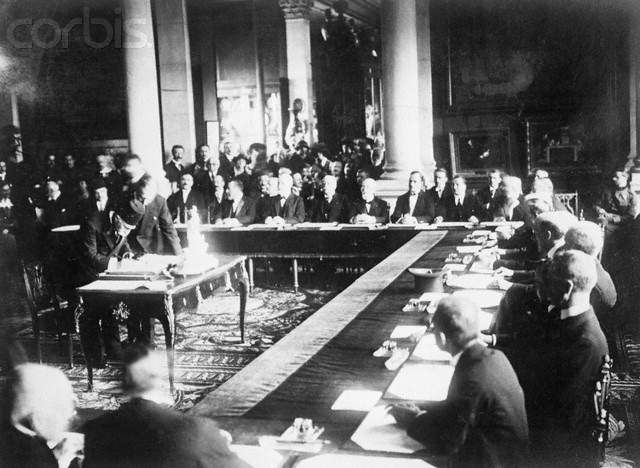

The Treaty of Sèvres did not create an independent Kurdistan. Signed on 10 August 1920, it proposed local autonomy for a defined, predominantly Kurdish area of eastern Anatolia and a conditional route to later independence. That process depended on the treaty entering into force, the Kurdish peoples within the defined area demonstrating to the League Council that a majority desired independence, and the Council judging them capable of independence and recommending it; Turkey had undertaken in advance to execute such a recommendation and renounce its rights. None of those stages was completed because Sèvres never entered into force.
Between 1920 and 1923, power shifted decisively. The Turkish National Movement defeated Armenian and Greek forces, France and Italy disengaged from their Anatolian projects, and Britain would not impose Sèvres by fighting another major war. The Treaty of Lausanne therefore recognised Turkish sovereignty within substantially revised frontiers and contained no Kurdish autonomy or independence mechanism. It did not, however, create every modern border dividing Kurdish communities: the Ottoman–Iranian frontier was older, while the Turkey–Iraq frontier around Mosul was settled only after a League of Nations process and the 1926 Ankara Treaty.
What you need to know
- Sèvres proposed a conditional process, not an immediate Kurdish state.
- Its Kurdish provisions covered a restricted part of eastern Anatolia rather than every Kurdish-inhabited region.
- The treaty failed because the military and diplomatic power needed to enforce it disappeared.
- Kurdish political leaders pursued different aims and did not act as a single national delegation with territorial control.
- Lausanne omitted the Sèvres mechanism, but it left the Mosul frontier for later settlement.
- The outcome exposed the gulf between the language of self-determination and the power politics of the postwar settlement.
What came first? The settlement in eight steps
- The Ottoman Empire was defeated. The Armistice of Mudros ended fighting between the Ottoman Empire and the Allies on 30 October 1918.
- Allied leaders attempted to redesign the former empire. The Paris Peace Conference, mandate proposals and the San Remo decisions allocated influence without producing a simple or consistent application of self-determination.
- A rival Turkish nationalist centre emerged. Mustafa Kemal’s movement rejected occupation and partition and established the Grand National Assembly at Ankara in April 1920.
- Sèvres proposed Kurdish autonomy and possible independence. Articles 62–64 established a limited, conditional procedure.
- The treaty never became operative. The Ottoman government signed, but Ankara rejected its authority and the treaty was not brought into force.
- War changed the bargaining position. Turkish nationalist victories and separate French and Italian withdrawals broke the coalition capable of imposing Sèvres.
- Lausanne replaced the failed settlement. Signed on 24 July 1923, it contained no equivalent Kurdish mechanism.
- Mosul remained unsettled. The League process of 1924–25 and the Ankara Treaty of 1926 fixed the Turkey–Iraq frontier.

Where did Sèvres fit into the postwar treaty system?
Sèvres belonged to a wider attempt to settle the First World War, but the treaties did not apply one consistent principle. Their terms combined security, punishment, strategic advantage, imperial control, nationality claims and selective appeals to self-determination.
| Settlement | What it contributes to this story |
|---|---|
| Brest-Litovsk, March 1918 | The Bolshevik government left the war and ceded extensive territory to the Central Powers. Its collapse after Germany’s defeat reopened struggles over the Caucasus, but it was not part of the later Paris settlement. |
| Versailles, June 1919 | Created the League of Nations framework and helped institutionalise the mandate system through Article 22 of the League Covenant. It provides the institutional context for the later Kurdish and Mosul provisions. |
| Trianon, June 1920 | Redrew Hungary’s borders and created large minorities outside its frontiers. It is a useful comparison showing that nationality and self-determination did not produce ethnically tidy states. |
| Sèvres, August 1920 | Attempted to settle the Ottoman conflict while dividing sovereignty and influence across Anatolia and the former Arab provinces. It was signed but never entered into force. |
| Lausanne, July 1923 | Replaced the unimplemented Anatolian settlement after Turkish nationalist success. It recognised Turkish sovereignty but deferred the Iraq frontier. |
| Ankara, June 1926 | Confirmed the Turkey–Iraq frontier following the League’s consideration of Mosul. |
Versailles therefore belongs in the main explanation because it supplied the League and mandate framework. Trianon is most useful as a comparison. Brest-Litovsk is earlier background: important to the collapse of wartime frontiers, but not a direct precursor of the Kurdish clauses.
What did Articles 62–64 actually say?
Article 62: a plan for local autonomy
Article 62 instructed a commission representing Britain, France and Italy to prepare a scheme of local autonomy for predominantly Kurdish areas east of the Euphrates, south of the proposed Armenian frontier and north of the frontier with Syria and Mesopotamia. The geography was therefore bounded and conditional. It did not encompass every Kurdish community across the Ottoman and Persian worlds.
Article 63: Ottoman acceptance
Article 63 required the Ottoman government to accept and execute the commission’s decisions within three months of their communication. This was an obligation imposed on the government that signed at Sèvres, not an agreement negotiated with the Ankara movement controlling an increasing share of Anatolia.
Article 64: possible independence later
Article 64 described a second stage. Within one year of the treaty entering into force, the Kurdish peoples within the Article 62 area had to address the League Council in a manner showing that a majority of the area’s population desired independence. The Council then had to consider the population capable of independence and recommend it. Only then did Turkey undertake to renounce its rights.
The article also contemplated the voluntary adhesion of Kurds in the relevant part of the Mosul vilayet if an independent Kurdish state emerged and the principal Allied powers approved. This was not an automatic transfer of Mosul and not a referendum guaranteed to occur.
The accurate verdict
It is reasonable to say that Sèvres placed possible Kurdish independence in an international treaty. It is misleading to say that it immediately created Kurdistan or established an unconditional promise subsequently deleted at Lausanne. The legal mechanism depended on events that never occurred, beginning with the treaty’s entry into force.
Why did the Sèvres settlement fail?
The signatory government lacked effective authority
The Istanbul government signed under Allied pressure. The nationalist movement at Ankara denied that it could surrender Anatolian territory and increasingly became the government with which other powers had to deal. A treaty is not self-executing: its provisions required political authority and coercive power on the ground.
Turkish nationalist forces changed the military position
The nationalist movement defeated the Armenian Republic in 1920 and the Greek army in the war culminating in 1922. These victories removed central territorial components of the Sèvres settlement and made its enforcement far more costly.
Allied policy fragmented
France reached the Ankara Agreement in October 1921 and withdrew from Cilicia. Italy had also moved away from enforcing its Anatolian claims. Britain retained major regional interests, particularly in Iraq and the Straits, but was unwilling to impose the entire Sèvres programme alone through another war. The settlement failed through a combination of battlefield outcomes, separate diplomacy and declining Allied commitment.
Kurdish politics were plural
Kurdish intellectuals, tribal leaders, religious authorities, Ottoman officials and regional communities did not share a single programme. Some advocated independence, some autonomy, some cooperation with Ankara and others the protection of local or dynastic interests. Fear of Armenian territorial claims, Islamic solidarity, local rivalries and distrust of European imperial intentions all shaped choices.
This diversity did not make Kurdish self-government illegitimate. It did make it harder to turn diplomatic language into a unified territorial project, especially without an internationally recognised delegation controlling the territory concerned.
The proposed geography contained competing claims
The territories discussed by diplomats contained Kurdish, Armenian, Turkish, Assyrian, Arab and other communities. Population information was incomplete and politically contested. The proposed Armenian settlement, the position of Christian minorities and the status of Mosul complicated any attempt to draw a single national frontier.
What changed at Lausanne?
Lausanne was negotiated with representatives of the Ankara government after its victories, not dictated to the defeated Ottoman government on the assumptions of 1920. The resulting treaty recognised Turkish sovereignty within substantially revised frontiers and abandoned the territorial framework of Sèvres.
Its minority regime in Articles 37–45 combined protections applying to all inhabitants or Turkish nationals, including the general language provision in Article 39, with specific communal rights for non-Muslim minorities in Articles 40–45. It did not recognise Kurds as a national minority or restore the Sèvres autonomy and independence procedure. Article 39 stated that no restrictions should be imposed on the free use by any Turkish national of any language in private intercourse, commerce, religion, the press, public meetings and similar contexts. That provision did not amount to Kurdish territorial autonomy, collective political recognition or a Kurdish-language education system.
The difference was produced by power as well as legal drafting. Ankara possessed military control and an effective negotiating delegation. Kurdish advocates did not participate as an equal sovereign party. Allied governments prioritised a durable peace with Turkey, the Straits, financial questions, population exchange and their separate imperial interests.
Did Lausanne divide the Kurds among four countries?
That familiar claim needs qualification. Lausanne helped consolidate a regional order in which a large Kurdish population remained within Turkey, but it did not single-handedly create all the frontiers dividing Kurdish communities.
- The Ottoman–Iranian frontier had a long history predating the First World War.
- The northern frontier of French-administered Syria developed through wartime partition plans, mandate arrangements and Franco-Turkish agreements.
- The proposed Iraq frontier around Mosul was explicitly left unresolved at Lausanne.
- The final Turkey–Iraq frontier followed the League process and the 1926 Ankara Treaty.
The broader outcome was nevertheless profound: no sovereign Kurdish state emerged, and Kurdish communities became minorities governed through different Turkish, Iraqi, Syrian and Iranian political systems.
Mosul, oil and the frontier with Iraq
Article 3 of Lausanne gave Britain and Turkey nine months to negotiate the Turkey–Iraq frontier. If they could not agree, the dispute would go to the League Council. Mosul mattered because of its population, strategic position, communications, imperial security and expected oil resources.
The League appointed a commission that investigated geographical, ethnic, economic, historical, strategic and political arguments. Its 1925 report recommended that the territory remain attached to Iraq, subject to conditions including continuation of the mandate relationship. The Council adopted a frontier broadly following that outcome, and Britain, Iraq and Turkey confirmed it in the Ankara Treaty of 5 June 1926.
Oil was important, but “Britain traded Kurdish independence for oil” states more than the evidence proves. The Sèvres mechanism was already unenforceable; British policy also concerned Iraqi viability, communications, strategy and avoidance of renewed war. A strong explanation must distinguish an important interest from a single secret bargain.
Six primary sources that let you test the argument
1. Woodrow Wilson’s Fourteen Points, 8 January 1918
Read: Point XII in the US National Archives transcript.
Wilson promised the Ottoman Empire’s non-Turkish nationalities an “unmolested opportunity of autonomous development”. The phrase helps explain later expectations, but it neither named the Kurds nor guaranteed independent statehood. It is evidence of declared American war aims, not proof that the Allies agreed how the principle would work.
2. The King–Crane Commission report, 28 August 1919
Read: The published commission report.
The American commissioners recommended that a geographically limited Kurdistan receive autonomy under close mandatory rule with possible later independence. Their discussion also exposed the mixed populations and political assumptions behind boundary-making. The commission had limited reach and its recommendations did not determine the peace settlement.
3. The Turkish National Pact, 28 January 1920
Read: The Turkish account and text of the Misak-ı Millî.
The pact expressed the minimum nationalist peace programme and described Ottoman-Muslim-majority territories as an indivisible whole. It helps explain Ankara’s rejection of partition and its appeal to Muslim unity. It should be read as a nationalist political claim, not a neutral demographic description.
4. Treaty of Sèvres, Articles 62–64, 10 August 1920
Read: The official British treaty-series text.
These articles establish the exact sequence of commission, autonomy, local request, League judgement and possible Turkish renunciation. They disprove both the claim that no Kurdish provision existed and the claim that Sèvres immediately created an independent country. Because the treaty never entered into force, the timetable in Article 64 never began.
5. Treaty of Lausanne, 24 July 1923
Read: the official treaty-series text, especially Article 3 on the Iraq frontier and Articles 37–45 on minority protections.
The text contains no equivalent of Articles 62–64. Article 3 demonstrates that Mosul was deferred rather than finally allocated at Lausanne, while Articles 37–45 show the treaty’s different minority framework. Absence must be interpreted carefully: it proves omission from the treaty, not the existence of one documented bargain explaining every Allied decision.
6. The League of Nations record on Mosul, 1924–25
Read: The United Nations digital record summarising the commission and Council process.
The record shows that the commission considered geographical, ethnic, historical, economic, strategic and political evidence before recommending a settlement. It is essential for correcting the claim that Lausanne itself assigned Mosul to Iraq. It also reflects the assumptions and power structure of the mandate system rather than an unconstrained act of Kurdish self-determination.
Common claims tested against the evidence
| Claim | Verdict |
|---|---|
| “Sèvres created an independent Kurdistan.” | Incorrect. It established a conditional route that never became operative. |
| “Lausanne abolished an existing Kurdish state.” | Incorrect. No state had been created under Sèvres. |
| “Lausanne contains no Kurdish autonomy mechanism.” | Correct. Its minority provisions did not reproduce Articles 62–64. |
| “Lausanne alone divided the Kurds among Turkey, Iraq, Syria and Iran.” | Misleading. Several older and later frontier settlements were involved. |
| “Britain exchanged Kurdish independence for Mosul’s oil.” | Unproven as a single bargain. Oil mattered within a wider strategic and political calculation. |
| “The Kurds had one agreed position in 1920.” | Incorrect. Kurdish politics contained competing leaders, loyalties and programmes. |
Why the episode matters
The passage from Sèvres to Lausanne illustrates the limits of treaty language when military control, diplomatic unity and representative authority are absent. It also demonstrates how selectively the postwar powers used the language of nationality and self-determination.
The enduring Kurdish grievance is not best expressed as the deletion of a country that had already existed. International diplomacy briefly established a restricted possibility, failed to realise it and then built a regional settlement without a Kurdish state or internationally guaranteed Kurdish autonomy. Understanding that more exact history makes the injustice clearer rather than weaker.
Continue learning
- Read the Treaty of Sèvres clauses before comparing later summaries.
- Explore how the League of Nations mandate system shaped Iraq and Syria.
- Continue with Explaining History’s guides to the Ottoman Empire, imperialism and the postwar Middle East.
Further reading
- Djene Rhys Bajalan, “The First World War, the End of the Ottoman Empire, and Question of Kurdish Statehood”.
- Martin van Bruinessen, Agha, Shaikh and State.
- David McDowall, A Modern History of the Kurds.
- Robert Olson, The Emergence of Kurdish Nationalism and the Sheikh Said Rebellion, 1880–1925.
- Erik J. Zürcher, Turkey: A Modern History.
- Sarah D. Shields, Mosul before Iraq: Like Bees Making Five-Sided Cells (State University of New York Press, 2000).



Leave a Reply