
The central argument of this article is that the 1947 Partition of India and the 1948 displacement of Palestinians (the Nakba) are not merely parallel historical tragedies but foundational “double displacements.” They each involved a primary, violent expulsion followed by a secondary, systemic dispossession—the denial of the right to return, the legal seizure of property, and the erasure of historical belonging in the new national orders. Created within months of each other by the retreat of the British Empire, these twin crises remade the political geography of Asia and the Middle East, manufactured the world’s two largest and most enduring refugee populations, and established toxic legacies of irredentism, militarization, and contested identity that define these regions to this day. This is the story of how lines drawn on maps fractured societies and how the consequences of those fractures continue to shape our world.
The Fracturing: Two Partitions, One Imperial Retreat
The years 1947 and 1948 represent the bloody climax of Britain’s imperial disengagement from its most volatile possessions. In both South Asia and Palestine, the British faced intractable conflicts they could no longer manage, leaving behind hastily conceived partition plans that served as exit strategies rather than durable political solutions.
The Road to Division: A Comparative Timeline
Mandatory Palestine (1917-1947)
· 1917: The Balfour Declaration commits Britain to support “a national home for the Jewish people” in Palestine, conflicting with promises of independence to Arab allies.
· 1920-1948: The British Mandate oversees growing Jewish immigration, swelling the population from under 10% to over 30% by 1947.
· 1937: The Peel Commission first proposes partition; Palestinian Arabs reject it, Zionists give provisional approval.
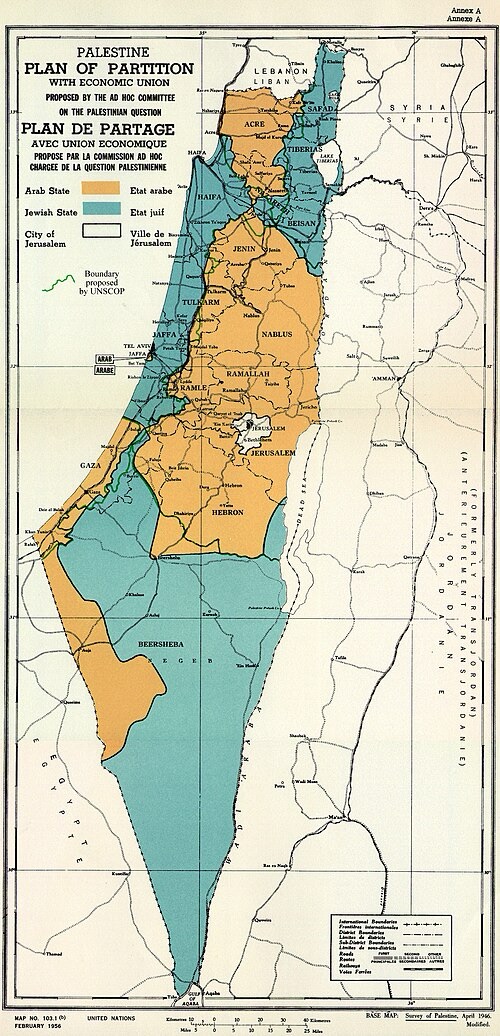
· 29 November 1947: UN General Assembly adopts Resolution 181 (II), the Partition Plan, with 33 votes in favor, 13 against, and 10 abstaining. The plan allocates approximately 56% of the land to a Jewish state and 43% to an Arab state, with Jerusalem as an international zone, despite Palestinian Arabs forming two-thirds of the population.
British India (1858-1947)
· Late 19th Century: The rise of organized Hindu and Muslim political consciousness.
· 1940: The Muslim League’s Lahore Resolution formally demands independent states for Muslim-majority areas.
· 1946-1947: Mounting communal violence and the failure of a unified cabinet make partition seem inevitable to the British.
· 3 June 1947: Viceroy Lord Mountbatten announces the Partition Plan, based on the “Radcliffe Line.”
· 14-15 August 1947: Transfer of Power. India and Pakistan become independent dominions.
The Nature of the Divide
The fundamental difference lay in the basis for partition and the international posture toward it.
· In Palestine, partition was an internationally sanctioned but locally rejected act. The UN plan was a geopolitical compromise, granting a majority of the land to the Jewish minority, in part as a response to the Holocaust. Palestinian Arabs and the surrounding Arab states saw it as a profound injustice that violated the principle of self-determination for the majority population. The Zionist leadership accepted it tactically, with figures like David Ben-Gurion viewing it as a stepping stone.
· In India, partition was a locally negotiated but internationally unmanaged divorce. It was driven by the political failure to reconcile the “two-nation theory” with a unified state. While the Indian National Congress opposed division until the last moment, the final plan was brokered between British, Congress, and Muslim League elites. There was no UN vote, no international peacekeeping force—just a rushed British departure and the handing over of sovereignty to two hostile successor states.
In both cases, the actual borders were poorly defined, based on outdated maps and census data, and were kept secret until the day of independence, maximizing confusion and panic. The lines did not merely divide territory; they cleaved through integrated economies, shared cultural zones, and millions of lives.
The Great Unraveling: Mechanics of Mass Displacement
The violence that followed the announcement of these borders was of a cataclysmic scale, but the mechanics of displacement revealed both stark similarities and critical differences.
Scale and Speed
· India (1947): An estimated 14-18 million people crossed the new borders in under a year, constituting the largest mass migration in human history. The violence was intensely communal, with massacres, abductions, and forced conversions occurring on all sides. Trains arriving from across the border, filled with corpses, became grim symbols of the partition.
· Palestine (1947-1949): Approximately 750,000 to 800,000 Palestinian Arabs—over half the Arab population of the territory that became Israel—fled or were expelled from their homes. This exodus unfolded in phases, intensifying after the UN vote and peaking during the 1948 Arab-Israeli War.
Causes: A Spectrum of Coercion
The historiography of both displacements grapples with the relative weight of “flight” versus “expulsion.” Modern scholarship acknowledges a complex mix of factors, where fear and direct force were inseparable.
· Fear and Psychological Warfare: In both cases, terrifying precedents were set. In Palestine, the Deir Yassin massacre of April 1948, where over 100 villagers were killed by Zionist militias, was widely publicized to panic surrounding populations into flight. In India, the scale of retaliatory violence created a self-perpetuating cycle of terror where minorities felt they had no choice but to flee preemptively.
· Direct Military Expulsion: In Palestine, scholars like Ilan Pappé and Benny Morris document systematic operations. Plan Dalet (Plan D), launched by the Haganah in April 1948, aimed to secure territory for the Jewish state and often involved the conquest and clearing of Arab villages. Expulsion orders, house demolitions, and massacres were direct tools. In India, while there was no single military blueprint, the breakdown of law and order and the partisanship of local police and militia often led to the forced eviction of minority communities.
· The Collapse of Authority and Leadership: In both crises, the departure or impotence of the governing power (Britain) created a security vacuum. The flight of local elites and community leaders in early stages demoralized those left behind and removed a stabilizing force. In Palestine, the disarray and strategic failures of the Arab leadership and invading armies contributed to the collapse.
The result was the same: a landscape emptied of ancient communities, dotted with abandoned villages and looted homes, creating what Palestinian historian Elias Sanbar calls a “world obliterated”.
The Second Displacement: Legal Erasure and the Manufacture of Permanent Refugeehood
The physical expulsion was only the first act. The second, and in many ways more durable, displacement was administered by law and state policy, which systematically transformed refugees into permanent stateless populations.
The Legal Architecture of Non-Return
· In Israel, a series of laws passed between 1948 and 1950 sealed the fate of Palestinian refugees. The Absentees’ Property Law (1950) was the cornerstone, defining any Palestinian who had left their home after November 1947—even if they remained within Israel’s new borders—as an “absentee.” Their property (homes, land, bank accounts) was transferred to a state custodian and later used to settle Jewish immigrants. This legal fiction prevented the return of over 700,000 refugees and confiscated millions of dunams of land.
· In India and Pakistan, while no single law mirrored Israel’s Absentees’ Property Act, a de facto population transfer was ratified by the Inter-Dominion Agreements. Both governments agreed to take responsibility for the welfare of incoming refugees and to manage the disposal of “evacuee property” to facilitate resettlement. This bureaucratic process, though chaotic, legally validated the exchange and extinguished any formal right of return. Property left behind was forfeited.
The International Response: Contrasts in Refugee Regimes
The international community responded to these crises in fundamentally different ways, cementing their divergent trajectories.
· Palestinian Refugees: The UN created a separate, specialized agency: the UN Relief and Works Agency (UNRWA), established in 1949. UNRWA’s mandate uniquely defines Palestinian refugees to include their descendants, leading to a registered population that has grown from 750,000 to over 5 million today. Arab host states (except Jordan) largely denied them citizenship, keeping them in camps as a political symbol of the unresolved conflict and the demand for the “right of return” based on UN Resolution 194.
· South Asian Refugees: They were handled by the universalist UN High Commissioner for Refugees (UNHCR) framework. Crucially, India and Pakistan, despite their poverty, framed the crisis as a domestic resettlement challenge. Refugees were granted citizenship and (however difficult) integrated into the national fabric. While trauma persisted, the legal question of return was closed. There is no “right of return” movement for Punjabi or Bengali refugees.
This discrepancy created what scholar Francesca Albanese calls a “political difference” in refugee status. South Asian refugees, however traumatized, became citizens of new nations. Palestinian refugees became, and remain, a statless people, their identity and grievance institutionalized by an international body.
Enduring Legacies: Frozen Conflicts and the Memory of Loss
The double displacement of 1947-48 did not end with the ceasefires. It built conflict into the DNA of the new states, creating legacies that are vividly alive today.
The National Identity of the Victors
· India and Pakistan were born in reciprocal trauma. Their national identities became defined in opposition to each other. This foundational hostility fueled three major wars, a nuclear arms race, and the persistent conflict over Kashmir—itself a monstrous offspring of partition’s flawed logic.
· Israel was founded on a demographic revolution, transforming a minority into a majority within its borders. Its identity as a Jewish state is inextricably linked to the negation of the Palestinian claim to the same land. The ongoing need to maintain a Jewish demographic majority continues to inform policies toward Palestinians on both sides of the Green Line.
The Politics of the Dispossessed
· For Palestinians, the Nakba is not a historical event but an ongoing process—”al-Nakba al-mustamirra”. The loss of 1948 is the core of national identity. The refugee camps in Lebanon, Syria, Jordan, and the occupied territories are not just homes but living monuments to the demand for return and justice. Events like the threat of eviction in Sheikh Jarrah in East Jerusalem are potent because they are seen as a continuation of the 1948 displacement, where Palestinians are denied property rights that Israeli law grants to Jews globally.
· For communities in South Asia, while a formal political “right of return” is absent, the memory of lost homelands—the watan in Pakistan for Indian Muslims, or ancestral villages in now-Pakistani Punjab for Sikhs and Hindus—persists in literature, film, and family lore. The border remains one of the world’s most militarized, and the trauma is transmitted epigenetically.
The Moral and Historiographical Battlefield
The struggle over the narrative of 1947-48 is as fierce as the political conflict. In Israel, the mainstream narrative long termed the war the “War of Independence,” portraying the refugee flight as a voluntary response to Arab leaders’ calls. The work of Israeli “New Historians” like Benny Morris, who accessed state archives, challenged this, detailing expulsions and massacres. In India and Pakistan, national histories often sanitize the violence, attributing it to “fanaticism” rather than political failure.
The Palestinian term “Nakba” (catastrophe) is itself a defiant act of historical framing, asserting a narrative of victimhood and injustice against the Israeli narrative of redemption and rebirth. In 2022, the UN began officially commemorating Nakba Day, a move Israel condemned as anti-Israeli—demonstrating how the battle over 1948’s meaning continues in international forums.
Conclusion: The Unfinished Partitions
The partitions of 1947-48 were catastrophic successes. They succeeded in creating new nation-states but failed to create peace or justice. They solved the British Empire’s problem of exit by transferring the catastrophic cost onto civilian populations.
The “double displacement” they engineered—first by violence, then by law—created two of the modern world’s most intractable problems. The legacy is a set of frozen conflicts where the past is never past: in the line of control in Kashmir, in the separation wall in the West Bank, in the rhetoric of politicians from Delhi to Islamabad and from Tel Aviv to Ramallah. These borders were drawn in haste and blood; they continue to bleed today.
The refugees of these twin cataclysms, and their descendants, are the living conscience of this unfinished history. Their ongoing plight is the clearest proof that partitions which prioritize political expediency over human dignity do not end conflicts; they merely re-found them on a basis of permanent grievance. In understanding 1947 and 1948, we are not studying ancient history. We are deciphering the origin code of some of the most dangerous and enduring crises of our present world.
Listen & Learn: Related Podcast Collections
Explore these curated episode collections to go deeper on the history behind this article:

Leave a Reply