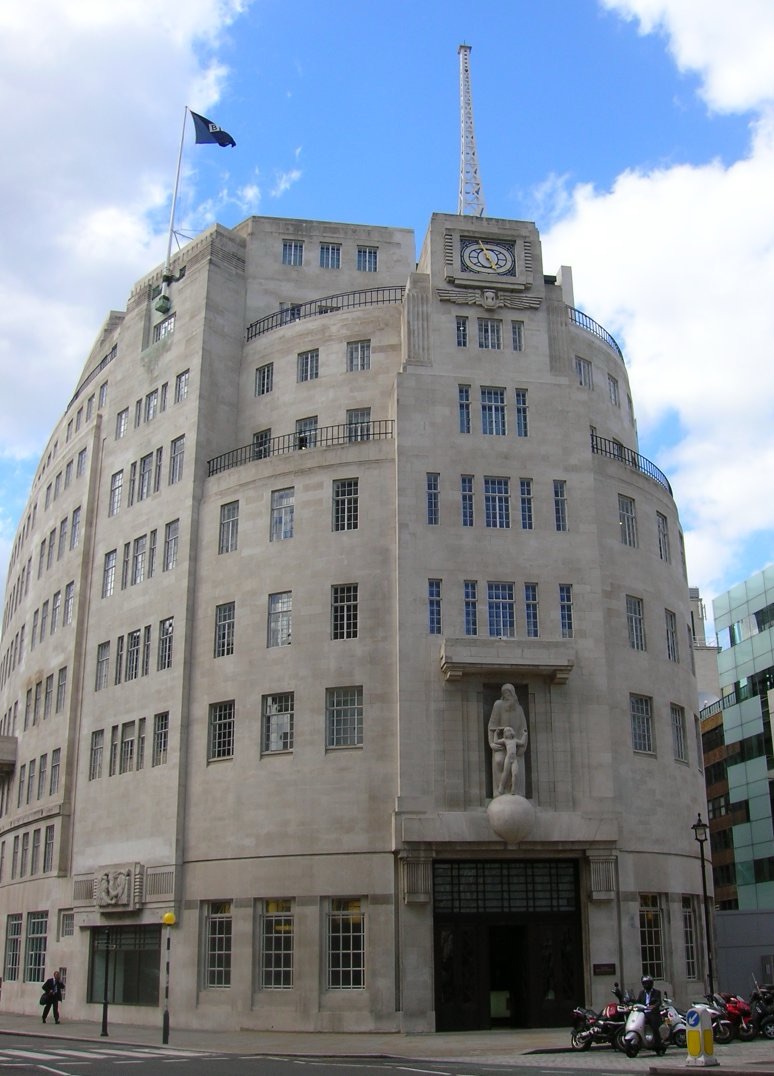

A Voice in the Ether, December 25, 1932
At 9:30 AM GMT on Christmas Day, 1932, the thin, reedy voice of King George V, crackling with the distinctive hiss of shortwave radio, pierced the airwaves. Transmitted from the new Broadcasting House in London, his speech was aimed not at his subjects in the British Isles, but at an imagined community scattered across the globe—from the Canadian prairies to the Indian subcontinent, the Australian outback to the African savannah.
“I speak now from my home and from my heart to you all,” the King declared. “To men and women so cut off by the snows, the desert, or the sea, that only voices out of the air can reach them.” The BBC Empire Service was born, a technological marvel designed to bind the sprawling British Empire together through the invisible threads of sound. It was a bold project of imperial audibility: the metropole would speak, and the periphery would listen, forging a unified, loyal imperial consciousness.
But in a dimly lit living room in Bombay, a Nigerian student’s lodgings in London, or a settler’s farm in Kenya, the reality was far more complex. The static that interrupted the King’s speech wasn’t just a technical flaw; it was a metaphor. For the Empire Service, in its attempt to create an imperial public sphere, would encounter a cacophony of reinterpretations, resistances, and competing frequencies. This is the story of how Britain tried to build a sonic empire, and how the world listened back on its own terms.
The Ideology of the Imperial Airwaves: “A Projection of England”
The Empire Service was not a spontaneous creation but the culmination of a decade of ideological engineering. In the aftermath of World War I, the British Empire was at its territorial peak but facing profound challenges. Rising nationalism in India and Egypt, growing economic independence in the Dominions, and a global spread of anti-colonial ideas threatened the imperial fabric. Radio, the exciting new medium of the age, was seen as the perfect antidote to centrifugal forces.
The Service’s founding father, BBC Director-General John Reith, envisioned it as a tool for “the projection of England.” For Reith, a Scottish Calvinist with a missionary zeal, broadcasting was a moral and civilizing force. The Empire Service would be a conduit for British values: rationality, fair play, constitutional monarchy, and cultural superiority. Its programming was a curated soundscape of imperial identity:
· The Symbolic Core: The King’s Christmas speech was the liturgical heart, an annual sonic ritual of allegiance.
· The Sound of “Englishness”: Regular broadcasts of Big Ben’s chimes, Shakespearean plays, and BBC news read in the impeccable “Received Pronunciation” were aural markers of the centre.
· The Pedagogical Mission: Programmes like Books and People, Science in the Making, and Farm Forum were designed to educate and uplift, implicitly positioning London as the fountainhead of knowledge and progress.
The underlying theory was one of “auditory imperialism.” Just as Roman roads or British railways physically connected territory, the radio would create a neural network for the empire. It would combat the “tyranny of distance,” foster a shared imperial citizenship, and counter the “mischievous” propaganda from other powers—a clear reference to the anti-colonial broadcasts already emanating from the Soviet Union and, later, Nazi Germany.
The Tyranny of Distance: Technical Trials and the Materiality of Listening
The ideological vision crashed into the formidable wall of physics. Shortwave broadcasting (then called “imperial wireless”) was in its infancy. Signals were erratic, susceptible to atmospheric interference, “fading,” and the diurnal cycle. The “Empire wavelength” was a battleground of static, where a cricket commentary from London might be drowned out by a thunderstorm over the Atlantic or a more powerful transmitter from Berlin.
This technical reality shaped the material culture of listening in profound ways:
· The Receiver as Artefact: The shortwave radio was an expensive, often finicky, piece of technology. In colonial settings, it was primarily found in the homes of white settlers, colonial administrators, and a thin layer of the Western-educated indigenous elite. Listening was not a universal experience but a privileged, or strategically important, act.
· The Spaces of Reception: The sound of the Empire Service filtered into different spaces with different meanings. In a colonial club in Nairobi, it was a comforting ritual of belonging. In a mission school in Lagos, it was an educational tool. For a nationalist intellectual in Calcutta, tuning in might be an act of intelligence-gathering, a way to “know the mind of the enemy.”
· The Labour of Listening: Audiences had to be diligent—carefully adjusting elaborate antennae, consulting published schedule charts that accounted for time zones, and patiently enduring patches of incomprehensible noise. This active struggle to hear made the act of reception a personal investment, not passive absorption.
The BBC’s Imperial Committee agonized over these “propagation conditions.” Their solution was technological relentlessness, building a global chain of relay stations (in Singapore, Aden, Cape Town) to boost the signal. Yet, the persistent static served as a constant, audible reminder of the gulf between the centralized broadcast and its dispersed, fragmented reception.
“Letters from the Outposts”: The Listener Writes Back
The BBC, keen to measure its reach, actively solicited feedback. The thousands of listener letters preserved in its archives provide a remarkable window into the early, resistive audience. They reveal that the imperial public sphere was not a passive receptacle but an active, critical site of engagement.
From the Dominions (Australia, Canada, New Zealand): Listeners often expressed kinship but also a growing sense of independent identity. Requests poured in not just for more British content, but for programmes about other parts of the Empire—stories from Africa, music from India. They wanted a network, not just a pipeline from London. A Canadian listener wrote in 1934 complaining of the “condescending tone” of some talks, asking for “less of the ‘mother country knows best’ and more of the Empire as a partnership.”
From Colonial Africa and Asia: Here, the responses were layered with political nuance. Many elite listeners valued the educational content and news. A 1935 letter from a Gold Coast (Ghana) listener praised the “impartial” news, contrasting it with local rumour. However, this was often a tactical appreciation. Others were sharply critical.
· The Complaint of Omission: A constant refrain was the lack of programming from their own regions. Where was African music? Indian philosophy? The service seemed a monologue, not a conversation.
· The Critique of Perspective: News of imperial events was filtered through a London lens. The 1935 Italian invasion of Abyssinia (Ethiopia), a seismic event across Black Africa, was covered by the BBC with a cautious, League of Nations-focused perspective that many African listeners found frustratingly detached from the racial and anti-colonial implications they saw.
· Subversive Readings: The very ideals broadcast—democracy, justice, liberty—were weaponized by listeners against the colonial state. An Indian correspondent pointedly asked how the BBC’s glowing tributes to British freedom squared with the imprisonment of Congress leaders. The medium’s ideology could be turned against its architects.
Competing Frequencies: The Crackle of Anti-Colonial and Alternative Broadcasts
The BBC’s dream of a monolithic imperial wavelength was a fantasy. The airwaves were a crowded, contested space. The Empire Service’s most significant impact may have been in spurring the very competition it feared.
· The Nationalist Counter-Broadcast: The Service demonstrated radio’s power, inspiring nationalists to build their own stations. All India Radio (AIR), established in 1936, became a platform for Indian classical music, regional languages, and, after independence, a key tool for national integration. In Egypt, radio became a potent instrument of Arab nationalism. The empire had taught its subjects the power of the microphone.
· The Anti-Colonial Surge: More directly challenging were overtly anti-colonial broadcasts. By the late 1930s, Nazi Germany’s Zeesen transmitter was broadcasting in English, Hindi, Arabic, and Swahili, blending anti-British propaganda with popular music. These broadcasts were widely listened to, not necessarily because of ideological alignment, but because they offered a dramatic alternative narrative. In India, Subhas Chandra Bose would later infamously use Radio Berlin and then Azad Hind Radio to rally support against the British.
· The Commercial and the Local: Even without political intent, commercial stations (like Radio Ceylon, which later became hugely popular across South Asia with its film music) and local rediffusion services (wired radio in African cities) offered entertainment-focused alternatives that often drew larger audiences than the paternalistic talk-heavy BBC fare.
The imperial auditory sphere was thus polyphonic. The voice of London now had to compete with the voice of Berlin, of Cairo, of Delhi, and of popular local taste.
V. Legacy: From Empire Service to World Service, and the Echoes of Static
The outbreak of World War II transformed the Empire Service. It became a vital tool for information and morale, broadcasting news into occupied Europe and across a empire at war. Its name changed to the BBC Overseas Service, reflecting a shift in rhetoric from imperial unity to allied solidarity. After the war, as the empire dissolved, it evolved into the BBC World Service, shedding its explicit imperial mandate for one of “global reach” and (controversially) “impartial news.”
The legacy of the Empire Service experiment is twofold:
- The Infrastructure of Global Media: It pioneered the technical and linguistic architecture of international broadcasting. Its relay stations, its model of central news gathering, and its multi-language approach became the template for global media players like Voice of America, Radio Moscow, and today’s global news networks.
- The Lesson in Failed Monologue: It stands as a classic case study in the limits of top-down cultural integration. The BBC assumed that broadcasting British culture would create imperial loyalty. Instead, it found that audiences came with pre-existing identities, political grievances, and cultural preferences. They used the medium for education, for news, for entertainment, and for intellectual ammunition in their own struggles. The “imperial public sphere” was not forged; it was a battleground of interpretations.
The crackling static that accompanied every broadcast was the sound of the empire’s own contradictions: the distance it could not overcome, the diversity it could not homogenize, and the voices it could not silence. In trying to make the empire audible to itself, the BBC ultimately made audible the many frequencies on which the end of empire would be transmitted. The airwaves, it turned out, were not a binding force, but a fracturing one—carrying not just the King’s speech, but the seeds of its own irrelevance.

Leave a Reply