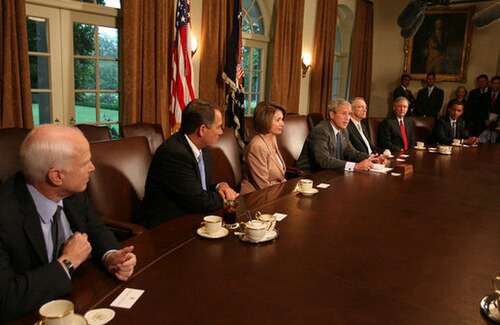

On the morning of September 18, 2008, three days after Lehman Brothers collapsed, Treasury Secretary Henry Paulson and Federal Reserve Chairman Ben Bernanke delivered an urgent warning to congressional leaders in a closed-door meeting on Capitol Hill. The financial system, they said, was hours away from a complete meltdown. The commercial paper market—the daily funding mechanism for corporate America—had frozen. Major banks were unable to borrow even overnight. AIG, the world’s largest insurance company, had already been rescued the previous day with an $85 billion emergency loan, but other institutions were teetering. “If we don’t do something,” Paulson reportedly told the assembled lawmakers, “this country is facing a full-scale financial collapse—not just a recession, but a depression.”
Bernanke was even more direct. The financial system, he said, was at risk of a “global financial catastrophe.” He later told the Financial Crisis Inquiry Commission: “I concluded that we were at risk of a breakdown in the financial system that would have consequences comparable to the Great Depression, but possibly even worse.” The lawmakers were stunned. They had not understood the depth of the crisis until that moment. Within days, the administration submitted a three-page proposal asking Congress for $700 billion to purchase troubled assets from financial institutions—the largest government intervention in the economy since the Great Depression.
The Emergency Economic Stabilization Act of 2008, which created the Troubled Asset Relief Program (TARP), was signed into law on October 3, 2008, after a dramatic political battle. The initial House vote failed on September 29, triggering a 777-point drop in the Dow Jones Industrial Average—the largest single-day point drop in history at that time. After adding taxpayer protections and executive compensation limits, the bill passed and was signed by President George W. Bush. Over the following months, the Treasury would deploy the TARP funds in ways that deviated significantly from the original plan. Instead of purchasing troubled assets, the Treasury primarily injected capital directly into banks through the purchase of preferred shares. The program would later expand to include bailouts of insurance giant AIG, the auto industry (General Motors and Chrysler), and the mortgage market (Fannie Mae and Freddie Mac). By the time TARP expired in 2010, the government had disbursed $426 billion. But the final cost to taxpayers was far lower than initially feared: as of 2025, the government had recovered virtually all of the TARP funds, with the total cost estimated at about $15 billion—a fraction of the $700 billion authorized.
This article examines the origins, implementation, and legacy of TARP. It analyzes the political debate over the bailout, the controversial rescue of AIG and the auto industry, the public outcry over executive bonuses, and the long-term consequences of the government’s unprecedented intervention in the financial system. It argues that TARP was a necessary evil—a deeply unpopular but essential response to a once-in-a-century financial panic—but that its legacy of “too big to fail” remains unresolved.
The Origins: From Three Pages to 500
The administration’s original proposal was remarkably brief. On September 20, 2008, the Treasury Department sent Congress a three-page bill requesting $700 billion to purchase “troubled assets” from financial institutions. The bill included almost no restrictions on the Treasury’s authority: Paulson would be able to spend the money at his discretion, without judicial review or congressional oversight. The proposal was so extreme that even Republicans balked. House Speaker Nancy Pelosi said the bill was “not acceptable” in its current form. Senator Chris Dodd, chairman of the Banking Committee, called it “stunning and breathtaking” in its assertion of unchecked power.
Over the next two weeks, Congress negotiated a much more detailed bill—growing to over 500 pages—that included taxpayer protections, limits on executive compensation for participating firms, an oversight board, and a requirement that the Treasury develop a plan to recoup any losses from the financial industry. But the political debate was bitter. Members of both parties faced constituents furious at the idea of bailing out the banks that had caused the crisis. The House initially rejected the bill on September 29, 2008, by a vote of 228 to 205. The Dow Jones Industrial Average plunged 777 points—the largest single-day point drop in history. After adding tax cuts and other sweeteners, the Senate passed an amended version on October 1, and the House passed it on October 3. President Bush signed the Emergency Economic Stabilization Act into law that afternoon.
The initial TARP plan called for purchasing “troubled assets”—primarily mortgage-backed securities and collateralized debt obligations—from banks, removing them from balance sheets and allowing banks to resume lending. But within weeks, Paulson abandoned that approach. In his memoir, he wrote: “We realized that the market for troubled assets was so illiquid that we couldn’t possibly set a fair price quickly enough to stabilize the system.” Instead, the Treasury would inject capital directly into banks by purchasing preferred shares. This was a much faster way to shore up bank balance sheets and restore confidence. By the end of October, the Treasury had announced a $250 billion Capital Purchase Program, with the first $125 billion going to nine major banks: Bank of America, JPMorgan Chase, Citigroup, Wells Fargo, Goldman Sachs, Morgan Stanley, Bank of New York Mellon, State Street, and Merrill Lynch.
The Bailouts: Who Got What
Over the life of TARP, the Treasury disbursed a total of $426 billion across multiple programs. The largest recipients were:
The Capital Purchase Program (CPP): $205 billion – This was the core bank bailout. The Treasury purchased preferred shares in 707 financial institutions. The nine largest banks received $125 billion in the first round, with Citigroup receiving $25 billion (later increased to $45 billion), Bank of America $15 billion (later increased to $45 billion), and JPMorgan Chase, Wells Fargo, and Goldman Sachs $10 billion each.
AIG: $67.8 billion – The insurance giant was not a bank, but its London-based financial products unit had sold hundreds of billions in credit default swaps on subprime mortgage bonds. The initial $85 billion rescue in September 2008 was not funded by TARP; it came from Federal Reserve emergency lending authority, but later TARP funds were used to purchase preferred shares in AIG. The total government commitment to AIG eventually reached $182 billion.
Auto Industry: $80.5 billion – General Motors received $50.5 billion, Chrysler $12.5 billion, and GMAC/Ally Financial $17.5 billion. The auto bailout was highly controversial, but it succeeded: GM and Chrysler emerged from bankruptcy in 2009 and repaid most of their loans by 2014.
Citigroup and Bank of America: Additional $65 billion – These two banks required multiple rounds of assistance after the initial capital injections were insufficient. Citigroup eventually received a total of $45 billion, and Bank of America $45 billion, making them the largest individual recipients.
Mortgage Programs: $48.5 billion – The Treasury also used TARP funds for programs to prevent foreclosures, including the Making Home Affordable program, which through its Home Affordable Modification Program (HAMP) offered incentives to mortgage servicers to modify loans. The results were mixed; the program modified approximately 1.8 million mortgages, far fewer than the 3–4 million originally projected, and the foreclosure crisis did not end until years after the programs were implemented.
The Auto Bailout: Rescuing Detroit
The most controversial element of TARP—aside from the bank bailouts themselves—was the rescue of the American auto industry. In December 2008, with General Motors and Chrysler weeks away from running out of cash, President Bush authorized $17.4 billion in TARP loans to the automakers. President Obama expanded the bailout after taking office, ultimately committing $80.5 billion to GM, Chrysler, and GMAC (the auto financing arm).
The auto bailout was different from the bank bailouts in one crucial respect: it required fundamental restructuring. GM and Chrysler were forced into bankruptcy in 2009. The government became the majority owner of GM (61% of common equity) and the owner of Chrysler (which was sold to Fiat). The unions were forced to accept deep concessions. Dealerships were closed by the thousands. Bondholders were wiped out. The restructuring was brutal, but it worked. GM emerged from bankruptcy in July 2009, just 40 days after filing. Chrysler emerged in June 2009. By 2014, the government had sold its remaining shares in GM and exited the auto industry. The Treasury estimated that the auto bailout cost taxpayers approximately $12 billion—far less than the $80 billion originally committed, but still a substantial loss.
Critics argue that the auto bailout was an illegal use of TARP funds, which were intended for financial institutions, not industrial companies. Supporters argue that the collapse of GM and Chrysler would have triggered a cascade of bankruptcies among auto parts suppliers, which would have shut down even Ford (which did not take TARP funds) and would have cost more than 1 million jobs. President Obama later said that the auto bailout was “the most difficult decision I made during the entire crisis—but it was also the right decision.”
Executive Bonuses: The AIG Outrage
No single event fueled public anger over the bailouts more than the revelation that AIG, which had received $170 billion in government aid, planned to pay $165 million in retention bonuses to executives in the same division—AIG Financial Products—that had nearly bankrupted the company. The bonuses were disclosed in March 2009, and the reaction was volcanic. President Obama called the bonuses “outrageous.” Treasury Secretary Geithner said they were “tone-deaf and irresponsible.” Congress rushed to pass a bill taxing the bonuses at 90%, though the provision was later modified.
The bonuses were legally problematic. The contracts had been signed before the bailout, and under New York law, they were enforceable. The government could have attempted to break the contracts, but that would have required litigation that could have taken years. In the end, most of the bonuses were paid, though some executives voluntarily returned them. The bonus controversy permanently poisoned public attitudes toward the bailouts. Polls throughout 2009 showed that a majority of Americans believed TARP was a mistake. The phrase “banker bonus” became a political liability that would shape the next decade.
The outrage was not entirely irrational, but it reflected a misunderstanding of TARP’s financial impact. As of 2025, the Treasury had recovered virtually all of the TARP funds, with total losses estimated at about $15 billion. The auto bailout portion was the biggest loss; the bank bailout portion actually generated a profit for taxpayers. But the public never believed that the government would be repaid. The perception of waste and cronyism persisted.
Stress Tests: Restoring Confidence
One of the most successful elements of the TARP program was not actually a part of TARP itself: the bank “stress tests” conducted by the Federal Reserve in early 2009. The stress tests were designed to determine how much additional capital the 19 largest banks would need if the economy deteriorated further. The tests were stringent, assuming unemployment would reach 10.3% and housing prices would fall another 22%. When the results were announced in May 2009, ten banks were told they needed to raise additional capital; nine were deemed sufficiently capitalized. The results were surprisingly reassuring: the total capital shortfall was just $75 billion—far less than the market had feared.
The stress tests worked. By requiring banks to disclose their capital needs publicly, the Fed provided transparency that allowed private capital to return to the banking system. After the stress tests, the major banks were able to raise the required capital from private investors without additional government funds. By the end of 2009, the banking panic had subsided. The stress test model would become a permanent part of the regulatory toolkit, institutionalized in the Dodd-Frank Act as the annual Comprehensive Capital Analysis and Review (CCAR).
TARP Repayments: The Government Gets Most of Its Money Back
Contrary to public perception, TARP was not a giveaway. The Treasury designed the Capital Purchase Program to be attractive to banks: the interest rate on the preferred shares was 5% for the first five years and 9% thereafter. Banks were also required to issue warrants to the Treasury, giving the government the right to purchase common shares at a fixed price. These warrants generated additional returns for taxpayers when banks repaid the TARP funds and the Treasury sold the warrants.
By the end of 2010, most major banks had repaid their TARP money. Bank of America repaid its $45 billion in December 2009. Citigroup repaid its $45 billion in December 2010. Goldman Sachs and JPMorgan Chase repaid in June 2009. The Treasury received significant profits from the warrants. For example, the Treasury sold its warrants in Goldman Sachs for $1.1 billion, earning a 23% return on its $10 billion investment. Overall, the bank bailout portion of TARP generated a profit of approximately $15–20 billion for taxpayers.
The losses came from other parts of TARP. The auto bailout cost about $12 billion. The mortgage programs lost about $20 billion. AIG, though eventually repaid, required a complex restructuring that also resulted in a small loss. The final tally, according to the Treasury’s 2025 report, was that TARP disbursed $426 billion and recovered $411 billion, for a total cost of $15 billion—or about 2% of the original $700 billion authorization. This does not include the Federal Reserve’s emergency lending programs, which by and large also recovered their funds.
Political Aftermath: The Tea Party, Occupy Wall Street, and Dodd-Frank
TARP was politically toxic. The bailouts were deeply unpopular with both the right and the left, albeit for different reasons. The right opposed TARP as an excessive government intervention in the free market, a bailout of irresponsible bankers, and a dangerous expansion of federal power. The left opposed TARP as a giveaway to the same bankers who caused the crisis, with insufficient protections for homeowners and workers. The “No” vote on TARP was surprisingly bipartisan: 95 Democrats and 133 Republicans voted against the initial House bill.
The political consequences were profound. The Tea Party movement, which emerged in early 2009, was fueled in large part by anger over the bailouts. The movement’s signature issue was opposition to government spending and debt, and TARP—along with the auto bailout and the subsequent stimulus—became the symbol of reckless government intervention. The Tea Party helped Republicans win control of the House in the 2010 midterm elections, and it shaped the Republican Party’s identity for the next decade.
On the left, Occupy Wall Street, which began in September 2011, channeled anger at the bailouts into a broader critique of economic inequality. The movement’s mantra—”We are the 99%”—explicitly blamed the financial industry for the crisis and the government for bailing out the banks while leaving ordinary homeowners to lose their houses. Occupy Wall Street did not translate into electoral success in the same way as the Tea Party, but its themes were adopted by Bernie Sanders’s presidential campaigns and by the progressive wing of the Democratic Party.
The legislative response was the Dodd-Frank Wall Street Reform and Consumer Protection Act of 2010. The act created the Consumer Financial Protection Bureau, gave regulators new authority to break up failing financial institutions, required banks to hold more capital, and restricted proprietary trading through the Volcker Rule. But Dodd-Frank did not break up the largest banks, and it did not fundamentally change the “too big to fail” problem. The debate over whether TARP was a necessary evil or a catastrophic precedent remains unresolved.
The Unresolved Legacy: Still Too Big to Fail
The most persistent criticism of TARP is that it institutionalized “too big to fail.” By rescuing the largest banks, the government signaled that no major financial institution would be allowed to fail in the future. This moral hazard—the incentive to take excessive risks because losses will be socialized—was arguably worsened by TARP. The largest banks emerged from the crisis even larger. In 2007, the six largest US banks held assets equal to about 55% of GDP. By 2010, that figure had risen to 64%. By 2020, it exceeded 80%. The too-big-to-fail subsidy—the implicit government guarantee that allows large banks to borrow at lower rates than smaller banks—persists.
The Dodd-Frank Act attempted to address this through the “Orderly Liquidation Authority” (OLA), which would allow the government to wind down a failing financial institution without a taxpayer bailout. But the OLA has never been used, and many experts doubt it would work in a crisis. The alternative is bankruptcy, but as Lehman demonstrated, bankruptcy is not designed for complex financial institutions. The too-big-to-fail problem remains unsolved.
Conclusion
TARP was the most controversial economic policy intervention since the New Deal. It violated core American principles of free markets, individual responsibility, and limited government. It rewarded the very institutions that had caused the crisis. It cost taxpayers $426 billion (though most of that was ultimately recovered). And it created a moral hazard that persists to this day. Yet by virtually every measure, TARP succeeded in its immediate objective: it stopped the panic. The banking system did not collapse. The commercial paper market resumed functioning. The global financial system was saved from a second Great Depression.
Whether the cure was worth the cost is a question that will never be settled. The critics are correct that TARP was a bailout of Wall Street, that it protected the bankers who caused the crisis, and that it did little for the millions of homeowners who lost their homes. The defenders are correct that the alternative—letting the financial system collapse—would have been far worse, triggering unemployment of 25% or more, the collapse of the global economy, and years of human suffering. TARP was a choice between two terrible options. The government chose the one that kept the economy from falling off a cliff.
The legacy of TARP is not just the $15 billion cost or the 2% loss. It is the enduring belief among many Americans that the system is rigged: that Wall Street gets bailed out while Main Street gets sold out. That belief—fueled by AIG bonuses, by the lack of prosecutions of senior bankers, by the foreclosure crisis—has shaped American politics for more than a decade. TARP may have saved the economy, but it also broke the public’s trust. That is a cost that no Treasury secretary can quantify.
Further Reading & Sources
· Barofsky, Neil. Bailout: An Inside Account of How Washington Abandoned Main Street While Rescuing Wall Street. Free Press, 2012.
· Congressional Oversight Panel. October Oversight Report: The TARP Program. U.S. Government Printing Office, 2008–2010.
· Geithner, Timothy F. Stress Test: Reflections on Financial Crises. Crown, 2014.
· Paulson, Henry M. On the Brink: Inside the Race to Stop the Collapse of the Global Financial System. Business Plus, 2010.
· Sorkin, Andrew Ross. Too Big to Fail: The Inside Story of How Wall Street and Washington Fought to Save the Financial System—and Themselves. Viking, 2009.

Leave a Reply