
On the evening of December 18, 2019, the United States House of Representatives voted to impeach Donald John Trump for the first time. The charges were abuse of power and obstruction of Congress. The president had, the House concluded, pressured a foreign leader—Volodymyr Zelenskyy of Ukraine—to investigate a political rival, Joe Biden, and had withheld nearly $400 million in military aid as leverage. When Congress attempted to investigate, the White House simply refused to comply, instructing current and former officials to ignore subpoenas and asserting executive privileges that had no basis in law or precedent.
It was, by any conventional measure, a constitutional crisis. And Donald Trump treated it as a minor inconvenience. He held rallies where he mocked the proceedings. He tweeted that the impeachment was a “hoax” and a “witch hunt.” He insisted that the phone call with Zelenskyy was “perfect.” The Senate acquitted him. He declared victory and moved on.
What was striking about the impeachment—and the second impeachment that followed in January 2021, after he incited a mob to attack the Capitol—was not the constitutional drama itself. It was the way Trump refused to recognise the drama at all. He did not defend his actions on the merits, because the merits were irrelevant to him. He did not engage with the constitutional arguments, because he did not believe that the Constitution constrained him. He treated impeachment as a political problem to be managed, a narrative to be controlled, a set of procedural obstacles to be navigated. And then he moved on, as he had always moved on, from the bankruptcies and the lawsuits and the investigations, leaving behind a trail of unresolved obligations.
This is not a story about corruption, though there was plenty of that. It is a story about the erosion of the idea that the presidency is an office—a set of responsibilities, constraints, and institutional loyalties that outlast any single occupant. Trump did not simply occupy the presidency. He treated it as an extension of his own personality, his own grievances, his own will. And he did so not through any grand theory of executive power, but through the accumulated weight of a thousand small decisions, each one a refusal to accept that the office was larger than the man.
But a necessary caveat: the institutions Trump degraded were not innocent. The American presidency, for all its constitutional majesty, has always been an instrument of violence abroad and exclusion at home. The “guardrails” that previous generations of institutionalists have praised—the career civil service, the intelligence community, the Justice Department—have also produced drone strikes that killed civilians, surveillance programs that violated privacy, and a carceral state that locked millions in cages. To lament their erosion without acknowledging their complicities is to risk writing a eulogy for a system that many Americans had good reason to mistrust long before Trump arrived.
The Guardians and Their Dismissal
The American presidency is supported by an array of institutions, norms, and personnel that are supposed to outlast any administration. The career civil service. The intelligence community. The Justice Department, which is supposed to operate independently of political pressure. The FBI, whose directors are appointed to ten-year terms precisely to insulate them from the whims of presidents. The White House Counsel’s office, which is supposed to advise the president on what he cannot do.
Trump viewed all of these as obstacles. The career civil service was the “deep state,” a conspiracy of bureaucrats determined to thwart his agenda. The intelligence community was part of the “witch hunt.” The Justice Department and the FBI were corrupt institutions that had been weaponised against him. The White House Counsel’s office was a team of lawyers whose job was to figure out how to do what he wanted, not to tell him that he couldn’t.
The pattern began early. In May 2017, Trump fired FBI Director James Comey, who was leading the investigation into Russian interference in the 2016 election. The stated reason was Comey’s handling of the Hillary Clinton email investigation, but Trump’s own words—in an interview with NBC’s Lester Holt—revealed the real motivation: “When I decided to just do it, I said to myself, I said, ‘You know, this Russia thing with Trump and Russia is a made-up story, it’s an excuse by the Democrats for having lost an election.’” He fired Comey to stop the Russia investigation. He said so, on television.
The reaction from the institutional guardrails was immediate. The acting attorney general, Rod Rosenstein, had written a memo criticising Comey’s handling of the Clinton investigation, and the White House initially cited that memo as the reason for the firing. But when Trump contradicted his own administration’s story, Rosenstein appointed a special counsel, Robert Mueller, to investigate Russian interference and possible obstruction of justice. The investigation ran for nearly two years. It produced a detailed report documenting ten episodes of potential obstruction. And then, when the report was released, Attorney General William Barr—a Trump appointee who had sought the job in part to protect the president—summarised it in a four-page letter that distorted its findings and declared that Trump had been exonerated.
The Mueller investigation was a test of the institutional guardrails. They held, just barely. The special counsel was appointed. The investigation proceeded. The report was written. But the guardrails could not compel accountability. That required Congress, which was divided, and ultimately the voters, who re-elected Trump’s party in 2020 and then, in 2024, elected Trump himself. The institutions could produce the facts. They could not produce the consequences.
It is worth pausing here. The “guardrails” that held—just barely—were the same institutions that had, in living memory, lied the country into the Iraq War, covered up torture, and spied on civil rights leaders. To celebrate their resilience is not straightforward. They were resilient enough to investigate a president who threatened their prerogatives, but not resilient enough to prevent the wars, the surveillance, the mass incarceration that preceded him. Trump did not break a healthy system. He exploited a sick one.
The Transformation of the Counsel’s Office
Perhaps no single institution was more degraded by Trump than the White House Counsel’s office. In previous administrations, the counsel’s role was to serve as the president’s legal conscience—to tell him what he could and could not do, and to resign if he insisted on crossing legal lines. John Dean, Richard Nixon’s counsel, later described the role as “the president’s lawyer, not the president’s man.”
Trump treated the counsel’s office as a personal law firm. He demanded loyalty, not legal advice. When his first White House counsel, Don McGahn, refused to fire Mueller—because Trump had ordered him to do so, and because McGahn believed it would be illegal—Trump demanded that McGahn publicly deny that the order had been given. McGahn refused. He threatened to resign. Trump backed down, but he never forgave McGahn for placing the law above the president’s wishes.
The counsel’s office that Trump wanted was not an office of legal advisers but an office of legal enablers. He found what he was looking for in Pat Cipollone, who replaced McGahn in 2018. Cipollone did not tell Trump what he could not do. He told him how to do what he wanted, and when that was impossible, he told him how to delay, how to litigate, how to run out the clock. The distinction between the office of the presidency and the person of Donald Trump simply disappeared.
The consequences of this transformation are still unfolding. The legal principle that the president is not above the law, established in the Watergate era, was always more norm than rule. It depended on presidents accepting that the law applied to them, and on the institutions of accountability enforcing that acceptance. Trump refused to accept it. He argued, through his lawyers, that a sitting president could not be indicted, that executive privilege shielded him from congressional oversight, that the courts had no jurisdiction over his exercise of core executive powers. And when the courts disagreed, as they often did, he simply ignored them, or appealed, or moved on to the next fight.
Whether the courts will ultimately endorse some version of Trump’s immunity claims remains an open question as of early 2026. Several cases are working their way through the system. But the deeper damage may already be done. Trump has demonstrated that a president who is willing to test the limits of the law can operate for years in a grey zone that the framers of the Constitution did not anticipate and that the courts have been slow to police.
The Pardon Power as Personal Prerogative
The pardon power is one of the president’s few unilateral constitutional authorities. The Framers gave it to the president as a tool for mercy and reconciliation—a way to correct miscarriages of justice, to heal the nation after periods of conflict, to show compassion to those who had earned it. For most of American history, presidents used it sparingly, and with circumspection. They sought recommendations from the Justice Department’s Office of the Pardon Attorney. They avoided pardoning friends and allies.
Trump treated the pardon power as a tool of patronage. He pardoned Joe Arpaio, the Arizona sheriff convicted of criminal contempt for defying a court order to stop racially profiling Latinos. He pardoned his former campaign adviser Roger Stone, who had been convicted of lying to Congress and witness tampering. He pardoned his former national security adviser Michael Flynn, who had pleaded guilty to lying to the FBI. He pardoned Charles Kushner, the father-in-law of his son-in-law, who had been convicted of tax evasion and witness retaliation. He pardoned four former Blackwater contractors who had been convicted of killing unarmed Iraqi civilians. He commuted the sentence of his longtime friend Roger Stone. He pardoned his former campaign chairman Paul Manafort, who had been convicted of tax fraud, bank fraud, and conspiracy against the United States.
What linked these pardons was not mercy. It was loyalty. Trump pardoned people who had been loyal to him, who had refused to cooperate with investigators, who had been caught up in the legal dragnet that he believed was aimed at him. The message was clear: if you are loyal to Donald Trump, he will protect you from the consequences of your actions.
The pardon power had always contained the potential for abuse. What prevented abuse was a set of norms—informal but powerful—that presidents had respected for more than two centuries. Trump did not break those norms. He simply ignored them. And because no one could stop him—the pardon power is, by its nature, unreviewable—he got away with it. The norms were revealed to be what they had always been: habits, not laws. And habits can be broken.
The Attack on the Deep State
The phrase “deep state” has a specific meaning in political science: the permanent bureaucracy of a state, which may exercise power independently of elected officials. In Turkey, Egypt, and other countries with histories of military intervention, the deep state is a real phenomenon. In the United States, the concept has always been more conspiracy theory than reality. The career civil service is independent, but it is not autonomous; it operates within a framework of laws and regulations that are ultimately controlled by elected officials.
Trump believed—and he told his followers—that the intelligence community, the Justice Department, the FBI, and the career civil service were engaged in a coordinated conspiracy to undermine his presidency. He called them the “deep state,” the “swamp,” the “administrative state.” He accused them of treason. He demanded that they be purged.
The purge came, slowly at first, then faster. In October 2020, Trump signed an executive order creating a new job classification—Schedule F—that would have stripped tens of thousands of career civil servants of their employment protections, making them fireable at will. The order was designed to allow Trump to replace career officials with political loyalists, transforming the nonpartisan civil service into a patronage army. He did not have time to implement it fully before leaving office, but the attempt revealed his intentions. He wanted to destroy the very idea of a professional civil service—an idea that had been a cornerstone of American governance since the Pendleton Act of 1883.
The Biden administration rescinded Schedule F on its first day. But the damage was done. Trump had shown what was possible. He had demonstrated that the norms protecting the civil service were, like so many other norms, just habits. And habits can be broken.
It is worth noting, however, that the civil service Trump attacked was not the neutral, professional body of civics textbooks. It had been politicised long before he arrived—by Reagan’s assault on the air traffic controllers, by the George W. Bush administration’s placement of political appointees throughout the agencies, by decades of conservative legal activism aimed at dismantling the administrative state. Trump did not invent the hostility. He inherited it, radicalised it, and gave it a voice.
The Election and Its Aftermath
The ultimate test came after the 2020 election. Trump lost. He lost the popular vote by more than seven million. He lost the Electoral College by 306 to 232—the same margin by which he had defeated Hillary Clinton in 2016, which he had called a “landslide.” And then he refused to concede.
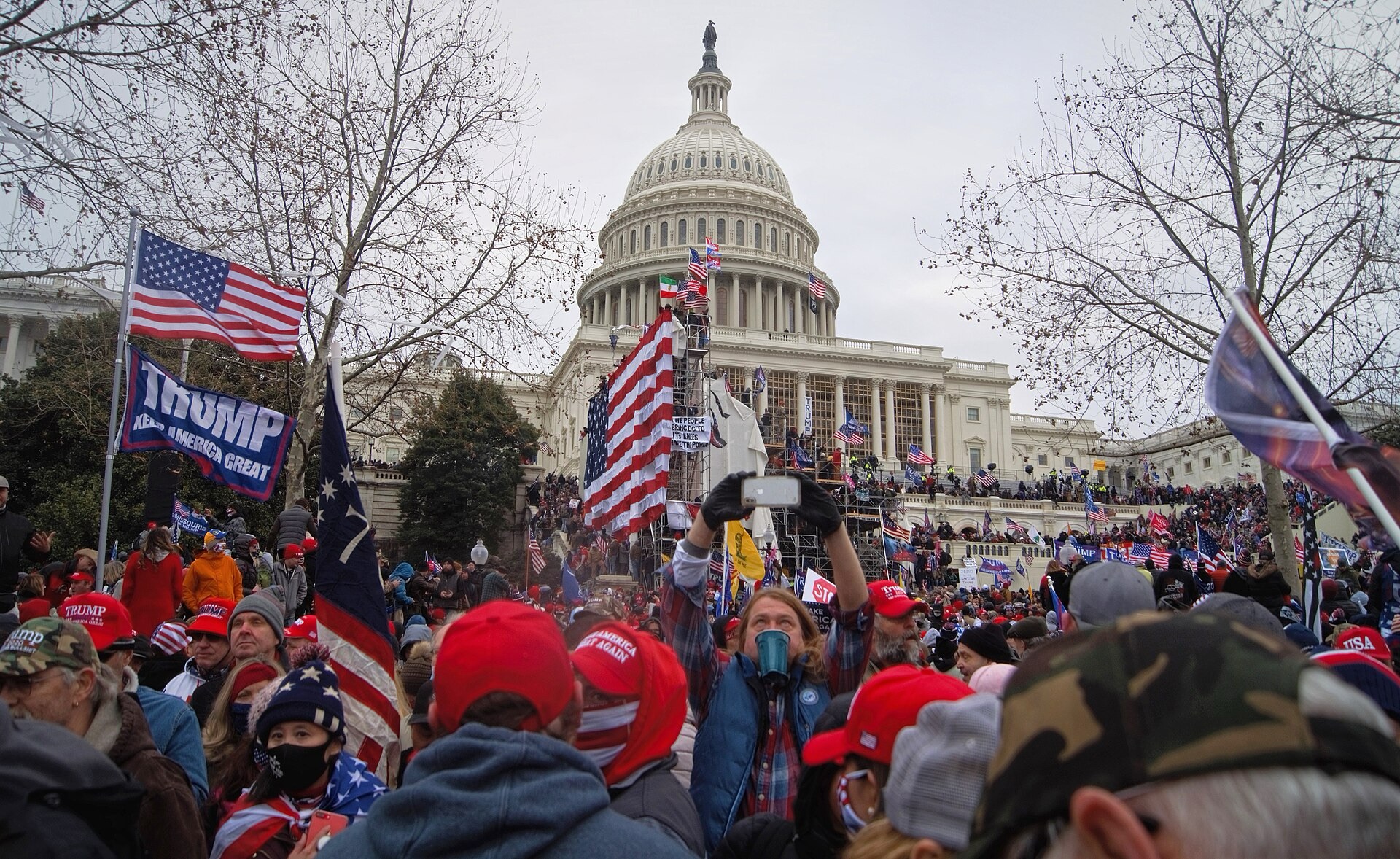
What followed was an assault on the institutions of democratic governance unlike any in American history. Trump filed dozens of lawsuits challenging the results in key states. He lost nearly all of them, often before judges he had appointed. He pressured state officials to “find” votes that would overturn the results. He called the secretary of state of Georgia, Brad Raffensperger, and asked him to “find 11,780 votes”—exactly one more than Biden’s margin of victory in the state. He summoned his supporters to Washington on January 6, 2021, and told them to “fight like hell.” They did. They attacked the Capitol. They beat police officers. They erected a gallows. They chanted “Hang Mike Pence.” And Trump watched on television, for hours, refusing to call them off.
The institutions held, just barely. The courts rejected Trump’s claims. State officials certified the results. Congress reconvened after the attack and certified Biden’s victory. The guardrails did not collapse. But they came closer to collapsing than they ever had before. And the reason they held was not because Trump respected them—he did not—but because the people who manned them, from election officials to judges to members of Congress, chose to do their duty. The institutions were only as strong as the people willing to defend them.
The Office After Trump
What is left of the presidency after Trump? The question is not merely academic. Trump is running for office again. He may win. If he does, he will return to the White House with a clearer understanding of its vulnerabilities and a more developed apparatus for exploiting them. He has spent the years since leaving office studying the institutional guardrails that constrained him, and he has promised to dismantle them.
But even if Trump never returns to office, he has already changed the presidency. He has shown that the norms and habits that constrained previous presidents were, in fact, fragile. He has shown that a president who refuses to accept the legitimacy of the institutions around him can do enormous damage before anyone can stop him. He has shown that the distinction between the office and the person—between the presidency and the president—is not self-enforcing.
And yet. The institutions Trump attacked were not innocent. The presidency he degraded was already an office of extraordinary, often unaccountable power. The “guardrails” that previous generations praised had failed to prevent the Iraq War, the torture program, the mass surveillance of American citizens, the drone war that killed thousands of civilians. To mourn their erosion is to mourn a system that was always more comfortable with power than with justice.
This is the uncomfortable truth that institutionalist laments often avoid. Trump did not create a crisis out of a healthy system. He exploited a system that was already sick. The question for the future is not whether the guardrails can be repaired. It is whether a different kind of politics—one that does not depend on the goodwill of presidents or the resilience of compromised institutions—is possible. That question will not be answered by the courts or the civil service or the counsels’ offices. It will be answered, if it is answered at all, by movements and organisers and citizens who do not look to the presidency for salvation. The office after Trump may be diminished. The question is what takes its place.
Photo Credit: Tyler Merbler

Leave a Reply