
In the latest episode of the Explaining History Podcast, I explore the competing theories attempting to explain what is happening in the Persian Gulf – and what it tells us about the end of American hegemony.
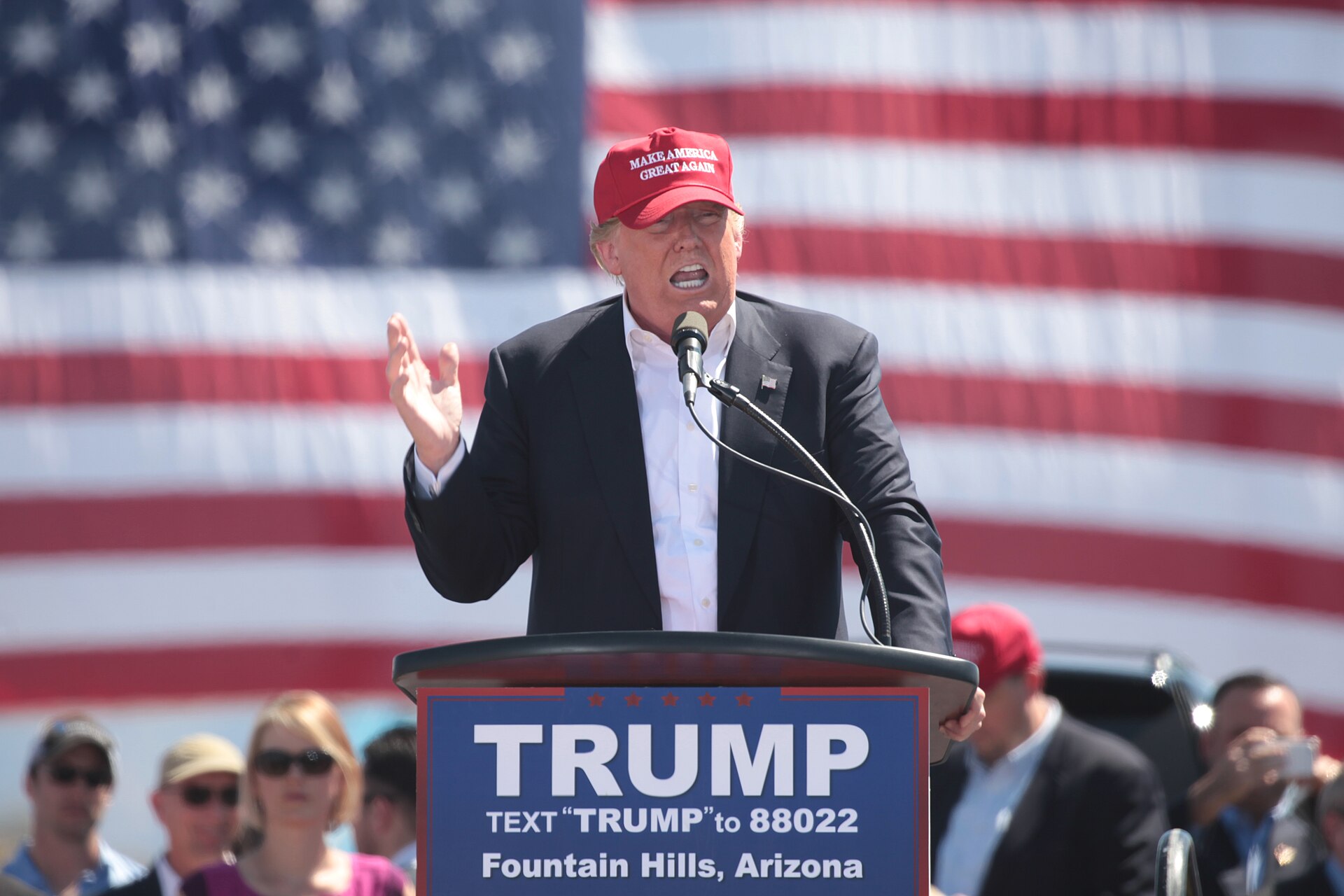
(photo credit: Gage Skidmore – https://creativecommons.org/licenses/by-sa/3.0/deed.en)
There are many competing theories about what we are seeing in the Gulf, and many different arguments about why America is doing what it is doing. These arguments fall into roughly two camps: the idea that there is an overarching grand plan behind everything that has happened since Venezuela in January, and – for my money – the more plausible argument that we exist in a moment of imperial decline and the chaos that that decline initiates.
Today, we examine both.
The Mearsheimer Thesis: Catastrophic Defeat
John Mearsheimer, the prominent international relations theorist, has been talking about the effects of the Israel lobby on the United States since about 2006. His current argument is that America has been conclusively defeated – and that Trump has, perhaps inadvertently, signaled a surrender.
Consider the evidence. About a week to ten days ago, America published a fifteen-point series of demands: the dismantlement of Iran’s nuclear program, the opening of the Straits of Hormuz, and a number of other key conditions. Most of these demands had already existed under the previous nuclear deal brokered by Barack Obama. Trump was essentially seeking to return to the situation that existed before he, under the goading of Netanyahu, tore up the Iran nuclear deal.
Following that, Iran published its own ten-point program: their dominance of the Strait of Hormuz, the continued enrichment of uranium, the demand for reparations, the removal of American bases in the Gulf. Trump accepted this ten-point plan as the basis for continued negotiations.
Let that sink in. America has had to evacuate its bases in the Middle East. One of its aircraft carriers mysteriously catches fire – the truth of that story will come out at some point. America is unable to achieve its strategic objectives (what those objectives are is debatable, because they keep changing anyway). It has lost control of the world’s key strategic waterway. Its ally Israel finds its anti-missile defense system failing, being heavily pulverised by Iranian missiles and drones.
And crucially – perhaps most crucially – America is running out of munitions.
The Munitions Crisis
America is running out of Tomahawk missiles. These take a long time to build, and they are exceedingly expensive. America has burned through something like eight to ten years of its Tomahawk stockpile. The Iranians, by contrast, have plenty of cheap missiles, rockets, and drones to throw at anyone who challenges them in the Gulf.
The Americans have had to remove their ships out into the Indian Ocean. Trump is now talking about blockading the Straits of Hormuz. But this is impossible. If it were possible to have ships close enough to the coastline without being in range of Iranian missiles, they would be doing it right now. The fact that major capital ships have had to be withdrawn – moved out of range – tells you everything.
Can an American president on a whim get on Twitter and say “we’re going to do this thing now” and have that translate into a coherent military strategy? To blockade and potentially board hundreds of tankers, you need your naval assets arranged in a particular way – certain kinds of ships, certain kinds of troops, helicopters. Can naval forces be that adaptable and responsive, particularly when you’ve lost most of the bases in the Gulf?
It seems rather implausible. Mearsheimer’s point – that America has suffered a catastrophic defeat, and that Trump has essentially signaled surrender – is largely accurate.
The Medhurst Thesis: The Blockade of China
But there is another perspective, advanced by journalist Richard Medhurst. His essential argument – and his reporting is very good on this – is that this is a blockade of China. Venezuela, Iran, Greenland, and the under-reported phenomenon of Russia’s shadow fleet being boarded by American allies, the Nord Stream pipeline – all of these are about:
- Putting Europe in a position of being energy dependent on America
- Choking off China’s industries
America itself has an abundance of oil and liquid natural gas. The petrodollar is under immense pressure at the moment – possibly terminal pressure. So if you cripple the rest of the world, and make the export of petroleum to China very difficult, China either sees its industries atrophy (because it hasn’t quite got enough renewables yet to power itself) or it has to come cap in hand to America. Then America, this pirate state, gets to renegotiate things from a position of strength.
This is entirely plausible. Medhurst’s journalism is well-researched and well-documented.
The Problem: Trump’s Chaos
But both theories rely on an assumption that may not hold: that Trump is a semi-rational actor. To some extent he is, but we must question how responsive he is to these challenges, and what level of reality he is existing in at the moment.
Trump’s reality is very often decided by the people around him who are giving him advice. He probably wouldn’t be in this disaster to begin with had it not been for Netanyahu and what Netanyahu persuaded him of. When one looks at these situations, one often thinks: “If I was in that situation, there would be this problem and that would be my response.” But we are not in that situation. We have to remember that it is Trump making these decisions.
According to a New York Times investigation, Trump went into all of this on a “yeah, sounds good” whim. Netanyahu presented him with a case for attacking Iran; he thought very little about it. He had senior military and intelligence people saying “this is a really bad idea, don’t do it.” But he had his son-in-law Jared Kushner and his good friend Steve Witkoff, who egged him on.
The White House and various branches of government have been effectively de-professionalised. The institutional knowledge and institutional memory that the president has access to has dwindled. There is a profound anti-intellectualism – a belief that nobody who really knows anything actually matters. All you need is a key decision-maker who has masqueraded as a successful entrepreneur but is essentially just a crook.
The Hitler Parallel – Carefully Considered
I am wary about Nazi comparisons. But there is one area where it fits together quite snugly, and it doesn’t apply only to Trump – there are numerous other examples.
Hitler de-professionalised large parts of his regime’s ministries. He removed people who did know things and replaced them with people who didn’t. Ribbentrop, a classic example, gave Hitler more misleading advice than virtually anybody else. Hitler trusted him – saw him as as much of a friend as Hitler was capable of having. Ribbentrop told Hitler things he wanted to hear.
Underneath Hitler was a state that gave the impression of order, but in fact there was widespread chaos. Far less worked than you think. When the German army got bogged down around Moscow in the winter of 1941 and started to freeze to death, there was no winter clothing for them. They had to appeal to the German people to send fur coats. Why? Because the systems for planning, organisation, logistics, and manufacture had been systematically ripped apart. Different ministries competed with one another. The chaos was deliberately created by Hitler because it helped him remain powerful and free of threats.
Trump surrounds himself with similar sorts of people. He surrounds himself with sycophants and fools.
America’s Supply Chain Collapse
In a different way, America’s supply chains have been gobbled up, run down, and degraded to a shadow of themselves by fifty years of neoliberalism – fifty years of just-in-time supply, fifty years of outsourcing, fifty years of people looking at stockpiles and wondering why they are there instead of why they can’t be translated into share price valuations.
This is the context. America cannot replenish its munitions quickly. Its industrial base has been hollowed out. Its decision-making has been de-professionalised. And it has just been strategically and tactically defeated by a power it assumed it could crush in a weekend.
The View from Tehran
If you observe this from Tehran, what you might be thinking is that these negotiations are a once-in-a-lifetime, once-in-a-generation, historically unique moment. A moment to permanently protect yourself from the Americans. An opportunity to remove the Americans from the Gulf forever. An opportunity to have leverage over the world. An opportunity to reduce US power in the Middle East permanently. An opportunity to finally deal with the threat of Israel.
Whether America had any interest in negotiating in good faith is debatable. But the outcome is clear: the Iranians are winning.
The Israeli Question
Israel’s popularity across America has plummeted. The American public are not going to forget in a hurry that Israel tried to drag them into potentially a world war. Israel’s standing in the estimation of many Americans – not just Democrats, not just people on the left, but MAGA types as well – has plummeted throughout the Gaza genocide.
What you may see now is a total reordering of decades and decades of support in the Middle East for Israel. You have a political class – Gavin Newsom the other week was declaring himself a “died-in-the-wool Zionist” – that is totally disconnected from broad swathes of the American public and indeed sections of the American Jewish community, who are by no means united on the question of Israel.
Iran potentially sees a future where there is division between America and Israel. Trump has apparently cursed Netanyahu’s name – and if he did, he will have followed a long line of American presidents who reached a point of rage-filled exasperation with Israeli prime ministers. It is almost a White House tradition.
Conclusion: Trying to Fathom the Unfathomable
This episode is more a case of trying to fathom, to some extent, the unfathomable – trying to find the strategic motivations behind America’s actions. Of course, because there is so much chaos, and because Trump seems to have gone into all this on a whim, any attempt to impose grand strategic coherence may be futile.
People point to the worst, most terrible outcomes: fertilisers being held back, planting seasons being missed, famines happening. All of it is possible. Is it going to happen? I don’t know. I hope not.
What we are witnessing is the end of a world order that has existed since 1945 – or in stages since 1945. The stage we are living through began around 1991, was fatally undermined in 2008, and has reached its apogee after 2016. We are going to see the collapse of an imperium before too long. And there will be international chaos for a long time following that.
The distance from George H.W. Bush’s “new world order” to Trump’s chaotic adventurism is less than 40 years. Trump is not the cause of American decline; he is an accelerant to an ongoing process. But the process is real, and the consequences are already upon us.
If you enjoyed this piece, please consider supporting the Explaining History Podcast. We’re migrating from Patreon to Substack – more details soon.

Leave a Reply