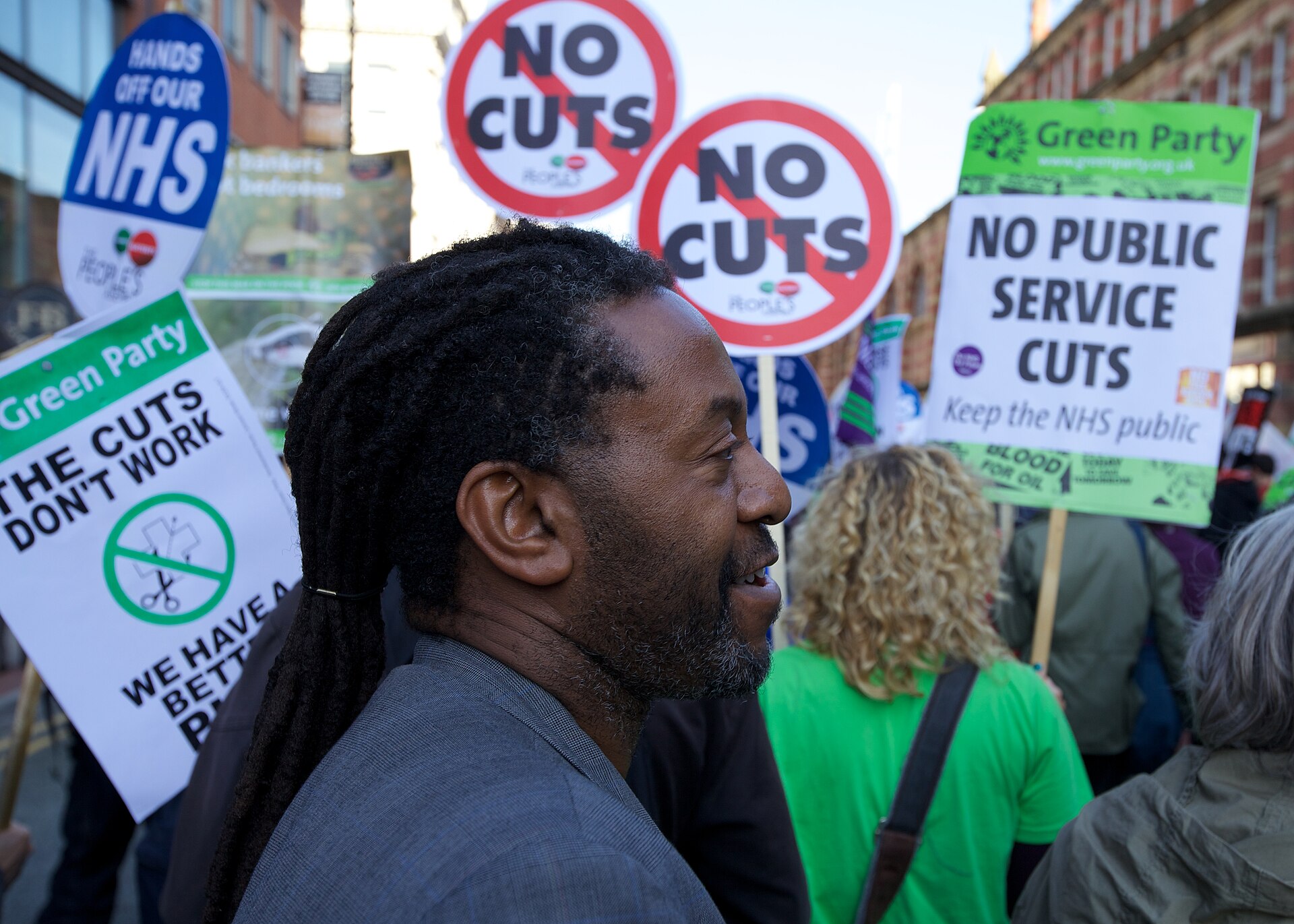

It has become common in the UK to talk about austerity as if it is a thing of the past – something that happened between 2010 and 2024, now supposedly over. This is completely wide of the mark.
The Labour government has made some token inroads into rolling back austerity. The vote to end the two‑child benefit cap – a policy that punished poor families for having more than two children – is one example. And as the Green Party has surged on the left, Labour has suddenly realised that doing some vaguely socially democratic things might be an idea to stave off the party’s almost unavoidable extinction. But structural damage done to British society is probably unfixable – not without something approaching wartime levels of economic and social mobilisation.
The real story of austerity, however, is not just about spending cuts. It is about how those cuts were sold to the public – and how a culture of “thrift” became a way of deciding who truly belongs.
The Two‑Child Cap: Punishment Masquerading as Policy
For those who don’t know, social welfare was hammered in Great Britain from 2010 onwards. A large number of Britain’s working poor – most of the people affected are in low‑wage jobs, because from Thatcherism onwards we built a low‑wage economy where the majority of returns on productivity go to capital, not labour – had their wages subsidised with income support. The biggest change to welfare that appealed directly to the readers of rabidly right‑wing newspapers was the change to child benefit.
Child benefit is the money allocated to parents per child. The Daily Mail campaigned successfully for the government to adopt a two‑child benefit cap. This means that if a parent has a third or fourth child, the benefits for the first two children are shared out with the third or fourth. The household does not receive any additional support for the extra children.
Why did we do this? In an age where we are suddenly realising that we have gone beyond the replacement level of the population – where there will soon be more elderly people than young people – why would a government deliberately penalise families for having children?
The answer is not economics. It is culture war. The way you win general elections isn’t through economics; it is through appealing to particular kinds of prejudice. George Osborne himself said that austerity served no other purpose than being wildly politically successful.
One of the anti‑working class tropes in the British press – aimed largely towards a lower‑middle‑class, middle‑class, bourgeois audience – is that feckless working class people have too many babies. They have children they can’t afford. They have more children than middle class people who work hard. Lazy scroungers are being subsidised, and this is a scandal. There should be resources for “good” sorts of people – hardworking, sensible, prudent – and few resources for “bad” sorts of people, who can be punished out of their fecklessness.
The two‑child benefit cap was a way of delivering punishment to poor people for having children – as if procreation were a dreadful crime. And it was a way of speaking to middle class anxieties as the middle class in Britain gradually became poorer and more precarious. Many people say, “I couldn’t afford to have three children, so I don’t.” There is a kind of national sport of tutting at working class mums with multiple children, particularly those on low incomes, looking stressed, having a child having a tantrum in the supermarket. Unspoken – or barely spoken, or sometimes overtly spoken – class prejudices are woven into all of this. The Conservatives used that as a tool to get themselves re‑elected with a majority in 2015, which essentially gave us Brexit.
The Cultural Politics of Thrift
But the most sophisticated part of the austerity project was not the cuts themselves. It was the cultural apparatus that made those cuts seem not only necessary but virtuous.
Liam Stanley, in his excellent book Britain Alone, writes:
“Since austerity invites the whole nation to live within its means to solve an emergency and secure its future, conflict pops up in unlikely places. For if those who make poor consumption choices and eat the wrong things are stigmatised and pushed towards the boundaries of Britishness, then those who make the right consumption choices and eat the right things are logically going to be celebrated, valued and possibly even given greater protection in the face of austerity.”
Committing to live within one’s own means – by adequately suppressing one’s appetite for food, but also for sex and shopping – became a nationalist act, a way of signalling one’s inclusion within the informal boundaries of Britishness.
Every country has formal boundaries of national identity – passports, citizenship tests, laws. But they also have informal ones: notions of what a person like you is, or isn’t, should or shouldn’t be. In Great Britain, the idea of thrift – “neither a borrower nor a lender be” – runs deep within the national psyche. This is how you get Margaret Thatcher talking about the country having a “corner shop economy”, holding up her father, a shopkeeper who ran a balanced budget, as a model for how a nation should be run. It was manna from heaven for neoliberals looking to shift the balance of power towards elites.
And at the beginning of the austerity period, the chorus was relentless: “Our forebears knew how to be thrifty during the war. They had potato peel pie and got on with it. They didn’t complain.” The subtext was that the wartime generation – who danced to the jitterbug, had cream teas, and lived through a hail of Nazi bombs – were proper sorts of people. They were the right kind of people. And the fact that they were a far more homogeneously white society added an unspoken racial subtext.
Austerity Chic and the Middle Class Performance of Thrift
As Stanley writes, the age of austerity coincided with a middle‑class rediscovery of wartime as a period rich with wisdom and trends for the times. Wartime and post‑war nostalgia allowed middle‑class consumers to rediscover and repackage self‑sufficiency and pride of the past into a “self‑conscious performance of thriftiness in a bid to further one’s cultural capital”.
The increasing popularity of allotments is one key example. Growing one’s own fruit and vegetables allows people to explore a degree of self‑sufficiency – practised as environmentalist or anti‑capitalist, but also as nostalgia for the “dig for victory” spirit of wartime rationing. Allotments have become so popular that demand now significantly outweighs supply.
This middle‑class shift in how to relate to food is reflected in the changing work of food writers. Nigel Slater’s 2005 Kitchen Diaries was dedicated to discussing the virtues of trendy North London eateries. His 2012 sequel saw him retreat into his home to discover the humble benefits of thrifty cooking, making particular use of leftovers. Meanwhile, cupcakes were identified as the definitive food item of 2012, in part because they symbolise an ironic and kitsch kind of thriftiness.
If you remember that period, it was pretty awful in terms of popular cultural output. There were innumerable shows about thrift on television – as if somebody at the Treasury had rung up Channel 4 and given them a heads‑up. Super Scrimper, a Channel 4 show that regularly had millions of viewers, was exemplary of this trend. The programme and its associated media – a website, books – were essentially primers on how to consume cleverly. There were literally instructions on how to be a responsible, thrifty, good household, often bound up in the aesthetic of wartime Britain.
This was a wonderful way to steer people away from wider political questions about wealth inequality, poverty, and the financial crisis. The message was that we were returning to older values that helped our grandparents navigate a complex world. “Britain is in financial meltdown and nearly half of all adults are worried about their finances? Never fear – Mrs M and her super scrimper army are back to show us how to survive this slump.”
The Cruel Irony
There is a cruel irony to these trends. This romanticisation of austerity is only available to people with sufficient resources to choose it. Those who are some way away from experiencing the rise of food insecurity, who are facing the brunt of spending cuts, cannot afford to perform thrift. They are simply poor.
The class dimensions were made clear enough by a contribution to a 2009 BBC Radio 4 documentary on thrift, where someone described the new trend as “almost being embarrassed over consumption – sitting at a dinner party and people apologising that they’re taking the family on holiday to Bali, bemoaning the fact that the cancellation fees are too high and that their children would far prefer to go to Cornwall.” This conspicuous austerity became very fashionable. This is the context in which it was possible to speak of Kate Middleton as “the thrifty royal” – her version of super scrimping, shopping at high street store Mothercare and being noted to wear the same dress twice, was celebrated by the British press.
Consumerism, National Identity and the Politics of Blame
There are numerous times in history where consumption decisions have been presented as moral choices. Look at Stalin’s Russia, where certain consumer choices were seen as politically desirable and patriotic. Or look at Lizabeth Cohen’s Consumers’ Republic, which examines how Americans articulated their national identity through consumption during and after the Second World War. The interconnection of consumerism, politics and identity is not novel.
What was novel during the austerity years was the sophistication of the device. It ensured that austerity as a policy was imposed – and that the focus of the response to the 2008 financial crisis never really shifted to looking at the structure of society, at economic relations, at the power of capital. Instead, we were taught to look at our neighbours, at their shopping baskets, at their DVD box sets, at their takeaways. The villains were not the bankers or the buy‑to‑let landlords or the city speculators. They were working class families.
Austerity Never Ended
The Labour government has started to make some token gestures. They have ended the two‑child benefit cap – a policy that should never have existed. They have promised to invest in public services. But the cultural work of austerity – the idea that poverty is a moral failing, that thrift is a national virtue, that some people deserve help and others do not – has not been undone. It lives on in every tut of a middle‑class shopper, every television programme about “extreme couponing”, every newspaper column about benefit scroungers.
Austerity may be officially over. But its spirit – and its weaponisation of class prejudice – is still very much with us.
*If you enjoyed this piece, please consider supporting the Explaining History Podcast. We are migrating from Patreon to Substack – details in the show notes. The Liam Stanley book referenced is *Britain Alone: How a Decade of Conflict Remade the Nation.

Leave a Reply