
Introduction
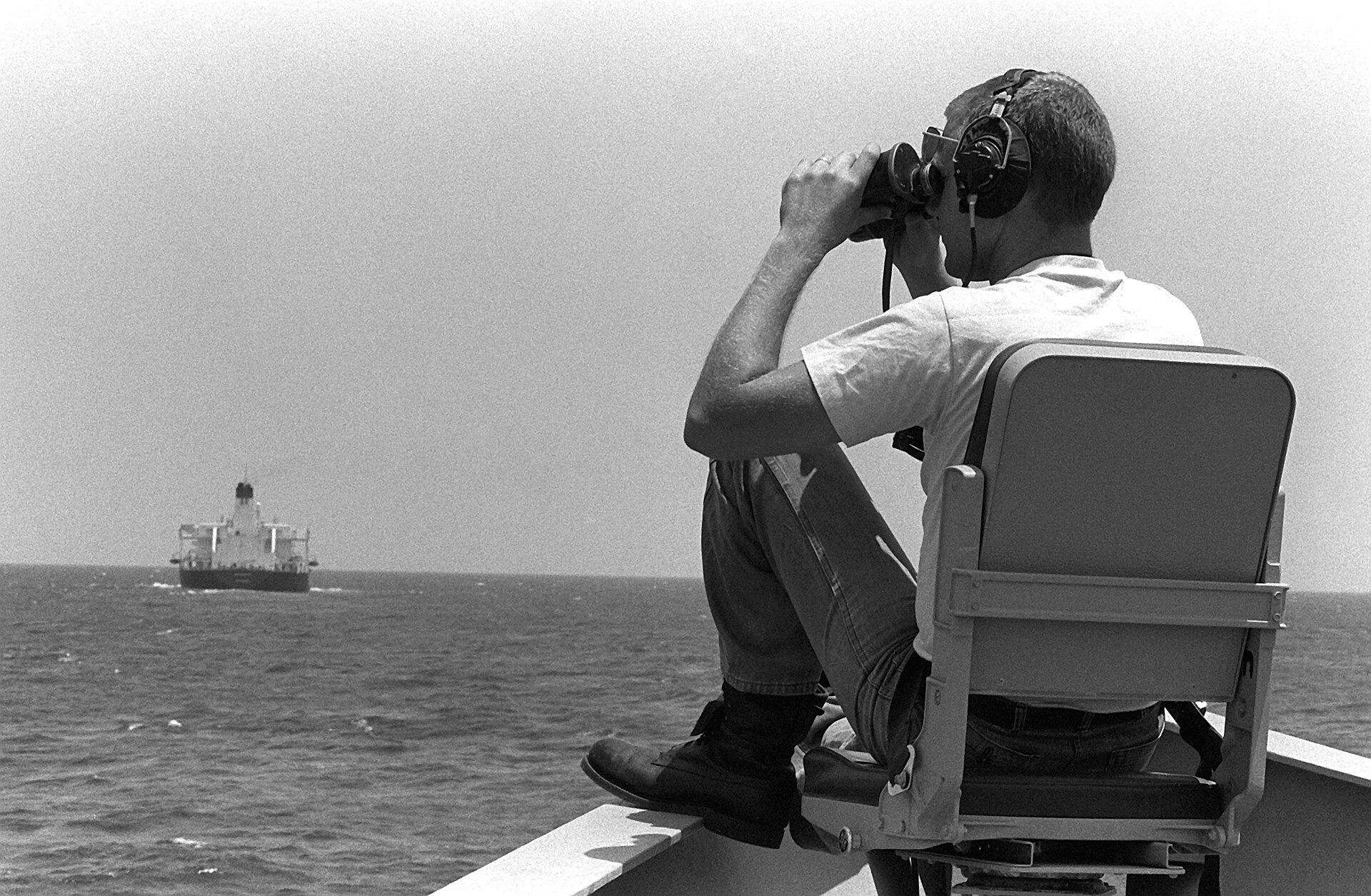
At 10:15 a.m. on May 17, 1987, the USS Stark, a Perry-class frigate patrolling the Persian Gulf, was hit by two Exocet missiles fired from an Iraqi jet. The attack, later deemed accidental, killed thirty-seven American sailors and ripped a gaping hole in the ship’s hull. Only heroic damage control efforts saved the vessel from sinking .
The Stark incident exposed a truth that Washington had been reluctant to acknowledge: the United States was already at war in the Persian Gulf, even if no one had formally declared it. By 1987, the Iran-Iraq WarIran-Iraq War
Short Description (Excerpt):A brutal eight-year conflict (1980–1988) initiated by Saddam Hussein’s invasion of Iran. While devastating, the war inadvertently strengthened the Islamic Republic, allowing it to suppress internal dissent under the guise of wartime patriotism.
Full Description:The Iran-Iraq War was one of the 20th century’s bloodiest conflicts, featuring trench warfare and the use of chemical weapons. Saddam aimed to seize oil-rich territory and crush the revolutionary threat next door. Instead, Iran mobilized a massive volunteer force (“human waves”) fueled by religious fervor to defend the revolution.
Critical Perspective:Khomeini famously called the war a “divine blessing.” It allowed the regime to militarize society and label any political opposition as treason. The war forged the identity of the Islamic Revolutionary Guard Corps (IRGC) and entrenched the narrative of Iran as a besieged fortress of Islam fighting against a corrupt world, a narrative that sustains the state to this day.
Read more had spilled beyond the land borders of the two combatants and into the international waters of the Gulf, threatening the oil shipments on which the global economy depended. The “Tanker War,” as it became known, saw both sides attack commercial shipping in an effort to cripple each other’s economies. And it drew the United States, slowly but inexorably, into direct military confrontation with the Islamic RepublicIslamic Republic
Short Description (Excerpt):The unique form of government established after the revolution. It is a hybrid system combining elements of a modern parliamentary democracy (elections, president, parliament) with a theocratic guardianship (Supreme Leader, Guardian Council).
Full Description:The Islamic Republic was the outcome of the referendum in 1979. While it has the trappings of a republic, ultimate power resides with the unelected religious leadership. The constitution explicitly subordinates the will of the people to the principles of Islam as interpreted by the Supreme Leader.
Critical Perspective:This dual structure creates a permanent institutional conflict. The tension between the “republican” mandate (popular sovereignty) and the “Islamic” mandate (divine sovereignty) results in a system where elected officials are often powerless to implement change if it contradicts the interests of the clerical elite. It represents an experiment in “religious democracy” that critics argue is inherently contradictory.
Read more of Iran.
But this overt confrontation was only half the story. Even as the Reagan administration publicly tilted toward Iraq—removing Saddam Hussein’s regime from the list of state sponsors of terrorism in 1982, reestablishing diplomatic relations in 1984, and sharing satellite intelligence with Baghdad —senior officials were secretly engaged in a covert arms-for-hostages deal with Iran. The Iran-Contra Affair, as it came to be known, would become the most damaging political scandal of Reagan’s presidency, revealing a shadow foreign policy run from the White House basement in direct violation of American law and stated policy.
This article examines the Tanker War and the Iran-Contra Affair as two sides of the same coin: America’s contradictory, covert, and ultimately catastrophic engagement with Iran in the 1980s. It argues that these events deepened Iranian suspicion of American intentions, cemented the narrative of American duplicity, and set the stage for the enduring hostility that would define U.S.-Iran relations for decades to come.
The Strategic Context: War in the Gulf
The War Spreads to Sea
By 1984, the Iran-Iraq War had reached a stalemate on land. Iranian human-wave attacks had failed to breach Iraqi defenses; Iraqi counteroffensives had failed to eject Iranian forces from Iraqi territory. Both sides looked for new ways to inflict pain.
Iraq, with its small navy and limited access to the sea, attacked Iranian oil exports from the air. Using French-supplied Super Étendard jets and Exocet missiles, Iraqi aircraft targeted tankers loading at Iran’s Kharg Island terminal, as well as ships carrying Iranian oil through the Gulf. The strategy was simple: cripple Iran’s economy by attacking its only significant source of revenue .
Iran responded in kind, but with different tools. Lacking Iraq’s air power, Iran used surface vessels, small boats, and naval mines to attack shipping bound for Iraq’s allies, particularly Kuwait and Saudi Arabia, which were funding Saddam’s war effort. Two Iranian frigates, the Sahand and Sabalan, became notorious for their attacks on unarmed neutral shipping—attacks that American commanders viewed as piracy or terrorism on the high seas .
The “Tanker War” escalated steadily. Between 1984 and 1987, more than 400 ships were attacked, dozens of sailors were killed, and insurance rates for Gulf shipping skyrocketed. The global economy, heavily dependent on Gulf oil, watched with growing alarm .
Kuwait’s Plea and America’s Response
In late 1986, Kuwait approached both the United States and the Soviet Union with an unprecedented request: would they protect its tanker fleet from Iranian attack? For Kuwait, the calculation was simple. It had lent Iraq billions of dollars during the war and was allowing Iraqi oil to be exported through its terminals. Iranian retaliation was inevitable, and Kuwait’s own shipping was increasingly vulnerable.
For the Reagan administration, Kuwait’s request presented both an opportunity and a dilemma. The opportunity was strategic: by protecting Kuwaiti tankers, the United States could demonstrate its commitment to Gulf security, exclude the Soviets from a vital region, and push back against Iranian revolutionary expansion. The dilemma was operational: escorting tankers through mine-infested waters patrolled by Iranian small boats would put American forces directly in harm’s way, risking escalation that Washington did not want .
After negotiations, the administration agreed to reflag eleven Kuwaiti tankers with American flags and provide them with naval escorts. The operation was code-named Earnest Will. It began in July 1987, just two months after the Stark attack, and would continue until the war’s end .
The Tanker War: 1987-1988
Operation Earnest Will
The first escorted convoy, in July 1987, suffered an immediate setback. The reflagged tanker Bridgeton struck an Iranian mine, sustaining damage but remaining afloat. The image of a U.S.-flagged vessel, supposedly under American protection, being crippled by a cheap mine was embarrassing and revealing. It demonstrated that Iran’s asymmetric tactics—mines, small boats, and hit-and-run attacks—could challenge even the world’s most powerful navy .
The mining also forced the United States to escalate. Over the following months, the American presence in the Gulf grew substantially. By late 1987, Joint Task Force Middle East included dozens of warships, supported by carrier aviation and special operations forces. The Navy deployed two floating bases—converted barges—to support SEAL and helicopter operations against Iranian small boats and mine-laying vessels .
A low-level conflict developed through the fall of 1987. U.S. forces boarded and sank an Iranian mining ship. SEALs exchanged fire with Iranian Revolutionary Guard small boats, leaving several Iranians dead. When Iran fired a Silkworm missile at a U.S.-flagged tanker in October, wounding the captain, the United States responded by destroying an Iranian oil platform used as a base for attacks on shipping .
The USS Samuel B. Roberts and Operation Praying Mantis
Tensions eased somewhat over the winter of 1987-88, but Iran resumed mining in the spring. On April 14, 1988, the frigate Samuel B. Roberts struck a mine while transiting international waters. The explosion blew a massive hole in the ship’s hull, and only heroic damage-control efforts—the crew worked for hours in flooding compartments—saved the vessel from sinking .
The attack demanded a response. President Reagan and his national security team authorized retaliatory strikes against Iranian targets. The operation, code-named Praying Mantis, would become the largest American naval surface action since World War II .
On April 18, 1988, three American surface action groups—each comprising three ships—struck Iranian targets across the Gulf. One group attacked the Sassan oil platform, used as a command-and-control center for attacks on shipping. Another struck the Sirri platform. Both were destroyed, with Marines boarding the Sassan platform to gather intelligence before demolishing it .
The third group patrolled the Strait of Hormuz, seeking to engage Iranian warships. The opportunity came when the Iranian attack boat Joshan sortied from port and challenged the American formation. After issuing repeated warnings—”Stop and abandon ship. I intend to sink you”—the Americans opened fire when the Joshan launched a Harpoon missile. The missile was defeated by chaff and electronic countermeasures; the Joshan was not so fortunate. American ships sank the Iranian vessel with a combination of Standard missiles and naval gunfire .
Later that day, American aircraft attacked Iranian frigates that had sortied from Bandar Abbas. The Sahand was sunk; the Sabalan was heavily damaged and barely made it back to port. By nightfall, two Iranian oil platforms were aflame, three warships were at the bottom of the Gulf, and dozens of Iranian sailors were dead. American losses: one helicopter and two Marines, lost in an accident unrelated to enemy action .
The Vincennes Disaster
Operation Praying Mantis demonstrated American naval dominance, but it did not end the conflict. Through the spring and summer of 1988, U.S. and Iranian forces continued to skirmish in the Gulf. And on July 3, the most tragic incident of the entire Tanker War occurred.
The USS Vincennes, a sophisticated Aegis cruiser, was operating in Iranian waters near the Strait of Hormuz. The ship’s crew, tense after months of confrontation, misidentified Iran Air Flight 655—a civilian Airbus A300 carrying 290 passengers and crew—as an attacking F-14 fighter. The Vincennes fired two surface-to-air missiles. Both hit. All 290 people aboard were killed .
Washington claimed the incident was a tragic accident, the result of stress, confusion, and the inherent difficulty of identifying aircraft in a combat zone. Tehran believed otherwise. In the Iranian telling, the Vincennes deliberately shot down a civilian airliner—an act of mass murder that demonstrated American hostility toward the Iranian people. The fact that the Vincennes was operating in Iranian waters at the time, and that the Reagan administration had consistently tilted toward Iraq, made the American explanation difficult for Iranians to accept .
Two weeks later, Iran accepted UN Security CouncilSecurity Council Full Description:The Security Council is the only UN body with the authority to issue binding resolutions and authorize military force. While the General Assembly includes all nations, real power is concentrated here. The council is dominated by the “Permanent Five” (P5), reflecting the military victors of the last major global conflict rather than current geopolitical realities or democratic representation. Critical Perspective:Critics argue the Security Council renders the UN undemocratic by design. It creates a two-tiered system of sovereignty: the Permanent Five are effectively above the law, able to shield themselves and their allies from scrutiny, while the rest of the world is subject to the Council’s enforcement. Resolution 598, agreeing to a ceasefire that ended the eight-year war. The timing was not coincidental. The Vincennes shootdown convinced Iranian leaders that the United States was prepared to enter the war directly on Iraq’s side—a prospect that Tehran, exhausted and isolated, could not survive .
The Shadow War: Iran-Contra
Even as American and Iranian forces skirmished in the Gulf, a secret channel of communication and cooperation existed between Washington and Tehran. The Iran-Contra Affair, which would explode into public view in November 1986, represented the strangest and most contradictory aspect of America’s Iran policy in the 1980s.
Origins: The Hostage Crisis in Lebanon
The story begins not in Tehran but in Beirut. Beginning in 1982, a series of Americans—journalists, academics, diplomats, and CIA officers—were kidnapped in Lebanon by Shia militant groups linked to Iran. The hostages became a running sore for the Reagan administration, generating constant media coverage and political pressure. Reagan, who had entered office vowing never to negotiate with terrorists, found himself increasingly desperate to secure their release .
By 1985, a backchannel had opened. Israeli intermediaries, who had their own complex relationships with Iran, approached American officials with a proposal: Iran’s leadership, desperate for weapons to continue the war against Iraq, might be willing to use its influence in Lebanon to secure the hostages’ release. Arms for hostages—a direct violation of Reagan’s stated policy—was on the table.
The Deal Unfolds
What followed was a series of covert arms shipments from Israel to Iran, with American approval and replenishment of Israeli stocks. The first shipment, in August 1985, involved 96 TOW anti-tank missiles. More shipments followed over the next year, eventually totaling perhaps 2,000 TOW missiles and several hundred HAWK anti-aircraft missiles .
The transactions were bizarre in every respect. They involved Iranian intermediaries, Israeli arms dealers, American National Security Council staff, and a cast of characters that included CIA officers, retired generals, and assorted adventurers. They were conducted in secret, with no congressional notification, in direct violation of the Arms Export Control Act and Reagan’s own public commitments. And they produced only mixed results: some hostages were released, but others were immediately seized to replace them, creating a cycle of arms-for-hostages that never actually ended the crisis .
The rationale offered by administration officials was convoluted. They argued that the arms sales were not a hostage exchange but an attempt to open a strategic dialogue with “moderates” in Tehran—figures who might, with American encouragement, steer Iran away from revolutionary radicalism. This fantasy, which persisted despite all evidence to the contrary, allowed officials to convince themselves that they were engaged in grand strategy rather than trading weapons for hostages .
The Diversion
The scandal took on an additional dimension in November 1986, when Lebanese newspaper Al-Shiraa revealed the secret arms sales. As investigators dug deeper, they discovered another layer of wrongdoing: proceeds from the Iranian arms sales, approximately $30 million, had been diverted to fund the Contra rebels in Nicaragua—a direct violation of the Boland Amendment, which prohibited U.S. assistance to the Contras .
The diversion was the brainchild of Lieutenant Colonel Oliver North, a National Security Council staffer who operated with minimal oversight and maximal self-confidence. North’s network of private donors, foreign governments, and covert operatives had been supporting the Contras outside congressional oversight. The Iranian arms sales provided a convenient, deniable funding stream.
The Fallout
When the scandal broke, it consumed Washington. Congressional hearings, special prosecutors, and media investigations dominated the news for two years. Multiple officials were indicted; North and National Security Advisor John Poindexter were convicted (though their convictions were later overturned on technical grounds). President Reagan’s approval ratings plummeted, and his remaining years in office were shadowed by questions about his management, his knowledge, and his veracity.
For Iran, the scandal confirmed what many already believed: the United States could not be trusted. Even as Washington publicly condemned Iran, supported Iraq, and imposed an arms embargo (Operation Staunch), it was secretly selling weapons to Tehran. The contradiction was not, from the Iranian perspective, evidence of American complexity or internal conflict. It was evidence of American duplicity—a government that said one thing and did another, that could not be relied upon to keep its word or honor its commitments .
The Dual Policy: Understanding American Contradictions
How could the same administration simultaneously arm Iraq, sell weapons to Iran, and skirmish with Iranian forces in the Gulf? The answer lies in the fragmented nature of American foreign policy and the competing priorities that drove it.
The Public Policy: Tilt Toward Iraq
The public policy was straightforward: prevent an Iranian victory. The Reagan administration, like its predecessor, viewed revolutionary Iran as a greater threat than Ba’athist Iraq. Khomeini’s radical Islamism, his hostility to Israel, his calls for exporting the revolution—all posed a direct challenge to American interests in the Middle East. Saddam Hussein, whatever his faults, was a secular nationalist who had broken with the Soviets and could be managed .
This logic drove the tilt toward Iraq. Washington removed Iraq from the list of state sponsors of terrorism in 1982, reestablished diplomatic relations in 1984, and provided Saddam with satellite intelligence on Iranian troop positions. When other countries sold weapons to Iraq, the United States tacitly approved. When the State Department launched Operation Staunch, a global effort to persuade other governments not to sell arms to Iran, the message was consistent: Iran was the enemy; Iraq was, if not a friend, at least a necessary ally against a greater threat .
The Secret Policy: Engagement with Iran
The secret policy was driven by different imperatives: hostages, strategy, and the fantasy of moderation. The hostages in Lebanon were a constant political liability, generating media coverage that made the administration look weak and helpless. If arms sales could secure their release, the political benefits were substantial.
Beyond the hostages, some officials believed that Iran was too important to be simply abandoned to revolutionary radicalism. They imagined that “moderates” existed within the Iranian leadership—figures who might, with American encouragement, steer the country away from Khomeini’s path. Arms sales, in this telling, were not a hostage ransom but an investment in Iran’s strategic realignment .
Both justifications were flawed. The hostage-for-arms cycle never actually resolved the hostage crisis; it simply created perverse incentives for more hostage-taking. And the “moderates” never materialized; the Iranian officials who dealt with the Americans were as committed to the revolution as anyone in Tehran. The fantasy of moderation, like the fantasy of a quick hostage release, was a mirage.
The Iranian Perspective
From Tehran, these American contradictions were not contradictions at all. They were evidence of a coherent if duplicitous strategy: the United States supported Iraq openly while engaging Iran secretly, always pursuing its own interests at Iranian expense.
The arms sales, when revealed, did not generate gratitude in Tehran. They generated suspicion. If the Americans were selling weapons to Iran while publicly arming Iraq, what did that say about American reliability? If they would trade weapons for hostages while condemning terrorism, what did that say about American principles? The Iran-Contra Affair reinforced every negative stereotype that Iranians held about the United States: that it was deceitful, that it could not be trusted, that its stated policies were always covers for hidden agendas .
This suspicion would have profound consequences. When Iranian officials later considered engaging with the United States—during the Clinton administration, after 9/11, in the nuclear negotiations—the memory of Iran-Contra hung over every discussion. Why should Iran trust American promises, when American actions had proven so consistently duplicitous?
The Legacy: From Tanker War to Enduring Hostility
The Military Legacy
The Tanker War demonstrated both American naval dominance and its limits. Operation Praying Mantis was a clear military victory: American forces destroyed Iranian platforms and warships with minimal losses. But the Vincennes shootdown showed how easily that dominance could produce catastrophe. A state-of-the-art warship, equipped with the world’s most advanced air defense system, had shot down a civilian airliner—killing 290 people and generating a propaganda victory for Iran that no military action could offset.
The Tanker War also shaped Iranian military doctrine. Confronted with American technological superiority, Iran invested heavily in asymmetric capabilities: small boats, naval mines, anti-ship missiles, and, later, drones. These tools, cheap and difficult to counter, would become the foundation of Iranian naval strategy for decades to come. When Iranian forces harassed U.S. Navy vessels in the Gulf in the 2000s and 2010s, they were applying lessons learned in 1987-88.
The Political Legacy
Iran-Contra left deep scars on American politics, but its effects on Iran were perhaps more profound. The scandal confirmed the revolutionary narrative of American hostility. It demonstrated that the United States could not be trusted to honor its commitments or tell the truth about its actions. And it provided a stock of images and memories—secret arms shipments, duplicitous officials, hostages traded for weapons—that would be invoked for generations.
For Iranians who had lived through the war, the American role was unambiguous. The United States had supported Iraq throughout the conflict, providing intelligence, diplomatic cover, and, through third parties, weapons. It had shot down a civilian airliner and killed 290 people. And even as it did these things, it had secretly sold weapons to Iran—not out of friendship, but for hostages and covert funding. The message was clear: the United States acted only in its own interest, and Iran could expect nothing but hostility and manipulation .
The Diplomatic Legacy
The combination of overt hostility and covert engagement created a pattern that would persist for decades. American policy toward Iran has oscillated between confrontation and negotiation, sanctions and secret channels, ever since. The Clinton administration explored rapprochement and imposed new sanctions. The Bush administration labeled Iran part of an “axis of evil” and offered to negotiate. The Obama administration pursued diplomacy while maintaining maximum pressure. The Trump administration withdrew from diplomacy and imposed maximum pressure.
Through all these oscillations, Iran has watched and remembered. Every American overture is viewed through the lens of past betrayals. Every American threat is viewed through the lens of past attacks. The shadow of the Tanker War and Iran-Contra hangs over every interaction, a reminder of what happens when the United States engages with Iran.
Conclusion: The War That Never Ended
The Tanker War ended in 1988, but its effects continue to shape the Gulf. The United States maintains a substantial naval presence in the region, watching for Iranian mines and small boats. Iran maintains its asymmetric capabilities, ready to challenge American dominance if necessary. The two countries have skirmished repeatedly since 1988—in 2016, when Iranian small boats harassed American warships; in 2019, when Iran shot down an American drone; in 2020, when the United States killed Qasem Soleimani; in 2025-26, when the “Twelve-Day War” brought Iran and Israel into direct confrontation .
Iran-Contra ended with convictions, pardons, and a presidential commission, but its political effects are equally enduring. The scandal reinforced Iranian suspicion of American intentions and provided a template for understanding American behavior. When American officials speak of engaging with Iran, Iranian officials remember the arms-for-hostages deals. When American officials threaten Iran, Iranian officials remember the Vincennes. Trust, once broken, is difficult to restore.
The Tanker War and Iran-Contra were not the beginning of U.S.-Iran hostility—that began with the 1953 coup. But they were critical moments in its consolidation. They demonstrated that even when the United States and Iran were not formally at war, they were locked in a conflict that could escalate at any moment. They showed that American policy could be simultaneously hostile and duplicitous, publicly committed to one course while secretly pursuing another. And they ensured that when the war finally ended in 1988, the peace would be only a cease-fire—a pause in a conflict that had no clear resolution.
Three decades later, that conflict continues. The tankers still sail through the Gulf, now escorted by American and allied warships. The mines still lurk in the waters. The drones still fly overhead. And the suspicion, the hostility, the mutual incomprehension—all the products of those years of shadow war—remain as powerful as ever.
Further Reading
· Crist, David. The Twilight War: The Secret History of America’s Thirty-Year Conflict with Iran. Penguin Press, 2012. The definitive account of U.S.-Iran military confrontation, with extensive coverage of the Tanker War.
· Ganji, Babak. Politics of Confrontation: The Foreign Policy of the USA and Revolutionary Iran. I.B. Tauris, 2006. A scholarly analysis of the ideological and strategic dimensions of U.S.-Iran conflict.
· Kornbluh, Peter, and Malcolm Byrne, eds. The Iran-Contra Scandal: The Declassified History. The New Press, 1993. A collection of declassified documents from the National Security Archive, with expert commentary.
· Sick, Gary. October Surprise: America’s Hostages in Iran and the Election of Ronald Reagan. Times Books, 1991. A provocative account of the hostage crisis and its connection to the 1980 election, by a former National Security Council staffer.
· Wise, Harold Lee. “One Day of War.” Naval History Magazine, March 2013. A detailed account of Operation Praying Mantis from the U.S. Naval Institute .
· Zonis, Marvin. Majestic Failure: The Fall of the Shah. University of Chicago Press, 1991. A psychological and political analysis of Iranian leadership, with insights into revolutionary foreign policy.

Leave a Reply