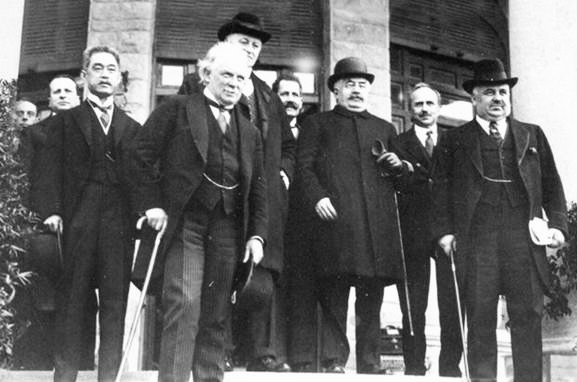

Introduction: The Villa Devachan and the New World Order
On April 19, 1920, the Supreme Council of the Allied Powers convened at the Villa Devachan, an ornate Edwardian residence in the Italian resort town of San Remo. The setting was tranquil, overlooking the Mediterranean Riviera, but the business at hand was the definitive partition of the Middle East. For eighteen months following the Armistice of Mudros in October 1918, the fate of the Ottoman Empire’s Arab provinces had existed in a state of suspended animation. British and French armies occupied the terrain from the Levant to Mesopotamia, but the legal status of these territories remained undefined.
The San Remo Conference marked the transition from the secret, provisional diplomacy of the war years—typified by the 1916 Sykes-Picot Agreement—to the formal international law of the post-war era. It was here that the Great Powers operationalized the “Mandate System,” a novel concept in international relations designed to reconcile the imperial ambitions of the victors with the Wilsonian idealism that had permeated the Paris Peace Conference.
While historical narratives often focus on the Sykes-Picot map, that agreement was merely a statement of wartime intent, partially rendered obsolete by the war’s end. San Remo was the execution. It was the moment where political aspirations were codified into international agreements. The resolutions adopted at San Remo dismantled the Ottoman Empire legally, allocated the mandates for what would become Iraq, Syria, Lebanon, and Palestine, and incorporated the Balfour Declaration into the framework of the settlement.
This article provides a detailed analysis of the San Remo Conference. It examines the geopolitical vacuum that necessitated the meeting, the application of Article 22 of the League of Nations Covenant, the specific diplomatic negotiations between David Lloyd George and Alexandre Millerand regarding oil and territory, and the immediate, violent reaction the conference triggered across the Arab world.
The Geopolitical Vacuum: 1918–1920
To understand the specific decisions made at San Remo, one must first analyze the uncertain interregnum that followed the end of World War I. When the Ottoman Empire surrendered in October 1918, the strategic map did not align with the political agreements made during the war.
Great Britain found itself in a position of overwhelming dominance. British imperial forces occupied Baghdad, Basra, and Mosul in Mesopotamia. In the Levant, General Edmund Allenby’s Egyptian Expeditionary Force controlled Palestine and the Syrian coast. By contrast, France, exhausted by the carnage on the Western Front, had a limited military footprint in the region.
However, the political landscape had been complicated by two new factors: the entry of the United States into the war and the rise of Arab nationalism.
President Woodrow Wilson’s “Fourteen Points,” delivered in January 1918, challenged the “old diplomacy” of secret treaties and annexation. Point XII stated that the non-Turkish nationalities of the Ottoman Empire should be assured an “absolutely unmolested opportunity of autonomous development.” This rhetoric captured the imagination of the Arab public. In Damascus, Emir Faisal bin Hussein, the military leader of the Arab Revolt, had established an Arab administration under the auspices of the British military, believing that Britain would honor its wartime pledges to support Arab independence.
By the spring of 1920, this status quo was untenable. The United States, following the Senate’s rejection of the Treaty of Versailles in November 1919, was retreating into isolationism. This removed a primary check on British and French colonial ambitions. With Wilson effectively out of the picture, London and Paris were free to revert to traditional imperial bargaining, albeit dressed in new legal language. The British government, led by Prime Minister David Lloyd George, realized it could not hold the entire Middle East alone; the cost of occupation was too high, and friction with France was threatening the alliance in Europe. A formal settlement was required to regularize the occupation and distribute the spoils.
The Mandate System: Article 22 in Practice
The mechanism chosen to resolve the tension between colonial ambition and Wilsonian self-determination was the “Mandate.” Conceptually developed by General Jan Smuts of South Africa, the mandate system was enshrined in Article 22 of the Covenant of the League of Nations.
Article 22 represented a shift in the theory of international law. In the 19th century, a conquered territory became a colony, possessed by the sovereign power. Under the Mandate system, the territory was theoretically held in trust on behalf of the League of Nations. The “Mandatory” power was not a sovereign owner but a tutor, tasked with providing “administrative advice and assistance” until the population was ready for self-rule.
The former Ottoman territories were designated as Class A Mandates, a category reserved for nations considered to have reached a relatively high stage of development. The text of Article 22 noted that the existence of these communities as independent nations could be “provisionally recognized” subject to the administrative advice and assistance of a Mandatory. Crucially, the article stated that the “wishes of these communities must be a principal consideration in the selection of the Mandatory.”
The San Remo Conference was convened to operationalize this article. However, the proceedings revealed that the “wishes of these communities” clause was largely bypassed. The King-Crane Commission, an American inquiry sent to the Levant in 1919 to ascertain local preferences, had reported that the population overwhelmingly rejected French rule and preferred a single united Syrian state. This report did not shape the Allied decisions at San Remo. Instead, the allocation of mandates proceeded based on the strategic and economic requirements of Britain and France.
The Supreme Council: Personnel and Agendas
The San Remo Conference was an exclusive affair, conducted by the “Supreme Council” of the Allied powers. The key participants were British Prime Minister David Lloyd George, French Premier Alexandre Millerand, and Italian Premier Francesco Nitti. Japan was represented by Ambassador Matsui Keishirō. The United States sent Robert Underwood Johnson, the Ambassador to Italy, but only as an observer with no voting rights.
The dynamic of the conference was defined by the bilateral negotiation between Lloyd George and Millerand. Relations between the two allies were strained. France was deeply suspicious that Britain intended to renege on the Sykes-Picot Agreement and use Faisal’s Arab government in Damascus as a proxy to exclude France from Syria.
Lloyd George, a pragmatic imperialist, recognized that British overreach in the Middle East was dangerous. He needed French support in Europe to enforce the Treaty of Versailles against Germany. Therefore, his strategy at San Remo involved a complex negotiation often described as a diplomatic trade-off. Britain would withdraw its support for Faisal and recognize France’s mandate over Syria. In exchange, France would agree to concessions regarding the Mosul vilayet (transferring it to the British sphere) and abandon claims to Palestine, allowing Britain to take the mandate for the territory west of the Jordan River.
The Partition of the Levant and the Fate of Faisal
The most immediate political consequence of San Remo was the delegitimization of the Arab Kingdom of Syria. Since October 1918, Faisal bin Hussein had ruled Damascus as a de facto monarch. He had attended the Paris Peace Conference, arguing for Arab independence based on the British promises made to his father, Sharif Hussein, in the McMahon-Hussein Correspondence.
At San Remo, the Supreme Council formally assigned the mandate for Syria and Lebanon to France. By doing so, the international community stripped Faisal’s government of its standing. The resolution implied that the territory was awaiting French “tutelage” rather than existing as a sovereign state.
This decision was a calculated realpolitik maneuver. Lloyd George effectively washed his hands of the Hashemite cause in Syria. The British army, which had been the guarantor of Faisal’s position, prepared to withdraw from the Syrian littoral to make way for French troops.
The San Remo Resolution gave France the international sanction it required to assert control. General Henri Gouraud, the French High Commissioner in the Levant, used the mandate as justification to issue an ultimatum demanding the dissolution of the Arab army. This trajectory, set at San Remo, led directly to the Battle of Maysalun in July 1920, the defeat of the Arab forces, and the expulsion of Faisal from Damascus.
The Palestine Mandate and the Balfour Declaration
A significant legacy of San Remo was its treatment of Palestine. In 1917, British Foreign Secretary Arthur Balfour had issued a letter expressing sympathy for Zionist aspirations—the Balfour Declaration. Until 1920, this was a statement of British policy; it had not yet been enshrined in a binding international treaty.
At San Remo, the British delegation ensured that the principles of the Balfour Declaration were incorporated into the resolution regarding the Palestine mandate. The French were initially skeptical, and the Italians concerned about religious sites, but the final resolution included the obligation for the Mandatory power to put into effect the declaration in favor of the establishment in Palestine of a national home for the Jewish people, with the understanding that the civil and religious rights of non-Jewish communities would not be prejudiced.
This clause transformed the declaration from a political promise into an international legal obligation for the Mandatory power. It differentiated the Palestine Mandate from the others. While the mandates for Iraq and Syria were broadly focused on administrative assistance leading to independence, the Palestine Mandate included this specific dual obligation.
The conference also confirmed that Britain would hold the mandate for Palestine, replacing the international administration proposed in the 1916 Sykes-Picot plan. This secured a strategic buffer for the Suez Canal, a long-standing British objective.
Oil and the Mosul Question
While the diplomats discussed political boundaries, a parallel negotiation addressed the region’s economic future. On April 24, 1920, British and French representatives signed an oil agreement that resolved the dispute over the Mosul vilayet.
Geologists and oil executives, particularly those from the Turkish Petroleum Company (TPC), had identified Mosul as a likely source of significant oil reserves. In 1916, Sykes and Picot had assigned Mosul to the French sphere of influence. By 1920, the strategic importance of oil made British control of Mosul a priority.
The agreement codified at San Remo facilitated the transfer of Mosul to the British sphere of influence (later incorporated into the Iraq mandate). In exchange, France was granted a 25% share in the TPC (later the Iraq Petroleum Company) and rights to transport oil via pipelines through the French mandate of Syria to the Mediterranean. This arrangement underscores how economic imperatives—specifically oil and transit routes—shaped the territorial configuration of the new mandates, influencing the eventual borders of Iraq.
The Regional Reaction: 1920
The decisions taken at San Remo were not received passively in the Middle East. The publication of the resolution sparked a wave of violence and insurrection across the region in 1920.
The Iraqi Revolt
In Mesopotamia, the announcement that Britain had been awarded the mandate shattered the hopes of Iraqi nationalists who had expected independence. The mandate was viewed by many as a synonym for colonization. In the summer of 1920, mass protests in Baghdad coalesced with tribal uprisings in the mid-Euphrates region. The “Great Iraqi Revolt” (Thawrat al-Ishrin) united Sunni and Shia communities in an insurgency against the British administration. Britain suppressed the revolt using air power and military force, but the violence forced London to rethink its method of control, leading to the installation of a client monarchy the following year.
The Syrian Crisis
In Damascus, King Faisal rejected the San Remo decision, but his position was militarily untenable. The French Army of the Levant used the mandate to enforce its authority. The resulting invasion and the occupation of Damascus in July 1920 marked the beginning of the French mandate period, which would be characterized by frequent unrest.
The Turkish National Movement
To the north, the San Remo conference set the stage for the Treaty of Sèvres (August 1920), which attempted to partition Anatolia. This galvanized the Turkish National Movement under Mustafa Kemal (Atatürk). The rejection of the Allied partition plans by the Turkish nationalists led to the Turkish War of Independence and the eventual annulment of Sèvres, resulting in the Treaty of Lausanne in 1923.
Conclusion: The Framework of the Modern Middle East
The San Remo Conference was a pivotal event in the political history of the Middle East. It translated the wartime aspirations of the Allied powers into a concrete administrative framework. The decisions made at the Villa Devachan in April 1920 established the mandate system that would govern the region for decades.
The conference solidified the division of the Arab provinces into separate spheres of British and French administration. Iraq was formed under British supervision; Syria and Lebanon were placed under French control; and Palestine was established as a separate British mandate incorporating the Zionist pledge.
Critically, San Remo highlighted the tension between the new international norms of self-determination and the persistence of imperial interests. By allocating mandates based on strategic necessity rather than local consent, the conference established a political order that lacked legitimacy in the eyes of many of its subjects. The Mandate system, intended as a “sacred trust,” was frequently experienced as a continuation of colonial rule by other means, setting the stage for the nationalist struggles that would define the region’s mid-20th-century history.

Leave a Reply