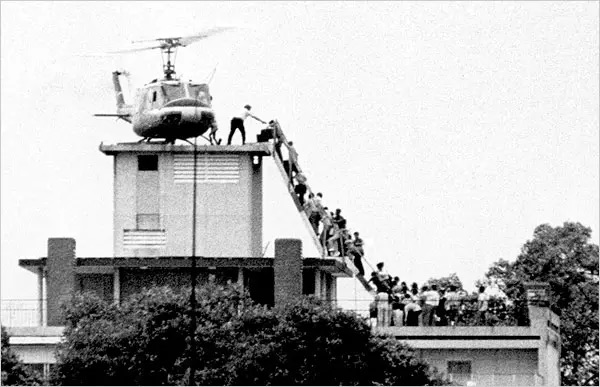
The United States spent more than a decade in Vietnam, deployed more than half a million troops at the height of its commitment, dropped more tons of ordnance on that country than were dropped by all sides combined in the Second World War, and lost. The defeat was not primarily military — American forces never lost a major set-piece battle in Vietnam, and they inflicted casualties on the opposing forces at ratios that would, in any previous war, have constituted decisive victory. The defeat was political, strategic, and ultimately moral: a failure at the highest levels of American government to understand what the war was, who the enemy was, what the Vietnamese people wanted, and what winning would actually have required. The consequences of that failure — the 58,000 American dead, the three million Vietnamese dead, the generation of domestic division, the long shadow cast over American foreign policy — endure decades after the last helicopter lifted from the roof of the American embassy in Saigon.
The origins of American involvement in Vietnam lie not in the Cold WarCold War The geopolitical and ideological confrontation between the United States and the Soviet Union that dominated global politics from 1947 to 1991. It was fought not through direct military conflict between the superpowers but through proxy wars, arms races, espionage, and ideological competition across the developing world. The Cold War began before the Second World War had fully ended: American and Soviet disagreements over the post-war order in Europe were visible at Yalta in February 1945 and had hardened into open confrontation by 1947, when the Truman Doctrine committed the United States to resisting Soviet expansion and the Marshall Plan began binding Western Europe to American economic leadership. The term itself was popularised by journalist Walter Lippmann in 1947, capturing the essential quality of a conflict that neither side could allow to become hot — because both possessed nuclear weapons capable of annihilating the other’s cities. The resulting stalemate was managed through deterrence, alliance systems (NATO in the West, the Warsaw Pact in the East), and the deliberate avoidance of direct superpower confrontation even while both sides fought intense proxy wars in Korea, Vietnam, Angola, Afghanistan, and dozens of other theatres. The Cold War was simultaneously a strategic competition and an ideological one: each side claimed to represent the future of humanity, and each used development aid, propaganda, cultural diplomacy, and covert action to advance its model in the non-aligned world. It ended not with a military defeat but with the internal collapse of the Soviet system between 1989 and 1991. The Cold War’s most important characteristic was its globality: what began as a European dispute about occupation zones became a worldwide competition that shaped the politics of every continent. For the United States, it justified interventions that overthrew democratic governments (Iran 1953, Guatemala 1954, Chile 1973) on the grounds that any leftist government was a Soviet beachhead; for the Soviet Union, it justified the crushing of reform movements within its own bloc (Hungary 1956, Czechoslovakia 1968) on the grounds that any deviation threatened the socialist camp. The Cold War’s legacy is therefore not only the fall of the Berlin Wall but the long list of democracies destroyed, developmental alternatives foreclosed, and civil wars fuelled in the name of containing the other side. The Third World paid the price for a confrontation between two powers that never actually fought each other. but in the French colonial period that the Cold War complicated and eventually terminated. Vietnam had been part of French Indochina since the late nineteenth century, administered with the combination of economic extraction and cultural paternalism that characterised French colonialism across its empire. Ho Chi Minh — poet, revolutionary, and communist — had founded the Viet MinhViet Minh Full Description:The Viet Minh (League for the Independence of Vietnam) was the primary political and military organization resisting French colonial return. Unlike a standard political party, it operated as a “united front,” prioritizing national liberation over class struggle during the early stages of the conflict. This strategy allowed them to rally peasants, intellectuals, and workers alike under the banner of patriotism. Critical Perspective:The success of the Viet Minh challenged the Western narrative that the war was merely a proxy battle of the Cold War. It demonstrated the power of a “people’s war,” where political education and mass mobilization proved more decisive than superior military technology. However, critics note that as the war progressed, the leadership ruthlessly eliminated non-communist nationalist rivals to consolidate absolute power., the Vietnamese independence movement, in 1941, and had spent the Second World War fighting both Japanese occupation and, intermittently, French reassertion. His declaration of Vietnamese independence in September 1945, which opened with a quotation from the American Declaration of Independence, was a deliberate appeal to the democratic superpower he hoped would support Vietnamese self-determinationSelf-Determination Full Description:Self-Determination became the rallying cry for anti-colonial movements worldwide. While enshrined in the UN Charter, its application was initially fiercely contested. Colonial powers argued it did not apply to their imperial possessions, while independence movements used the UN’s own language to demand the end of empire. Critical Perspective:There is a fundamental tension in the UN’s history regarding this term. While the organization theoretically supported freedom, its most powerful members were often actively fighting brutal wars to suppress self-determination movements in their colonies. The realization of this right was not granted by the UN, but seized by colonized peoples through struggle. against French colonial restoration.
The French War and the American Inheritance
The appeal was unsuccessful. The Truman administration, committed to rebuilding European allies against the Soviet threat, could not afford to alienate France, and the French government had made clear that its willingness to participate in the emerging Atlantic security architecture was conditional on American acquiescence in its colonial restoration. American financial support for the French war in Indochina began in 1950, the year of the Korean WarKorean War korean-war The war fought on the Korean peninsula from June 1950 to July 1953 between North Korea (supported by China and the Soviet Union) and South Korea (supported by a US-led UN coalition). It ended in an armistice along roughly the pre-war border, killing approximately three million people and leaving the peninsula divided to this day. North Korea’s invasion of South Korea on 25 June 1950 transformed the Cold War from a European confrontation to a global one. The UN Security Council — able to act only because the Soviet Union was boycotting it over China’s seat — authorised military intervention; the resulting force was 90% American under General Douglas MacArthur. After initial North Korean advances pushed South Korean and American forces to a small perimeter around Pusan, MacArthur’s amphibious landing at Inchon in September 1950 turned the tide dramatically, and UN forces advanced toward the Chinese border. China’s intervention in October 1950 — with approximately 300,000 troops — pushed UN forces back south of Seoul before the front stabilised roughly along the 38th Parallel. MacArthur publicly advocated extending the war to China, was dismissed by Truman, and subsequent negotiations focused on returning to the pre-war border. The armistice of July 1953 created the demilitarised zone along the 38th Parallel that remains one of the most militarised borders in the world. The war killed approximately 36,000 Americans, an estimated 2-3 million Koreans (the proportion of civilians was extraordinarily high), and over 180,000 Chinese soldiers. It left the Korean question unresolved: no peace treaty was ever signed, and the armistice remains technically in force. The Korean War is both a Cold War success story and a demonstration of the Cold War’s human costs. American intervention preserved South Korean sovereignty and the conditions under which South Korea eventually became a democracy and one of the world’s most successful economies. The cost was three years of devastation, a million civilian deaths, and a division that separated families for generations. The war also established the template for subsequent American interventions: a UN mandate providing international legitimacy, American military leadership, allied contributions, and a political objective (containing communist expansion) whose relationship to the military objectives (defeating the North Korean army) was always contested. MacArthur’s dismissal — which established the principle of civilian control over a general publicly challenging the president — is one of the most important constitutional moments in American Cold War history.’s outbreak, by which point the Truman administration had decided that Ho Chi Minh’s communist identity outweighed his nationalist credentials. It was the first of many American decisions about Vietnam made on the basis of a framework that consistently prioritised Cold War ideology over the political reality of Vietnamese nationalism.
The French were defeated at the Battle of Dien Bien PhuDien Bien Phu The decisive battle of the First Indochina War fought from March to May 1954, in which Viet Minh forces surrounded and defeated a French garrison in a remote valley in northwest Vietnam. The French defeat ended their presence in Indochina and directly preceded American involvement.
The battle at Dien Bien Phu was a French attempt to draw the Viet Minh into conventional battle on ground chosen by the French — a fortified camp in a valley they planned to supply by air. General Henri Navarre believed the Viet Minh lacked the artillery and logistics to mount a sustained siege. He was wrong on both counts. Viet Minh General Vo Nguyen Giap moved artillery pieces by human effort over jungle mountains, positioning them on the high ground overlooking the French positions and neutralising the airstrip that was the camp’s lifeline. The siege lasted 57 days, from March 13 to May 7, 1954 — the day before the Geneva Conference opened to discuss Indochina’s future. The French garrison of approximately 16,000 men was annihilated: 2,293 killed, 5,195 wounded, nearly 9,000 taken prisoner (of whom fewer than half survived captivity). The defeat shocked France, where the war had already become deeply unpopular, and precipitated both the negotiations at Geneva that partitioned Vietnam and the political crisis that eventually ended the Fourth Republic. The lesson that the United States chose not to learn from Dien Bien Phu — that the Viet Minh’s capacity for sustained revolutionary warfare could defeat a technologically superior conventional force — would be re-demonstrated at great cost over the following twenty years.
Dien Bien Phu represents the moment when the post-1945 order of European colonial power was shown to be definitionally over. A European army, equipped with modern weapons and air support, had been defeated by a largely peasant force whose main advantage was the willingness of its soldiers and support network to suffer extraordinary hardship in pursuit of national liberation. The psychological impact across the colonial world was enormous: if France could be defeated in Vietnam, the claim that European military superiority made empire impregnable was finished. The battle’s significance was not just military but epistemological — it demonstrated that the model of war that the anti-colonial movements had developed, combining political mobilisation of the population with guerrilla and ultimately conventional military strategy, could defeat a colonial power that refused to accept the political costs of prolonged counter-insurgency. The United States would spend the next two decades refusing to absorb this lesson. in May 1954, a siege in which Viet Minh forces under General Vo Nguyen Giap surrounded and overwhelmed a heavily fortified French military base that had been intended to draw the guerrillas into a set-piece battle France expected to win. The Geneva AccordsGeneva Accords Full Description:The Geneva Accords were the diplomatic conclusion to the war on the battlefield. Major powers, including the Soviet Union and China, pressured the Vietnamese revolutionaries to accept a partition of the country rather than total victory, fearing a wider escalation that could draw in the United States.
Critical Perspective:This agreement represents the betrayal of local aspirations by Great Power politics. The division of the country was an artificial construct imposed from the outside, ignoring the historical and cultural unity of the nation. By creating two opposing states, the Accords did not bring peace; rather, they institutionalized the conflict, transforming a war of independence into a civil war and setting the stage for the disastrous American intervention that followed. that followed in July 1954 provisionally divided Vietnam at the 17th parallel17th Parallel
Full Description:The provisional military demarcation line established by the Geneva Accords. It split Vietnam into a Communist North and a pro-Western South. Intended to be temporary, it hardened into a permanent geopolitical border that defined the next two decades of war. The 17th Parallel was the physical manifestation of the Cold War stalemate. North of the line, the Viet Minh consolidated a socialist state; south of the line, the US and France propped up an anti-communist regime. The demilitarized zone (DMZ) surrounding it became the most heavily militarized strip of land in the world.
Critical Perspective:This border represents the “betrayal” of Geneva. Despite controlling vast swathes of the country south of this line, the Viet Minh were pressured by their Soviet and Chinese allies to withdraw behind it to avoid provoking the United States. It illustrates how the territorial integrity of small nations is often carved up to satisfy the strategic anxieties of Great Powers.
Read more, with Ho Chi Minh’s Democratic Republic of Vietnam in the north and a French-backed government in the south, pending national elections in 1956 that were intended to reunify the country. The Eisenhower administration refused to sign the Accords. American intelligence assessments conceded that Ho Chi Minh would win any free election by a substantial majority — Eisenhower later acknowledged this in his memoirs, estimating 80 per cent — and the administration had no intention of permitting that outcome.
What the United States did instead was build a state. The government of Ngo Dinh Diem in South Vietnam, which was authoritarian, Catholic, and dependent on American support from its first day, was presented to the American public as a democracy worth defending. The 1956 elections were never held. American military advisers began training the Army of the Republic of Vietnam (ARVN). The National Liberation Front — the Viet CongViet Cong viet-cong The American and South Vietnamese term for the communist insurgent forces fighting within South Vietnam, formally known as the National Liberation Front. Combining former Viet Minh cadres, local recruits, and North Vietnamese infiltrators, they conducted guerrilla warfare against the South Vietnamese government and American forces. The National Liberation Front of South Vietnam was founded in December 1960, drawing on the networks of former Viet Minh fighters who had remained in the south after the 1954 Geneva partition, supplemented by new recruits radicalised by the repressive anti-communist campaign of the Diem government. The term ‘Viet Cong’ — Vietnamese Communist, used disparagingly — was employed by the South Vietnamese government and adopted by the American military rather than by the organisation itself, which used the NLF designation. At the movement’s core were southern cadres who had genuine political roots in the rural communities they organised; around this core were North Vietnamese-trained organisers and, increasingly from the mid-1960s, regular North Vietnamese Army units who fought alongside and increasingly supplanted the southern guerrillas. The Tet Offensive of 1968 was militarily catastrophic for the NLF: the southern infrastructure that had been built over a decade was exposed and largely destroyed, shifting the military burden increasingly to northern forces. After 1975, the NLF’s political representatives in the provisional revolutionary government found themselves marginalised within the unified Vietnam as Hanoi’s structures absorbed the south. The Viet Cong’s history illustrates a recurring pattern in communist revolutionary movements: the tension between local revolutionary movements with genuine grassroots foundations and party leaderships that subordinate them to strategic priorities determined elsewhere. The southern cadres who built the NLF’s political infrastructure over years of patient organising in Vietnamese villages had different experiences, different political cultures, and in some cases different political aspirations from the Hanoi leadership that eventually directed the war. After victory, the southerners’ organisations were dissolved into the northern party structure, and many former NLF members found themselves effectively excluded from the unified state they had fought to create. This outcome — which was not unique to Vietnam — raises questions about the relationship between revolutionary movements and the states that emerge from their victories, and about the capacity of revolutionary ideology to accommodate the genuine political diversity of the societies it claims to represent., as the Americans called them — began organising armed resistance in the south from the late 1950s, supported by the north and by the popular resentment that Diem’s repressive governance reliably generated.
Escalation: The Kennedy and Johnson Years
By the time John F. Kennedy took office in January 1961, the number of American military advisers in Vietnam stood at around 900. By his assassination in November 1963, it had risen to more than 16,000. Kennedy’s intentions for Vietnam remain genuinely contested, but the debate is ultimately academic, because the man who succeeded him had no such ambiguity. Lyndon Johnson was determined not to be the president who lost Vietnam. The political memory of the “loss” of China in 1949 and the congressional fury it had generated was still vivid in Democratic Party politics, and Johnson had observed at close quarters what McCarthyismMcCarthyism Full Description The wave of anti-communist suspicion, accusation, and persecution that swept the United States in the late 1940s and early 1950s, associated with Senator Joseph McCarthy of Wisconsin. McCarthy claimed — without evidence — that the US government and army were riddled with communist agents. The period saw the blacklisting of suspected communists from Hollywood and academia, loyalty investigations of federal employees, and the destruction of careers through innuendo. McCarthy was finally discredited during the Army-McCarthy hearings of 1954. Critical Perspective McCarthyism has been so thoroughly discredited that it is easy to forget it enjoyed genuine popular support. The fear of Soviet espionage was not entirely irrational — the Rosenbergs had passed nuclear secrets to the Soviets, and Soviet intelligence had penetrated the US government. McCarthy exploited a real anxiety for political purposes, but the mechanisms he used — guilt by association, demands for loyalty oaths, the destruction of careers without due process — were symptoms of a democratic culture that had partially suspended its own principles in the face of perceived existential threat. had done to the reputations of those accused of insufficient anti-communism.
The Gulf of Tonkin incident of August 1964 provided the pretext for full commitment. An American destroyer, the USS Maddox, was attacked by North Vietnamese torpedo boats on 2 August while conducting intelligence operations in the Gulf of Tonkin; a second attack two days later was at the time reported as confirmed but was almost certainly fabricated — the reports were based on confused radar readings and nervous sonar operators, and the evidence collapsed on examination. Johnson knew the second attack was doubtful even as he used it to request from Congress the Gulf of Tonkin ResolutionGulf of Tonkin Resolution The US Congressional resolution of August 1964 that gave President Johnson authority to use military force in Southeast Asia without a formal declaration of war, following alleged North Vietnamese attacks on American destroyers. It became the legal basis for the entire American military escalation in Vietnam. On 2 August 1964, the USS Maddox, conducting electronic surveillance in the Gulf of Tonkin, was attacked by three North Vietnamese torpedo boats. On 4 August, a second alleged attack was reported — an attack that the evidence strongly suggests either did not occur or was a radar phantom in rough weather conditions. The Johnson administration presented both incidents to Congress as unprovoked attacks on American vessels in international waters, concealing the Maddox’s intelligence-gathering mission and the fact that the second attack was questionable. Congress passed the Gulf of Tonkin Resolution on 7 August 1964 with only two dissenting votes in the Senate, authorising the President to take ‘all necessary measures’ to repel attacks on US forces and prevent further aggression. Johnson used this resolution as the legal authority for the subsequent escalation that would eventually commit over 500,000 American troops to Vietnam. The resolution was repealed in 1971, but by then it had served its purpose: providing a semblance of congressional authorisation for a war that Congress had never formally declared. Declassified documents released in 2005 confirmed what Vietnam-era critics had long argued — that intelligence officials knew the second attack was questionable but did not correct the record before the vote. The Gulf of Tonkin Resolution is the clearest pre-Iraq-2003 example of a manufactured casus belli used to obtain legislative authority for a war that could not have been sold to Congress on its actual terms. The Johnson administration did not want a formal war — that would have required congressional debate, public justification, and international accountability — but wanted the practical authority to escalate. The resolution provided this in the form of a blank cheque. The pattern it established — executive branch manipulation of intelligence about a triggering incident to obtain legislative approval for military action — has recurred often enough to suggest it is a structural feature rather than an aberration of American war-making. The resolution also illustrates the constitutional consequences of institutional complicity: a Congress that allows itself to be deceived and votes 504 to 2 to authorise open-ended military action is not performing its constitutional function, however understandable the political pressures that produced that vote., which authorised the president to take “all necessary measures” to repel attacks and prevent further aggression in Southeast Asia. The resolution passed with two dissenting votes in the Senate. It became the legal basis for the entire American war.
By the end of 1965, 185,000 American troops were in Vietnam. By 1968, the number exceeded 500,000. The strategy, under General William Westmoreland, was one of attrition: to kill North Vietnamese and Viet Cong soldiers faster than they could be replaced, to find and destroy enemy forces, and to demonstrate through superior firepower that the war was unwinnable for the other side. The approach was precisely wrong. The United States was fighting a limited war for limited objectives — the preservation of a South Vietnamese government — against an enemy for whom the war was unlimited, existential, and had already lasted decades against two previous occupying powers. Ho Chi Minh had said, early in the conflict, that the Vietnamese were prepared to fight for twenty years; the Americans were not.
Tet and the Collapse of the Narrative
On 31 January 1968, the first day of the Vietnamese Lunar New Year — Tet — the North Vietnamese Army and the Viet Cong launched simultaneous coordinated attacks on more than a hundred South Vietnamese cities and towns, including the American embassy compound in Saigon, where Viet Cong fighters briefly occupied the grounds before being killed. The attacks were ultimately repulsed with heavy casualties on the attacking side. Militarily, Tet was a failure for the North Vietnamese. Politically, it was a catastrophe for the Americans.
The Johnson administration had spent months assuring the American public that the war was being won, that enemy strength was declining, that there was “light at the end of the tunnel.” The Tet OffensiveTet Offensive tet-offensive The coordinated surprise attacks launched by North Vietnamese and Viet Cong forces on 30 January 1968 against more than 100 South Vietnamese cities and towns, including Saigon. Although the military offensive was repelled with heavy communist losses, its political impact in the United States was decisive — it destroyed public confidence in the official narrative that the war was being won. The Tet Offensive — timed to coincide with the Vietnamese lunar new year — violated the informal ceasefire that normally accompanied the holiday and targeted urban centres that the US military command had described as pacified. The assault on the US Embassy compound in Saigon, where Viet Cong sappers briefly penetrated the compound before being killed, was broadcast live on American television. The battle of Hue — where North Vietnamese forces occupied the imperial capital for 25 days before being driven out at enormous cost — destroyed one of South Vietnam’s most historic cities and produced documented evidence of communist executions of civilians. Khe Sanh, a US Marine base besieged for 77 days, created fears of a second Dien Bien Phu. In military terms, the offensive was a failure for North Vietnam: the expected popular uprising in South Vietnam did not materialise, the Viet Cong suffered catastrophic losses (approximately 40,000 dead), and most objectives were held only briefly before being recaptured. But militarily the offensive was not primarily designed to win territory — it was designed to demonstrate that the Johnson administration’s optimistic briefings were false, that the ‘light at the end of the tunnel’ did not exist. In this psychological and political objective, it succeeded completely. Tet demonstrated that in a democratic society, the relationship between military reality and political reality is mediated by narrative — and that a narrative sustained by institutional credibility can be destroyed in a single news cycle by events visible to television cameras. The ‘credibility gap’ between official optimism and battlefield reality had been building for years; Tet collapsed it in 72 hours. Walter Cronkite’s editorial broadcast from Vietnam on 27 February 1968 — ‘It seems now more certain than ever that the bloody experience of Vietnam is to end in a stalemate’ — reflected and accelerated a shift in establishment opinion that made the war politically untenable. Johnson announced he would not seek re-election on 31 March 1968. The lesson American military strategists drew — that the media had lost the war by undermining public support for a militarily sound effort — misread the causality. The problem was not that the media showed the gap between official claims and reality; the problem was the gap itself, and the institutional decisions to maintain false optimism in official communications that made the gap unsustainable when reality arrived. demonstrated, to an audience watching the attack on the American embassy on their television screens, that the enemy was capable of attacking anywhere in South Vietnam simultaneously, that the pacification campaigns had failed to reduce NLF infrastructure, and that the official narrative of progress was false. Walter Cronkite, the CBS News anchor whose measured authority had given him an almost unprecedented public trust, flew to Vietnam after Tet and returned to deliver an editorial conclusion — broadcast on 27 February 1968 — that the war was a stalemate that could not be won. When Johnson watched the broadcast, he reportedly said that if he had lost Cronkite, he had lost middle America. He withdrew from the presidential race a month later.
The My Lai massacre, which took place on 16 March 1968 but was not reported publicly until November 1969, was the most devastating single document of what the war was doing to the people fighting it and the people it was being fought among. A unit of American soldiers under Lieutenant William Calley entered the village of My Lai in Quang Ngai province and killed between 347 and 504 unarmed civilians — men, women, children, infants — over the course of several hours. The massacre was covered up by the Army chain of command for more than a year, and when it became public it produced a crisis that went beyond the specific crime to the nature of the war itself: a war in which civilian populations were indistinguishable from the enemy, in which the strategic logic required destroying villages in order to save them, in which the metrics of success had become divorced from any meaningful reality. Calley was convicted of murder in 1971. His sentence was commuted by Nixon.
Vietnamisation and Withdrawal
Richard Nixon, who won the 1968 election in part on the promise of a secret plan to end the war, did not end the war. What his administration did was Vietnamisation — the gradual transfer of combat responsibility to the ARVN while American troop numbers were reduced — combined with the escalation of bombing, including the secret bombing of Cambodia that began in March 1969, which was concealed from Congress and the American public for fourteen months. The logic of Vietnamisation was that the United States could withdraw without being seen to have lost, by leaving behind a South Vietnamese military capable of defending its government. The logic depended on the South Vietnamese government being capable of generating the political loyalty that would motivate its military to fight, and it never was.
The anti-war movement that had been building since the mid-1960s reached its fullest expression in the years after Tet and My Lai. The Kent State shootings of May 1970, in which National Guard troops killed four students protesting the Cambodia invasion at Ohio’s Kent State University, produced the most vivid single image of the domestic war within the war. The Paris Peace Accords, signed in January 1973, provided for American withdrawal and a ceasefire. The ceasefire did not hold. In the absence of American military support, the South Vietnamese government progressively lost ground over the following two years. In April 1975, as North Vietnamese forces closed on Saigon, the American evacuation — Operation Frequent Wind — lifted the remaining Americans and as many Vietnamese allies as could reach the embassy rooftop by helicopter. On 30 April 1975, a North Vietnamese tank crashed through the gates of the Presidential Palace in Saigon. Vietnam was unified under communist government the following year.
The Reckoning
The scale of the destruction was staggering. More than 58,000 Americans died; more than 300,000 were wounded. Vietnamese casualties — military and civilian, North and South — are estimated at between one and three million dead; the range reflects the impossibility of accurate counting, not confidence in the lower figure. The physical landscape of Vietnam was transformed: the carpet bombing, the defoliation by Agent OrangeAgent Orange Full Description A herbicide and defoliant used by the US military during the Vietnam War to destroy jungle cover and deny food crops to enemy forces. Between 1961 and 1971, approximately 19 million gallons of Agent Orange were sprayed over South Vietnam. It contained dioxin, a highly toxic compound now known to cause cancer, birth defects, and other severe health conditions. An estimated three million Vietnamese and over 150,000 American veterans have suffered from health conditions linked to Agent Orange exposure. Critical Perspective Agent Orange represents a use of environmental warfare whose consequences have continued for generations. The Vietnamese government estimates that dioxin contamination remains in affected areas sixty years after the war. American veterans’ struggles to gain recognition for Agent Orange-related health conditions, which the US government initially resisted, mirror broader patterns in which the human costs of military decisions are borne by individuals while being denied by institutions., the cratering of agricultural land created an ecological catastrophe whose effects continued long after the fighting ended. Agent Orange contained dioxin compounds that caused cancers and birth defects in the Vietnamese population for decades.
The political consequences in the United States were equally lasting. The “Vietnam syndrome” — the public resistance to military intervention abroad that succeeded the war — shaped American foreign policy for a generation, producing the reluctance to commit ground troops that manifested in Lebanon in 1983 and Somalia in 1993. The War Powers Resolution of 1973, passed over Nixon’s veto, was Congress’s attempt to reassert its constitutional authority over the use of military force.
The veterans who returned found a country that could neither celebrate nor properly mourn what they had done and what had been done to them. The literature, film, and testimony they produced — from Tim O’Brien’s The Things They Carried to the wall of the Vietnam Veterans Memorial in Washington, designed by Maya Lin as a reflective surface in which the names of the dead appeared alongside the viewer’s own face — constitute one of the most searching bodies of work about the experience of war produced in the twentieth century.
What Vietnam demonstrated, in terms that no subsequent generation of American policymakers has been able entirely to ignore and none has been able to fully absorb, was the limit of military power as an instrument of political transformation. The United States had the capacity to destroy but not to build; to kill but not to create the conditions under which a legitimate government could emerge and sustain itself. The lesson was not that military power was useless but that it was insufficient — that wars fought without achievable political objectives, against enemies more committed than oneself, in support of governments unable to generate the loyalty of their own people, could not be won regardless of the ordnance available. It was a lesson that subsequent adventures would prove had been learned, at best, partially.


Leave a Reply