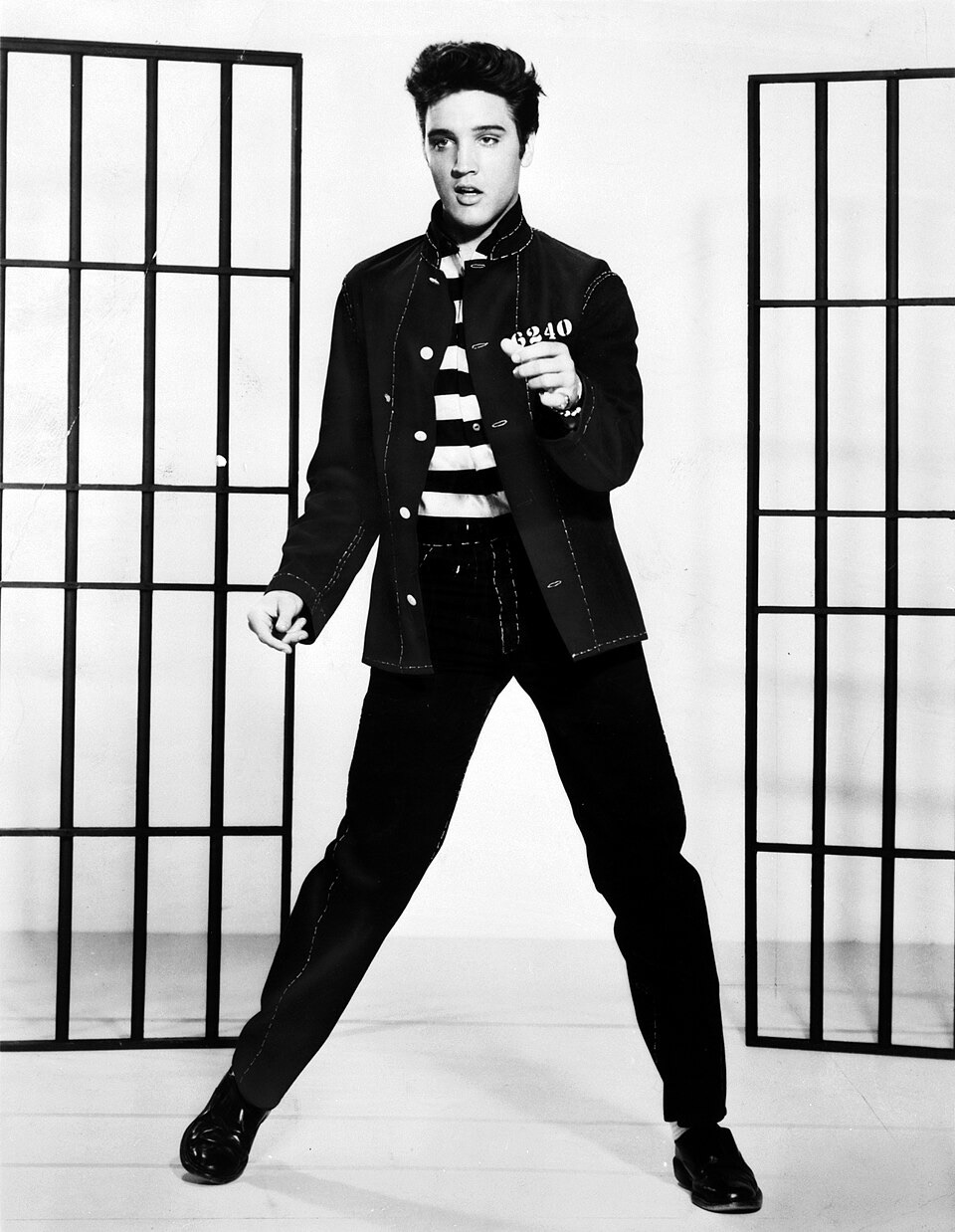

Rock and roll did not begin on the day Elvis Presley walked into Sun Studio in Memphis in the summer of 1954 and recorded his first single. It had been building for decades in the Black churches and juke joints of the American South, in the blues of the Mississippi Delta and the jump bands of the urban North, in the gospel choirs that made Saturday night and Sunday morning into expressions of the same ecstatic human impulse. What changed in 1955 was not the music but the audience — and, behind the audience, the industry that decided white teenagers were ready to buy it. The history of rock and roll begins there, in that decision, with all its commercial calculation and all its unintended cultural consequences, none of which anyone involved had the capacity to foresee.
The word “rock and roll” itself was Black slang, a sexual euphemism that the disc jockey Alan Freed began using on his Cleveland radio show in the early 1950s as a way of playing rhythm and blues records for an audience he was carefully not describing as Black. The music he was programming — the urgent, syncopated, electrically amplified sound being made by artists like Muddy Waters, Howlin’ Wolf, and Little Richard — was not new. What was new was the medium, and the market. The postwar economic boom had created, for the first time in American history, a mass class of teenagers with disposable income and no particular obligation to spend it on what their parents spent their money on. The 45rpm single, introduced in 1949, was cheap, portable, and perfectly suited to a bedroom turntable. Radio stations discovered that teenagers would listen for hours to find their song. The music industry, which had assumed that popular taste ran to the crooning ballads of Perry Como and Patti Page, began to notice that something else was happening.
The Roots and the Rip-Off
The mechanism by which Black music became rock and roll is inseparable from the racial economy of mid-century America. Rhythm and blues had a well-established commercial infrastructure by the early 1950s, with independent labels — Chess in Chicago, Atlantic in New York, Specialty in Los Angeles — recording Black artists for Black audiences on what the industry called “race records.” These records charted on the Billboard R&B chart, which was the polite postwar rebrand of the race chart, and they were rarely played on the mainstream pop radio stations that reached white suburban homes.
What changed was the cover version economy. When a Black artist recorded a song that attracted white teenage listeners — usually via the intermediary of a white disc jockey willing to play R&B — a major label would commission a white artist to record a cleaned-up version of the same song for the mainstream market. The original disappeared; the cover prospered. Pat Boone’s version of Little Richard’s “Tutti Frutti” outsold the original on the pop charts in 1956. Georgia Gibbs covered LaVern Baker’s recordings with such commercial aggression that Baker petitioned Congress for copyright protection. The process was systematic and largely legal: copyright law at the time offered minimal protection to the original composers, and the majors had the distribution networks that the independents could not match.
Chuck Berry, who emerged from Chess Records in 1955 with “Maybellene,” was among the Black artists who broke through to the white teenage market directly rather than through the cover version filter, partly because his music was already being packaged with white teenagers in mind — his lyrics were full of high schools, drive-ins, and Fords, the landscape of white teenage aspiration — and partly because his guitar playing, with its insistent two-note riffs and showmanlike athleticism, was simply too distinctive to be adequately imitated. Fats Domino, Little Richard, and Bo Diddley followed through the same narrow opening. Their success was real and unprecedented; it was also, structurally, the exception to a rule that kept the wealth flowing toward white performers and white-owned companies.
Elvis and the Threshold Moment
Elvis Presley was a white boy from Mississippi who had grown up listening to Black gospel and rhythm and blues, and whose recordings for Sam Phillips at Sun Records between 1954 and 1955 captured something that Phillips had been looking for: the emotional immediacy of Black musical performance in a package that white audiences could receive without the cultural anxiety that Black performers still reliably triggered. When RCA bought Presley’s contract from Sun in November 1955 for $35,000 — at the time unprecedented in the industry — they were not buying a musical phenomenon but a distribution opportunity.
The Ed Sullivan Show appearances of 1956, watched by an audience estimated at 60 million, were the threshold moment: the point at which rock and roll stopped being a musical subculture and became a mass cultural event, something that parents argued about at dinner tables and ministers denounced from pulpits. The moral panic that accompanied Presley’s rise — focused on his pelvis, on the sexuality he projected, on the way teenage girls screamed in ways that alarmed their mothers — was, in retrospect, a panic about the precise thing that rock and roll was transmitting: the emotional directness, the bodily physicality, the refusal of inhibition, of the Black musical tradition from which it came. The white cultural establishment was objecting to its own teenagers adopting the aesthetic values of a culture it had always treated as inferior, and the objection contained an unacknowledged acknowledgment of what those values were.
The British Invasion and the Feedback Loop
By the early 1960s, American rock and roll had already begun to be smoothed back into the pop mainstream from which it had briefly escaped. Presley had been drafted into the Army in 1958 and returned as a more manageable, studio-polished entertainer. The spontaneous energy of the first wave had been processed into a product. It fell to a group of young musicians in Liverpool, who had spent the late 1950s obsessively listening to Chuck Berry, Little Richard, and Buddy Holly imports at a time when American originals were simply unavailable in the UK, to return those influences transformed.
The Beatles arrived in the United States in February 1964 for their Ed Sullivan appearance to an audience of approximately 73 million people — more than Sullivan had drawn for Elvis eight years earlier. What they brought was not a British version of American rock but American rock refracted through the specific conditions of postwar British youth culture: the skiffle craze, the coffee bars, the sardonic wit that was itself a specifically British class response to the authority culture of the 1950s. Their songs were tighter, more harmonically sophisticated, and — crucially — more self-authored than anything that had come before in mainstream pop. The writing partnership of Lennon and McCartney was the engine of a commercial phenomenon, but it was also the beginning of a new expectation: that rock musicians would write their own material, that the music would be an expression of something personal rather than a performance of songs produced by the Tin Pan Alley factory system.
The Rolling Stones, who followed the Beatles across the Atlantic in the same year, were drawing on a different well — the Chicago electric blues of Muddy Waters and Robert Johnson, which they pursued with a deliberate primitivism that was in some respects a more aggressive appropriation of Black American form than anything the first generation of white rock artists had attempted. The British Invasion had a strange paradox at its centre: British musicians making American music more popular in America than American musicians currently could, while returning the music’s Black origins to white American teenagers who had been culturally cut off from them.
The Sixties Apotheosis
Between 1964 and 1970, rock music expanded from a commercial entertainment form into something that understood itself — and was understood by its audience — as a cultural and even political force. Bob Dylan’s move from acoustic folk to electric rock in 1965, bitterly contested at the time by folk purists who saw amplification as a betrayal of protest authenticity, was in retrospect the decisive signal that the music’s ambitions had outgrown any single genre. His albums of the mid-1960s — Bringing It All Back Home, Highway 61 Revisited, Blonde on Blonde — established that rock could carry the weight of literary seriousness, that its lyrics could aspire to the condition of poetry rather than pop formula.
The psychedelic explosion of 1966 and 1967 — Sgt. Pepper, Are You Experienced, the Doors’ debut — was the moment at which rock most explicitly proclaimed its own artistic ambition, and at which the relationship between the music and the counterculture became symbiotic rather than merely adjacent. Woodstock in August 1969 was the ceremonial expression of a generation’s conviction that music was not entertainment but community, not product but truth. Jimi Hendrix was perhaps the most acute demonstration of the contradictions running through the entire enterprise: a Black American musician whose guitar language drew on the blues tradition as completely as anyone working in rock, most famous to a predominantly white audience whose cultural framework treated his Blackness as part of his exotic otherness rather than as the source of the musical vocabulary they were consuming. His performance of “The Star-Spangled Banner” at Woodstock — bending the national anthem into the sonic landscape of Vietnam, making the feedback and the dissonance comment on the violence being conducted in the country’s name — was a moment of genuine political art.
The Industry Absorbs Its Discontents
The rock business of the early 1970s was among the most commercially successful entertainment enterprises in American history, and the relationship between commercial success and the music’s counter-cultural credentials was a tension that the industry managed with remarkable skill. The album replaced the single as the primary commercial unit, which meant longer, more elaborate recordings that required more expensive production. The independent labels that had broken the music were absorbed into major conglomerates. Led Zeppelin, the Who, and the Rolling Stones became stadium acts whose concerts resembled precisely the large-scale, corporate-managed entertainment events that the original rock and roll gesture had been against.
Punk, which erupted in Britain and America in 1976 and 1977, was the most violent reaction against this trajectory: the Sex Pistols and the Clash presenting themselves as a deliberate return to the raw, amateur, three-chord urgency of rock’s origins, explicitly in opposition to the bloated professionalism of what had come before. Punk produced genuinely radical music and genuinely transformative fashion, and it was absorbed by the industry within three years. By 1979 it was a marketing category.
The Global Sound
Rock’s most significant cultural achievement was not any individual recording or movement but its emergence as the first genuinely global popular music. In the Soviet bloc, where Western rock was officially condemned and practically unavailable through licensed channels, it circulated on bootleg tapes and homemade recordings pressed on X-ray plates — a circulation that was simultaneously a form of cultural resistance and a demonstration of the music’s ability to cross political boundaries that nothing else could. The authorities’ attempts to suppress this musical life — most famously in the prosecution of the Czech underground band The Plastic People of the Universe in 1976, which contributed to the formation of the human rights movement Charter 77 — were a backhanded acknowledgment of what they understood to be the music’s power.
In post-colonial Africa and in Latin America, rock’s encounter with local musical traditions produced hybrid forms — Nigerian Afrobeat, Brazilian Tropicália, Congolese rumba — that were not rock but could not have existed without it, and that fed back into the global mainstream in ways that complicated any simple narrative of American cultural imperialism. The music moved in multiple directions at once, and each direction transformed it.
What the Music Was
By the end of the twentieth century, rock and pop had accomplished what no previous popular music had managed: they had created a genuinely global youth culture, a set of aesthetic values and emotional languages that crossed national, class, and linguistic boundaries with an ease that no political movement of the same period had achieved. This was partly the consequence of the American entertainment industry’s extraordinary distribution infrastructure, and partly the consequence of the specific qualities of the music itself — its volume, its physicality, its directness of emotional address, its refusal of the decorum that older musical forms required.
What it had not done, and what its most utopian advocates had claimed it would do, was change the underlying social structures within which it circulated. The industry that produced it remained as profit-driven as any other. The racial inequalities at its foundation — in publishing royalties, in radio play, in critical recognition — were not resolved by the music’s success; they were in some respects reproduced by it. Chuck Berry, who wrote the foundational grammar of rock guitar, died less famous than the Rolling Stones, who had learned that grammar from him. The revolution in feeling that rock and roll promised turned out to be a revolution in feeling that could be purchased for the price of an album, consumed in a bedroom, and left there when the listener grew up. This was not nothing. The capacity of music to provide young people with languages for experiences their culture had not previously given them words for — desire, anger, tenderness, defiance, solidarity — was real, and it left lasting marks on the people who grew up with it and through it. What rock and roll was, in the end, was not a political revolution but a revolution in the vocabulary of the emotions, which is perhaps what it had always been, from the first evening someone in a Mississippi juke joint played a guitar line that made everyone in the room feel less alone.

Leave a Reply