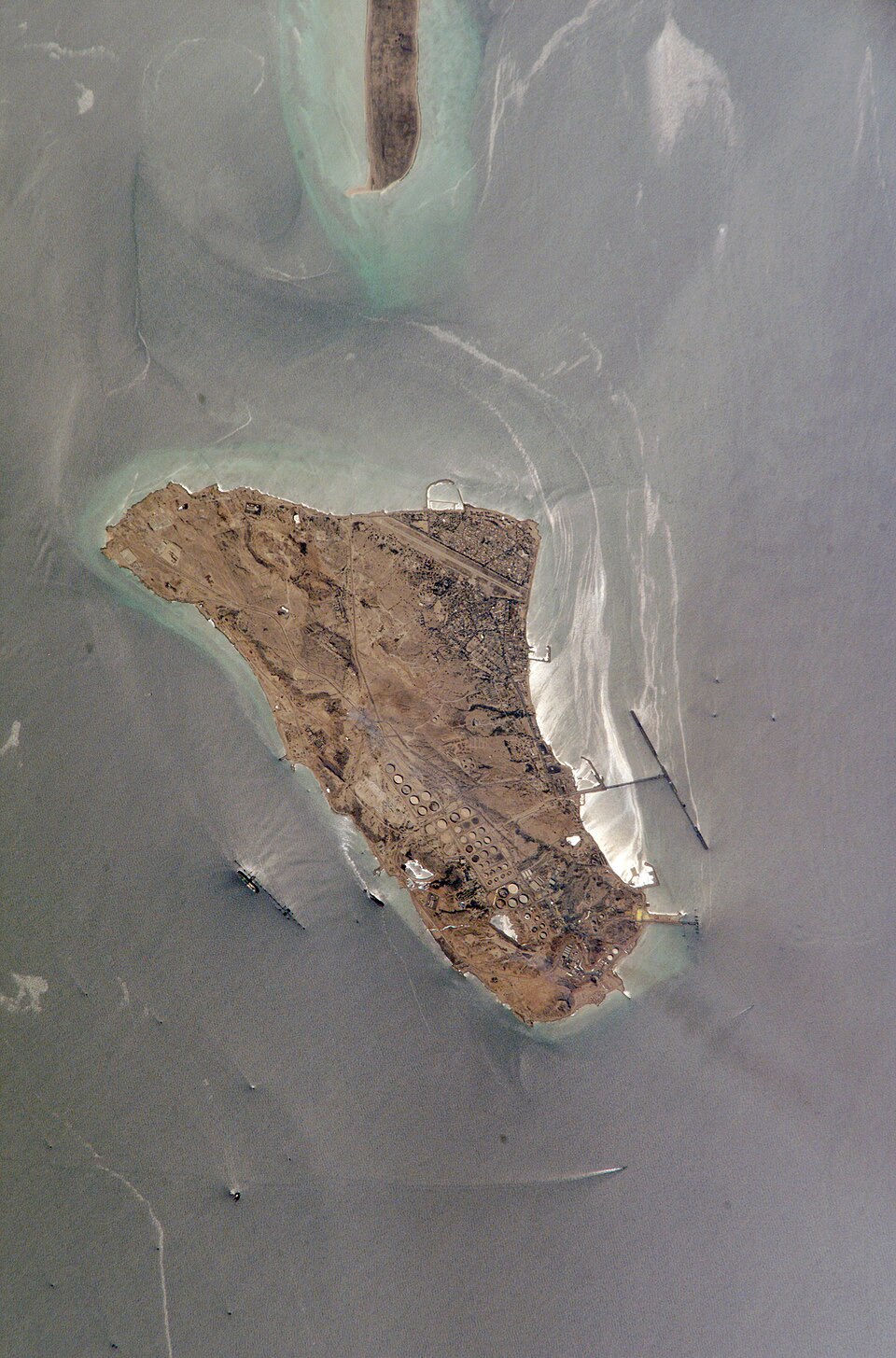

On March 13, 2026, President Donald Trump announced that the United States military had “totally obliterated every MILITARY target in Iran’s crown jewel, Kharg Island”. He deliberately spared the oil infrastructure—for now. But the rhetoric from Washington suggests this may only be the opening act. Administration officials have openly discussed seizing the island, with one source describing a plan to “get them by the balls and use it for negotiations”. Senator Tom Cotton has argued that any Iranian move to close the Strait of Hormuz would signal weakness, with extensive contingency options prepared.
The temptation is understandable. Kharg Island handles approximately 90 per cent of Iran’s crude oil exports, with a storage capacity of 28 million barrels and loading infrastructure capable of handling eight to nine supertankers simultaneously. Oil revenues fund nearly 40 per cent of the Iranian government’s budget. Seizing this asset, the argument runs, would leave the regime economically crippled without requiring American troops to set foot on the Iranian mainland.
But this logic rests on a foundation of strategic amnesia. The United States is contemplating an amphibious seizure of a fortified island within striking distance of a hostile shore, intending to hold it indefinitely against an adversary with demonstrated capacity for asymmetric warfare. The historical record offers two stark warnings: Gallipoli (1915), where a naval campaign intended to force the Dardanelles became a nine-month slaughter, and Dien Bien Phu (1954), where French forces occupying a valley under enemy-held high ground learned that fixed positions without secure supply lines become death traps. America’s military planners would do well to study both—because Kharg Island contains the worst elements of each, combined with twenty-first-century weaponry that makes permanent occupation under fire a strategic impossibility.
The Prize: Why Kharg Matters
Kharg Island is a small coral outcrop roughly 25 kilometres off Iran’s western coast, less than half the size of Manhattan. Its strategic significance derives from geography and geology. The Iranian mainland’s sloping shoreline prevents supertankers from docking in deep water; Kharg’s long jetties provide the necessary access. Pipelines carry crude from Iran’s major fields—Ahvaz, Marun, Gachsaran—to storage tanks on the island, where vessels load for export. The terminal can handle approximately 7 million barrels per day and load multiple ultra-large crude carriers simultaneously.
Analysts describe Kharg as Iran’s energy “single point of failure”. Its capacity dwarfs all other Iranian export terminals combined. During the Iran-Iraq WarIran-Iraq War
Short Description (Excerpt):A brutal eight-year conflict (1980–1988) initiated by Saddam Hussein’s invasion of Iran. While devastating, the war inadvertently strengthened the Islamic Republic, allowing it to suppress internal dissent under the guise of wartime patriotism.
Full Description:The Iran-Iraq War was one of the 20th century’s bloodiest conflicts, featuring trench warfare and the use of chemical weapons. Saddam aimed to seize oil-rich territory and crush the revolutionary threat next door. Instead, Iran mobilized a massive volunteer force (“human waves”) fueled by religious fervor to defend the revolution.
Critical Perspective:Khomeini famously called the war a “divine blessing.” It allowed the regime to militarize society and label any political opposition as treason. The war forged the identity of the Islamic Revolutionary Guard Corps (IRGC) and entrenched the narrative of Iran as a besieged fortress of Islam fighting against a corrupt world, a narrative that sustains the state to this day.
Read more (1980–1988), Iraqi forces repeatedly bombed the island, yet it remained largely operational; damage was typically repaired quickly, demonstrating that disabling it would require sustained, large-scale attacks. This resilience is precisely why the island now commands Washington’s attention.
The economic logic for seizure appears compelling. Control Kharg, and you control the regime’s cash flow. As retired General Jack Keane put it, such a move would effectively put Iran in “checkmate,” given that oil revenues constitute “50% of their budget, 60% of the revenue, 80, 90% of the distribution points for their oil”. The White House’s National Energy Dominance Council, led by adviser Jarrod Agen, has hinted that Kharg is central to Operation Epic Fury’s rationale.
There is even a historical echo that proponents find encouraging. Earlier in 2026, after US forces captured Venezuelan leader Nicolás Maduro, Washington took control of the country’s crude trade by intercepting and rerouting tankers. The Kharg proposal extends this logic: control the terminal, and you control the exports, preserving the infrastructure for a future post-conflict government while denying revenue to the current regime.
But this analogy collapses under scrutiny. Venezuela’s oil infrastructure lies within the Western hemisphere, far from hostile shores. Kharg sits fifteen miles from Iran, within easy range of ballistic missiles, drones, and fast-attack boats. The regime that loses Kharg would not simply accept its fate. As one retired admiral observed, “If we seize Kharg Island, they’re going to turn off the spigot on the other end. It’s not like we control their oil production”.
The First Unlearned Lesson: Dien Bien Phu and the Fallacy of the Fortified Enclave
The French defeat at Dien Bien Phu in 1954 remains one of history’s great military miscalculations. General Henri Navarre, seeking a decisive victory against the Viet MinhViet Minh Full Description:The Viet Minh (League for the Independence of Vietnam) was the primary political and military organization resisting French colonial return. Unlike a standard political party, it operated as a “united front,” prioritizing national liberation over class struggle during the early stages of the conflict. This strategy allowed them to rally peasants, intellectuals, and workers alike under the banner of patriotism. Critical Perspective:The success of the Viet Minh challenged the Western narrative that the war was merely a proxy battle of the Cold War. It demonstrated the power of a “people’s war,” where political education and mass mobilization proved more decisive than superior military technology. However, critics note that as the war progressed, the leadership ruthlessly eliminated non-communist nationalist rivals to consolidate absolute power., ordered his forces to occupy a valley in northwestern Vietnam. The logic seemed sound: establish a fortified base astride enemy supply lines, draw the Viet Minh into conventional battle, and destroy them with superior French firepower and air support. The base sat 120 miles from the nearest French supply depot, but Navarre believed airpower alone could sustain his garrison.
His intelligence officers made three fatal assumptions. First, they believed the Viet Minh possessed no heavy artillery capable of reaching the valley. Second, even if they did, the surrounding mountains made it impossible to position guns overlooking the French positions. Third, the garrison’s supply lines, dependent on a single airstrip, could be maintained indefinitely.
All three assumptions proved catastrophically wrong. General Võ Nguyên Giáp mobilized 60,000 troops who manually hauled disassembled artillery pieces up steep jungle slopes. Thousands of porters carried ammunition and supplies on bicycles along hidden trails. When the Viet Minh guns opened fire on March 13, 1954, the first barrage disabled the airstrip, immediately crippling French resupply. French artillery positions in the valley were methodically destroyed from above. Over fifty-seven days, Giap’s forces overran the strongpoints one by one. On May 7, more than 16,000 French troops surrendered. The defeat ended French colonial rule in Indochina.
The parallels to Kharg Island are unmistakable. Like the French at Dien Bien Phu, American forces would occupy a fixed position within range of hostile shores. Like the French, they would depend on sea and air supply lines vulnerable to interdiction. And like the French, they would face an adversary with demonstrated capacity to employ asymmetric tactics, including ballistic missiles, drones, and fast-attack craft, against precisely such targets.
Giap’s formula for victory at Dien Bien Phu was simple: isolate the enemy, cut supply lines, position artillery on high ground, and accept massive casualties to achieve victory. The French learned this lesson through defeat. The Americans should have learned it through observation—because fourteen years later, Giap tried the same tactics against US Marines at Khe Sanh, and failed.
Why Khe Sanh Is Not Kharg
In January 1968, Giap deployed two divisions—the 304th and 325th, both veterans of Dien Bien Phu—to surround the Marine base at Khe Sanh. The parallels seemed ominous. A remote valley, a fortified garrison, a determined enemy holding the high ground. President Lyndon Johnson reportedly kept a sand table model of Khe Sanh in the White House Situation Room, obsessively tracking the siege.
But the Marines had studied Dien Bien Phu. Unlike the French, they deliberately occupied the high ground, holding Hills 861, 861A, and 881 South. They positioned 175mm guns capable of counter-battery fire against North Vietnamese artillery. Critically, the base sat only 28 miles from major American supply bases, compared to Dien Bien Phu’s total isolation.
Most importantly, American airpower in 1968 bore no resemblance to French airpower in 1954. The French had approximately seventy-five aircraft available for the entire Indochina theater. At Khe Sanh, American forces could call on thousands of aircraft from carriers and air bases throughout South Vietnam, Thailand, and Guam. C-130 transports used low-altitude parachute extraction systems to deliver supplies when landing became impossible. AC-47 “Spooky” gunships dominated the night. Operation Niagara coordinated 24,000 tactical fighter-bomber sorties and 2,700 B-52 strategic bomber runs, dropping more than 75,000 tons of bombs on Giap’s divisions. When North Vietnamese forces moved within a mile of the base, believing B-52s were prohibited from bombing that close, American commanders reduced the safety restriction to half a mile. One strike allegedly destroyed two NVA battalions preparing to assault the base.
After seventy-seven days, the siege was lifted. American casualties numbered approximately 500; North Vietnamese losses were estimated between 5,000 and 10,000. Giap’s tactics had failed.
But this is not a comforting precedent for Kharg. The conditions that enabled American success at Khe Sanh do not apply. The United States would not be relieving a base twenty-eight miles from its supply lines; it would be holding an island fifteen miles from an enemy shore, with the nearest American bases hundreds of miles away. The air supremacy that proved decisive at Khe Sanh would be contested by Iranian air defenses that, while degraded, retain the capacity to threaten supply routes. And crucially, the adversary at Khe Sanh lacked the capacity to strike American bases elsewhere in the region—an option Iran possesses and has explicitly threatened to exercise.
The Second Unlearned Lesson: Gallipoli and the Seduction of Amphibious Solutions
The Gallipoli Campaign of 1915 offers an even more direct warning. The Allied plan was elegant in its simplicity: force the Dardanelles Strait with naval power, seize Constantinople, and knock the Ottoman Empire out of the war. When naval bombardment failed to suppress Ottoman defenses, the Allies shifted to an amphibious landing on the Gallipoli Peninsula. The objective was limited, the forces committed initially modest, and the strategic payoff potentially enormous.
What followed was nine months of grinding stalemate. The landings on April 25, 1915, achieved surprise but failed to secure decisive objectives. Ottoman forces, commanded by Mustafa Kemal, held the high ground and refused to break. The Allies found themselves pinned on narrow beaches, unable to advance, unable to withdraw without catastrophic losses. Supply lines were exposed to enemy fire. Naval gunfire, which planners had assumed would suppress Ottoman defenses, proved ineffective against well-entrenched positions. The campaign ended in evacuation—a tactical success but strategic humiliation.
The lessons of Gallipoli were debated for decades. The British Admiralty drew a counterintuitive conclusion: the campaign had actually proven the feasibility of opposed landings on open beaches. As Admiral Sir T.H. Binney later observed, with evident satisfaction, after the Normandy landings, “Is it too much to claim that the seeds of this successful effort were planted on our failure on 25th April, 1915?”
But this reading conveniently ignores the conditions that made Normandy succeed and Gallipoli fail. Overlord enjoyed overwhelming material superiority, complete air supremacy, and a deception campaign that kept German reserves pinned elsewhere. More importantly, Normandy was a lodgment—a foothold—not a permanent occupation. The objective was to establish a beachhead from which to break into the European continent, not to hold a fixed enclave indefinitely.
Kharg presents the opposite problem. The island is not a gateway to anything; it is a destination. The objective would be to hold it, not to break out from it. And unlike Normandy, where Allied forces could build up overwhelming strength on a broad front, Kharg would be a fixed position within range of Iranian ballistic missiles, drones, and fast-attack craft. The fifteen miles of water that separate the island from the mainland are not a barrier; they are a killing zone.
Iranian Countermeasures: What We Know
The Iranian response to any seizure of Kharg would not be passive. Tehran has already warned that oil and energy infrastructure belonging to firms cooperating with the United States would “immediately be destroyed and turned into a pile of ashes” if Iran’s energy facilities are attacked. This is not empty rhetoric. Iran’s military doctrine, developed over decades of conflict with Iraq and the United States, emphasizes asymmetric retaliation over conventional defense.
The most immediate threat is ballistic missile attack. Iran possesses one of the largest ballistic missile arsenals in the Middle East, including systems capable of reaching Kharg from launch sites deep within the country. While US and Israeli strikes have degraded Iran’s military infrastructure, analysts caution that the regime remains intact and, if anything, has become more hardline, with the Islamic Revolutionary Guard Corps consolidating power. Ballistic missiles are notoriously difficult to eliminate through air power alone; they are mobile, dispersed, and can be concealed.
The second threat is naval. Iranian forces on nearby islands—Abu Musa and the Greater and Lesser Tunbs—already overlook the shipping lanes used by tankers entering and leaving the Gulf. From these positions, they can threaten vessels with missiles, drones, and swarms of fast-attack craft. The Iranian navy has been substantially degraded, with at least thirty vessels reportedly destroyed since Operation Epic Fury began. But degradation is not elimination. Asymmetric forces—small boats, mines, coastal anti-ship missiles—remain in operation.
The third threat is third-party. Iran has cultivated relationships with non-state actors throughout the region, including Hezbollah in Lebanon, Shia militias in Iraq and Syria, and Houthi forces in Yemen. The US embassy in Baghdad has already been struck by a missile during the current conflict. Retaliation for a Kharg seizure would likely expand this targeting to include American facilities, personnel, and allies throughout the Middle East.
The fourth threat is economic. Any disruption to Kharg would immediately reduce global oil supply by approximately 1.5 to 2 million barrels per day. Iran could exacerbate this by mining the Strait of Hormuz, through which one-fifth of global oil supply passes. The resulting price spike would harm not only the United States but also its allies and neutral nations, creating diplomatic pressure to end the operation.
Finally, Iran has threatened to target the oil infrastructure of Gulf states allied with the United States. JP Morgan has warned that any strike on Kharg would “trigger severe retaliation in the Strait of Hormuz or against regional energy infrastructure”. This is the nightmare scenario: a limited operation intended to pressure Tehran expands into a regional war that shatters global energy markets and draws the United States into direct conflict with multiple adversaries.
The Trap of Mission Creep
The most insidious danger of a Kharg seizure is not the initial operation but what follows. Kamran Matin, associate professor of international relations at the University of Sussex, articulates the problem with precision: to protect the island, “they have to also occupy some more land in the mainland, and mission creep will just expand and expand”.
This is not speculation; it is the logic of military geography. Kharg sits fifteen miles off the Iranian coast. Iranian forces on the mainland would possess the ability to fire directly at the island with artillery, rockets, and missiles. The United States would face a choice: absorb constant bombardment, attempt to suppress Iranian fire through air and naval strikes, or seize territory on the mainland to create a buffer. Each option has catastrophic drawbacks.
Constant bombardment would make permanent occupation impossible. Air and naval suppression would require sustained operations that would themselves be vulnerable to Iranian countermeasures. A mainland buffer would require exactly the kind of ground invasion that the Kharg option was designed to avoid. And each step would create new vulnerabilities, new requirements, new escalations. The limited operation becomes a war.
This dynamic has been observed throughout American military history. The Vietnam War began with “advisers” and expanded to half a million combat troops. The Iraq War began with the capture of Baghdad and expanded into an eight-year counterinsurgency. Afghanistan began as a campaign to destroy al-Qaeda and became America’s longest war. Each began with assurances of limited objectives, quick victories, and easy exits. Each ended with the United States trapped, unable to achieve its objectives and unwilling to accept the costs of withdrawal.
Kharg offers the same seductive promise: a quick, decisive blow that will force Tehran to negotiate. The historical evidence suggests a different outcome: a long, bloody commitment that bleeds American power while failing to achieve its political objectives.
Permanent Occupation Under Permanent Fire: A Strategic Impossibility
The phrase “permanent occupation under permanent fire” captures the fundamental absurdity of the Kharg proposal. The United States would be seizing a fixed position within range of an adversary’s weapons, intending to hold it indefinitely while that adversary retains the capacity to attack it constantly. This is not a strategy; it is a trap.
Consider the logistics. Kharg’s facilities, as critical as they are, have no value if they cannot be operated. The island would require a permanent garrison to defend against attack. That garrison would require constant resupply of food, water, ammunition, fuel, and spare parts. Those supplies would have to be delivered by sea or air, both vulnerable to interdiction. Every resupply mission would risk ships or aircraft to Iranian missiles, drones, and fast-attack craft. Every loss would require replacement. Every casualty would require evacuation. The cost of holding Kharg would quickly exceed any conceivable benefit.
Consider the strategic position. The United States would be defending a fixed position while Iran retains the ability to choose when, where, and how to attack. The advantage in any sustained conflict lies with the side that can concentrate force against a point of vulnerability. Kharg, by its very nature, is a point of vulnerability. It is small, isolated, and within range of Iranian territory. Holding it would require the United States to defend a fixed position while Iran retains the strategic initiative.
Consider the political context. The United States is not fighting a declared war with a clear political objective. Operation Epic Fury’s stated goals include destroying Iran’s ballistic missiles and production capacity, demolishing its navy, ending its ability to arm proxies, and preventing it from obtaining a nuclear weapon. These are ambitious objectives that air power alone cannot achieve. Seizing Kharg would commit American ground forces to an open-ended occupation while the underlying political objectives remain unmet. The island would become a hostage to Iranian retaliation, a permanent vulnerability rather than a strategic asset.
Conclusion: The Unravelling
Gallipoli did not destroy the British Empire. Dien Bien Phu did not immediately destroy the French Empire. But each was a wound that never fully healed—a crack in the edifice that, under sufficient pressure, would eventually splinter into collapse. The United States, if it seizes Kharg Island, will not suffer a mere wound. It will invite its own unravelling.
The trap is not that Kharg will be difficult to hold. The trap is that holding it becomes impossible, yet leaving becomes unthinkable. Once American troops are dug in on that coral outcrop, once the first naval vessel is struck by an anti‑ship missile and the first casualties are broadcast to a nation that was promised a swift and surgical operation, the logic of escalation will seize control. To protect the garrison, the United States will strike mainland missile batteries—and discover that new batteries appear overnight. To silence those batteries, it will need to seize coastal footholds—and from those footholds, Iranian forces armed with decades of asymmetric warfare experience will bleed the most powerful military on earth one convoy, one patrol, one outpost at a time.
This is not a war of occupation in the manner of Iraq or Afghanistan. It is worse. It is a war fought on the adversary’s terms, within sight of his shore, with his supply lines intact and America’s stretched across thousands of miles of contested water. Every tanker that approaches Kharg will be a target. Every resupply mission will become a siege‑breaking operation. Every month the flag flies over the island will exact a price in blood, treasure, and strategic attention that the United States cannot afford to pay indefinitely—but will be unable to stop paying without confessing that the entire enterprise was a catastrophic miscalculation.
The deeper damage will be to the architecture of American power itself. Allies in the region, who today provide basing and overflight rights, will watch the Kharg garrison bleed and begin calculating their own survival. They have seen this pattern before: an American promise of a quick victory, followed by a grinding stalemate, followed by a withdrawal that leaves behind chaos and a resurgent adversary. Why would Gulf states risk Iranian retaliation to support an occupation that cannot be sustained? Why would European powers anchor their security to a Washington that tied its prestige to a barren island fifteen miles from an enemy coast and lost?
This is what imperial overstretch looks like in its terminal phase: a strategic decision made in the confidence of overwhelming force, executed with tactical brilliance, and then slowly, inexorably consumed by the geometry of geography and the mathematics of attrition. The United States will win the battle for Kharg Island. It will lose everything that follows. And when, after years of bloodshed and billions of dollars, the last helicopter lifts off from the burning jetties and the American flag is lowered for the final time, the world will draw one conclusion: the empire that could not hold Kharg could hold nothing that mattered.
Gallipoli foreshadowed the end of Britain’s unchallenged naval dominance. Dien Bien Phu marked the moment France ceased to be a colonial power. Kharg Island will be remembered as the place where the American Empire went to die—not in a single cataclysmic defeat, but in a slow, self‑inflicted bleeding that revealed, beyond any doubt, that the age of American supremacy had passed.

Leave a Reply