
“It is a peculiar sensation, this double-consciousness, this sense of always looking at one’s self through the eyes of others, of measuring one’s soul by the tape of a world that looks on in amused contempt and pity.”
The French évolué and the Portuguese assimilado—the “evolved” or “assimilated” African—stood as the supposed crowning achievement of European colonialism. These were individuals who had mastered the colonizer’s language, converted to his religion, and internalized his culture. They were living proof, it was claimed, of the civilizing mission’s success.
This article argues, however, that the creation of this class was colonialism’s most profound and fatal paradox. By educating a select few in the ideals of European liberty and equality while subjecting them to the brutal reality of racial hierarchy, France and Portugal engineered a pervasive crisis of identity. This condition, best understood through W.E.B. Du Bois’s concept of “double consciousness,” produced not loyal intermediaries, but a generation of deeply alienated intellectuals. Their “tortured minds,” caught between the promise of assimilation and the practice of prejudice, became the engine for both reformist critique and revolutionary nationalism, ultimately fueling the ideological fires that consumed the empire.
The Faustian Bargain: Systems of Assimilation and Their Hollow Promise
The policies of France and Portugal, while distinct in flavor, shared a core hypocrisy: they dangled the carrot of full citizenship while upholding a stick of immutable racial difference.
- The French “Mission Civilisatrice”
France offered a theoretical path to assimilation through its ideology of a universal, indivisible republic. An African subject could, in principle, become a citoyen (citizen) by renouncing personal legal status, embracing French culture, and attaining education. This created a stark legal and social dichotomy between the vast majority of sujets (subjects), governed by the oppressive Code de l’indigénat, and a tiny elite of évolués. The pathway was through elite lycées in Dakar or Brazzaville and, for the exceptional few, universities in Paris. The unspoken truth was that no matter their fluency in Molière or mastery of Cartesian logic, the évolué was first and foremost seen as a noir—a Black man in a white man’s world. - The Portuguese “Lusotropical” Myth
Portugal’s system, framed by the state doctrine of Lusotropicalism, claimed a unique, non-racist propensity for cultural mixing. The reality was a rigid, bureaucratic caste system. The Estatuto do Indígena formally divided the population into indígenas (natives) and civilizados (the civilized). To become an assimilado, one had to undergo a humiliating application process: proving fluency in Portuguese, financial stability, “good habits,” and a European lifestyle. The result was not integration but the creation of a minuscule, bureaucratic class.
A Statistical Mirage: The Reality of Assimilation
The grand rhetoric of assimilation collapsed against the hard numbers, revealing it as a mechanism of control, not inclusion.
Portuguese Africa:
· Angola (c. 1958): 30,089 assimilados in a total population of 4,392,000 (≈ 0.7%).
· Mozambique (c. 1958): 4,353 assimilados in a total population of 6,234,000 (≈ 0.07%).
These statistics prove the system was designed to fail. It was a performative gesture for international audiences, not a genuine project of uplift. For the few who navigated this maze, the reward was not equality but a new form of subjugation: higher taxes, mandatory identity cards, and the daily indignity of earning less than a white peer for the same job, all while being ostracized from both European clubs and, often, their communities of origin.
The Anatomy of Alienation: Double Consciousness in the Colonial Mind
This is where Du Bois’s framework becomes essential. The évolué/assimilado experienced a profound “twoness”: an internal conflict between their achieved European self and their ascribed African self.
Frantz Fanon, a Martinican évolué trained in French psychiatry, dissected this condition in Black Skin, White Masks. He described the trauma of being seen not as an individual, but as a racial archetype—a “phobogenic object” that provokes anxiety in the white colonizer. The educated African, fluent in the colonizer’s tongue, is often addressed in infantilizing “petit-nègre” pidgin, a crushing reminder that his mastery is irrelevant. This psychological “wrenching of the soul,” as Du Bois put it, led to a painful self-consciousness and a moral hesitancy fatal to genuine confidence.
The Voices of Crisis: Journalism and Literature as Catharsis
This alienation found its most potent expression in the literary and journalistic output of the évolué class, which served as a laboratory for new anti-colonial identities.
· Négritude: In 1930s Paris, the journal L’Étudiant Noir, co-founded by Léopold Sédar Senghor (Senegal), Aimé Césaire (Martinique), and Léon Damas (French Guiana), became a crucible for this crisis. Négritude was not a rejection of French culture but a defiant assertion of African cultural and spiritual values, forged through the French intellectual tradition. It was an attempt to heal double consciousness by reclaiming the denigrated African “self” and declaring it a source of pride and philosophical value.
· Portuguese Africa’s Protests: Similarly, in Mozambique, the newspaper O Brado Africano (The African Cry), run largely by assimilados, became a platform for critiquing the hypocrisy of Portuguese rule. Articles exposed the vast gap between the myth of Luso-tropical harmony and the reality of forced labor, racial discrimination, and the stifling of African aspiration. These writings charted a journey from pleas for reform within the system to a growing conviction of its fundamental bankruptcy.
The Political Divergence: From Reformist Pathos to Revolutionary Praxis
The psychological tension of double consciousness did not produce a unified political response. Instead, it fractured into two primary paths, defining the major ideological struggle of late colonialism.
The Reformist Path: The Perfection of Mimicry
One branch, represented by Léopold Sédar Senghor, sought to perfect the assimilation until the colonizer was shamed into honoring his promise. Senghor’s strategy was elite persuasion, arguing for a “Civilization of the Universal” that synthesized European reason with African emotion. He became a député in the French National Assembly, working meticulously within the system. His aim was to prove the évolué was more French than the French in his dedication to their ideals, thereby compelling a dignified partnership.
The Revolutionary Path: The Shattering of the Mirror
The other branch concluded the mirror itself was rotten. For them, the experience of double consciousness led to a total rejection of the colonial framework.
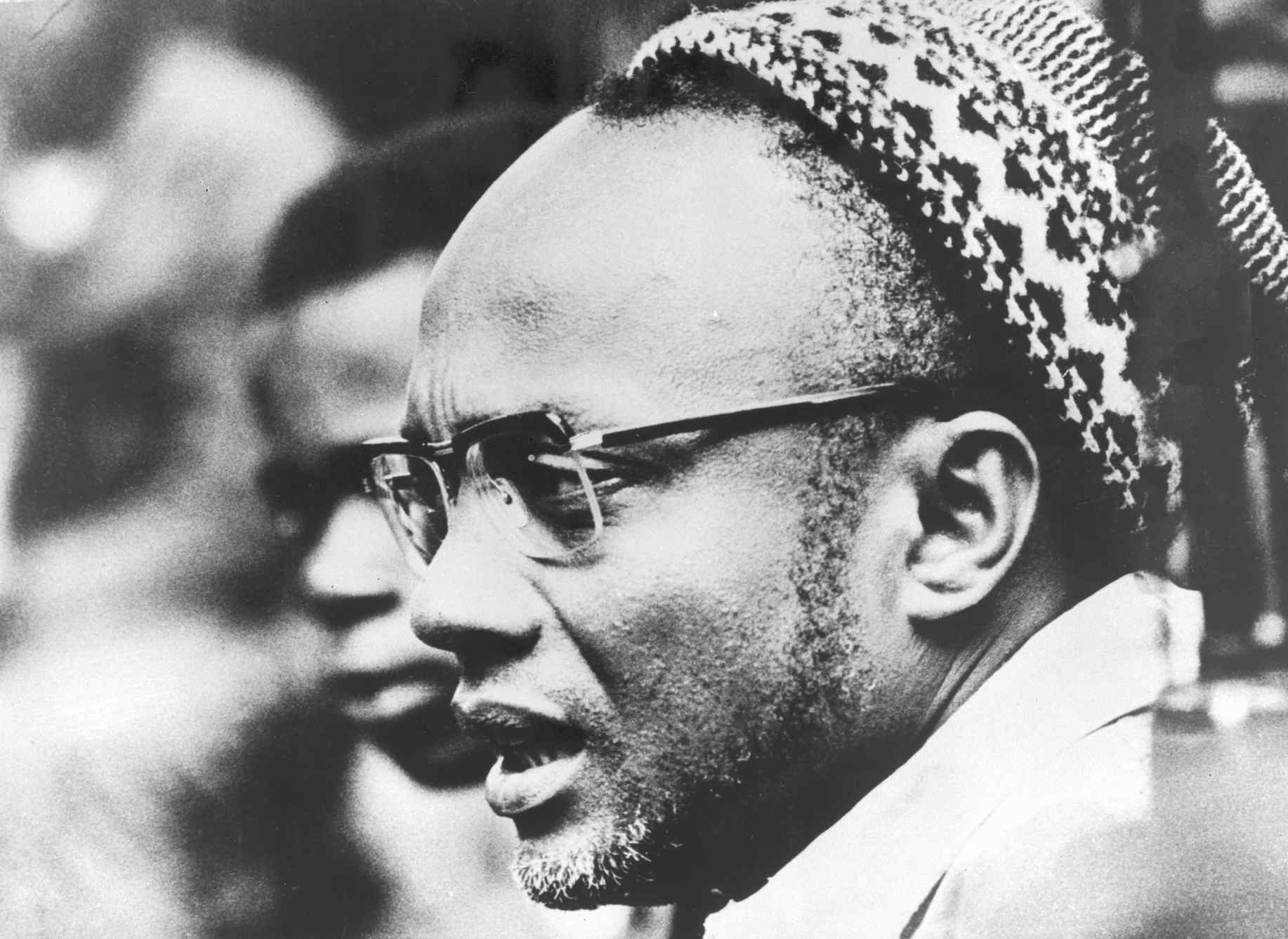
· Amílcar Cabral (pictured above) of Guinea-Bissau, an agronomist and impeccable assimilado, used his scientific training not to serve Portugal but to analyze the material and social structure of colonial exploitation. He famously shifted the question from identity to political economy: “We are not fighting so that a black man can replace a white man in a Mercedes; we are fighting so that there will be no more Mercedes.”
· Eduardo Mondlane, first president of FRELIMO in Mozambique, an educated sociologist, called the assimilado system a mechanism to create a few “honorary whites”. He channeled his elite education into building a mass revolutionary movement.
The Unresolved Legacy: The Post-Colonial Burden
The crisis of the évolué/assimilado did not end with independence; it was inherited by the new nation-states. The first generation of post-colonial leaders were these Western-educated elites. This created an immediate and enduring tension: a gap between the governing elite, often culturally distant and operating within colonial-era structures, and the largely rural populace. The “tortured mind” of the colonial intermediary evolved into the sometimes alienated mind of the post-colonial ruler, struggling to define a national identity that was neither a mimicry of Europe nor a romanticized, static past.
Conclusion: The Cracked Foundation
The évolué and assimilado were living contradictions, embodying the unsustainable lie at colonialism’s heart. In attempting to create a class of loyal mimics, France and Portugal instead manufactured a generation of expert critics, fluent in the empire’s own logic, who used that logic to deliver its verdict. The psychological fracture they implanted—the double consciousness of being told you are equal while being treated as inferior—proved more powerful than any army. It transformed education into a weapon, alienation into a motive, and the tortured individual mind into the catalyst for collective liberation. In the end, the colonial project was not defeated by those it excluded, but by those it most intimately, yet deceitfully, attempted to create.

Leave a Reply