

The Wannsee Conference and the Nazi Camps – Explaining History
The Holocaust dominates our modern understanding of the 20th century. It is the singular event against which all other atrocities are measured. Yet, in the immediate post-war years, public discourse around the genocide of European Jews was surprisingly muted. Due to Cold War realpolitik and the desire to rehabilitate West Germany, the full scale of the horror was often repressed.
It wasn’t until the 1960s that the Holocaust exploded into public consciousness. However, even today, misconceptions persist about the mechanics of the genocide. In this week’s podcast, I returned to Nikolaus Wachsmann’s essential book, KL: A History of the Nazi Concentration Camps, to unpack the complex relationship between the concentration camps and the “Final Solution.”
The Margins of Terror
Contrary to popular belief, in the early years of the war, concentration camps like Dachau and Buchenwald were on the sidelines of anti-Jewish policy. By early 1942, Jews made up fewer than 5,000 of the 80,000 inmates in the KL system. Why? Because the Nazis wanted the genocide to happen “somewhere else.”
Most concentration camps were on German soil. The Nazi leadership was acutely aware of public morale and knew that while antisemitism was widespread, there was little appetite among the general populace for industrial-scale murder on their doorstep. The policy was “out of sight, out of mind.” The genocide was to be conducted in the lawless spaces of occupied Poland, far from the eyes of ordinary Germans.
The Wannsee Pivot
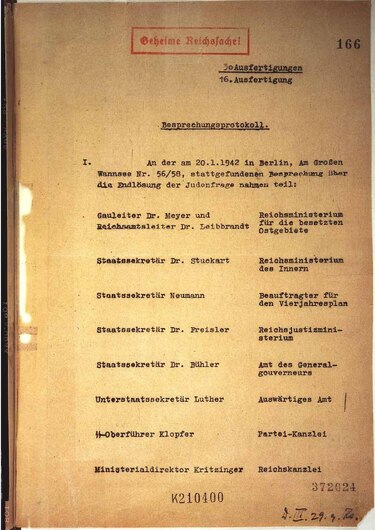
The turning point came with the Wannsee Conference in January 1942. Here, Reinhard Heydrich and other senior officials coordinated the logistics of mass murder. The language used was deliberately euphemistic—”resettlement in the East” and “natural wastage”—not because they feared future trials, but to grease the wheels of bureaucracy. Saying the quiet part out loud makes the administrative task of genocide harder.
Initially, the plan didn’t heavily involve the existing concentration camps. But the war changed everything. By 1942, the invasion of the Soviet Union had stalled. The Nazi plan to use millions of Soviet POWs as slave labor for gigantic settlement projects in the East collapsed because most of those prisoners were already dead from starvation and neglect.
Annihilation Through Labour
Facing a labor shortage, Himmler made an impulsive decision: Jews would replace the Soviet POWs. This shift transformed camps like Majdanek and, crucially, Auschwitz.
Auschwitz-Birkenau was originally intended for Soviet prisoners. Now, it became the nexus of the Holocaust. Jewish prisoners from across Europe were funneled there not just to be murdered immediately, but to be worked to death—”annihilation through labour.”
This improvisation highlights a key aspect of the Nazi regime: it was not a perfectly ordered machine, but a chaotic system of competing fiefdoms and reactive decisions. The Holocaust evolved not just from a master plan, but from the failures of the war effort.
The Architecture of Death
The physical transformation of Auschwitz reflects this shift. The famous rail spur and gatehouse at Birkenau—the image most people associate with the Holocaust—were only built in 1944 to facilitate the murder of 450,000 Hungarian Jews. Before that, victims were marched from the station.
The SS also realized that the existing crematoria could not handle the anticipated death toll. Construction chief Hans Kammler ordered the building of massive new crematoria at Birkenau, reasoning that it made no sense to haul corpses back to the main camp. At the same time, Ravensbrück personnel were transferred to Auschwitz to set up a women’s camp, anticipating the influx of female Jewish prisoners.
Conclusion
Understanding these mechanics is vital. In an age where history is often distorted by “Holocaust edutainment,” fictionalized memoirs, and social media denialism, we need rigorous historical analysis. The Holocaust was not just an explosion of hatred; it was a bureaucratic process shaped by the contingencies of war, labor needs, and the chaotic nature of the Nazi state itself.
Part 3: Tidied Transcript
Nick: Welcome to the Explaining History podcast. I’m diving back today into one of my favourite books, KL by Nikolaus Wachsmann.
I think one of the really important reasons for looking at this book is that when we talk about the Holocaust, it is such a hegemonic part of modern history discourse. It is the thing everybody is perhaps most aware of when they consider the atrocities of the 20th century.
However, the Holocaust wasn’t always prominent in public consciousness. It exploded from the 1960s onwards. In the 40s and 50s, there was a positive repression of Holocaust memory and debate for a host of reasons tied up with the Cold War, the division of Germany, and the rehabilitation of West Germany. American Jews were initially reticent, fearing that being too vocal during the era of McCarthyism might invite antisemitism.
By the 1990s, the Holocaust had become the singular atrocity of the 20th century in the public mind. But the mechanics of it still produce a great deal of confusion. One of the things I wanted to talk about today was the nature of the different kinds of camps and the victimhood of the Jewish prisoners within them.
We’re going to dive into the book, specifically the chapter “Holocaust.” Wachsmann writes:
“In the early years of the Second World War, the concentration camps had stood on the sidelines of Nazi anti-Jewish policy.”
This sounds odd to our ears, but the concentration camps and the death camps in Poland were not the same thing. The concentration camps (KL) were marginal to the “Final Solution” initially. By early 1942, Jews made up fewer than 5,000 of the 80,000 KL inmates.
The reason for this is that most German concentration camps were on German soil, and the Nazis explicitly didn’t want a genocide to happen there. The policy was “out of sight, out of mind.” The Nazis were conscious of public morale; while antisemitism was widespread, there was little desire for an industrial, mechanized genocide on home soil.
On January 20th, 1942, the Wannsee Conference took place. Senior officials gathered to coordinate the “Final Solution.” Heydrich laid out the plan: European Jews would be concentrated in the occupied East and murdered there, either straight away or by working them to death.
The language used was full of euphemisms like “resettlement” and “natural wastage.” Why? I don’t think they feared future trials. I think bureaucratic systems require a conspiratorial element where nothing is said in the open. Explicit language makes the process harder to execute.
Even then, the concentration camps were not on the agenda at Wannsee. However, within days, SS leaders changed their tune. The trigger was the realization that the grandiose settlement plans in the East could not be realized with Soviet POWs—too few had arrived, and too many were already dead.
Himmler made an impulsive decision: Jews would replace Soviet soldiers. On January 26th, 1942, just six days after Wannsee, Himmler ordered the camps to get ready to accommodate 100,000 male Jews and 50,000 women.
This highlights the chaotic nature of the Nazi regime. It wasn’t a perfectly ordered machine; it was a system of spontaneous, contradictory decision-making. Fascism thrives on dynamism and action, often at the expense of standardized governance.
Because the invasion of Russia had stalled by 1942, the Nazis needed labor. As Timothy Snyder argues, out of this chaos, the Holocaust emerged as a way for Himmler and Göring to salvage something from the war effort.
Majdanek and Auschwitz became the primary destinations. Auschwitz was chosen for its location and infrastructure. Crucially, the famous image of trains entering the camp through the gatehouse only happened from 1944 onwards, built to facilitate the murder of Hungarian Jews. Before that, prisoners were route-marched from the station.
The new role of Auschwitz prompted major changes. First, construction chief Hans Kammler decided to build large crematoria at Birkenau, reasoning it was inefficient to haul corpses back to the main camp. Second, Auschwitz prepared for a mass influx of women. Himmler turned to experts from Ravensbrück, bringing in female guards and supervisors to set up a women’s compound.
We need to be careful with how we consume Holocaust history. There is a lot of “edutainment” out there—fictionalizations like The Boy in the Striped Pyjamas, which are often historically inaccurate and criticized by survivors. Then there is the dregs of Holocaust denial on social media.
That is why books like KL are so valuable. They allow us to mentally handle the horrors while explaining the nature and process of the genocide.
Announcement:
I am currently setting up a live study event for January on the Russian Revolution and Stalinism. If you are a student or just interested, keep your eyes peeled for an announcement later this week!
Take care, everybody. All the best. Bye.
30.6s
Use Arrow Up and Arrow Down to select a turn, Enter to jump to it, and Escape to return to the chat.

Leave a Reply