
Introduction: The Cockpit of Europe
Geographically, the Low Countries—Belgium, the Netherlands, and Luxembourg—occupy the “Cockpit of Europe.” For centuries, this flat, river-veined terrain has served as the preferred invasion corridor for Great Powers seeking to outflank one another. In 1914, the violation of Belgian neutrality by Imperial Germany was the casus belli that brought the British Empire into the Great War. The subsequent four years of trench warfare in Flanders cemented the strategic reality that the security of France and Britain was inextricably linked to the integrity of the Belgian frontier.
Yet, in May 1940, when the Wehrmacht launched Fall Gelb (Case Yellow), the Low Countries faced the onslaught not as integrated members of an anti-German coalition, but as isolated neutrals. For four years prior to the invasion, Belgium and the Netherlands had rigorously pursued a policy of strict neutrality, refusing to coordinate their defenses with the Franco-British alliance or allow Allied troops to proactively deploy on their soil.
This diplomatic posture is frequently analyzed as a tragedy of small states caught between leviathans. However, a critical examination reveals it to be a profound strategic failure that actively facilitated the German victory. The return to neutrality in the mid-1930s created a “strategic vacuum” on France’s northern flank. It forced the Allied armies to abandon their prepared defensive lines and rush into an encounter battle in Belgium—a maneuver that Gamelin called the “Dyle Plan”—at the precise moment the Germans struck. This article explores the intellectual and political origins of this neutrality, the illusion of the “Oslo States” bloc, and how the diplomatic estrangement of the Low Countries doomed the defense of the West.
“
The Belgian Pivot: From Alliance to “Independence”
To understand the disaster of 1940, one must trace the dissolution of the post-1918 security architecture. Following the Great War, Belgium abandoned its traditional 19th-century neutrality (which had failed in 1914) and entered into a formal military alliance with France in 1920. For fifteen years, the French and Belgian general staffs coordinated plans, viewing the defense of the Meuse and the Albert Canal as a joint enterprise.
This alignment began to fracture in the mid-1930s due to shifts in the geopolitical and domestic landscape. The catalyst was the remilitarization of the Rhineland in March 1936. When Hitler marched troops into the demilitarized zone—violating both Versailles and the Locarno Treaties—France, paralyzed by the caretaker government of Albert Sarraut and the ghost of Verdun, did nothing.
To the Belgian political elite, this was a revelation. If France would not fight to defend the Rhineland, the buffer zone essential for its own security, would it fight to defend Liège or Brussels? The credibility of the French security guarantee evaporated overnight. Furthermore, the signing of the Franco-Soviet Pact in 1935 alienated the Catholic, conservative elements of the Belgian establishment, who feared being dragged into a war to support Bolshevism.
In October 1936, King Leopold III delivered a seminal speech to the Council of Ministers, announcing a “Policy of Independence” (Politique d’Indépendance). This was a nuanced but critical shift. It was not “neutrality” in the passive sense of 1839; it was an armed, autonomous neutrality. Belgium would rearm and defend its borders against anyaggressor, whether German, French, or British.
The domestic political context of this decision is often overlooked. Belgium was increasingly paralyzed by the linguistic and cultural rift between French-speaking Walloons and Dutch-speaking Flemings. The Flemish movement was deeply suspicious of the military alliance with France, viewing it as a tool of Walloon domination. By adopting a policy of “Exclusive Belgian” interest, Leopold III hoped to unite the fractured country behind the Crown. While politically astute domestically, strategically it was disastrous. It severed the connective tissue between the Belgian Army and the French High Command, turning the border into a blind spot.
The Dutch Dilemma: The Fortress of Water
If Belgium’s neutrality was a reactive pivot, the Netherlands’ neutrality was a deeply entrenched existential identity. The Netherlands had managed to stay out of the Great War, maintaining its neutrality through trade and a precarious diplomatic balancing act. By 1939, the Dutch had not fought a major European war since the defeat of Napoleon.
This long peace fostered a strategic culture of “legalism.” The Dutch political elite believed that strict adherence to international law would protect the state. Consequently, the Netherlands refused to engage in staff talks with Belgium or the Allies. General Izaak Reijnders, the Dutch commander (later replaced by Henri Winkelman), was forbidden from coordinating defense plans with his southern neighbors to avoid “provoking” Germany.
Militarily, the Dutch relied on the concept of Vesting Holland (Fortress Holland). The strategy was essentially Napoleonic: in the event of invasion, the Dutch army would retreat to the western provinces (Amsterdam, Rotterdam, The Hague) and flood the land. The “New Dutch Waterline” was designed to turn the core of the country into an island.
However, this strategy was tragically obsolete. It ignored the reality of air power. While water could stop infantry and tanks, it could not stop the Luftwaffe, nor could it prevent airborne troops from landing behind the water lines. The Dutch military was woefully under-equipped for modern warfare; they possessed almost no tanks, limited anti-aircraft artillery, and a fleet of Fokker biplanes that were outclassed by the Messerschmitt Bf 109. The Dutch reliance on water was a reliance on a 17th-century defense against a 20th-century threat.
The Illusion of the “Oslo States”
In the late 1930s, as the League of Nations collapsed, the small powers of Northern Europe attempted to forge a “Third Way.” Known as the “Oslo States” (comprising the Scandinavian nations, the Low Countries, and eventually Finland), this loose grouping sought to preserve peace through economic cooperation and strict neutrality.
The Oslo Group represented the delusion that small states could opt out of the ideological clash between Fascism and Democracy. The diplomatic discourse among these nations focused on trade barriers and moral suasion, ignoring the raw power dynamics of the continent.
For Belgium and the Netherlands, the Oslo concept provided a false sense of solidarity. They believed that by acting as a bloc, they could deter aggression. In reality, the bloc had no military teeth. When Germany invaded Denmark and Norway in April 1940, the Oslo concept collapsed instantly. Yet, the Low Countries did not draw the necessary conclusion: that neutrality was no shield against the Third Reich. Instead, they clung even tighter to their legalistic status, refusing Allied entreaties to base RAF fighters on Dutch soil, fearing this would provide Hitler with a pretext for invasion—as if Hitler needed pretexts.
The Strategic Vacuum and the Dyle Plan
The refusal of the Low Countries to align with France and Britain created a nightmare scenario for General Maurice Gamelin, the Allied Supreme Commander. He knew that the decisive battle would be fought in Belgium. The geography dictated it; the Gembloux Gap and the plains of Flanders were the traditional invasion routes.
However, because Belgium was neutral, Allied troops could not enter the country until the Germans violated the border. This meant the Allies could not prepare defensive positions, dig trenches, or lay communications networks in the vital battle zone. They would have to race the Germans to the defensive line after the war had started.
Gamelin’s solution was Plan D (the Dyle Plan). Upon the German invasion, the French First Army and the British Expeditionary Force (BEF) would leave their prepared positions on the French border and rush forward into Belgium to establish a line along the Dyle River, stretching from Antwerp to Namur.
This was a high-risk maneuver. It required the Allies to fight an encounter battle while moving, abandoning the advantages of their own fortifications (the extension of the Maginot Line). Worse, it depended entirely on the Belgian Army holding the line of the Albert Canal for at least five days to allow the Allies to dig in. Because there were no staff talks, Gamelin had to guess how long the Belgians could hold. He assumed the formidable fortress of Eben-Emael would delay the Germans significantly. He was wrong.
The neutrality policy thus imposed a structural rigidity on the Allied response. It forced the elite mobile divisions of the French Army (the 1st, 2nd, and 3rd Light Mechanized Divisions) to rush north into the “Trap of Breda” and the Gembloux Gap, pulling the strategic reserve away from the center of the line—the Ardennes—where the true German Schwerpunkt(main effort) would fall.
The Mechelen Incident: The Warning Wasted
The tragedy of this lack of coordination is best exemplified by the “Mechelen Incident” of January 10, 1940. A German Luftwaffe major, carrying the complete operational plans for the invasion of the Low Countries, became lost in fog and crash-landed in neutral Belgium. The plans were captured before they could be fully burned.
The documents revealed a conventional Schlieffen-style attack through central Belgium. This intelligence windfall should have spurred immediate military integration. The Belgian High Command briefly lowered the border barriers at the French frontier, and Gamelin prepared to move.
However, King Leopold and his government balked. They refused to invite the Allies in, hoping that the intelligence compromise would force Hitler to cancel the invasion (which he postponed, but largely due to weather). The Belgians shared the intelligence with the French but kept the political door bolted.
Crucially, this incident had a perverse effect. It confirmed Gamelin’s belief that the main attack would come through Belgium, reinforcing his commitment to the Dyle Plan. Simultaneously, it forced the Germans to rethink their strategy. General Erich von Manstein successfully argued that the compromised plan was too predictable. The result was the shift of the main thrust to the Ardennes (the Manstein Plan). The Low Countries’ neutrality thus achieved the worst possible outcome: it gave the Allies false confidence in a compromised plan while forcing the enemy to adopt a more brilliant, unexpected one.
May 1940: The Collapse of the Shields
When the attack finally commenced on May 10, 1940, the strategic failure of neutrality manifested in immediate tactical disasters.
In Belgium, the defensive scheme relied on the fortress of Eben-Emael guarding the Albert Canal. The Belgian doctrine assumed this modern fortification could hold out for weeks. Instead, it fell in hours. German glider troops landed on the roof of the fortress, using shaped-charge explosives to disable the gun cupolas. The “shield” of Belgium was pierced before the Allies had even crossed the border. The Belgian army began a chaotic retreat, forcing the rushing French and British troops to engage in “meeting engagements” with German panzers rather than settling into a stable line.
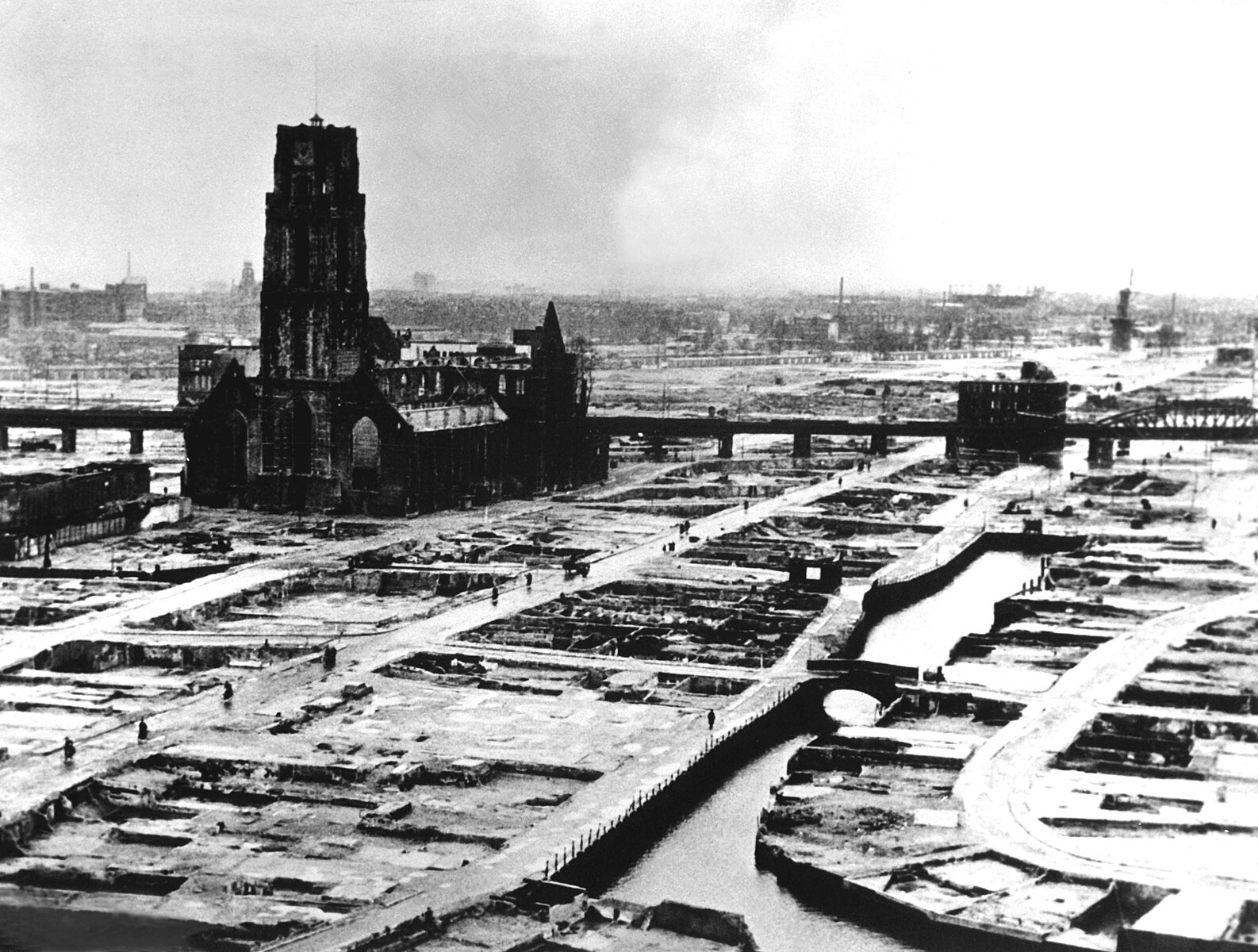
In the Netherlands, the “Fortress Holland” concept disintegrated. The Germans launched a massive airborne assault, dropping paratroopers directly onto the airfields of The Hague and Rotterdam to decapitate the Dutch government. While the Dutch fought bravely and actually recaptured some airfields, the strategic shock was total. The Luftwaffe terror-bombed Rotterdam on May 14, razing the city center. Facing the threat of similar destruction to Utrecht, General Winkelman surrendered the Netherlands on May 15—after only five days of fighting. The northern flank of the Allied line simply evaporated.
The Politics of Surrender: The Royal Question
The military collapse precipitated a political crisis that fractured the tenuous relationship between the Low Countries and the Allies.
In the Netherlands, Queen Wilhelmina and the cabinet fled to London to establish a government-in-exile. This preserved the legitimacy of the Dutch state and allowed the Dutch navy and colonial resources (in the East Indies) to continue the fight.
In Belgium, the situation was far more acrimonious. As the Allied armies were encircled in the pocket that would become Dunkirk, King Leopold III made the controversial decision to remain with his troops rather than flee. On May 28, he unconditionally surrendered the Belgian Army.
This surrender exposed the left flank of the BEF and French forces at Dunkirk, necessitating a frantic reconfiguration of the perimeter. French Prime Minister Paul Reynaud delivered a blistering radio address, accusing Leopold of a “treason without precedent in history.” While Leopold viewed his decision as a constitutional necessity (acting as Commander-in-Chief sharing the fate of his soldiers), the Allies viewed it as the final betrayal of the neutrality policy. Leopold spent the war as a “prisoner” in his palace, a decision that would tear Belgium apart post-war (the Royal Question) and lead to his eventual abdication.
The Failure of Command and Control
The strict neutrality led to a fatal lack of interoperability. During the brief campaign, there was no unified command structure. General Billotte, the French commander of the First Army Group, was nominally in charge of coordinating with the Belgians and British. However, the Belgian Army had different radio frequencies, different map grid systems, and different logistical distinctives.
General Van Overstraeten, Leopold’s military advisor, frequently clashed with British and French commanders, refusing to subordinate Belgian movements to the overall strategic necessity of the coalition. The Belgians retreated northwest (to protect their ports), while the British retreated west (to the coast), and the French tried to retreat south (to reconnect with the Somme). This divergence opened gaps in the line that the Germans exploited ruthlessly. The neutrality policy meant that the “Allies” were effectively fighting three separate wars against a single, unified enemy.
Conclusion: The Price of Isolation
The Fall of the Low Countries is often portrayed as a victim narrative—innocent bystanders trampled by the Nazi war machine. While the moral culpability for the invasion lies entirely with Berlin, the political responsibility for the scale of the disaster must be shared by the governments of Brussels and The Hague.
The “Policy of Independence” and strict neutrality were delusions in the age of total ideological warfare. By refusing to choose a side until the bombs were falling, the Low Countries denied the Western democracies the time and space required to build a coherent defense. They acted as “free riders” on the French security guarantee while undermining the military viability of that guarantee.
The Dyle Plan was a desperate gamble forced upon the French by Belgian neutrality. Had the French been allowed to fortify the Belgian frontier in 1939, or had the Belgian army been integrated into a unified command structure, the Ardennes gamble might have been contained. Instead, the strategic vacuum on the northern flank acted as a lure, drawing the best Allied forces into a trap from which they could not escape. The lesson of 1940 was stark: in a conflict of continental scale, neutrality is not a shield; it is merely an invitation to be defeated in detail.
Historiographical Note
The historiography of the Low Countries in 1940 is dominated by the “Royal Question” and the defense of national honor.
1. The “Treason” of Leopold III:
Immediately following the war, the narrative was dominated by the Reynaud/Churchill view: Leopold III betrayed the alliance. This was contested by Belgian royalists who argued Leopold acted as a “shield” for his people, preventing the total destruction of Belgium (a “Vichy-lite” argument). Hubert Pierlot (the Belgian PM in exile) led the political charge against the King. Modern historians like Herman Van Goethem continue to debate Leopold’s potential willingness to collaborate with a German New Order.
2. The Viability of the Dyle Plan:
Military historians like Brian Bond and Jeffery A. Gunsburg have reassessed the Dyle Plan. Traditionally seen as Gamelin’s great blunder, Gunsburg argues in Divided and Conquered that the Dyle Plan was the only rational choice given the political constraints imposed by Belgian neutrality. The failure was not the plan itself, but the lack of time to implement it—a direct result of the refusal of staff talks.
3. Dutch Historiography:
Dutch history has grappled with the “Broken Rifle” (Het Gebroken Geweer) symbolism—the pre-war pacifism. Historians like L. de Jong (in his monumental The Kingdom of the Netherlands During World War II) established the standard narrative of a naive nation rudely awakened. Recent revisionism has focused on the competence of General Winkelman and the tactical successes of the Dutch military, shifting the blame to the decades of political neglect of the armed forces.
4. The Small Power Dilemma:
International Relations scholars use the 1940 case to study “Alliance entrapment vs. abandonment.” The Low Countries feared entrapment (being dragged into a French war) more than abandonment, failing to realize that their geography made isolation impossible.
Further Reading
- Bond, Brian. Britain, France and Belgium, 1939-1940 (Brassey’s, 1990).
- The essential text on the diplomatic and military friction between the three nations. Bond meticulously details the failed staff talks and the mistrust that crippled the alliance.
- Gunsburg, Jeffery A. Divided and Conquered: The French High Command and the Defeat of the West, 1940(Greenwood Press, 1979).
- A rigorous defense of Gamelin’s operational logic, placing the blame squarely on the strategic constraints imposed by Belgium.
- Kossmann, E.H. The Low Countries, 1780–1940 (Oxford University Press, 1978).
- Provides the deep historical context of the Flemish/Walloon divide and the long tradition of Dutch neutrality, explaining why the political elites made the decisions they did.
- Keyes, Roger. Outrageous Fortune: The Tragedy of Leopold III of the Belgians (Secker & Warburg, 1984).
- A sympathetic biography (by the son of the British liaison officer to Leopold) that attempts to rehabilitate the King’s reputation, offering a counter-point to the “treason” narrative.

Leave a Reply