
Spec link: AQA “Tsarist and Communist Russia, 1855–1964” — the economic transformation of the 1890s that reshaped Russian society and set the terms for 1905 and 1917.
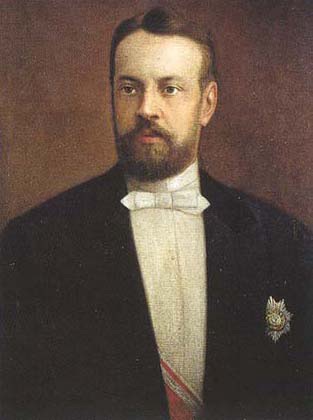
The industrial surge of the 1890s — the “Great Spurt,” in Alexander Gerschenkron’s famous phrase — is one of the most important and most under-used topics in the whole 1855–1964 course. It is where the economic and social forces that would tear the autocracy apart were deliberately called into being by the autocracy itself. At its centre stands Sergei Witte, Minister of Finance from 1892 to 1903, the most capable servant the late tsarist state produced and the architect of a state-driven industrialisation whose triumphs and contradictions defined the reign of Nicholas II.
The problem Witte set out to solve
By the 1890s Russia’s backwardness relative to the industrial powers was a strategic emergency as much as an economic one. A great power that could not produce steel, rails and modern weapons could not remain a great power, as the Crimean War had already shown. Witte, a former railway administrator, understood industrialisation as a matter of national survival and state strength rather than of private enterprise or social progress. His model was frankly one of modernisation from above: because Russia lacked a large domestic middle class and a deep pool of private capital, the state itself would have to drive, direct and finance the process. This is the key conceptual point for students — Russian industrialisation was a government project, not a bourgeois one, and that fact shaped everything that followed.
Witte’s system
Witte’s programme rested on several interlocking policies. Railways were the spine: the network expanded enormously, above all the Trans-Siberian Railway begun in 1891, which opened Siberia, linked resources to industry, and served both economic and military ends. Railway building generated demand for coal, iron and steel, pulling the heavy industries of the Donbas, the Urals and the south forward with it.
To pay for this, Witte pursued foreign investment and loans aggressively, drawing capital especially from France, Belgium and Britain. To make Russia attractive to foreign lenders he put the currency on the gold standard in 1897, guaranteeing the rouble’s stability. He maintained high protective tariffs to shield infant Russian industries, and he raised the revenue to service foreign debt through heavy indirect taxation — on everyday consumables such as vodka, sugar, tobacco and matches — and through the continued export of grain squeezed out of a hungry peasantry. The burden of industrialisation, in short, fell squarely on the rural poor, who paid the taxes and produced the exports that funded the factories.
The results — real and dramatic
By any statistical measure the Great Spurt was a genuine success. Between the early 1890s and 1900 industrial output roughly doubled; the growth rate of around eight per cent a year was among the fastest in the world. Coal, iron, steel and oil production expanded rapidly — Russia briefly became the world’s largest oil producer — and the country built the industrial base of a modern great power in a single decade. New industrial cities and vast enterprises appeared, often financed and managed by foreigners and concentrated in a handful of centres, which produced factories of exceptional size. Russia had, in a compressed and lopsided way, undergone an industrial revolution.
The social contradiction
But the Great Spurt’s very success generated the social forces that would destabilise the regime — and this is the argument examiners most want to see. Rapid, concentrated industrialisation created a new urban working class, crammed into overcrowded, dangerous cities and huge factories, working long hours for low wages with no legal trade unions and no political rights. Concentrated in large plants in cities like St Petersburg, this proletariat was small as a share of the population but strategically located and easily mobilised — precisely the conditions Marxists regarded as revolutionary. The peasantry, meanwhile, was squeezed harder than ever to fund the drive, deepening rural discontent.
Witte thus embodied, more sharply than anyone, the central dilemma of the late autocracy: the regime needed industrial and military strength to survive as a great power, but the process of acquiring that strength created social classes with grievances the autocracy refused to address politically. The 1899–1903 economic slump, which threw workers out of work and helped trigger a wave of strikes, showed how quickly the new proletariat could turn against the state. The revolution of 1905 followed within two years of Witte’s fall from the finance ministry, and the working class he had helped to create was at its heart.
Continuity into the twentieth century
The Witte model did not die with his ministry. Stolypin after 1906 attempted to complete the modernisation by reforming the peasantry and creating a class of independent farmers, and the pre-1914 years saw a second industrial boom. More strikingly, the fundamental logic of Witte’s approach — forced, state-directed industrialisation extracting the cost from the peasantry, pursued for reasons of national strength against a hostile world — reappeared, in a far more brutal form, in Stalin’s Five Year Plans from 1928. Seeing that continuity is one of the most rewarding synoptic connections the whole course offers: the tsarist finance minister and the Communist dictator were answering the same question — how does a backward Russia industrialise fast enough to survive? — and reaching recognisably similar answers.
Judgement
Witte’s Great Spurt was a remarkable achievement of state power and economic vision, and it made Russia an industrial nation. But it was industrialisation without political modernisation, and that imbalance was its undoing. By creating an urban working class while denying it any legitimate voice, and by funding the whole enterprise on the backs of the peasantry, the autocracy manufactured the very forces that would rise against it in 1905 and destroy it in 1917. For the 1855–1964 argument, Witte is the economic counterpart to the political story: further proof that the tsarist regime could modernise Russia’s economy but could not, or would not, modernise itself — and that the gap between the two would prove fatal.
Further reading on Explaining History: the Alexander III article covers the reactionary politics within which the industrial drive began; the 1905 Revolution pieces trace how the new working class turned on the regime.

Leave a Reply