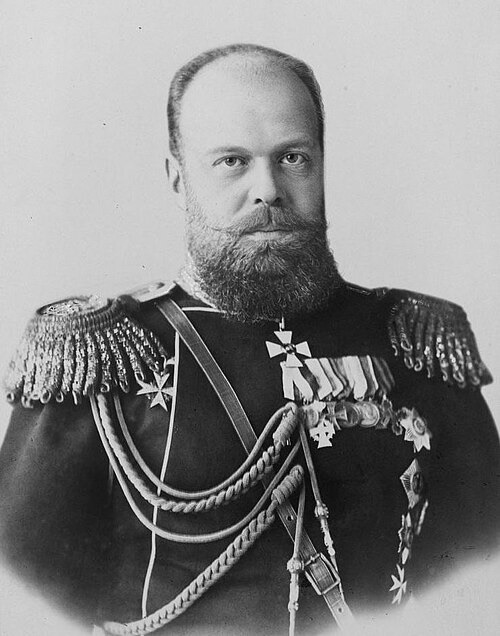

Spec link: AQA “Tsarist and Communist Russia, 1855–1964” — the counter-reforming reign that shaped the autocracy Nicholas II inherited.
If Alexander II poses the question of whether autocracy can reform, his son Alexander III poses the opposite one: what happens when a Russian ruler decides that reform itself is the disease? Coming to the throne in March 1881 over his father’s assassinated body, Alexander III drew a single, uncompromising lesson from that murder — that concession breeds revolution, and that the survival of the dynasty depended on the reassertion of undiluted autocratic power. His thirteen-year reign is the great case study in Russian reaction, and understanding it is essential to explaining both the surface stability and the underlying fragility of the state that collapsed a generation later.
The ideology of reaction
Alexander III’s outlook was shaped by his former tutor and now chief adviser, Konstantin Pobedonostsev, Procurator of the Holy Synod, who despised parliamentary government, a free press and Western liberalism as corrosive foreign imports. The reign’s guiding formula was the old triad of Orthodoxy, Autocracy and Nationality. Within weeks of his accession, Alexander issued the Manifesto on Unshakable Autocracy, killing off the tentative Loris-Melikov proposals his father had approved and signalling that there would be no movement towards representative institutions. The reign’s philosophy can be summarised simply: the tsar would rule as God’s appointed autocrat, the Church would guard the people’s souls, and everything Russian would be exalted over everything that was not.
The counter-reforms
Reaction was translated into policy through a series of measures designed to claw back the independence Alexander II’s reforms had granted. The 1889 introduction of the Land Captains (zemskie nachalniki) placed appointed nobles in direct authority over the peasantry, with power to override village decisions and administer summary justice — a deliberate reversal of the spirit of emancipation and local self-government. The zemstva and town dumas were curbed by raising property qualifications and increasing central supervision, weakening the elected element Alexander II had introduced. In education, Tolstoy’s successor Delyanov issued the notorious 1887 “cooks’ children” circular, restricting secondary and university access for the lower classes, while university autonomy was crushed in 1884. Censorship tightened, and the security police — the Okhrana — extended their surveillance of political life.
Students should note the pattern: these were not random acts of repression but a coherent attempt to reoccupy the ground the Great Reforms had opened, restoring noble authority in the countryside and central control over local government, courts and education without formally abolishing the reformed institutions.
Russification and religious persecution
Nationality, the third element of the triad, was expressed through an aggressive policy of Russification — the imposition of the Russian language, administration and Orthodox faith on the empire’s non-Russian peoples. Poles, Finns, Ukrainians and the Baltic peoples saw their languages restricted and their local privileges eroded. The policy was most violent in its treatment of the empire’s Jews, subjected to the discriminatory May Laws of 1882, tightened residence restrictions in the Pale of Settlement, quotas on education, and a wave of state-tolerated pogroms. Far from securing loyalty, Russification alienated exactly those subject nationalities whose grievances would later feed both liberal and revolutionary opposition, and drove a generation of persecuted minorities towards emigration and radical politics.
The paradox: reaction and modernisation together
The essential complexity of the reign — and the point that separates strong answers from weak ones — is that political reaction coincided with the beginnings of rapid economic modernisation. Under finance ministers Bunge, Vyshnegradsky and, from 1892, Sergei Witte, the state pursued industrial development, railway construction and foreign investment with growing vigour. Vyshnegradsky’s drive to boost grain exports to fund industrialisation (“we shall go hungry, but we shall export”) contributed to the catastrophic famine of 1891–92, which killed hundreds of thousands and exposed both the human cost of the policy and the incompetence of the administration’s response — a moment that reinvigorated public opposition and the zemstvo movement.
This is the reign’s defining paradox: the regime was deliberately dragging Russia into the industrial age while forbidding the political and social change that industrialisation everywhere else produced. It was creating an urban working class and an entrepreneurial middle class while denying both any legitimate political voice. The contradiction was contained under Alexander III by his personal authority and force of will, but it was passed on, unresolved and intensified, to his weaker son.
Judgement: stability bought on credit
Alexander III died in 1894 with his autocracy apparently intact: there was no revolution, the revolutionary movement had been driven underground, and the state seemed strong. On the surface, reaction had “worked.” But the stability was bought on credit. By suppressing the institutions through which grievances might have been expressed and reforms negotiated, and by simultaneously unleashing the economic forces of modernisation, Alexander III ensured that the pressures building beneath the autocracy had no outlet. He handed Nicholas II a regime that was ideologically rigid, socially brittle and economically transforming — the worst possible combination.
For the 1855–1964 synoptic argument, Alexander III is the crucial counter-example to his father: he shows that the alternative to reforming autocracy was not stability but deferral. The problems Alexander II had tried, however imperfectly, to address did not disappear when reform stopped; they accumulated. The reign is best understood as the moment the Russian state chose repression over adaptation — and thereby made the eventual explosion more, not less, likely.
Further reading on Explaining History: the pieces on Russia’s Jews in the nineteenth century and the intelligentsia illuminate the human consequences of Russification; the Witte article traces the industrial drive that began under this reign.

Leave a Reply