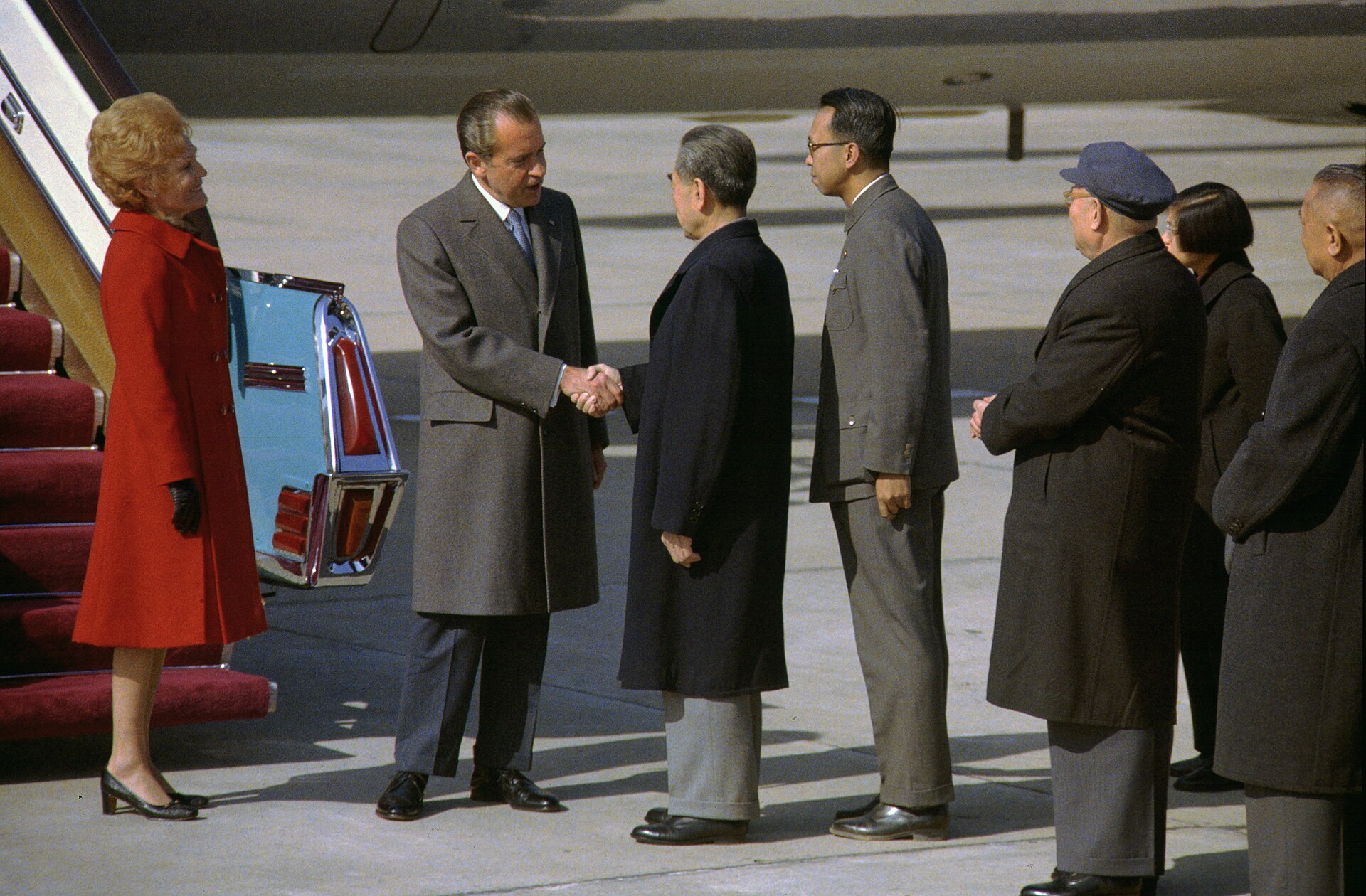


Trump with Xi Xinping, searching for an exit from the disaster in the Persian Gulf he has created for himself.

There are moments in political life when a country begins to discover, often to its surprise, that the habits which once secured its dominance no longer work quite so well. The language of confidence remains intact. The flags are still flown, the speeches still made, the alliances still invoked. But beneath the surface, the relationship between power and persuasion has altered. What used to be achieved through leverage now has to be improvised through performance. That is the world the United States increasingly inhabits, and it is the world in which Donald Trump’s diplomacy, especially toward China and Iran, has to be understood.
What interests me is not simply the spectacle of Trumpian politics, though spectacle is certainly part of the story. It is the deeper historical fact that the international system has changed in ways the American political class has not fully absorbed. Trump’s manoeuvres resemble, in a crude and diminished way, Richard Nixon’s opening to China, but the resemblance is misleading. Nixon’s diplomacy in 1972 was conducted from a position of relative American strength, in a world shaped by the Cold War, the Sino-Soviet split, and the hard logic of bipolar rivalry. Trump, by contrast, acts in an era of American overextension, Chinese rise, and regional crises that expose the limits of U.S. military and political reach. The difference is not merely one of style. It is one of historical position.
Nixon’s world
Nixon’s trip to Beijing is one of those episodes that has become so familiar it can seem almost mythic. The image of the arch anti-Communist president shaking hands with Mao Zedong is still startling, but the deeper significance of the visit lies in its strategic framing. Nixon and Kissinger were not trying to make the world nicer; they were trying to re-order it. They wanted to exploit the rift between China and the Soviet Union, ease American pressure in Vietnam, and establish a diplomatic architecture that might serve U.S. interests for years to come.
That kind of thinking belongs to the tradition of realism in international relations. Realists assume that states are driven by security, competition, and the search for advantage in an anarchic international system. Nixon’s China opening fits that tradition almost perfectly. It was cynical, but it was also strategic in the deepest sense: a move that acknowledged constraints while trying to exploit them. The famous phrase “only Nixon could go to China” captures the political risk, but it also points to the fact that the move was intelligible as statecraft.
It helped that China in 1972 was poor, isolated, and still living with the political wreckage of the Cultural Revolution. The Mao era was ending in exhaustion rather than triumph. Beijing wanted recognition, technology, and room to manoeuvre against Moscow. Washington could offer that, because Washington still had the bigger hand. That asymmetry made negotiation possible.
Trump’s narrower room
Trump’s China diplomacy emerges from the opposite condition. He is trying to negotiate with a country that is vastly more consequential than the China Nixon met, and from a United States that is no longer able to assume unilateral advantage with any confidence. The difference is visible not only in economics and technology, but in mood. Nixon’s diplomacy was part of a coherent grand strategy; Trump’s often feels like a sequence of improvisations, driven by pressure, optics, and the need for immediate relief.
The present crisis with Iran makes that harder still. American power has been tested in a theatre where it has long claimed decisive superiority, and the results have been sobering. Military force has proven costly, alliances have looked shakier than advertised, and the gap between rhetoric and capability has become impossible to ignore. The war has not simply exposed tactical limitations; it has revealed the difficulty of turning hard power into political settlement.
That is one reason the analogy with Vietnam continues to matter. Nixon’s opening to China mattered partly because it helped Washington imagine a way out of Southeast Asia. But the current Middle Eastern conflict looks less like a pathway to order than a widening trap. The more force is used, the more visible the limits of force become. The more force is withheld, the more American credibility frays.
China’s advantage
China’s great strength today is that it does not need to rush. That is not an accidental virtue; it is a structural one. A rising power can often benefit from patience, especially if its rival is pressured, distracted, and politically divided. Beijing can afford to wait while Washington burns through stockpiles, exhausts diplomatic goodwill, and unsettles its partners. It can present itself as steady in a world that increasingly sees the United States as volatile.
Henry Kissinger, for all the moral wreckage attached to his legacy, understood that China tended to think in long arcs rather than short bursts. He understood too that Beijing did not see itself as a junior member of a Western-led order, but as a central historical actor that had temporarily been forced into a subordinate position. That self-understanding matters. It shapes how Chinese leaders interpret pressure, how they read American weakness, and how they prepare for a future in which the balance of power may continue to tilt in their favour.
The realist framework helps here, but only up to a point. Structural realism explains why China behaves like a rising power, but it does not fully explain the symbolic and historical confidence with which Beijing now operates. That confidence is not simply material. It is civilisational. And it is one reason American attempts to shame, coerce, or outplay China so often misfire.
Iran and the credibility trap
Iran is the arena in which American credibility has become most visibly exposed. Once Washington enters a confrontation and fails to achieve a clear result, its opponents learn something important: pressure is not the same as control. The Americans may still be able to strike, punish, and disrupt, but that is not the same as being able to determine the outcome.
This is where the old language of credibility, familiar from Cold War strategy, begins to sound increasingly fragile. If allies are uncertain, adversaries are emboldened. If adversaries conclude that American commitments are reversible, they adapt accordingly. That is why Gulf states, East Asian allies, and Taiwan all read events together rather than separately. The world is not a set of isolated files; it is a connected system of signals.
Trump’s problem is that he performs strength in a world that increasingly interprets his actions as evidence of strain. He wants to be seen as the man who makes deals and bends adversaries to his will. Yet the conditions in which such performances once worked have eroded. The more he insists on control, the more the gap between claim and reality invites mockery, resistance, or both.
The shape of a new order
What is emerging is not a clean transition from one dominant power to another, but a more unsettled geometry in which no actor can fully impose its will. That is an uncomfortable prospect for Washington, because the United States has long depended on the assumption that it can shape outcomes everywhere, even if imperfectly. The Iraq and Afghanistan disasters weakened that assumption. The current crises in the Middle East and East Asia are eroding it further.
The danger in such moments is not only military. It is psychological. Declining powers often become more prone to self-deception just when they most need clarity. They cling to old habits, overestimate remaining leverage, and treat humiliation as something to be postponed rather than confronted. That is why leaders like Trump are so consequential. They are not merely causes of decline; they are its symptoms, amplifiers, and often its most theatrical expressions.
The deeper historical comparison may be with Britain in the late imperial period, rather than with any one Cold War episode. Like Britain after the loss of unquestioned supremacy, the United States is discovering that the world is not obliged to continue according to its assumptions. It can still command, but less often. It can still threaten, but less effectively. It can still lead, but only if others are willing to follow.
That is the real lesson hidden inside the comparison with Nixon. Nixon’s diplomacy worked because it was conducted from a position of strength, however morally compromised and strategically ruthless that strength may have been. Trump’s version of the same game takes place after the conditions that made such diplomacy possible have begun to fade. The result is not simply a weaker performance. It is a different historical moment altogether.
And that is where the argument becomes most compelling to me. The United States is not merely struggling with one president, one war, or one diplomatic setback. It is struggling with the end of a long assumption: that American power could always be converted into political advantage if used hard enough, loudly enough, or theatrically enough. That assumption is no longer reliable. The world has changed. The question now is whether American politics can change with it.
In that sense, Trump is less an aberration than a diagnosis. He reveals the extent to which American political culture has come to depend on image, speed, and the promise of easy dominance. He also shows how little of that survives contact with a genuinely altered world. The old language of supremacy still circulates, but it increasingly sounds like a dialect spoken after the empire has already begun to thin at the edges.
The most unsettling thing is not that decline is happening. All great powers decline eventually, and history is full of states that were once unchallengeable and then, over time, became uncertain of their own authority. The unsettling thing is the mismatch between the scale of the American self-image and the scale of its present options. That gap invites overreach. It invites embarrassment. It invites the kind of improvisation that mistakes movement for strategy.
That is why China matters so much in this story. China is not merely an external rival. It is the mirror in which American weakness becomes visible. It forces a reckoning with the limits of military power, the fragility of alliances, the failure of manufacturing policy, and the hollowness of rhetoric that no longer commands obedience. And it does so at a time when Iran, Ukraine, the Gulf, and Taiwan all suggest that the world is becoming less governable by a single power than it has been for decades.
If there is a lesson here, it is not that the United States is finished. It is that power now has to be exercised with a degree of humility that recent American politics has struggled to supply. Nixon understood this in his own cold, calculating way. Trump does not appear to. He mistakes pressure for leverage, optics for authority, and bluster for strategy. That may work in a television studio. It does not work nearly as well in a world where other states have their own plans, their own memories, and their own sense of time.
The coming years are likely to be defined by that discovery. Not a sudden collapse, but an accumulation of misreadings. Not an apocalyptic break, but a steady erosion of confidence. And in that erosion lies the real historical story: a superpower learning, slowly and painfully, that it no longer controls the terms of the world it once took for granted.

Leave a Reply