
The Great Depression (1929–41) remains the longest and most severe economic downturn in modern history. In the United States, between 1929 and 1933, industrial production fell nearly 47 percent, gross domestic product (GDP) declined by 30 percent, and unemployment reached more than 20 percent—peaking at 25 percent in 1933. By comparison, during the Great Recession of 2007–09, the second largest economic downturn in U.S. history, GDP declined by 4.3 percent, and unemployment reached slightly less than 10 percent.
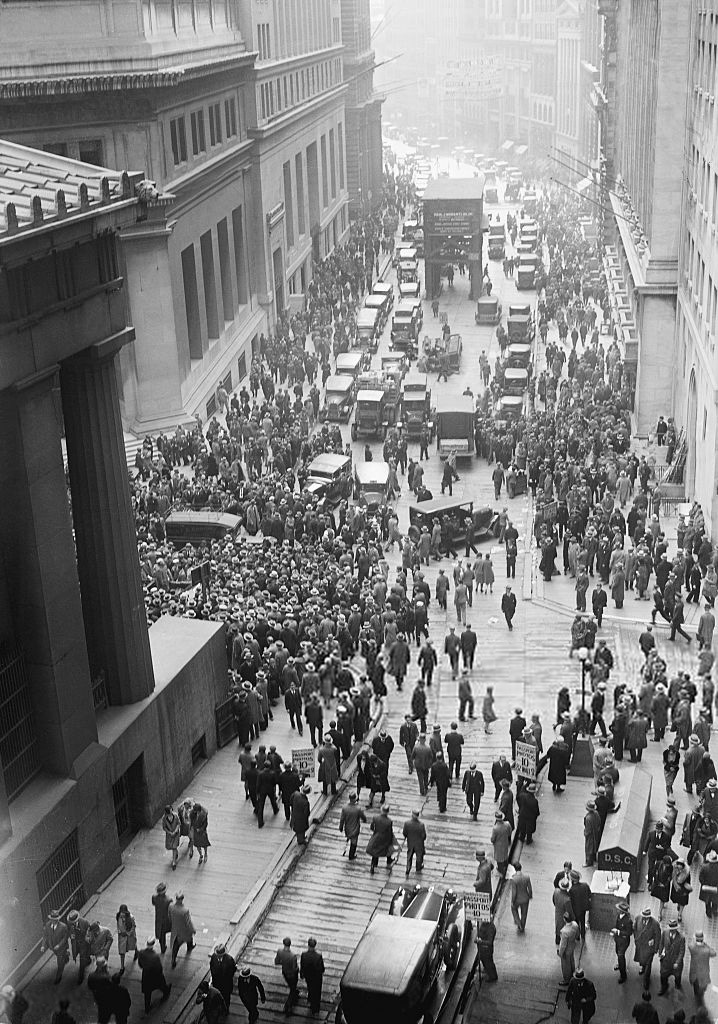
For generations, popular memory has simplified this catastrophe into a single, dramatic event: the stock market crash of October 1929. Black Thursday, Black Monday, and Black Tuesday have become shorthand for the moment prosperity ended and hardship began. Yet as every student of the period soon discovers, the crash was not the cause of the Great Depression but rather its most visible detonator—the spark that ignited a conflagration whose fuel had been accumulating for years.
This article examines the multiple, interconnected factors that brought the American economy to its knees. Drawing on recent peer-reviewed scholarship, we explore four primary causes: the structural weaknesses beneath the Roaring Twenties’ prosperity, the stock market crash of 1929 and its psychological aftermath, the banking panics and monetary contraction that transformed a recession into a depression, and the international transmission mechanisms that turned an American crisis into a global catastrophe. Throughout, we engage with the major historiographical debates, giving particular attention to radical political economy perspectives that locate the Depression’s origins in the inherent contradictions of capitalism itself.
The Illusion of Prosperity: Capitalism’s Inherent Instability
The 1920s are remembered as the Roaring Twenties—a decade of jazz, flappers, and seemingly limitless prosperity. Between 1922 and 1929, the U.S. stock market underwent a historic expansion, with the Dow Jones Industrial Average increasing nearly fivefold. As stock prices rose to unprecedented levels, investing in the stock market came to be seen as an easy way to make money, and even people of ordinary means used much of their disposable income—or even mortgaged their homes—to buy stocks.
Yet beneath this glittering surface, fundamental weaknesses were accumulating. For radical political economists like Leo Panitch and Sam Gindin, the prosperity of the 1920s masked deeper contradictions inherent to capitalism itself. In their groundbreaking analysis of capitalist crises, they argue that financial meltdowns must be understood not as aberrations but as expressions of “the inner logic of capitalism itself” . The Great Depression, from this perspective, was not a failure of policy or a correctable malfunction but a systemic crisis generated by capitalism’s normal operations.
David Harvey, the distinguished Marxist geographer, has articulated this perspective with particular clarity. Writing in the context of the 2008 crisis, Harvey observed:
“A synoptic view of the current crisis would say: while the epicentre lies in the technologies and organisational forms of the credit system and the state-finance nexus, the underlying problem is excessive capitalist empowerment vis-à-vis labour and consequent wage repression, leading to problems of effective demand papered over by a credit-fuelled consumerism of excess in one part of the world [the West, especially the U.S.] and a too-rapid expansion of production in new product lines in another [e.g., much of Asia]” .
Harvey’s analysis of the 2008 crisis applies equally to 1929. The “underlying problem” of the Great Depression, in this view, was “excessive capitalist empowerment” and the consequent “wage repression” that undermined mass purchasing power .
Income Inequality and Underconsumption
The statistical record bears out this interpretation. The decade’s industrial prosperity was concentrated at the top of the income distribution. Between 1923 and 1929, corporate profits increased by 62 percent, while wages and salaries increased by only 11 percent. Productivity gains, fueled by electrification and new manufacturing techniques, flowed disproportionately to capital rather than labor.
This created a crisis of underconsumption that contemporaries on the left recognized well before the crash. As one recent study notes, “The main reasons [for the Depression] were already understood by liberals and, especially, leftists of the time, years before John Maynard Keynes systematized some of their ideas. Central to them was the growing inadequacy of mass purchasing power in the U.S., in large part a consequence of the sickly state of organized labor” .
The statistics are staggering. “Income and wealth inequality, for example, approximated the pathological extremes of our own day, with the top 0.1 percent of families in 1929 receiving as much as the bottom 42 percent. The top 0.5 percent of Americans also owned 32.4 percent of all the net wealth of individuals” . Poverty was widespread: “12 million families—more than two in five—had incomes below $1,500, which itself was (according to the Brookings Institution) $500 below the income required to supply basic necessities. Seventy-one percent of families in 1929 earned less than $2,500 annually” .
Trade union membership had by 1929 declined from a wartime peak of 5 million to less than 3.5 million—out of a labor force of 49 million . This weakening of labor’s bargaining power was not incidental to the Depression but central to it. The capacity of working people to consume what they produced had been systematically eroded, creating a fundamental imbalance between the economy’s productive capacity and the population’s purchasing power.
The Credit Solution and Its Limits
Two mechanisms temporarily bridged this gap: consumer credit and stock market speculation. The 1920s saw the first widespread use of installment buying for automobiles, radios, and household appliances. By 1929, an estimated 60 percent of all automobiles and 80 percent of radios were purchased on credit. Consumer debt mounted steadily throughout the decade.
More dramatically, stock market speculation became a national obsession. By the end of the decade, hundreds of millions of shares were being carried on margin—meaning that their purchase price was financed with loans to be repaid with profits generated from ever-increasing share prices. This practice allowed investors to control large positions with relatively small down payments, typically as little as 10 percent cash. The system worked brilliantly as long as prices rose. When they stopped rising, it would prove catastrophic.
From a Marxist perspective, this credit-fueled consumption represented not a solution to capitalism’s contradictions but their postponement and intensification. As Panitch and Gindin argue in The Making of Global Capitalism, the state-finance nexus that emerged in the 1920s attempted to manage these contradictions but ultimately could not transcend them . The crash would reveal the fragility of the entire edifice.
The Stock Market Crash of 1929: Spark, Not Cause
The stock market did not crash in a single day but over the course of several panic-stricken weeks in October 1929. The market had actually been slipping since early September, but the dramatic decline began on “Black Thursday”—October 24, 1929—when the Dow Jones industrial average declined 2 percent, though on record volume of 12.9 million shares. On “Black Monday” (October 28), it plunged 13 percent; the next day, “Black Tuesday” (October 29), it fell a further 12 percent on volume of some 16 million shares—a record that would stand for decades.
Between September and November, stock prices fell 33 percent overall. Over the next three years, the decline would continue, with the U.S. stock market ultimately falling a staggering 89 percent from its 1929 peak, reaching its nadir in July 1932 when the Dow closed at 41.22. The index would not regain its 1929 peak until 1954.
The Psychological Aftermath
The psychological impact of the crash was profound. Millions of overextended shareholders who had lost everything were not the only ones affected. The crash shattered confidence in the economy among both consumers and businesses who had not themselves speculated. Accordingly, consumer spending, especially on durable goods, and business investment were drastically curtailed.
As spending fell, businesses responded by reducing production and laying off workers, which further reduced spending and investment in a vicious downward spiral. By 1930, 4 million Americans looking for work could not find it; that number had risen to 6 million in 1931.
Yet the crash alone, however devastating, need not have produced the decade-long catastrophe that followed. Previous financial panics—in 1873, 1893, 1907, and 1920—had produced severe but relatively short-lived depressions. What transformed this downturn into the Great Depression was a series of subsequent failures, particularly in the banking system.
Banking Panics and Monetary Contraction
In their influential 1963 work, A Monetary History of the United States, 1867–1960, Milton Friedman and Anna Jacobson Schwartz argued that the underlying cause of the Great Depression was a “great contraction” of credit due to an epidemic of bank failures. From the cyclical peak in August 1929 to the cyclical trough in March 1933, the stock of money in the United States fell by over one-third.
The Wave of Bank Failures
The credit crunch had surfaced several months before the stock market crash, when commercial banks with combined deposits of more than $80 million suspended payments. It reached critical mass in late 1930, when 608 banks failed—among them the Bank of the United States, which accounted for about a third of the total deposits lost. Despite its name, this was a private commercial bank, but its failure was particularly devastating because of its prominence in New York and its large immigrant customer base.
Between 1930 and 1932, the United States experienced four extended banking panics, during which large numbers of bank customers, fearful of their bank’s solvency, simultaneously attempted to withdraw their deposits in cash. Ironically, the frequent effect of a banking panic is to bring about the very crisis that panicked customers aim to protect themselves against: even financially healthy banks can be ruined by a large panic.
The numbers were staggering. In 1929 alone, 659 banks closed their doors. By 1932, an additional 5,102 banks went out of business. By early 1933, about 9,000 banks had failed in total, and $2.5 billion in deposits were lost.
The Federal Reserve’s Role and Its Class Character
According to Friedman and Schwartz, the Federal Reserve could have mitigated the crisis by cutting interest rates, making loans to banks, and buying government bonds through open-market operations to inject liquidity into the banking system. Instead, it made a bad situation worse. The Fed raised interest rates (further depressing lending) and deliberately reduced the money supply in the belief that doing so was necessary to maintain the gold standard.
From a Marxist perspective, however, the Fed’s actions were not merely technical errors but reflected the class character of monetary policy. As Panitch and Gindin argue, central banks in capitalist societies are fundamentally tasked with managing the contradictions of capitalism on behalf of the capitalist class . The Fed’s priority was not protecting working people’s deposits or maintaining employment but preserving the international gold standard—a mechanism that privileged financial interests and international creditors over domestic needs.
Only in April 1932, amid heavy political pressure from populist and progressive forces, did the Fed attempt large-scale open-market purchases—its first serious effort to counter the liquidity crisis. Even this did not suffice to avert a final wave of bank failures in late 1932, which precipitated the first state “bank holidays” (temporary statewide closures of all banks).
Debt Deflation and the Collapse of Borrowing
The banking crisis had consequences beyond the immediate loss of deposits. As banks failed or scrambled to survive, they called in loans and refused to extend new credit. This credit crunch forced more and more businesses to sell assets in a frantic dash for liquidity, driving down asset prices and making balance sheets look even worse.
Economist Irving Fisher articulated the theory of debt deflation to explain this process. As prices fell, the real burden of debt increased. Borrowers owed the same nominal amounts but were earning less money with which to repay them. This led to defaults, which further weakened banks, which further reduced lending, which further depressed prices—a vicious circle that Fisher called the “debt-deflation spiral.”
The Gold Standard and Imperial Rivalries
Whatever its effects on the money supply in the United States, the gold standard unquestionably played a role in the spread of the Great Depression from the United States to other countries. Under the gold standard monetary system, the standard unit of currency was kept at the value of a fixed quantity of gold and was freely convertible at home or abroad into a fixed amount of gold. The gold standard created, in effect, a single world money called by different names in different countries.
The Mechanism of Transmission
As the United States experienced declining output and deflation, it tended to run a trade surplus with other countries because Americans were buying fewer imported goods, while American exports were relatively cheap. Such imbalances gave rise to significant foreign gold outflows to the United States, which in turn threatened to devalue the currencies of the countries whose gold reserves had been depleted.
Accordingly, foreign central banks attempted to counteract the trade imbalance by raising their interest rates, which had the effect of reducing output and prices and increasing unemployment in their countries. The resulting international economic decline, especially in Europe, was nearly as bad as that in the United States.
Countries that abandoned the gold standard earliest—Britain in 1931—recovered first. The United States effectively devalued its currency in 1933 when Roosevelt took the nation off the gold standard, and this action, by allowing monetary expansion, is considered by many economists to have been crucial to the eventual recovery.
The Imperial Context
For radical political economists, the international dimensions of the Depression cannot be separated from the imperial rivalries that had culminated in World War I and continued to structure global capitalism in the 1920s. Panitch and Gindin’s analysis emphasizes how “the American state” emerged from this period as “the dominant force within global capitalism,” a position that would be consolidated through the New Deal and World War II .
The Depression, in this view, was not merely a national crisis but a crisis of the entire imperialist world system. The competition among capitalist powers for markets, resources, and spheres of influence had created an unstable international order that the gold standard attempted—and failed—to stabilize.
The Smoot-Hawley Tariff and Capitalist Competition
In June 1930, President Herbert Hoover signed the Smoot-Hawley Tariff Act, which raised already high import duties on a range of agricultural and industrial goods by some 20 percent, making them unaffordable for all but the wealthy. The act aimed to help American industry sell more home-produced goods by making foreign goods more expensive.
Retaliation and Trade Collapse
The legislation naturally provoked retaliatory measures by several other countries. Foreign countries responded by taxing American goods on sale in their countries. The cumulative effect was declining output in several countries and a dramatic reduction in global trade. International trade dropped by approximately 50 percent during the Depression years.
The tariff was particularly devastating for agricultural regions. It dramatically decreased the amount of exported goods, contributing to bank failures, especially in agricultural areas. Farmers who had been encouraged to overproduce during World War I and the 1920s now found themselves unable to sell their crops either at home (where consumers had no money) or abroad (where tariffs blocked access).
The tariff wars of the 1930s exemplified capitalism’s inherent tendency toward inter-imperialist rivalry. Unable to cooperate in managing the crisis, capitalist powers turned on one another, intensifying the downturn and creating conditions that would ultimately contribute to the outbreak of World War II.
The Dust Bowl: Capitalism and Environmental Degradation
In 1930, severe droughts in the Southern Plains brought high winds and dust from Texas to Nebraska, killing people, livestock and crops. In 1934, the worst drought in modern American history struck the Great Plains. Windstorms stripped topsoil and turned the whole area into a vast Dust Bowl, destroying crops and livestock and displacing some 2.5 million people.
The Dust Bowl was not a purely natural disaster. Decades of over-farming and poor agricultural practices—driven by capitalist agriculture’s relentless pressure for profit—had removed the deep-rooted grasses that held the Plains soil in place. When drought came, the exposed topsoil simply blew away in massive dust storms that darkened skies as far east as Washington, D.C.
The environmental catastrophe compounded the economic one. Farmers who had struggled through the 1920s and the early Depression years now lost their land entirely. Thousands of “Okies” and “Arkies”—refugees from the Dust Bowl—migrated to California and other western states in search of work, only to find competition for scarce jobs and hostility from local populations.
For environmental historians influenced by Marxist analysis, the Dust Bowl represented capitalism’s characteristic disregard for the natural conditions of production. The pursuit of short-term profit had destroyed the long-term fertility of the soil, leaving both land and people devastated.
Hoover’s Response: The Limits of Bourgeois Policy
Herbert Hoover had become president in 1929 after promising to bring prosperity to everyone in America with the slogan “a chicken for every pot.” However, Hoover thought that it was the job of charities to look after the poor, not the job of the government. He followed the policy of laissez-faire, believing that government should not interfere in what businesses were doing, and he believed in “rugged individualism”—the idea that people should sort out their own problems.
The Class Character of Hoover’s Policies
No U.S. government ever before had to deal with an economic problem as big as the Great Depression. To begin with, Hoover’s policies were not very effective. Eventually, Hoover did try to take actions he thought would help people. However, very little of what he tried had any effect before the 1932 presidential election.
Some of Hoover’s actions made the financial situation worse. In October 1929, Hoover asked Congress for a $160 million cut in income taxes. He believed that lower taxes would help struggling businesses to make more money. However, this left the U.S. government with less money to use to deal with the crisis. In December 1930, Hoover reversed this tax cut. The 1932 Revenue Act raised taxes for everyone, increasing the top level of income tax from 25 percent to 63 percent.
When he restricted the supply of bank notes to stop the value of money held by banks from falling, people had less money to spend. When he increased interest rates to make borrowing more expensive, it became more difficult for companies to get loans.
Hoover’s policies reflected his class position and his commitment to capitalist class interests. Even when he intervened—as with the Reconstruction Finance Corporation (RFC), created in January 1932 to provide emergency loans to struggling banks, insurance companies, and railroads—his focus was on propping up capitalist enterprises rather than providing direct relief to working people.
Popular Resistance and the Limits of Reform
While Hoover attempted to manage the crisis from above, working people organized from below. The unemployed did not passively accept their fate. As one study of the period notes, “Among the downtrodden emerged a significant anti-capitalist populism, often unrecognized in historical analyses. The mass rejection of capitalist practices and values was more thoroughgoing and significant than most historians have realized” .
Unemployed Councils, Workers Committees, and Unemployed Leagues sprang up across the country, organizing protests, eviction blockades, and hunger marches. These organizations “proved that it is possible to organize the unemployed” and demonstrated that “sweeping ideological appeals tend to be less effective and sustainable than appeals to concrete problems and material needs” .
Contrary to later portrayals of the unemployed as demoralized and apathetic, research shows that “the long-term unemployed are, rarely apolitical or apathetic. If they, like many others, sometimes seem so, that is only because they have been shut out of the political process and have no clear means of influencing it” .
This popular pressure from below would prove crucial in shaping the more ambitious reforms of the New Deal era. As Panitch and Leys have shown in their analysis of subsequent crises, working-class mobilization has repeatedly been essential to forcing even limited reforms from capitalist states .
Competing Explanations: From Keynes to Marx
Economists and historians continue to debate the relative importance of these various factors. The major interpretations fall into several categories: demand-driven theories, monetarist explanations, and radical political economy.
The Keynesian View
Keynesian economists argue that the depression was caused by a widespread loss of confidence that led to underconsumption. Once panic and deflation set in, many people believed they could avoid further losses by keeping clear of the markets. Holding money became profitable as prices dropped lower and a given amount of money bought ever more goods, exacerbating the drop in demand.
John Maynard Keynes himself argued that there were good reasons why investment does not necessarily increase in response to a fall in interest rates. Businesses make investments based on expectations of profit. If a fall in consumption appears to be long-term, businesses analyzing trends will lower expectations of future sales. Therefore, the last thing they are interested in doing is investing in increasing future production, even if lower interest rates make capital inexpensive.
In this view, the self-reinforcing dynamic of declining demand was the central problem, and only government spending could break the cycle by directly creating demand when the private sector would not.
The Monetarist View
Milton Friedman and Anna Schwartz offered a fundamentally different explanation. The Great Depression, in their view, was caused by the fall of the money supply. People wanted to hold more money than the Federal Reserve was supplying. As a result, people hoarded money by consuming less. This caused a contraction in employment and production since prices were not flexible enough to immediately fall. The Fed’s failure was in not realizing what was happening and not taking corrective action.
The Marxist Critique
For Marxist economists, both Keynesian and monetarist explanations remain within the horizons of capitalism itself. They seek to explain why capitalism malfunctioned and how it might be made to function better, rather than questioning whether capitalism as a system can ever serve human needs.
As Howard and King document in their comprehensive History of Marxian Economics, Marxian analyses of the Great Depression focused on capitalism’s inherent contradictions: the tendency of the rate of profit to fall, the exploitation of labor, and the recurrent crises of overproduction that characterize capitalist development . From this perspective, the Depression was not a correctable malfunction but an expression of capitalism’s fundamental nature.
Panitch and Gindin’s work on the 2008 crisis extends this analysis to our own time. They “provocatively challenge the call by much of the Left for a return to a largely mythical Golden Age of economic regulation as a check on finance capital unbound. They deftly illuminate how the era of neoliberal free markets has been, in practice, undergirded by state intervention on a massive scale” . Regulation, in this view, “is not a means of fundamentally reordering power in society, but rather a way of preserving markets” .
The conclusion they draw is radical: “it’s time to start thinking about genuinely transformative alternatives to capitalism—and how to build the collective capacity to get us there” .
Conclusion: A Crisis of Capitalism Itself
The Great Depression was not caused by any single factor but by a cascade of failures—structural weaknesses in the 1920s economy rooted in inequality and wage repression, the stock market crash that shattered confidence, banking panics that destroyed the financial system, monetary contraction that starved the economy of credit, the gold standard that transmitted the crisis worldwide, tariff wars that strangled trade, and environmental catastrophe that compounded rural misery.
For radical political economy, these multiple factors are not merely a list of unfortunate events but expressions of capitalism’s inherent contradictions. The Depression revealed what Marxists had long argued: that capitalism is incapable of providing for the needs of the many, that its periodic crises are not aberrations but features of the system, and that only a fundamental transformation of social relations can create a society organized around human need rather than profit.
President Herbert Hoover’s philosophical commitment to limited government and capitalist class interests prevented an effective federal response. By 1932, with unemployment at 25 percent, banks failing by the thousands, and homeless veterans marching on Washington, the stage was set for a dramatic change in direction.
That change would come with the election of Franklin D. Roosevelt in November 1932 and the inauguration of the New Deal in March 1933. But Roosevelt inherited an economy in far worse condition than the one Hoover had presided over. Understanding the multiple causes of the Depression—and particularly the class dynamics that shaped both its origins and the responses to it—is essential for appreciating both the magnitude of the challenge Roosevelt faced and the debates, still ongoing among historians and economists, about whether the New Deal ended the Depression, merely eased its worst effects, or demonstrated the need for more fundamental change.
What is clear is that the Depression left scars on American society that would last for generations. It spawned fundamental changes in economic institutions, macroeconomic policy, and economic theory. Its social and cultural effects were equally staggering. And it established the framework within which subsequent crises—including the Great Recession of 2008—would be understood and debated.
For those who, like Panitch and Gindin, seek “genuinely transformative alternatives to capitalism,” the Great Depression offers not only lessons about what went wrong but also evidence of popular resistance and the possibility of another world. The unemployed councils, the eviction blockades, the hunger marches—these too are part of the Depression’s legacy, reminding us that “the drive for democratic socialism will continue” .
References
Aizer, A., Early, N., Eli, S., Imbens, G., Lee, K., Lleras-Muney, A., & Strand, A. (2024). The lifetime impacts of the New Deal’s youth employment program. The Quarterly Journal of Economics, 139(4), 2579–2635.
Ferguson, N. (2008). The End of Prosperity? History News Network.
Wright, C. Down But Not Out: The Unemployed in Chicago during the Great Depression .
Het em, R. L. (2012). The Great Contraction, 1929–1933. In The Great Recession: Market Failure or Policy Failure? Cambridge University Press.
Horowitz, D. (2024). Demagoguery and the Depression. History Faculty Publications and Presentations, 103 .
Howard, M.C. & King, J.E. (1992). A History of Marxian Economics, Volume II: 1929-1990. Princeton University Press .
Panitch, L. (2013). Crisis of What. Journal of World-Systems Research, 19, 181-185 .
Panitch, L., Albo, G., & Gindin, S. (2010). In and Out of Crisis: The Global Financial Meltdown and Left Alternatives. PM Press .
Panitch, L. & Gindin, S. (2012). The Making of Global Capitalism: The Political Economy of American Empire. Verso .
Panitch, L. & Leys, C. (2020). Searching for Socialism. Verso Books .
Listen & Learn: Related Podcast Collections
Explore these curated episode collections to go deeper on the history behind this article:

Leave a Reply