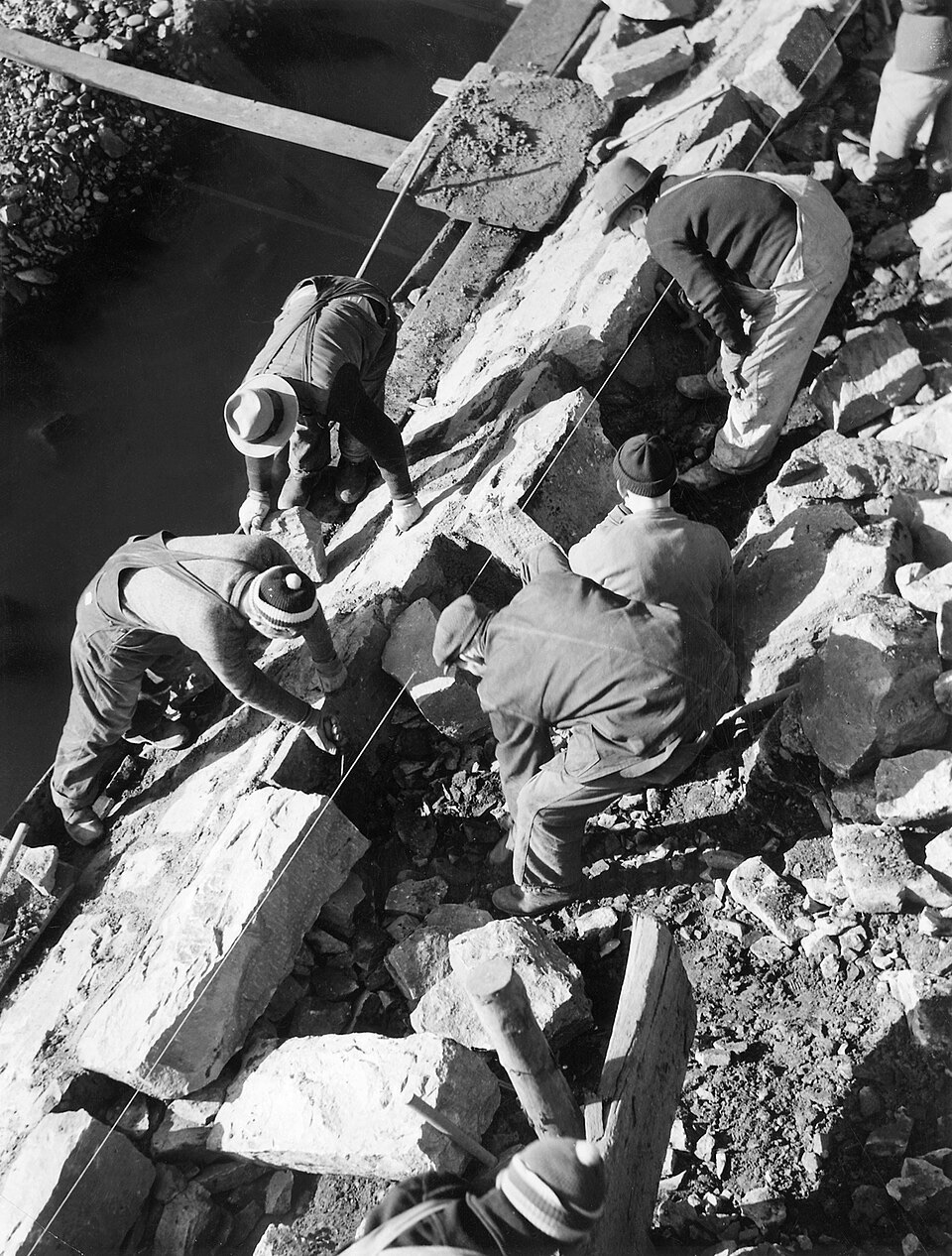

The Great Depression (1929–41) left no corner of the American West untouched. Farm and ranch communities were especially hard hit as prices for grains and livestock plunged, while drought conditions across the Great Plains between 1931 and 1937 created the catastrophic Dust Bowl. Mining, logging, fishing, and manufacturing economies suffered equally as demand for commodities fell, sending unemployment and foreclosure rates soaring. Banks failed, and cities sprouted Hoovervilles—makeshift squatter towns where the unemployed struggled merely to survive .
When Franklin D. Roosevelt took office in 1933, he promised the “forgotten man” relief through jobs. The New Deal subsequently radically refashioned the nation’s economy, transformed its cultural landscape, and brought the federal government into the daily lives of most Americans . Among the most ambitious of these initiatives were three flagship relief agencies: the Civilian Conservation Corps (CCC), the Works Progress Administration (WPA), and the Public Works Administration (PWA). Together, they constituted the first and largest fiscal expansion during peacetime in American history .
This article examines these three programs in depth, drawing on recent peer-reviewed scholarship and primary sources to evaluate what they accomplished for individual beneficiaries and for the nation as a whole. While historians and economists continue to debate whether the New Deal ended the Depression or merely eased its worst effects, the microeconomic evidence on these relief programs reveals a more nuanced story—one of genuine transformation for millions of individuals, even as the macroeconomy struggled to fully recover.
The Civilian Conservation Corps: Saving Young Men and the Environment
The Civilian Conservation Corps (CCC, 1933–42) was perhaps the most beloved of all New Deal programs. It employed young men aged 17 to 25 in unskilled, manual labor on conservation projects across the nation’s parks and forests. Under Army supervision, enrollees were sent to work in rural camps where they were fed, housed, and given access to medical care. Beyond work experience, the CCC provided academic and vocational courses, helped recipients find employment, and delivered cash transfers to participants’ families .
The scale of the program was remarkable for its time. Between 1933 and 1942, the CCC trained three million enrollees—representing approximately one-third of all American men aged 17 to 24—across 2,600 camps . Typical CCC pay was $30 per month, of which $25 was required to be sent home to support families. This requirement transformed the program into a direct transfer to struggling households while simultaneously providing young men with structure, skills, and purpose.
During the Great Depression, youth unemployment rates were estimated to exceed 25 percent and reached as high as 60 percent in some communities . The CCC directly addressed this crisis by removing young men from overburdened urban labor markets while channeling their labor into environmental preservation. Enrollees planted trees, fought forest fires, built park infrastructure, and implemented soil erosion control measures across millions of acres. At the Petrified Forest National Park in Arizona, for example, CCC workers refashioned the Painted Desert Inn between 1935 and 1940, giving it the pueblo-style look still enjoyed by visitors today .
The Lifetime Impact: New Evidence from Longitudinal Research
For decades, evaluating the CCC’s effectiveness was complicated by the absence of long-term data on participants. That has recently changed. A groundbreaking 2024 study by Aizer, Early, Eli, Imbens, Lee, Lleras-Muney, and Strand created the first individual-level dataset of CCC participants and their lifetime outcomes. The researchers digitized administrative records for roughly 25,000 men from CCC programs in Colorado and New Mexico, covering the population served in those states between 1938 and 1943. They then matched these enrollee records to complete-count 1940 U.S. census data, World War II enlistment records, Social Security Administration records, and individual death records .
The findings fundamentally reshape our understanding of the program’s impact. Training duration in the CCC varied from a few days to more than two years, with the average enrollee participating for nine months. The researchers found no evidence that those who trained longer came from systematically different socioeconomic backgrounds. Moreover, many enrollees with both short and long durations ended their training for arbitrary reasons, allowing for causal inference .
The results reveal a striking pattern: longer service in the CCC produced no measurable short- or medium-term labor market benefits. Participants did not experience higher employment rates or wages immediately after leaving the program. However, over their lifetimes, those who spent one year in the CCC experienced:
· 5.2 percent higher lifetime earnings
· Approximately one additional year of life
· Claimed Social Security benefits (disability or pensions) 0.4 years later in life
· 10 percent lower rates of Social Security Disability Insurance (SSDI) claims
These gains were mediated through several channels. Longer CCC service led to measurable improvements in height and weight in young adulthood—powerful proxies for improved nutrition and health during a critical developmental period. Participants also demonstrated increased geographic mobility toward healthier and richer areas, suggesting the program expanded horizons and opportunities beyond immediate relief. The longevity gains were only apparent after age 55, indicating that health benefits accumulated over decades .
The researchers concluded that the CCC provided important in-kind goods and services to disadvantaged populations in a time of need, improving their long-term health, productivity, and longevity. However, while these gains were substantial, they may not have been large enough to fully compensate individuals for the massive losses associated with the Great Depression .
The CCC’s Conservation Legacy
Beyond individual benefits, the CCC transformed America’s physical landscape. The program emphasized sustainable grazing and timber harvesting practices, shifting federal land management toward scientific strategies. Under the Taylor Grazing Act of 1934, President Roosevelt initiated the withdrawal of more than 160 million acres from the public domain in 1935, solidifying the federal government’s role as western land manager .
The CCC never enrolled more than about 300,000 men at any single time . Yet its cumulative impact on national and state parks, wildlife refuges, fish hatcheries, and soil conservation districts was enormous. The program built thousands of miles of trails, countless park structures, and infrastructure that continues to serve the public today. Modern programs such as Job Corps, the Youth Conservation Corps, and JobsFirstNYC are all modeled after the CCC, testament to its enduring influence as a template for youth employment and conservation policy .
The Works Progress Administration: The Giant of New Deal Employment
If the CCC was the New Deal’s beloved youth corps, the Works Progress Administration (WPA, 1935–43) was its massive industrial army. Under WPA chief Harry Hopkins, the program put over three million workers to work in its first year alone . By the time it was disbanded in 1943, the WPA had employed 8.5 million individuals and spent almost $11 billion, with 80 percent of that total going directly to wages .
President Roosevelt believed that most Americans were not looking for handouts—they wanted to work. The WPA embodied this philosophy by providing jobs rather than direct relief. In return for an average salary of $41.75 per month, WPA employees were deployed across hundreds of thousands of construction projects throughout the country .
The WPA’s focus was deliberately labor-intensive. The program stipulated that 90 percent of project budgets go to wages, maximizing the employment impact of each federal dollar . Roughly three-quarters of WPA jobs were in public works, with over half involving highway, road, and street construction. Other major projects included water and sewer systems, parks, public buildings such as schools and libraries, and municipal infrastructure including swimming pools, high school stadiums, and power grids .
Transforming America’s Infrastructure
The scale of WPA construction was staggering. Over its lifetime, the program built or repaired an estimated 650,000 miles of roads, fundamentally transforming rural and urban transportation networks. It constructed thousands of bridges, schools, hospitals, post offices, and other public structures that still dot the American landscape .
In tiny Kim, Colorado, for example, the WPA (operating through its predecessor, the Civil Works Administration) constructed fine stone buildings for a school and gymnasium during the 1930s that are still in use today . In Wyoming, the Natrona County administrative center (formerly the courthouse) was built by the PWA in 1940 and features Art Deco flourishes and bas-relief stone insets that chronicle the state’s history—a testament to how New Deal programs invested not just in function but in beauty and civic pride .
The WPA built New York’s first municipal airport—LaGuardia—and countless other major facilities. It electrified rural America through the Rural Electrification Administration, brought hydroelectric power through the Tennessee Valley Authority and Bonneville Power Administration, and constructed thousands of miles of levees and flood control projects .
Cultural Projects and the Federal Art Project
One of the most successful, if controversial, aspects of the WPA was the Federal Art Project (FAP), started in 1935. Employing artists, musicians, actors, and writers, the FAP focused upon nationalist and patriotic themes using the then-current genre of social realism. Major painters as well as unknown artists were employed, largely producing murals and sculpture for public buildings .
The program was based on a recognition that art was needed even in times of economic crisis. It successfully spread original art to many small American towns, operated over 100 community art centers, and compiled a 20,000-piece Index of American Design documenting American decorative arts . In San Francisco, the Coit Tower murals—commissioned through the Public Works of Art Project—remain a celebrated example of New Deal cultural patronage, depicting scenes of California life with social realist vigor .
In Wisconsin, the Federal Art Project was headed by Charlotte R. Partridge, director of the Layton Art Gallery in Milwaukee. The project produced extensive records including biographical sketches of Wisconsin artists, documentation of artworks produced, and materials relating to the Index of American Design. This documentation preserved not only art but the histories of artists who might otherwise have been forgotten .
The WPA’s Limits
Despite its enormous achievements, the WPA never succeeded in bringing the economy to full employment. By 1934, the unemployment rate had dropped to about 21 percent, and by 1937 only 14 percent of Americans were jobless . However, when WPA spending was cut back in 1937–38 as part of an ill-timed austerity push, unemployment rose again sharply—suggesting that the program’s stimulus was real but remained dependent on continued federal commitment .
The WPA was eased out of existence by 1943 as the American economy boomed due to World War II production . Congress refused to grant new appropriations, and the agency was disbanded despite its demonstrated role in helping the nation’s jobless maintain a minimum standard of living throughout the 1930s .
The Public Works Administration: Big Projects, Slow Spending
The Public Works Administration (PWA, 1933–39) differed fundamentally from both the CCC and the WPA. Created by the National Industrial Recovery Act in June 1933 and run by Secretary of the Interior Harold L. Ickes, the PWA was designed to spend “big bucks on big projects” . Its mission was to stimulate heavy industry and construction through massive infrastructure contracts with private firms.
The PWA was budgeted $3.3 billion—an enormous sum for the era—to be spent on public works as a means of providing employment, stabilizing purchasing power, improving public welfare, and contributing to a revival of American industry. Unlike the WPA’s labor-intensive approach, the PWA funded capital-intensive engineering projects: dams, bridges, hospitals, warships for the Navy, and large-scale electricity generation facilities .
Ickes, a famously cautious administrator, insisted on careful planning and rigorous review of all PWA projects. This ensured high-quality construction and minimal corruption but also meant that money spent slowly in the program’s early years. While this frustrated those seeking immediate relief, it produced infrastructure of lasting value .
Monumental Achievements
Between July 1933 and March 1939, the PWA funded and administered the construction of more than 34,000 projects. Streets and highways were the most common, with 11,428 road projects accounting for over 15 percent of the total budget. School buildings came second, with 7,488 constructed—14 percent of all PWA spending .
Some of the most famous PWA projects remain iconic American structures today:
· The Grand Coulee Dam in Washington state
· The Triborough Bridge and Lincoln Tunnel in New York City
· The Key West Highway in Florida
· Electrification of the Pennsylvania Railroad between New York and Washington, D.C.
The PWA also contributed to housing, though not as extensively as supporters had hoped, building only 25,000 units in four and a half years . Nevertheless, the program’s broader impact on industrial recovery was substantial. It helped push industrial production back toward pre-Depression levels and provided the federal government with its first systematic network for distributing funds to localities .
The PWA’s Uneven Legacy
Historians have noted that the PWA “had a far greater impact on the national infrastructure than on unemployment” in its early years . The program did not significantly change the unemployment level or help jumpstart widespread creation of small businesses. Its projects were too capital-intensive and slow to deploy to provide immediate jobs for the mass of unemployed workers .
Yet the PWA’s historical legacy may be as important as its practical accomplishments. It ensured that conservation would remain an element in national discussion, provided federal administrators with broad experience in public policy planning, and demonstrated that government could successfully manage massive engineering enterprises. The PWA also insisted that private contractors hired for PWA projects—urged but not required to hire the unemployed—and Ickes tried to ensure that African Americans received their share of jobs, establishing precedents for federal oversight of employment practices .
Comparative Assessment: Relief, Recovery, and Structural Transformation
Evaluating the effectiveness of the CCC, WPA, and PWA requires distinguishing among their different objectives. The CCC focused on youth development and conservation while providing family support through required remittances. The WPA prioritized maximum employment through labor-intensive public works. The PWA aimed to stimulate heavy industry through capital-intensive infrastructure.
What the Programs Achieved Together
Collectively, these three programs transformed the American landscape and the relationship between citizens and their government. They built infrastructure that still serves communities today: roads, bridges, schools, hospitals, parks, and utilities. They preserved natural resources and created the National Park system’s modern infrastructure. They supported American culture through the arts projects and preserved historical records .
For individual participants, the benefits extended across lifetimes. CCC enrollees experienced better health, higher lifetime earnings, and longer lives. WPA workers maintained their dignity through employment rather than charity and acquired skills that served them in subsequent employment. PWA projects employed hundreds of thousands in private industry and created assets that facilitated future economic growth .
The programs also established enduring institutional frameworks. The FDIC, SEC, Social Security, and federal labor standards all emerged from the same reform impulse that created the relief agencies. Rural electrification transformed farm life. Federal housing programs reshaped American homeownership. The regulatory state took form .
What They Could Not Accomplish
Despite these achievements, the relief programs did not end the Great Depression. Unemployment remained above 14 percent until wartime mobilization began in 1941. The recession of 1937–38, triggered by premature spending cuts, demonstrated the economy’s continued dependence on federal stimulus .
Some historians argue that the programs’ scale was simply insufficient relative to the crisis. The CCC never enrolled more than 300,000 men at once—meaningful but far from sufficient for a youth population facing 25 percent unemployment. The WPA employed three million at its peak, but with 12 to 15 million unemployed in the worst years, even this massive program could only reach a fraction of those in need .
Others note structural limitations. The requirement that 90 percent of WPA budgets go to wages, while maximizing employment, limited spending on materials and thus the multiplier effect on private industry. The PWA’s careful planning, while producing quality infrastructure, slowed stimulus precisely when rapid action was needed. Political constraints prevented even bolder experiments .
The Debate Among Economists
Economists continue to debate whether the New Deal prolonged the Depression or hastened recovery. Keynesians argue that insufficient spending left the economy trapped in underemployment equilibrium. Monetarists point to monetary policy mistakes and uncertainty created by New Deal interventions. Recent scholarship emphasizes that different programs had different effects and that individual-level outcomes sometimes diverged from macroeconomic aggregates .
What is clear is that for millions of Americans, these programs provided not just material support but hope. The CCC, WPA, and PWA embodied Roosevelt’s conviction that the federal government had both the capacity and the responsibility to act in times of crisis. They created physical and human capital that outlasted the Depression itself. And they established precedents for federal action that shaped American governance for generations.
Conclusion: The Enduring New Deal
The relief and jobs programs of the New Deal represented an unprecedented federal commitment to American workers and communities. The CCC transformed a generation of disadvantaged youth while preserving the nation’s natural heritage. The WPA put millions to work building infrastructure that still serves communities today. The PWA demonstrated that government could successfully manage massive engineering projects and stimulate heavy industry.
Recent scholarship reveals that these programs’ effects extended across participants’ entire lifetimes, improving health, earnings, and longevity in ways that short-term evaluations could not capture. While the New Deal did not end the Great Depression—wartime mobilization finally accomplished that—its relief programs fundamentally altered the trajectory of millions of individual lives and the physical and institutional landscape of the nation .
The CCC, WPA, and PWA left a complex legacy: genuine transformation alongside persistent limitations; hope realized for many but insufficient for all; infrastructure that still stands and institutions that still function. Understanding their full effects requires looking beyond macroeconomic aggregates to the individual experiences documented in newly available data and the physical evidence still visible in communities across America. In those schools, parks, bridges, and post offices—and in the longer lives of those who served—the New Deal’s relief programs remain present with us today.
References
Aizer, A., Early, N., Eli, S., Imbens, G., Lee, K., Lleras-Muney, A., & Strand, A. (2024). The lifetime impacts of the New Deal’s youth employment program. The Quarterly Journal of Economics, 139(4), 2579–2635.
America Builds: The Record of PWA. (2018). Forgotten Books. (Original work published 1935)
Ickes, H. L. (1935). Back to Work: The Story of PWA.
Living New Deal. (2025). How the New Deal benefitted rural Americans.
Smith, J. S. (2006). Building New Deal Liberalism: The Political Economy of Public Works, 1933–1956.
University of Wisconsin–Madison. (n.d.). Works Progress Administration (WPA) Federal Art Project records for Wisconsin.

Leave a Reply