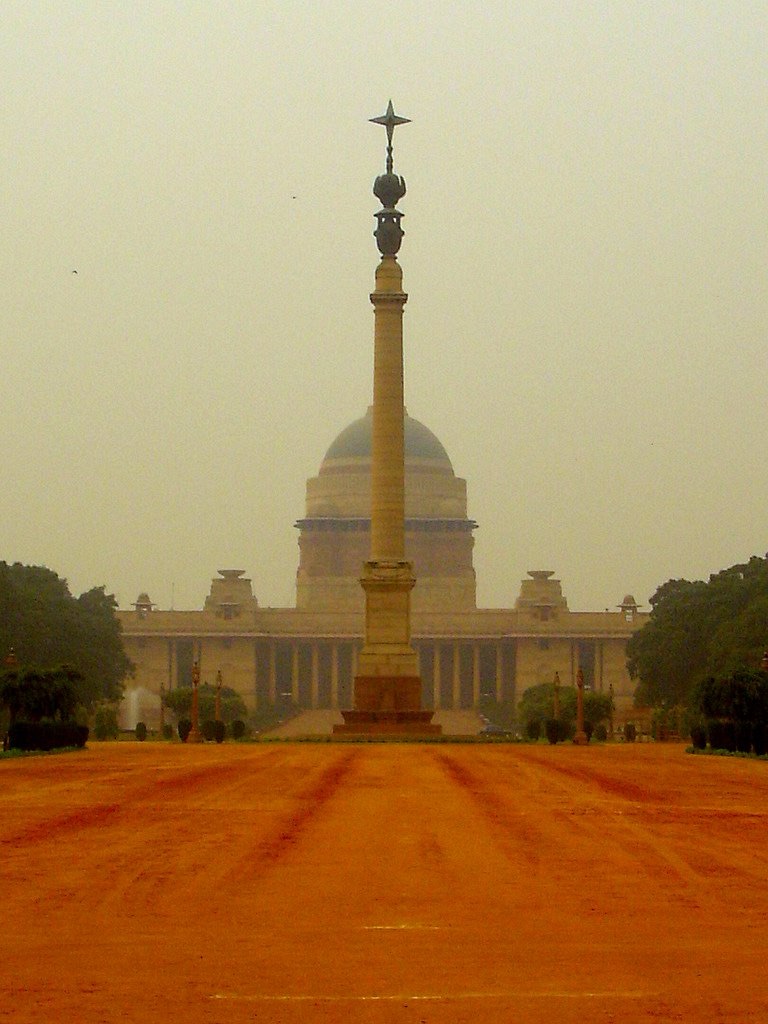

“In India, Lutyens took great pride in the plan of New Delhi as ‘the city of a just ruler’. This is telling of a clear message: the Raj was there to stay.” — Thomas R. Metcalf, An Imperial Vision: Indian Architecture and Britain’s Raj
On a crisp December day in 1911, King-Emperor George V stood before a vast, empty plain south of Old Delhi. With a tap of a mallet, he laid the foundation stone for a new imperial capital, declaring it would stand for all time as a symbol of British power in India. A continent away, in the dusty plains of Morocco, French Resident-General Hubert Lyautey had already begun a similar project in Rabat, sketching a Ville Nouvelle (New Town) destined to be a “garden city” of colonial order. These were not mere construction projects; they were acts of supreme political theater.
This article argues that the construction of New Delhi (1911-1931) under the British and the Ville Nouvelle of Rabat (c. 1912 onward) under the French were the ultimate architectural expressions of late colonial ideology. Far beyond administrative necessity, these planned capitals were grand ideological statements in stone, landscape, and space. Their design—employing a calculated fusion of “Western” and “indigenous” motifs—visually articulated and enforced the core theories of indirect rule and colonial hierarchy. They were designed not only to overawe the colonized subject but to persuade the colonial ruler of his own timeless, benevolent legitimacy. In their wide boulevards, segregated quarters, and stylized facades, we can read the blueprints of imperial dreams, dreams that ultimately proved as fragile as the empires that built them.
The Blueprint of Dominion: Architecture as Colonial Ideology
Before a single stone was laid in New Delhi or a boulevard plotted in Rabat, the ideological foundations were set. Colonial architecture was never a neutral art; it was a tool of governance, a “civilizing mission” rendered in concrete and marble. This mission, professing a duty to uplift “backward” peoples, was steeped in racial superiority and provided a moral alibi for economic exploitation and political control. It created a world where, as psychological theorists like W.E.B. Du Bois and Frantz Fanon later analyzed, the colonized subject was trapped in a “double consciousness,” forced to see themselves through the denigrating lens of the colonizer.
Architecture became a primary medium for broadcasting this ideology. It performed three key functions:
- Legitimation: It aimed to create an aura of permanence, destiny, and natural authority for the foreign regime.
- Segregation: It physically inscribed racial and social hierarchies into the very plan of the city, regulating contact and enforcing difference.
- Narrative Control: By selectively incorporating and reinterpreting indigenous architectural elements, it told a story of the colonial power as the rightful, synthesizing heir to local traditions, not its destroyer.
New Delhi and Rabat represent the apex of this ideological project, each tailored to its empire’s specific governing philosophy.
New Delhi: The Imperial Acropolis and the Grammar of Synthesis
The British decision to move India’s capital from Calcutta to Delhi was profoundly symbolic. Delhi was the storied seat of prior empires—Mughal, Sultanate—and by building there, the British Raj inserted itself directly into that lineage. The task of designing this imperial acropolis fell to architect Edwin Lutyens and his collaborator, Herbert Baker.
The Vision: An Orderly, Hierarchical Universe
Lutyens’ plan was a masterpiece of geometric authority. At its heart lay the immense King’s Way (now Rajpath), a two-mile ceremonial axis running from the Viceroy’s House (now Rashtrapati Bhavan) to the National War Memorial Arch (India Gate). This axis was not a street for commerce or community; it was a processional route for imperial pomp, designed for visual dominion. The entire city was laid out in a low-density, garden-city pattern of broad, tree-lined avenues and sprawling bungalow compounds, a stark contrast to the dense, organic morphology of Old Delhi. This spatial order communicated control, hygiene, and separation.
Architectural Fusion: Edwardian Baroque in a Mughal Dialect
Lutyens did not want a purely European city. He sought a “Western architecture with an Oriental motif,” creating what historian Thomas Metcalf calls an “imperial style.” This was not respectful homage but calculated appropriation. Key features included:
· The Mughal Garden: The gardens of the Viceroy’s House formalized the Persian charbagh (four-part garden) within strict European symmetry.
· The Chhajja and Jali: The deep stone sunshade (chhajja) and perforated stone screen (jali), traditional for climate control, were stylized and used as decorative elements on monumental facades.
· The Dome: The great dome of the Viceroy’s House, while inspired by the Buddhist stupa at Sanchi, was stripped of its religious context and scaled to surpass any Mughal precedent.
This synthesis served a clear ideological purpose. It suggested that British rule was not a violent rupture but a natural, superior evolution of Indian history—a rule capable of appreciating and perfecting local tradition. It visually enacted the “civilizing mission” by framing Western forms as the logical, modern container for curated Eastern details.
The Spatial Politics of Exclusion
The plan’s hierarchy was social and racial. At the summit was the Viceroy’s House, on Raisina Hill, literally and figuratively overlooking all. Below were the spacious bungalows of the European civil and military officers. The Indian population, even the princes and elites who collaborated with the Raj, were accommodated in separate zones. The walled city of Old Delhi was left as a congested, “picturesque” counterpoint—the unplanned, “traditional” past against which the modern, planned New Delhi defined itself. This segregation was the physical manifestation of the colonial belief in fundamental, irreconcilable difference.
Rabat: The “Garden City” and the Aesthetics of Association
If New Delhi was an imperial acropolis, Rabat’s Ville Nouvelle was conceived as a model colonial garden city. Its mastermind, Marshal Hubert Lyautey, the first French Resident-General of Morocco, was a disciple of the policy of “association.” Unlike the British “synthesis,” association did not aim for a hybrid style. It advocated for parallel development: preserving (and fossilizing) the Moroccan medina (old city) while building a modern, European city distinct and separate from it.
Lyautey’s Doctrine: Preservation as Control
Lyautey famously ordered his planners to “save the medina.” This was not an act of preservationist benevolence but a core tenet of indirect rule. By freezing the indigenous city in time as a living museum of “traditional” craft and social order, he sought to prevent the social unrest that rapid modernization in Algeria had caused. The old city was to remain picturesque, administratively manageable, and economically dependent. The modern world—with its banks, railways, and government—would exist next door, in the French quarter.
The Plan: Order, Hygiene, and Scenic Vistas
The planner Henri Prost designed the Ville Nouvelle with sweeping boulevards, public squares, and ample greenery. It emphasized vistas—long, controlled sight lines often terminating at a monument or a gate of the old city, constantly framing the “traditional” Morocco as a spectacle to be viewed from the modern European space. Zoning was strict, separating administrative, commercial, and residential functions with a clinical efficiency absent in the medina. This was the “civilizing mission” urbanized: offering a vision of progress, hygiene, and rational order that was physically and aesthetically inaccessible to most Moroccans.
Architectural Language: Art Deco and the “Berber Style”
While the urban plan was resolutely European, the architectural style of public buildings in Rabat engaged in its own form of selective borrowing. The Art Deco style, popular in the 1920s and 30s, became the vehicle. Architects like Edmond Brion and Albert Laprade infused Deco’s geometric forms with motifs labeled “Berber”: zigzag patterns, stylized calligraphy, and fortress-like crenellations. This “neo-Moorish” or “Berber Deco” style, seen in buildings like the Central Post Office and the Bank of Morocco, created a modern, distinctly French-colonial aesthetic. It referenced local heritage in a way that was decorative and detached, signaling French authority’s sensitivity without conceding any real political or cultural parity. It aestheticized difference while maintaining absolute power.
Comparative Blueprints: Two Cities, One Imperial Logic
Despite their different aesthetic vocabularies—Lutyens’ grand synthesis versus Prost’s modern segregation—New Delhi and Rabat shared a profound common logic.
Shared Imperial Strategies:
· The Vista of Power: Both cities used monumental axes (King’s Way in Delhi, the boulevards of Rabat) to organize space around symbolic power and control the colonizer’s gaze.
· Spatial Segregation: Both implemented rigid zoning that physically enforced racial and social hierarchies, separating the “native” city from the European quarters.
· Stylized Appropriation: Both selectively mined indigenous architecture for motifs (Mughal, Berber) to create a new style that legitimized colonial rule as culturally astute and historically destined.
· The Theater of Governance: Both capitals were designed as stages for the ritual performance of colonial authority—durbar ceremonies in Delhi, official parades in Rabat.
Divergences in Colonial Philosophy:
· British Synthesis vs. French Association: New Delhi’s architecture aimed for a unified, hybrid imperial style, visually integrating the Raj into India’s history. Rabat’s plan emphasized duality, keeping the “modern” and “traditional” separate to better manage both.
· Scale of Grandeur: New Delhi was conceived on a breathtaking, super-human scale meant to inspire awe. Rabat, though imposing, pursued a more “humane,” garden-city ideal meant to illustrate the benefits of French mission civilisatrice.
The Cracks in the Facade: Resistance and Legacy
These stone fantasies of eternal dominion were short-lived. New Delhi was inaugurated in 1931; within 16 years, the British Raj was gone, and the Indian tricolor flew over the Viceroy’s House. Rabat’s Ville Nouvelle became the capital of an independent Morocco in 1956.
The Limits of Architectural Propaganda
The colonized subjects were not passive audiences for this architectural theater. The very spaces designed to overawe them became sites of resistance. The maidans (parades) of New Delhi witnessed both imperial durbars and nationalist protests. The elegant boulevards of Rabat saw marches for independence. The “double consciousness” engendered by colonialism—the internal conflict of navigating the colonizer’s world—played out in these very spaces. The native intellectual or functionary, educated in Western ways but barred from full equality (the évolué or assimilado), walked these streets daily, embodying the contradictions the architecture tried to mask.
Post-Colonial Afterlives: Reclaiming the Stage
The post-colonial fate of these cities is a final chapter in their ideological story. Independent India and Morocco did not raze the colonial capitals; they repurposed them.
· In New Delhi, the Rajpath remains the ceremonial heart of the Republic, now used for Republic Day parades celebrating Indian democracy. The Viceroy’s House became the Rashtrapati Bhavan, home to India’s elected president. The power of the architecture was retained, but its symbolism was utterly transformed from imperial rule to sovereign democracy.
· In Rabat, the Ville Nouvelle seamlessly became the administrative center of the modern Moroccan kingdom. The French-built infrastructure was adopted and expanded. The preservation of the medina, initially a colonial strategy, is now a point of national pride and UNESCO World Heritage status.
This repurposing is the ultimate negation of the colonial vision. It proves that stone and space, no matter how ideologically charged, are ultimately inert. Their meaning is dictated not by their original designers, but by the people who inhabit them and the history they choose to make.
Conclusion: The Ruins of a Dream
New Delhi and Rabat stand today as magnificent, complex palimpsests. In their grand plans and fused styles, we can read the late colonial mind at its most ambitious and its most anxious. These were not just cities, but the last, grandiose attempts to materialize a dying world order—to build a belief in racial hierarchy and imperial destiny so solidly in stone that it would seem as eternal as the buildings themselves.
Yet, the empires fell, and the buildings remained. The “architectural theater of power” now stages a different show. The capitals built to symbolize unshakeable foreign control were, in the end, the most lavish guesthouses of empire—temporary accommodations vacated by their builders but left for the rightful owners to reclaim. They teach us that while architecture can be a powerful language of ideology, it is the people—moving through its spaces, contesting its meanings, and inscribing their own histories upon it—who hold the final pen in writing the story a city tells.

Leave a Reply