
Introduction: The Failure of Imagination
On May 10, 1940, the German Schwerpunkt (main effort) slammed into the French lines exactly where the French High Command had decided it could not possibly come: the Ardennes Forest.
For decades, the popular narrative of this intelligence failure has been one of surprise. It suggests that the Allies were caught unawares, blind to the German buildup. This is false. The French Deuxième Bureau (Military Intelligence) and the Swiss intelligence services had provided ample warnings of German concentrations on the Luxembourg border. Aerial reconnaissance had spotted Panzer columns stretching back for miles. The French High Command possessed the information. They simply refused to believe it.
This article explores the psychological phenomenon of “cognitive dissonance” in military decision-making. It argues that the French failure was not a lack of data, but a failure of processing. General Maurice Gamelin and his staff were trapped in a “mirror-imaging” mindset: they assumed the Germans would act as they would act. Because the French doctrine deemed the Ardennes “impassable” for tanks, they assumed the Germans shared this assessment. This intellectual rigidity turned the Ardennes from a geographical barrier into a psychological trap, allowing the Wehrmacht to achieve one of the greatest strategic surprises in history against an enemy who was watching them do it.
The Mirror Image: Why the Ardennes was “Impossible”
The French assessment of the Ardennes sector was rooted in the tenure of Marshal Pétain. In 1934, during a parliamentary hearing, Pétain declared the Ardennes to be “not dangerous.” He argued that the dense forests, steep ravines, and narrow winding roads made it impossible for a modern army to deploy there. “If they come that way,” he famously said, “we will pinch them off at the exit.”
This assessment became dogma. It was codified in French war plans. The Ninth Army, commanded by General André Corap and tasked with defending the Meuse sector opposite the Ardennes, was the weakest formation in the French order of battle. It was composed of older reservists (Series B divisions), possessed few anti-tank guns, and almost no anti-aircraft artillery.
The French logic was mathematically sound, if one assumed the Germans followed French doctrine. French tanks moved slowly and required massive logistical tails. To move seven Panzer divisions through the Ardennes using French movement tables would take weeks, creating a traffic jam that would be easy prey for the French Air Force.
The Germans, however, were not using French movement tables. They were gambling on traffic control. The “Manstein Plan” (Operation Sichelschnitt) was a logistical nightmare. It required pushing 41,000 vehicles through four narrow roads. German planners like Guderian calculated they could do it in three days if they moved day and night and ignored flank security. The French dismissed this as a fantasy. They projected their own caution onto a reckless enemy.
The Mechelen Incident: The Intelligence that Blinded
On January 10, 1940, a German Bf 108 courier plane crash-landed in Mechelen-sur-Meuse, Belgium. On board was a Luftwaffe major carrying the complete plans for Fall Gelb. The Belgians captured the documents, which detailed a conventional attack through central Belgium—a reprise of the 1914 Schlieffen Plan.
This intelligence coup was a catastrophe for the Allies. It confirmed Gamelin’s pre-existing bias. He had always believed the main German blow would come through the Gembloux Gap (the flat plains north of the Ardennes). The Mechelen documents proved him “right.”
Consequently, Gamelin committed his strategic reserve—the elite 7th Army under General Giraud—to a daring dash into the Netherlands (the Breda Variant) to link up with the Dutch. He moved his best mobile forces away from the center (the Ardennes) to the far left flank.
Crucially, the Germans reacted to the compromise by changing their plan. General Erich von Manstein convinced Hitler that the original plan was too predictable. The Germans shifted their weight to the Ardennes. The Allies, however, assumed the Germans would stick to the captured plan or a variation of it. The Mechelen Incident locked the Allies into the Dyle-Breda Plan, while liberating the Germans to adopt the Manstein Plan. It was the perfect intelligence trap: true information that led to a false conclusion because the enemy adapted.
The Warnings Ignored: “The Trees are Moving”
In the weeks leading up to May 10, the warning lights were blinking red.
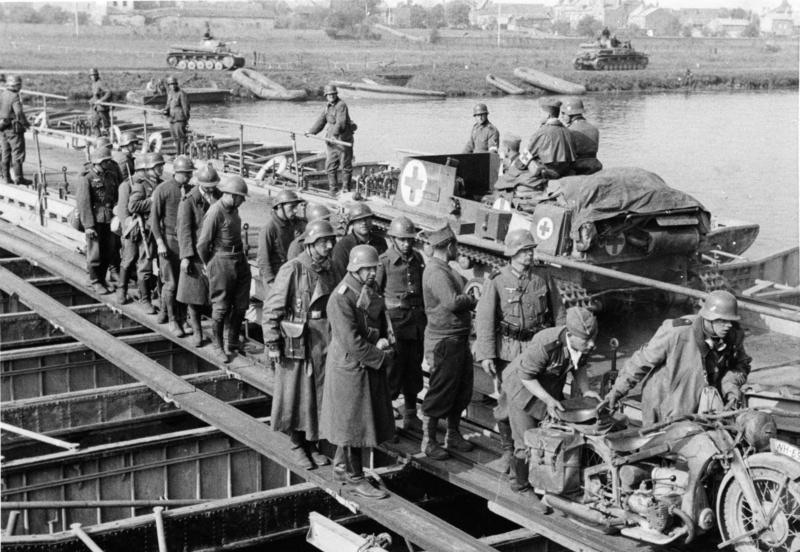
- The Swiss Connection: The “Viking Line”—a Swiss intelligence network—reported heavily on German movements. Colonel Roger Masson, chief of Swiss intelligence, warned the French that pontoon bridging equipment (useless in the flat plains but essential for the Meuse river) was massing opposite the Ardennes.
- Aerial Reconnaissance: On the morning of May 10 and the preceding days, French reconnaissance pilots reported massive columns of vehicles in the Luxembourg sector. One pilot famously reported, “The trees are moving,” referring to the camouflage.
- The Vatican: The Vatican, receiving information from anti-Nazi elements in the German resistance (the Oster Conspiracy), passed warnings to Brussels and Paris about an imminent attack in the south.
Why were these ignored? This is the classic problem of “noise” versus “signal.” The Allies were receiving hundreds of reports daily. Many pointed to the north; some pointed to the Maginot Line; some pointed to Switzerland.
Gamelin and his intelligence chief, Colonel Gauché, filtered these reports through their “confirmation bias.” Reports that indicated a northern attack were accepted as “signal.” Reports that indicated an Ardennes attack were dismissed as “noise” or German deception measures. They believed the columns in the Ardennes were a feint to draw French reserves away from the real battle in Belgium.
The “Impossible” Traffic Jam
On May 11 and 12, the German Panzer group Kleist was indeed stuck in a traffic jam of epic proportions in the Ardennes. The columns stretched back for 250 kilometers. It was the largest traffic jam in military history.
French reconnaissance planes saw this. They reported it. If the French Air Force had launched a massive bomber offensive against these stationary targets on the winding mountain roads, the German offensive might have been strangled in its crib.
However, the French Air Force command structure was paralyzed. The priority was covering the advance of the French Army into Belgium. The reports of the traffic jam were viewed with skepticism—”It cannot be the main effort because no one would be stupid enough to put that many tanks on those roads.”
General Huntziger, commanding the Second Army, refused to authorize pre-emptive artillery fire on the approach routes because he wanted to conserve ammunition for the “real” battle. He was fighting the war he imagined, not the war that was happening.
The Fog of War and the Speed of Collapse
When the Germans emerged from the forest on May 12, the French command simply could not process the speed of events.
The French intelligence cycle operated on a 24-hour basis. Reports were gathered during the day, analyzed in the evening, and briefed to the generals the next morning. By the time Gamelin sat down for his morning briefing on May 13 to hear about German “probes” at the Meuse, Guderian was already crossing the river.
The French commanders were victims of “temporal displacement.” They were issuing orders to defend the river while the enemy was already seizing the heights behind them. This intelligence lag induced a state of shock. When reality diverged so violently from their model, the commanders froze. General Corap of the Ninth Army suffered a nervous breakdown. General Gamelin lapsed into a strange passivity.
The Spy Hysteria: Seeking a Scapegoat
As the front collapsed, the French public and the rank-and-file soldiers could not believe that their generals had simply been outsmarted. They sought a more sinister explanation: treason.
The “Fifth Column” myth exploded. Rumors spread that German spies disguised as nuns or priests were directing Stuka attacks with mirrors. There were stories of farmers plowing arrows into fields to point the way for Panzers.
This paranoia was devastating. It led to the summary execution of innocent civilians and the breakdown of unit cohesion. Soldiers looked at their officers with suspicion—”Are they leading us into a trap?” It was easier to believe in a vast, omnipresent German spy network than to accept the mundane reality that the French High Command had made a catastrophic intellectual error.
Conclusion: The Prison of the Mind
The intelligence failure of 1940 was not a failure of acquisition; it was a failure of analysis. The French High Command had constructed a rigid mental model of the world. In this model, the Ardennes was a wall, the Germans were rational actors who followed French doctrinal rules, and the war would be a slow accumulation of force.
When the Germans refused to play by these rules, the French mind refused to accept it. They filtered out the warning signals because the truth was too terrifying to contemplate. If the Ardennes was permeable, then the entire French strategic plan was a suicide pact. Rather than face that reality, they chose to look away until the Panzers were crossing the Meuse. The defeat of France proves that the most dangerous fortification is not one made of concrete, but one made of assumptions.
Historiographical Note
1. The “Confirmation Bias” Thesis
Ernest R. May (Strange Victory) provides the definitive analysis of the intelligence failure. He uses modern decision-science theory to explain how Gamelin and his staff fell victim to cognitive biases. They were not stupid; they were “too smart”—they rationalized away evidence that contradicted their sophisticated but flawed worldviews.
2. The Role of Deception
Barton Whaley (Stratagem: Deception and Surprise in War) argues that the Germans actively fed the French confirmation bias. Operation “Breda”—the German push into Holland—was designed to look exactly like the attack the French expected, locking their attention north while the blow fell south.
3. The Swiss Connection
Christian Rossé (Le Service de renseignements suisse face à la menace allemande) details the high quality of Swiss intelligence provided to the French. This revisionist work demonstrates that the “surprise” was purely internal to the French command; the external network worked perfectly.
4. The Manstein Plan Revisionism
Karl-Heinz Frieser (The Blitzkrieg Legend) debunks the idea that the Ardennes plan was a long-held genius strategy of Hitler. He shows it was a last-minute improvisation (the “Manstein Plan”) adopted only after the Mechelen Incident compromised the original plan. This makes the French failure even more tragic—they were defeated by a plan that was barely weeks old.
Further Reading
- May, Ernest R. Strange Victory: Hitler’s Conquest of France (Hill and Wang, 2000).
- The essential text on the intelligence failure. May dissects the decision-making process in Paris and Berlin, showing how the French trapped themselves.
- Frieser, Karl-Heinz. The Blitzkrieg Legend: The 1940 Campaign in the West (Naval Institute Press, 2005).
- Provides the detailed German context of the Manstein Plan and the risks Guderian took in the Ardennes.
- Hinsley, F.H. British Intelligence in the Second World War (Her Majesty’s Stationery Office).
- (Volume 1). Covers the British side of the intelligence failure, showing that MI6 was equally culpable in dismissing the Ardennes threat.
- Kahn, David. The Codebreakers (Macmillan, 1967).
- (Relevant chapters). Discusses the role of signals intelligence (or the lack thereof) in the 1940 campaign.
- Strong, Kenneth. Intelligence at the Top (Cassell, 1968).
- Memoirs of a British intelligence officer that give a firsthand account of the confusion and denial in the Allied HQs.

Leave a Reply