
Introduction: The Eastern Question and the Balance of Power
By the summer of 1914, the “Eastern Question”—the diplomatic shorthand used by European chancelleries to describe the problem of the Ottoman Empire’s territorial disintegration—had ceased to be a theoretical concern and had become an immediate strategic crisis. For nearly a century, the European powers had managed the decline of the Ottoman state through a complex system of checks and balances. The survival of the Empire was not born of Ottoman strength, but of European rivalry; the Great Powers preferred a weak Ottoman buffer to a chaotic vacuum or, worse, the dominance of a single rival in the Eastern Mediterranean.
However, in the years immediately preceding the First World War, the calculus of the Great Powers shifted. The geopolitical utility of the Ottoman Empire as a stabilizer had eroded. The rise of the Committee of Union and Progress (CUP) in Istanbul, the empire’s humiliating defeats in the Balkan Wars of 1912–1913, and the intrusion of German economic and military power into the Near East fundamentally altered the strategic landscape.
The eventual partition of the Middle East, later codified in the 1916 Sykes-Picot Agreement, was not a spontaneous wartime improvisation. It was the result of a profound realignment in British, French, and Russian foreign policy that occurred between 1908 and 1914. This article analyzes the diplomatic and strategic environment prior to the outbreak of hostilities, examining how the conflicting imperatives of the Entente powers and the internal convulsions of the Ottoman state set the stage for the redrawing of the map of the Middle East.
The British Strategic Pivot: From Preservation to Partition
For the majority of the 19th century, British policy in the Near East was governed by the doctrine of preservation. British Foreign Secretaries, from Palmerston to Disraeli, viewed the maintenance of Ottoman territorial integrity as a vital national interest. The Ottoman Empire functioned as a massive geographical barrier, preventing Russian expansion into the Mediterranean and protecting the overland and maritime routes to British India.
By 1908, this policy was becoming untenable. Two factors drove a shift in British strategic thinking: the rise of German naval and colonial power, and the changing energy needs of the Royal Navy.
The primary threat to British hegemony in the 19th century had been Russia. However, the Anglo-Russian Convention of 1907 settled many of the colonial disputes between London and St. Petersburg in Central Asia. The new threat was the German Empire. Under Kaiser Wilhelm II, Germany pursued Weltpolitik (world policy), which included a concerted “Drive to the East” (Drang nach Osten).
The German Challenge and the Berlin-Baghdad Railway
The physical manifestation of this policy was the Berlin-Baghdad Railway. This infrastructure project, financed by the Deutsche Bank, aimed to connect Central Europe directly to the Persian Gulf, bypassing the British-controlled Suez Canal. For British planners, the railway was a strategic nightmare. It threatened to bring a hostile European army within striking distance of the Persian Gulf and the frontiers of India. The increasing German influence in Istanbul, solidified by military missions to train the Ottoman army, suggested to the British Foreign Office that the Ottoman Empire was no longer a neutral buffer, but a potential German satellite.
Simultaneously, a technological revolution was altering British strategic priorities. In 1911, Winston Churchill became the First Lord of the Admiralty. Under his tenure, the Royal Navy began the transition from coal-fired steam engines to oil-fired internal combustion engines. This decision granted the fleet greater speed and range, but it created a new strategic vulnerability: Britain had abundant coal, but no oil.
The Admiralty and the Oil Imperative
The Anglo-Persian Oil Company (which would later become BP) had discovered significant oil deposits in Persia (Iran), near the Ottoman border. The security of the Abadan refinery and the Shatt al-Arab waterway—the confluence of the Tigris and Euphrates rivers at the head of the Persian Gulf—became a matter of supreme national security. The Ottoman vilayets (provinces) of Basra and Baghdad were no longer just distant trade outposts; they were the flank of Britain’s energy supply. This shifted the British focus from simply keeping Russia out of Constantinople to actively securing the Mesopotamian littoral.
The Russian Imperative: The Straits and the Warm Water Port
While Britain reassessed its commitment to Ottoman integrity, Imperial Russia remained fixated on a singular geographic objective: the Turkish Straits (the Dardanelles and the Bosporus).
For Russia, the Straits were an economic windpipe. By 1913, 75% of Russia’s grain exports—the primary source of the Tsarist empire’s foreign currency—passed through the Bosporus. The ability of the Ottoman government to close the Straits during times of war (as happened during the Italo-Turkish War of 1911) threatened the Russian economy with strangulation.
Strategically, the Black Sea fleet was trapped. Russia’s desire for access to the “warm waters” of the Mediterranean required control over Constantinople (Istanbul). The Foreign Minister, Sergey Sazonov, viewed the Ottoman presence in Europe as a temporary anomaly. Following the Ottoman defeat in the Balkan Wars, St. Petersburg became convinced that the collapse of the Sultan’s rule was imminent. Russia’s entry into any general European war would therefore carry a non-negotiable war aim: the annexation of Constantinople and the Straits. This ambition was widely known in London and Paris and served as the price for keeping Russia in the Triple Entente.
The French Connection: Finance and the Civilizing Mission
France’s interest in the Ottoman lands differed in character from its allies. It was less strictly military and more deeply rooted in finance and cultural prestige. France was the primary creditor to the Ottoman state. By 1914, French investors held approximately 60% of the Ottoman public debt. The survival of the Ottoman entity was, in a financial sense, a French interest, as a disorderly collapse could wipe out vast portfolios of bonds.
However, France also possessed a distinct territorial ambition: “Greater Syria” (the Levant). This claim was based on historical ties dating back to the Crusades and the capitulations of the 16th century, which established France as the protector of Catholic Christians in the East (specifically the Maronites of Mount Lebanon).
The Comité de l’Asie Française, a powerful lobby group in Paris, argued that the Levant was a natural extension of French influence in the Mediterranean. As the partition of the empire became a more likely scenario, French diplomats, including François Georges-Picot, operated under strict instructions to ensure that no other power—particularly Britain—encroached upon the Syrian littoral, which included the vital ports of Beirut and Tripoli.
The Internal Catalyst: The Young Turk Revolution and the Alienation of the Periphery
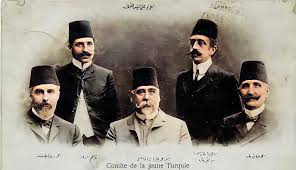
The external pressures on the Empire were exacerbated by a radical transformation of the Ottoman state apparatus. In 1908, the Committee of Union and Progress (CUP), led by a cadre of reformist military officers, forced Sultan Abdul Hamid II to restore the constitution. By 1913, following a coup, the CUP had established a de facto military dictatorship led by the “Three Pashas”: Enver Pasha (Minister of War), Talaat Pasha (Minister of Interior), and Djemal Pasha (Minister of Marine).
The CUP’s ideology shifted rapidly from Pan-Ottomanism—which promised equality for all subjects regardless of religion or ethnicity—to a rigorous form of Turkish nationalism. The regime implemented policies of centralization and “Turkification,” mandating Turkish as the language of administration and education.
This centralization proved disastrous for the empire’s cohesion in the Arab provinces. The Arab notables of Damascus, Baghdad, and Beirut, who had enjoyed a degree of autonomy and partnership under the Hamidian system, found themselves marginalized. In response, Arab cultural societies began to organize, first demanding decentralization and later, autonomy.
The British residency in Cairo, led by Lord Kitchener, watched these developments closely. Kitchener and his subordinates began to view the Arab nationalist movement not merely as an internal Ottoman problem, but as a potential strategic asset. If the Ottoman Sultan-Caliph allied with Germany, Britain would need a counter-weight in the Islamic world. The idea of transferring the Caliphate from the Ottoman Turks to an Arab lineage (specifically the Hashemites of Mecca) began to gain traction in British strategic circles before the war began.
The Balkan Wars and the Shift of Gravity
The decisive moment that signaled the end of the Ottoman Empire as a European power was the First Balkan War (1912–1913). A coalition of Balkan states (Bulgaria, Serbia, Greece, and Montenegro) routed the Ottoman army, stripping the empire of almost all its remaining European territories.
This defeat had profound consequences for the eventual partition of the Middle East. First, it deprived the empire of its most developed and industrialized provinces, leaving it economically reliant on its Anatolian and Arab territories. Second, the influx of Muslim refugees (muhajirs) from the Balkans into Anatolia hardened the Turkish nationalist sentiment of the CUP regime.
For the Great Powers, the Balkan Wars demonstrated that the Ottoman military was incapable of defending its borders. The “Sick Man” was on his deathbed. The British Foreign Office concluded that trying to prop up the empire was a waste of resources. Sir Edward Grey, the Foreign Secretary, began to countenance the idea that a partition might be inevitable. In 1913 and 1914, Britain and Germany actually negotiated a draft convention dividing the Ottoman Empire into spheres of economic influence, a precursor to the political partition that would follow.
The Road to War: August to November 1914
When the First World War broke out in August 1914, the Ottoman Empire did not immediately enter the conflict. There was a fierce debate within the CUP leadership. While Enver Pasha was strongly pro-German, other members of the cabinet favored neutrality.
The British government, however, committed a series of diplomatic blunders that pushed Istanbul toward Berlin. The most egregious was the seizure of two Ottoman dreadnoughts, the Sultan Osman I and the Reshadich, which were being built in British shipyards. These ships had been paid for by public subscription in the Ottoman Empire and were a source of immense national pride. Winston Churchill, prioritizing the Royal Navy’s superiority against Germany, ordered their requisition.
The reaction in Istanbul was one of public outrage. Germany capitalized on this immediately, dispatching the battlecruiser Goeben and the light cruiser Breslau to Constantinople. When the ships arrived, they were nominally transferred to the Ottoman Navy, replacing the vessels seized by Britain.
On October 29, 1914, the Ottoman fleet, led by the German Admiral Wilhelm Souchon aboard the Goeben (renamed Yavuz Sultan Selim), bombarded Russian ports in the Black Sea. It is likely that Enver Pasha authorized this attack specifically to force the empire into the war on the side of the Central Powers, presenting his wavering cabinet colleagues with a fait accompli.
Russia declared war on November 1, followed by Britain and France on November 5.
Conclusion: The Board is Set
The entry of the Ottoman Empire into the war clarified the strategic picture for the Entente powers. The policy of preservation was officially dead. The new objective was the dismantling of the Ottoman state.
However, the motivations for this dismantling were contradictory.
- Britain sought to secure the Suez Canal and the Persian Gulf, necessitating control over Mesopotamia and a buffer in Palestine.
- Russia demanded Constantinople and the Straits, effectively claiming the head of the empire.
- France demanded Syria and Cilicia to satisfy its colonial and financial lobbies.
These competing war aims were not complementary; they were friction points. As 1914 turned to 1915, and the expected quick victory over the “backward” Ottomans failed to materialize (most notably at Gallipoli), the Allies realized they needed a formal mechanism to reconcile their conflicting appetites. They needed a treaty that would delineate exactly where the British zone ended and the French zone began, and how to satisfy Russia without handing them hegemony over the East.
Thus, the stage was set for Mark Sykes and François Georges-Picot. They did not invent the partition of the Middle East; they merely drew the lines that the strategic imperatives of their governments had made inevitable.

Leave a Reply