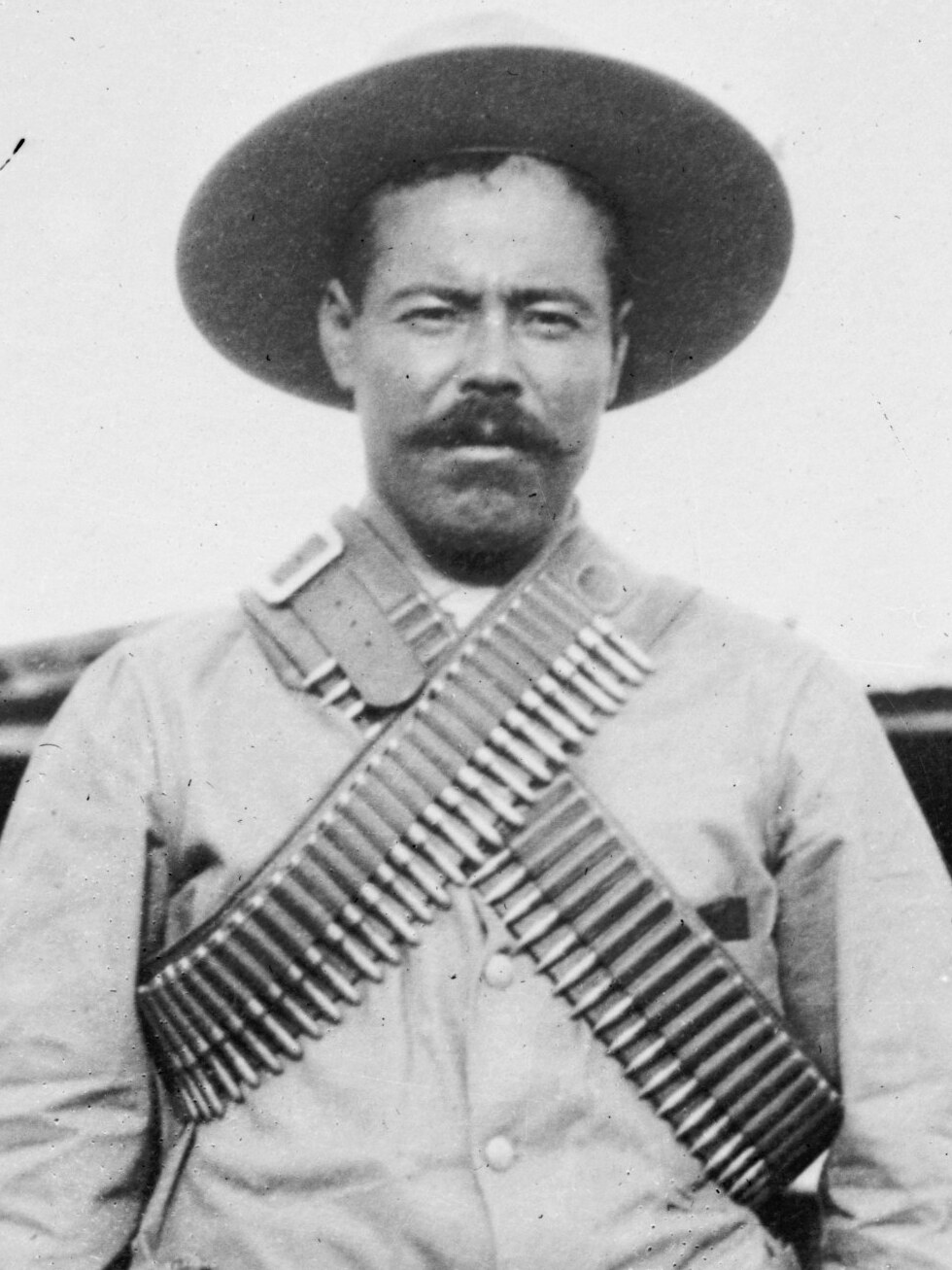

Early Life – Banditry and the Road to Revolution
José Doroteo Arango Arámbula, later known as Francisco “Pancho” Villa, was born in 1878 to a poor family in Durango, Mexico . Orphaned young, he struggled to support his mother and siblings as a sharecropper and various odd jobs . In his teens, Villa’s life took a fateful turn: after an hacienda owner allegedly assaulted his sister, young Doroteo shot the man and fled to the mountains to escape retribution . Hiding in the rugged Sierra Madre, he assumed the alias Francisco Villa (borrowed from a famed bandit or perhaps a grandfather’s name) and survived as an outlaw . For about six years he lived as a bandit chieftain, raiding cattle and money from wealthy haciendas. According to legend, he shared much of his loot with the poor, earning a “Robin Hood” reputation among peasants . This mix of ruthlessness and folk generosity would later fuel the Villa mythos.
Villa was a natural leader – cunning, charismatic, and bold. Though barely educated, he was “exceptionally bright” and demonstrated an aptitude for organizing raids like a master criminal planner rather than a mere holdup thief . He dreamed of a more stable life (at one point hoping to open a butcher shop) but found himself drawn back to outlawry when funds ran low . By 1910, Villa had tired of life on the run and slowly re-entered society in Chihuahua, working as a miner and butcher – yet local authorities still viewed him with suspicion as a known bandit . It was at this pivotal time that Abraham González, a supporter of the liberal reformer Francisco Madero, befriended Villa . González urged him to put his guerrilla skills to a higher purpose: “fight for the people” rather than against them . In effect, he convinced Villa that the coming revolution needed seasoned fighters like him. Thus, when Francisco I. Madero called for revolt against Porfirio Díaz’s long dictatorship in late 1910, Villa – now 32 – was ready to join the fight . This marked Villa’s transformation from outlaw to revolutionary, as he exchanged personal banditry for the cause of political and social change.
Rise of a Revolutionary General and the División del Norte
Villa’s entry into the Mexican Revolution (1910–1920) was swift and dramatic. Although he lacked formal military training (and had only rudimentary literacy), Villa proved to be a gifted soldier and organizer during Madero’s uprising . He gathered a band of fellow vaqueros, miners, and desperados from the north – men who knew him as an outlaw leader – and molded them into a fighting force. His intimate knowledge of the terrain and people of northern Mexico became a great asset . Villa placed a full division of trained men at Madero’s disposal, a force that he equipped and led himself . In 1911, Villa and another rebel leader, Pascual Orozco, won a key victory by capturing Ciudad Juárez (just across from El Paso, Texas), which pressured the Díaz regime to collapse . By May 1911, the long-time dictator Porfirio Díaz resigned and fled into exile, thanks in no small part to northern rebels like Villa. The successful ouster of Díaz transformed Villa from a local bandit into a nationally known revolutionary commander.
After Madero became president, Villa stayed on as an irregular cavalry leader in the new federal army. However, the early post-Díaz period was chaotic. In 1912, when a former ally (Orozco) revolted against Madero, Villa fought to suppress the rebellion. Serving under General Victoriano Huerta – an ambitious federal officer – Villa’s independent streak and popularity made Huerta suspicious. A clash of egos ensued: Huerta accused Villa of insubordination and ordered him executed . President Madero intervened at the last moment, commuting the sentence . Villa was imprisoned instead, but in a daring move he escaped jail in late 1912 and fled to the United States . This narrow brush with death at the hands of Huerta would not be the last time their fates intersected.
In February 1913, a military coup led by none other than Victoriano Huerta overthrew and murdered President Madero (the infamous “Ten Tragic Days” in Mexico City). Hearing of his mentor Madero’s assassination, Villa immediately returned from exile. By March 1913 he had crossed the Rio Grande back into Mexico with just a small band of men . Rallying old comrades and outraged maderistas (Madero supporters), Villa took control of the northern state of Chihuahua within weeks . He began amassing a large rebel army that came to be known as the División del Norte (“Division of the North”). What started as a handful of desperados swelled into an army of thousands as droves of ranchers, farmers, and adventurers joined Villa’s cause . By late 1913, Villa’s División del Norte had become “suddenly awesome,” rolling from victory to victory along northern rail lines .
Under Villa’s leadership, the División del Norte became the largest and most formidable rebel force in Mexico at the time . Villa proved adept at modern warfare despite his rough background – he mobilized cavalry with unprecedented speed using railroads and even deployed trains as mobile hospitals and supply lines . His forces were famous for their mobility and ferocity, and Villa paid his men well, one peso a day, an enormous wage then . This regular pay (and permission to loot defeated federal garrisons) ensured loyalty and drew recruits to his banner. Villa also enforced discipline ruthlessly. In one account from a Chihuahua hospital, when told some of his soldiers had harassed nurses, Villa had the offenders executed on the spot, making it clear such behavior “would not be tolerated” . Yet in other instances, Villa himself could be brutal with enemies, and his feared lieutenant Rodolfo Fierro (nicknamed El Carnicero, “The Butcher”) meted out summary violence. This mix of strict justice, charisma, and brutality defined Villa’s leadership style – he inspired devotion and fear in equal measure. Many poor villagers saw him as their avenger against the abusive hacendado class, while the elite viewed him as a dangerous bandit in uniform .
Victorious Campaigns of the División del Norte
Throughout 1913–1914, Pancho Villa led the División del Norte in a string of impressive military campaigns that solidified his fame as a revolutionary general. Alongside fellow revolutionaries Venustiano Carranza (in Coahuila) and Álvaro Obregón (in Sonora), Villa fought to topple the usurper Huerta under the broad alliance of the “Constitutionalist Army.” Villa’s men, with their lightning cavalry charges, captured city after city from Huerta’s demoralized federal troops. One of Villa’s early major victories came in spring 1914 at the Battle of Torreón, after bitter fighting in which his horsemen eventually took the city (albeit with heavy losses) . Villa’s boldest triumph followed at Zacatecas. In June 1914, defying Carranza’s orders, Villa’s army attacked the heavily fortified city of Zacatecas – deemed the “military heart of the nation” under Huerta . The Battle of Zacatecas (la Toma de Zacatecas) was one of the bloodiest of the revolution: roughly 20,000 Villistas assaulted 12,000 federal defenders entrenched in rugged hills . After days of fierce combat, Villa’s troops overran the city. The victory was decisive – Zacatecas was “one of the most decisive, and celebrated, of the revolution,” effectively shattering Huerta’s last stronghold . Federal casualties were enormous and the rout of Huerta’s army at Zacatecas marked the beginning of the end for his regime . Indeed, within weeks Huerta resigned the presidency and fled abroad in July 1914, as revolutionary forces marched toward Mexico City .
Villa’s battlefield achievements in 1914 made him one of the most powerful figures in Mexico. For a time, he controlled most of the north-west of the country and even served briefly as provisional governor of Chihuahua, where he reportedly implemented radical measures such as confiscating large haciendas and distributing land and cattle to widows and peasants . During that period, Villa also issued his own currency and imported arms and supplies from the United States (using proceeds from regional silver mines and customs), effectively running an autonomous wartime economy in the north. These actions reflected Villa’s political ideology, which was populist and pragmatic. Like his southern counterpart Emiliano Zapata, Villa professed a desire for tierra y libertad (“land and liberty”) for the poor. He was strongly in favor of land reform – as evidenced when his Chihuahua administration broke up elite estates – though he had no formal manifesto like Zapata’s Plan de Ayala . More than any abstract doctrine, Villa embodied a deep anger at the oppression of peons by the rich and a willingness to use force to redress social ills. His rebel movement (Villismo) attracted dispossessed ranch hands, cowboys, and farmers who sought vengeance against the old regime and a share of its spoils. This social revolutionary character of Villa’s army – unruly but motivated by class grievances – set it apart from the more middle-class led forces of Carranza.
Notably, Villa also understood the value of media and image in modern warfare. Unusual for the time, he welcomed journalists and even film crews into his camp. In 1913 he signed a contract with a Hollywood company (Mutual Film Co.) to film his battles . He thus became an international celebrity – the first revolutionary general to star in newsreels and movies. American reporters like John Reed interviewed him extensively, helping to craft an image of Villa abroad as the “wild revolutionary chieftain” with a charismatic flair. At the height of his power in late 1914, Villa was so prominent that the U.S. government considered officially recognizing him as Mexico’s legitimate leader instead of Carranza .
Rivals and Allies: Villa’s Relationship with Zapata, Carranza, and Obregón
With Huerta gone, the loose alliance of revolutionary factions fell apart. Villa’s ambitions and his vision for social revolution soon clashed with the plans of the more conservative Venustiano Carranza, who aimed to assume national power. In October 1914, a Convention of revolutionary leaders met in Aguascalientes to decide on a provisional government. The Convention exposed the ideological split: Carranza and Obregón represented the “political” revolutionaries (focused on liberal reforms and constitutional government), whereas Villa and Emiliano Zapata represented the “social” revolutionaries fighting for radical land redistribution and peasant rights . The Convention elected a compromise president, but Carranza rejected this outcome. By the end of 1914, Villa and Zapata formed an alliance against Carranza’s faction.
Though coming from different regions and backgrounds, Villa and Zapata held a mutual respect as champions of the poor. In early December 1914, the two legendary guerrilla generals met in person in Xochimilco near Mexico City, sealing an informal pact . Days later, Villa’s División del Norte and Zapata’s Ejército Libertador del Sur (Liberation Army of the South) jointly entered Mexico City in triumph on December 6, 1914 . Famously, Villa sat playfully in the presidential chair in the National Palace for a photograph, then vacated it – neither he nor Zapata had designs on actually governing from the capital . In fact, both men were more comfortable fighting in the field than administering the nation. After a few weeks, distrust of the urban populace and strategic caution led Villa and Zapata to withdraw from Mexico City back to their respective strongholds . This opened the door for Carranza’s forces, under General Obregón, to move in and claim the capital. The brief Villa–Zapata alliance symbolized the unity of Mexico’s two great popular revolutionaries, but in practice their coordination was limited. They never fully merged their armies or strategies, partly due to logistical difficulties and partly because each focused on his own regional struggle.
The most formidable opponent to emerge against Villa was General Álvaro Obregón, Carranza’s brilliant lieutenant. In early 1915, Villa turned his army southward to definitively defeat Carranza’s “Constitutionalist” forces. What followed were some of the revolution’s largest battles, as Obregón’s well-equipped troops met Villa’s cavalry in the Bajío region of central Mexico. The decisive confrontation came in April 1915 at the Battle of Celaya. Relying on experience and modern tactics learned from World War I, Obregón prepared fortified defenses with barbed wire entanglements, trenches, and machine gun nests – a style of positional warfare new to Mexican battlefields . Villa, characteristically aggressive, launched frontal cavalry charges. The result was disastrous for the División del Norte. After two massive assaults, Villa’s formidable cavalry failed to break Obregón’s lines . The Villista forces were decimated by machine-gun fire and entrenched artillery, suffering thousands of casualties . Obregón himself lost an arm in the fighting, but he won a complete victory. Celaya was a turning point: “one of the largest and bloodiest battles in Mexican history,” it broke the back of Villa’s offensive power . Villa was forced to retreat northward in defeat, ceding the initiative to Carranza. Over the next months in 1915, Obregón pursued Villa in a series of follow-up battles (Trinidad, Agua Prieta, etc.), further shrinking Villa’s territory. By the end of 1915, Carranza’s government was in virtual control of Mexico, and the U.S. had formally recognized Carranza as president – isolating Villa internationally .
Villa’s relationships with his revolutionary peers were complex. With Carranza, it turned from friendship to bitter enmity. Initially allies against Huerta, the two diverged sharply once victory was in hand. Carranza saw Villa as an insubordinate warlord, while Villa saw Carranza as an elitist who betrayed the Revolution’s social promises (Carranza was slow to implement land reform, for instance, which alienated Villa ). By 1915 they were exchanging insults and bullets. Villa nicknamed Carranza “the bean-counter” for his bureaucratic style, and Carranza denounced Villa as a bloodthirsty bandit. With Zapata, Villa maintained cordial ties and a common cause against Carrancismo; however, distance and the eventual collapse of Villa’s military strength meant the two never achieved a lasting coalition. Zapata continued guerrilla resistance in the south until his own assassination in 1919, while Villa licked his wounds in the north. With Obregón, Villa’s relationship went from comrades-in-arms to adversaries. Interestingly, Obregón had admired Villa’s prowess early on – at one point in 1914 they even met and posed for photographs together with U.S. General Pershing in Texas . But realpolitik prevailed: Obregón’s loyalty to Carranza and Villa’s refusal to submit ensured a fight to the finish. After Villa’s defeat, Obregón would remark on Villa’s bravery but also his tactical inflexibility at Celaya. Years later, when Obregón became president (1920), he offered amnesty to Villa even as he privately remained wary of his former foe. In sum, Villa’s interactions with other leaders were marked by shifting alliances reflective of the Revolution’s factional nature – loyalty lasted only until interests diverged.
The Raid on Columbus and War with the United States
By late 1915, Pancho Villa’s fortunes had declined. His army was badly mauled, he had lost the ability to wage large-scale war, and Carranza’s regime (now holding the presidency in Mexico City) was gaining diplomatic recognition. Crucially, Villa felt betrayed by the United States, which had supported Carranza with arms and even allowed Carrancista troops to traverse U.S. soil by train to outflank Villa in one battle . Once praised by U.S. media as a romantic outlaw, Villa became enraged at President Woodrow Wilson’s endorsement of Carranza. In early 1916 he sought revenge and a way to reassert himself. In January 1916, to demonstrate that Carranza did not truly control the north, Villa’s men stopped a train in Santa Isabel, Chihuahua, and executed 17 U.S. mining engineers on board . Then on March 9, 1916, Villa took an even bolder step – he raided U.S. territory, attacking the small border town of Columbus, New Mexico. With a few hundred horsemen, Villa crossed into New Mexico and assaulted the town, burning buildings and killing about 17 Americans (mostly civilians) . The raid caught the U.S. by surprise and caused a national sensation. It was the first foreign armed attack on U.S. soil since the War of 1812 .
Villa’s exact motives for the Columbus Raid remain debated. Some historians believe it was personal revenge against a local arms dealer who swindled Villa, or retaliation for the U.S. support of Carranza . Others argue Villa intended to provoke an American intervention in Mexico, expecting that a U.S. invasion would inflame Mexican nationalism and turn the people against Carranza’s “gringo-backed” government . Indeed, Villa reportedly told his illiterate soldiers that the Americans had to be taught a lesson for aiding Carranza and for an incident in El Paso where Mexican prisoners were horrifically burned (a story that enraged his men) . Whatever the reasoning, the Columbus raid had exactly the consequence Villa anticipated: President Wilson ordered a Punitive Expedition to hunt down Villa on Mexican soil . General John J. “Black Jack” Pershing led some 5,000 U.S. Army troops deep into northern Mexico just days after the raid, with the mission to capture or kill Pancho Villa . Over subsequent months, the U.S. expeditionary force swelled to over 10,000 men, equipped with automobiles, telegraphs, and even the novelty of a few aircraft – a very modern army by the standards of the day .
Villa, however, proved as elusive as ever. He knew the terrain intimately and enjoyed considerable local support. Many Mexican villagers, though they feared all armies to a degree, viewed Villa as a folk hero and misled the American troops or hid information, allowing Villa to stay one step ahead . The pursuit stretched on through most of 1916, with Pershing’s forces ranging hundreds of miles into Chihuahua. They never managed to catch the guerrilla leader. At one point Villa was wounded (shot in the knee in a clash with Carranza’s troops), but he slipped away into the mountains for weeks to recuperate . The Punitive Expedition tangled occasionally with Villista bands and even Carranza’s army – at one juncture U.S. troops skirmished with Carrancista forces, nearly sparking a wider war . As the months passed, Villa’s force dwindled to a few hundred loyal fighters, but Pershing could not find the “needle in a haystack.” By early 1917, with the United States edging toward entry into World War I, President Wilson recalled the frustrated Pershing. The U.S. troops withdrew without capturing Villa . The expedition was officially deemed a failure on its primary objective . However, it did have side effects: it “proved good training for [future] military leaders, including George S. Patton” and allowed the U.S. Army to test new equipment like trucks and airplanes under harsh conditions . In Mexico, the legend of Villa only grew – he had defied Uncle Sam on his own soil and gotten away, reinforcing his image as the indomitable guerrilla. To Mexican nationalists, Villa’s stand made him a symbol of resistance to American intervention (even if his raid had invited it in the first place). Conversely, in the U.S. press, Villa was now cast firmly as a villain – a murderous bandit who had to be stopped . The Columbus raid thus cemented both sides of Villa’s reputation: hero in Mexico, outlaw in the United States.
Final Years: Retreat, Retirement, and Assassination
Villa survived the Punitive Expedition, but by 1917 his military capacity was greatly diminished. The Mexican Revolution was winding down with Carranza in power as president and a new constitution (1917) promising reforms. Villa spent the next few years in sporadic guerrilla warfare against Carranza’s government, largely confined to remote areas of Chihuahua and Durango. He no longer commanded a grand army, but with a small band of loyalists he continued to be a thorn in the side of the authorities – attacking army outposts, derailing trains, and seizing the occasional town. Villa’s persistence kept the spirit of rebellion alive in the north even as other revolutionary fronts went quiet. By 1920, however, the situation changed once again. Carranza was assassinated in May 1920 in a rebellion led by northern generals (ironically including some ex-Villistas). The new interim president, Adolfo de la Huerta, recognized that making peace with Villa was politically prudent. That summer, Villa accepted an amnesty deal with De la Huerta’s government . In exchange for laying down arms, Villa was granted a full pardon and a hacienda (the Rancho de Canutillo, near Parral in Chihuahua) where he could retire in peace . Villa, now in his early 40s, withdrew from public life to become a farmer, raising crops and livestock with a cadre of former soldiers as his security.
For three years, Pancho Villa lived quietly on his ranch – a curious end for a man who had spent a decade in constant warfare. He seemed to accept his reduced role, though he remained a popular figure regionally. In 1923, Villa began to venture back into politics, at least rhetorically. He gave interviews hinting that he might run for office or otherwise insert himself into national affairs as the 1924 presidential election approached . This alarmed those in power. By then, General Álvaro Obregón was president (having succeeded Carranza in late 1920) and was grooming his ally Plutarco Elías Calles to be the next president. Villa’s potential return to the political scene threatened to upend their plans . On July 20, 1923, the inevitable caught up with Villa. As he drove his car through the town of Parral, a group of gunmen ambushed him and riddled him with bullets, killing Villa and his bodyguards in a bloody execution . Villa died instantly, aged 45. The assassins were never definitively punished; it is widely believed the plot was carried out by local political enemies with at least tacit approval from Obregón’s government . So ended the life of the famed guerrilla general – not on the battlefield, but in an orchestrated murder. Villa’s head was even stolen from his grave in a morbid epilogue, feeding rumors and legends about hidden vendettas and buried treasures .
At the time of his death, Mexico’s ruling establishment showed little interest in honoring Villa. He had been a thorn in their side for too long, and his faction had ultimately lost the power struggle. Yet among the common people of the north, Villa was mourned as a fallen hero. Thousands attended his funeral in Parral, and his old comrades stood guard at his hacienda fearing government treachery even in death . Their fears were not unfounded – Villa’s assassination removed a potential rallying figure against the new regime. As one observer put it, Villa was likely killed because the victorious revolutionary generals “could not risk that Villa re-enter politics and complicate the situation” . With Villa gone, the Mexican Revolution’s violent phase drew to a close.
Legacy – From Outlaw to Folk Hero
Pancho Villa’s legacy in the decades after his death underwent a remarkable evolution. Immediately after the Revolution, the new political elite (the winners like Obregón and Calles) were hesitant to celebrate Villa. In official histories promulgated by the ruling Institutional Revolutionary Party (PRI), Villa was long excluded from the pantheon of revolutionary heroes . While figures such as Madero, Carranza, and even Zapata were honored in textbooks and monuments, Villa’s memory was somewhat suppressed. This was partly because he had fought against the eventual victors and partly because his life as a bandit-turned-rebel did not fit the orderly narrative the government wanted to project. For a generation after 1923, Villa remained a contentious figure: respected by many veterans and campesinos, reviled by those who remembered his depredations, and ignored by official commemorations.
Yet Villa’s popular image only grew in lore. Among the Mexican masses, especially in the north, corridos (folk ballads) kept his exploits alive in song . These corridos celebrated Villa as “el León del Norte” (the Lion of the North) or “el Centauro del Norte” (the Centaur of the North), emphasizing his bravery, cunning, and Robin Hood persona. Storytellers traded tales (some true, many embellished) of Villa’s Robin Hood acts – how he would steal from rich hacendados to feed widows, or how he stood up to gringo interests. As one biographer, Friedrich Katz, noted, Villa was widely perceived as a destroyer of the old unjust order, and despite the violence he wrought, this had positive aspects in the eyes of the dispossessed . Villa played a decisive role in the Revolution’s victory over the old Porfirian regime, particularly by destroying the Federal Army of Huerta . During his brief governorship of Chihuahua he enacted significant land redistribution, seizing grand estates from the elite – an enduring point of pride for those who benefited . Such actions endeared him to ordinary Mexicans and solidified his reputation as a true man of the people.
It was precisely Villa’s popular acclaim that kept his legacy alive while officialdom kept its distance. Unlike Emiliano Zapata – whose image was eventually co-opted by the government as an agrarian martyr – Villa’s memory remained largely in the popular realm for many years . This arguably preserved the authentic folk hero aura around Villa. As one analysis put it, “popular tastes wanted Villa to be thrilling, not respectable…they were enamored of Villa the daring Robin Hood… the outlaw with uncanny power over men.” In other words, the people’s Villa was a larger-than-life figure of freedom and defiance, not a sanitized statue. Even in the United States, Villa’s legend had a lasting impact – though remembered negatively by many Anglos due to the Columbus raid, he also became a subject of endless fascination in books and Hollywood films (he has been portrayed in numerous movies about the Revolution). Over time, especially by the late 20th century, historical opinion of Villa grew more positive in Mexico. Scholars like Katz produced comprehensive biographies separating the man from the myth, acknowledging his flaws (his capacity for violence, his sometimes mercurial judgment) while also highlighting his achievements and the social forces he represented . Villa came to be seen, alongside Zapata, as one of the Revolution’s true icons – “defenders of the dispossessed” – whereas the more conservative leaders (Madero, Carranza, Obregón) faded in popular memory .
By 1976, the Mexican government was ready to rehabilitate Villa. In that year, Villa’s remains were exhumed from Parral and reinterred in the grand Monument to the Revolution in Mexico City, in a ceremonious act of belated honor . His name was also inscribed in gold in the Chamber of Deputies as a Hero of the Revolution – though not without controversy from those mindful of his checkered past . These official recognitions signaled that Villa had finally been fully embraced into the nationalist narrative of the Revolution. Today, Pancho Villa stands as a folk hero in Mexican culture. Town squares bear his statues, streets his name; countless corridos, novels, and histories recount his adventures. Outside Mexico, he remains the best-known figure of the Mexican Revolution, often depicted as the quintessential fiery guerilla general (a status enhanced by early Hollywood films he participated in). Importantly, the discourse around Villa often notes the class perspective in judging him: “those who idolized Villa came from the peasant class…those who declared him a bandit had upper-class relatives” in the old regime . This underscores that Villa’s image as hero or villain was always tied to social viewpoint. In the eyes of Mexico’s poor, he was their general – one who had risen from among them to challenge oppression – whereas to the old landowning class he was a deadly threat to the established order .
In historical hindsight, Francisco “Pancho” Villa’s influence on the Mexican Revolution was profound. He was instrumental in the military victories that toppled two regimes: Díaz in 1911 and Huerta in 1914. His army’s successes at battles like Zacatecas not only broke the federal forces but also proved that regional caudillos could command national attention . Villa’s insistence on tangible benefits for his followers (land, pay, spoils) forced the revolutionary leadership to address social issues like land reform more seriously. The 1917 Constitution, for example, enshrined land and labor reforms partly to undercut support for populist fighters like Villa and Zapata. Internationally, Villa’s actions led to a precarious conflict with the United States, influencing U.S.–Mexico relations and military policy on the eve of WWI. Ultimately, Villa’s life journey – from banditry to generalship, from hunted fugitive to governor, and finally martyrdom – encapsulates the tumult and contradictions of the Revolution itself. He was a man of stark dualities: ruthless killer and folk champion, illiterate rustic and shrewd commander, a unifier and a divider. As Mexico transitioned into a modern state, Villa’s legacy lived on in the hearts of the common people as the embodiment of revolutionary vengeance and hope. Today, over a century later, Pancho Villa is remembered not as a perfect hero, but as an indelible legend – a revolutionary who forged his own destiny and became a symbol of the Mexican people’s fight against oppression.
Bibliography
Katz, Friedrich (1998). The Life and Times of Pancho Villa. Stanford University Press. Rare Historical Photos (2024). “Pancho Villa: The True Story of Mexico’s Robin Hood Through Old Photos.” San José State Univ. – Watkins, Thayer (2008). “Francisco ‘Pancho’ Villa of Mexico.” Economic History of Mexico. Britannica (2023). “Battle of Celaya.” Encyclopedia Britannica. The Guardian – Sanchez, Carlos (2021). “Pancho Villa, my grandmother and the border’s revolutionary history.” University of Texas, Austin – Radio TAJ (2016). “Attack on Columbus, NM” and “The Punitive Expedition.”
Recommended Reading
Katz, Friedrich. The Life and Times of Pancho Villa. Stanford Univ. Press, 1998. – Definitive scholarly biography; thoroughly details Villa’s life and the revolution. McLynn, Frank. Villa and Zapata: A History of the Mexican Revolution. Basic Books, 2000. – Lively dual biography contrasting Villa with his southern counterpart Emiliano Zapata. Taibo II, Paco Ignacio. Pancho Villa: A Revolutionary Life. Seven Stories Press, 2024. – A recent narrative biography by a Mexican historian, offering a rich, anecdotal portrait of Villa.
Listen & Learn: Related Podcast Collections
Explore these curated episode collections to go deeper on the history behind this article:

Leave a Reply