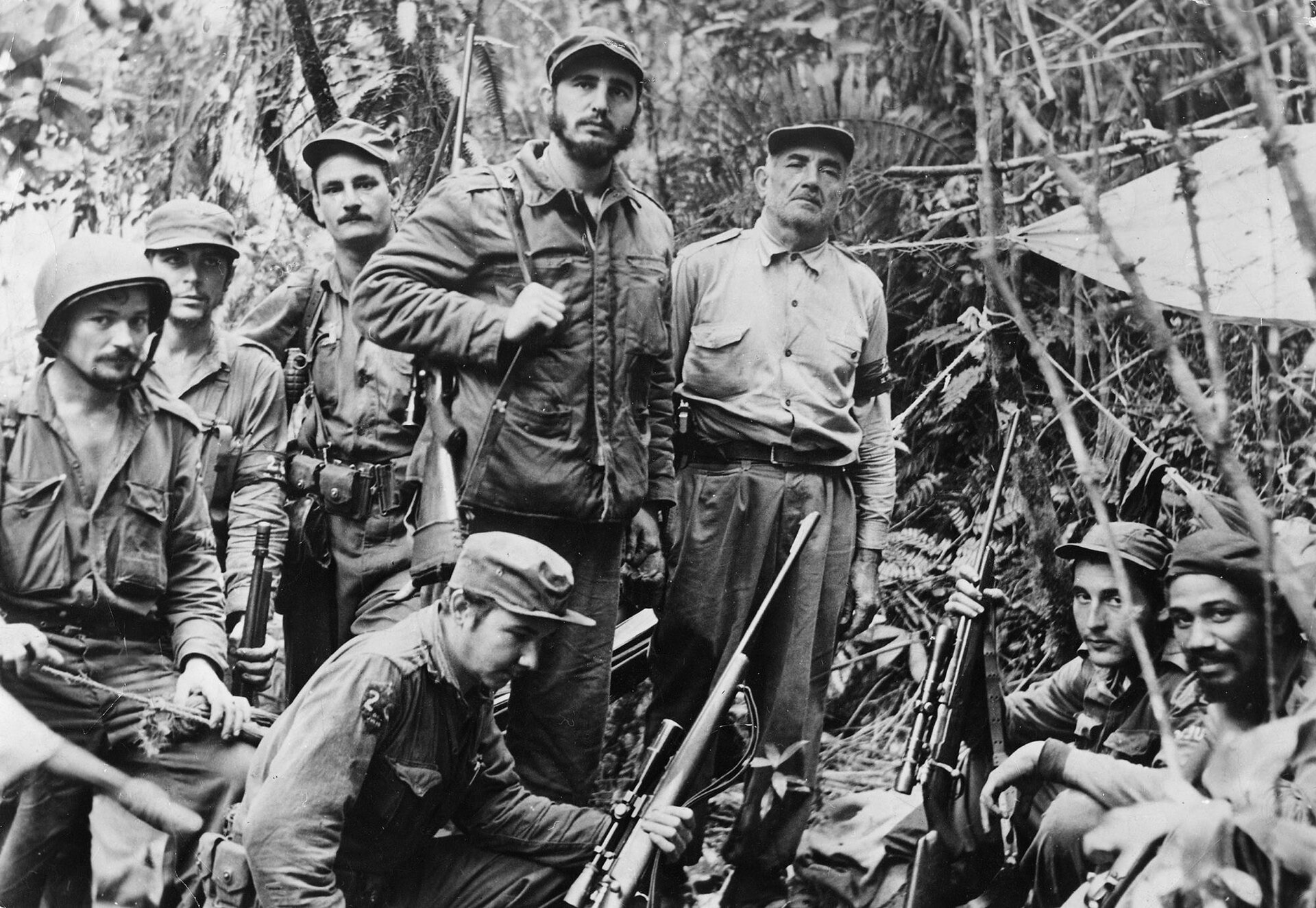

On New Year’s Day 1959, Fulgencio Batista, the dictator who had ruled Cuba for most of the previous twenty-five years, fled the country in the early hours of the morning, boarding a plane for the Dominican Republic as his regime collapsed around him. The news reached the guerrilla column led by Ernesto Guevara, which had spent the previous weeks fighting its way toward Havana, and the fighters who heard it greeted it with disbelief and then elation. Fidel Castro, who had spent the preceding two years fighting from the Sierra Maestra mountains with a force that at its lowest ebb had numbered only a few dozen men, entered Santiago on 2 January and Havana on 8 January, welcomed by crowds whose celebration was genuine and overwhelming. A revolution had succeeded. The question of what that revolution actually was — what kind of social transformation it represented, whose interests it served, and what its long-term character would be — was one that the participants themselves had not fully resolved, and that the next sixty-five years would answer in ways that confounded virtually everyone’s initial expectations.
Cuba Before Castro: The Problem That Made the Revolution
To understand the Cuban Revolution, it is necessary to understand Cuba’s particular position within the hemispheric order that the United States had constructed in the Caribbean and Central America over the preceding century. The United States had intervened militarily in Cuba in 1898, liberating it from Spanish colonialism in the Spanish-American War and then establishing, through the Platt Amendment of 1901, a constitutional provision that gave the United States the right to intervene in Cuban affairs to maintain order and protect American interests. The Platt Amendment was formally abrogated in 1934, but the relationship it had institutionalised — in which American business interests dominated the Cuban economy and American political will constrained Cuban sovereignty — persisted through other mechanisms.
By the 1950s, American corporations owned or controlled a substantial proportion of Cuba’s productive capacity: roughly half the sugar industry, most of the cattle ranches, a significant share of the public utilities, the telephone system, and the largest mining operations. Havana’s casino and hotel economy — which Batista had developed through an arrangement with American organised crime figures including Meyer Lansky and Lucky Luciano — generated wealth that flowed largely to American investors, Cuban elites, and Batista’s own circle, while the rural sugar workers who constituted the majority of Cuba’s working population lived in endemic poverty and seasonal unemployment. The gap between Cuba’s substantial economic potential and the living conditions of most Cubans was not incidental — it was the structural product of a particular political and economic arrangement, and it was what made the revolution.
Batista himself was a figure of considerable complexity, which is to say that he combined genuine popular support in his earlier political career with a later authoritarianism that became increasingly brutal and increasingly corrupt. He had come to power originally through a coup in 1933 that ended the Machado dictatorship and had governed Cuba through various constitutional arrangements before seizing power again in a coup in 1952 that cancelled elections he was likely to lose. The regime he established in the 1950s relied heavily on the secret police and on systematic torture and murder of opponents — the bodies of students and political activists left on Havana streets as warnings were a feature of the period — while simultaneously maintaining the economic arrangements that made it useful to American business and government. The combination was, in retrospect, inherently unstable: a regime that needed foreign support to maintain itself while generating domestic conditions that made revolution inevitable.
The Revolution and Its Ambiguities
Fidel Castro, who had led the July 26 Movement’s armed campaign against Batista, was a lawyer from a landowning family whose politics at the moment of victory were, by his own later account, nationalist and reformist rather than explicitly Marxist. The programme that the July 26 Movement had announced — land reform, nationalisation of some industries, restoration of the 1940 constitution, an end to American economic dominance — was radical by Cuban standards but was not, in itself, Communist. The Cuban Communist Party, the PSP, had not supported the armed struggle and had denounced Castro as an adventurist; the relationship between Castro’s movement and organised Marxism was, in the early stages, distant and cool.
What drove the revolution in a more explicitly socialist and then Communist direction was substantially the dynamic of the relationship with the United States. The Eisenhower administration’s response to the revolutionary government’s land reform and nationalisation programme — which was implemented in 1959 and 1960 with increasing speed and radicalism — was to move toward economic warfare and eventually toward active subversion. The CIA began organising Cuban exile forces in 1960. Trade restrictions were tightened. The sugar quota, on which Cuba’s export economy depended, was cancelled. Each American escalation produced a Cuban radicalisation; each Cuban radicalisation produced a further American escalation. The logic of the conflict pushed Castro toward Moscow, which offered economic and military support, and pushed the revolution toward a political identity — explicitly Communist, aligned with the Soviet Union — that had not been clearly present at the moment of victory.
Whether this outcome was inevitable, or whether a different American policy might have produced a different Cuba, is one of the central counterfactual questions of Cold War history. Historians have argued that American policymakers consistently misread Cuban nationalism as Soviet subversion, conflating a genuine social revolution with a Cold War proxy conflict, and that this misreading produced the very alignment with Moscow that it feared. The alternative reading — held by those who emphasise Castro’s own ideological commitments and the PSP’s gradual integration into the revolutionary government — is that the Communist outcome reflected genuine preferences rather than merely reactive necessity. Both arguments contain evidence and neither is wholly satisfying. What is clear is that by 1961 Cuba was aligned with the Soviet Union, and that the consequences of that alignment would shape the island’s history and the hemisphere’s politics for generations.
The Bay of Pigs and the Making of a Legend
The event that most decisively shaped how the Cuban Revolution was perceived, both inside Cuba and internationally, was the failed Bay of Pigs invasion of April 1961. The invasion — in which approximately fourteen hundred Cuban exiles trained, equipped, and transported by the CIA landed at the Bay of Pigs on Cuba’s southern coast with the expectation that the Cuban population would rise against Castro — was a military and political catastrophe of the first order. The landing force was captured within three days; the popular uprising did not materialise; the air strikes that were supposed to provide cover were cancelled at the last minute by President Kennedy, who was trying to maintain plausible deniability of American involvement; and Castro’s government emerged from the crisis with its domestic legitimacy enormously strengthened and with the international moral argument — that the United States was attempting to overthrow a sovereign government — comprehensively won.
The Bay of Pigs transformed Castro into something he had not quite been before: a David who had defeated Goliath, a small country that had defied the most powerful nation on earth and survived. The imagery was enormously potent across the Third World and the Latin American left, where resistance to American imperialism had a history and a political vocabulary. Castro’s Cuba became a symbol for an entire generation of Latin American revolutionaries and intellectuals — the proof that revolution was possible, that the United States could be beaten, that the future belonged to those willing to fight for it. The Guevarist foco theory of guerrilla warfare — which held that a small determined group of fighters could create the conditions for revolution by example, without waiting for the objective economic conditions that orthodox Marxism required — drew much of its credibility from the Cuban experience, and spread from Cuba to Venezuela, Bolivia, Colombia, and eventually, with less success, across much of the rest of the continent.
The Cuban Missile Crisis of October 1962 — in which the Soviet Union’s installation of nuclear missiles in Cuba was discovered by American reconnaissance and produced a thirteen-day confrontation that brought the world closer to nuclear war than it has been before or since — added another layer to Cuba’s Cold War significance. The crisis was resolved, as historians have subsequently documented in detail, through a private deal in which the Soviet Union withdrew its missiles in exchange for an American pledge not to invade Cuba and a secret undertaking to remove American Jupiter missiles from Turkey. Cuba itself was notably absent from the negotiations: Castro was not consulted about the withdrawal of the missiles and was furious when he learned of it, feeling that the Soviet Union had used Cuban territory as a bargaining chip and then discarded it. The episode revealed the limits of the relationship between Cuba and the Soviet Union, which was never the straightforward patron-client arrangement that American Cold War rhetoric implied.
Revolution in Practice: Achievements and Costs
The revolution that consolidated itself in the early 1960s produced a set of social achievements that were real, substantial, and genuinely transformative for much of the Cuban population. The literacy campaign of 1961, which sent young volunteers across the country to teach reading and writing to rural adults, reduced illiteracy from roughly forty percent to under four percent in a single year — one of the most rapid and successful literacy programmes in history. Healthcare was extended to previously unserved rural populations; life expectancy rose; infant mortality fell dramatically. Land reform redistributed agricultural land to hundreds of thousands of rural workers and peasants who had previously worked as labourers on large estates. The social inequalities of Batista’s Cuba — extreme even by Latin American standards — were substantially reduced.
The costs were also real and substantial. Political opposition was eliminated: independent political parties were banned, free elections were never held, and the government’s relationship to criticism was consistently one of suppression. The press was brought under state control. The University of Havana, which had been one of the most politically active institutions in Latin America, was subordinated to the revolution. Homosexuals were sent to labour camps in a campaign that Castro later acknowledged as a serious error. The Catholic Church was severely restricted. Approximately one million Cubans — a significant proportion of the professional, business, and middle classes — left the country in the revolution’s first decade, most going to Miami, where they established a diaspora community whose political influence on American Cuba policy would prove enduring and consequential.
The cultural politics of the revolution were complex from the beginning. A brief initial period of relative artistic freedom — symbolised by the influential cultural institution Casa de las Américas and by Alfredo Guevara’s ICAIC film institute, which produced some of the finest cinema in Latin American history — gave way progressively to tighter political control. Castro’s declaration in 1961, responding to the censorship of a documentary film by ICAIC, established the formula that would govern Cuban cultural life for decades: “Within the revolution, everything. Outside the revolution, nothing.” The line between what was within and what was outside the revolution was drawn by the government, and it narrowed over time. By the early 1970s, following the Padilla Affair — in which the poet Heberto Padilla was arrested, subjected to a public confession, and imprisoned, generating outrage among the international left that had previously supported the revolution — the cultural liberalism of the early period had effectively ended.
The Myth and Its Uses
Che Guevara, who was captured and executed in Bolivia in October 1967 while attempting to replicate the Cuban revolutionary experience on the South American mainland, became — in death — perhaps the most powerful political symbol of the twentieth century’s second half. The photograph taken by Alberto Korda in Havana in March 1960, which captured Guevara in a black beret with an expression of focused intensity, was reproduced on millions of posters, t-shirts, murals, and revolutionary pamphlets across the world. The image outlasted the revolution’s specific politics; it became available for any cause that presented itself as oppositional, radical, and willing to sacrifice. The gap between the image and the historical man — who had supervised firing squads, who had held genuinely radical economic views that most of his admirers did not share, who died in a strategic failure based on miscalculations about the revolutionary potential of the Bolivian peasantry — was substantial, but the myth had its own momentum.
The mythology of the Cuban Revolution served different interests at different moments. For the Latin American left in the 1960s and 1970s, it provided inspiration and a model. For the American right, it provided a permanent justification for the embargo and a demonstration of the Communist threat in the hemisphere. For the Cuban government, it provided legitimacy that could be deployed whenever the revolution’s domestic record required defending. The reality of what the revolution had actually produced — a small island economy dependent on Soviet subsidies for most of its existence, whose most educated citizens had left in large numbers, whose political system had never allowed the genuine democratic expression of popular will, but which had also achieved genuine and lasting improvements in health and education — was more complicated than any of these uses could accommodate.
The Soviet Union’s collapse in 1991 removed the subsidies on which Cuba’s economy had come to depend and produced the “Special Period in Time of Peace” — a years-long economic crisis in which Cubans experienced severe shortages of food, fuel, and basic goods, and in which the government was forced to open the economy partially to foreign tourism and remittances while maintaining its political monopoly. The revolution survived, partly through genuine popular loyalty, partly through the coercive capacity of the state, and partly because the American embargo provided a permanent external enemy against which the government could direct popular frustration. The question of what the revolution meant — what it had achieved, what it had failed to achieve, what it had suppressed and at what cost — remained contested inside Cuba in ways that the government did not permit to be fully expressed, and outside Cuba in ways that were often more about the observer’s political needs than about Cuba itself.
Fidel Castro died in November 2016, having outlasted nine American presidents and the Soviet Union itself. He had been the longest-serving head of government in the world at the time of his formal transfer of power to his brother Raúl in 2008, and had made Cuba, a small island of eleven million people with no significant strategic resources, one of the most argued-about places on earth. Whether the revolution he had led was a triumph of anti-imperialism or a tragedy of authoritarian rule — or both simultaneously, in proportions that remain genuinely disputed — is a question that serious historians continue to debate, and that the Cuban people themselves have never been given a free opportunity to answer. That unresolved question is perhaps the most honest summary of what the Cuban Revolution ultimately was: a genuinely radical break with a genuinely unjust order, that produced both real achievements and real repressions, and whose ultimate historical verdict remains open in ways that the mythologies produced by both its admirers and its enemies have worked, with considerable success, to obscure.

Leave a Reply