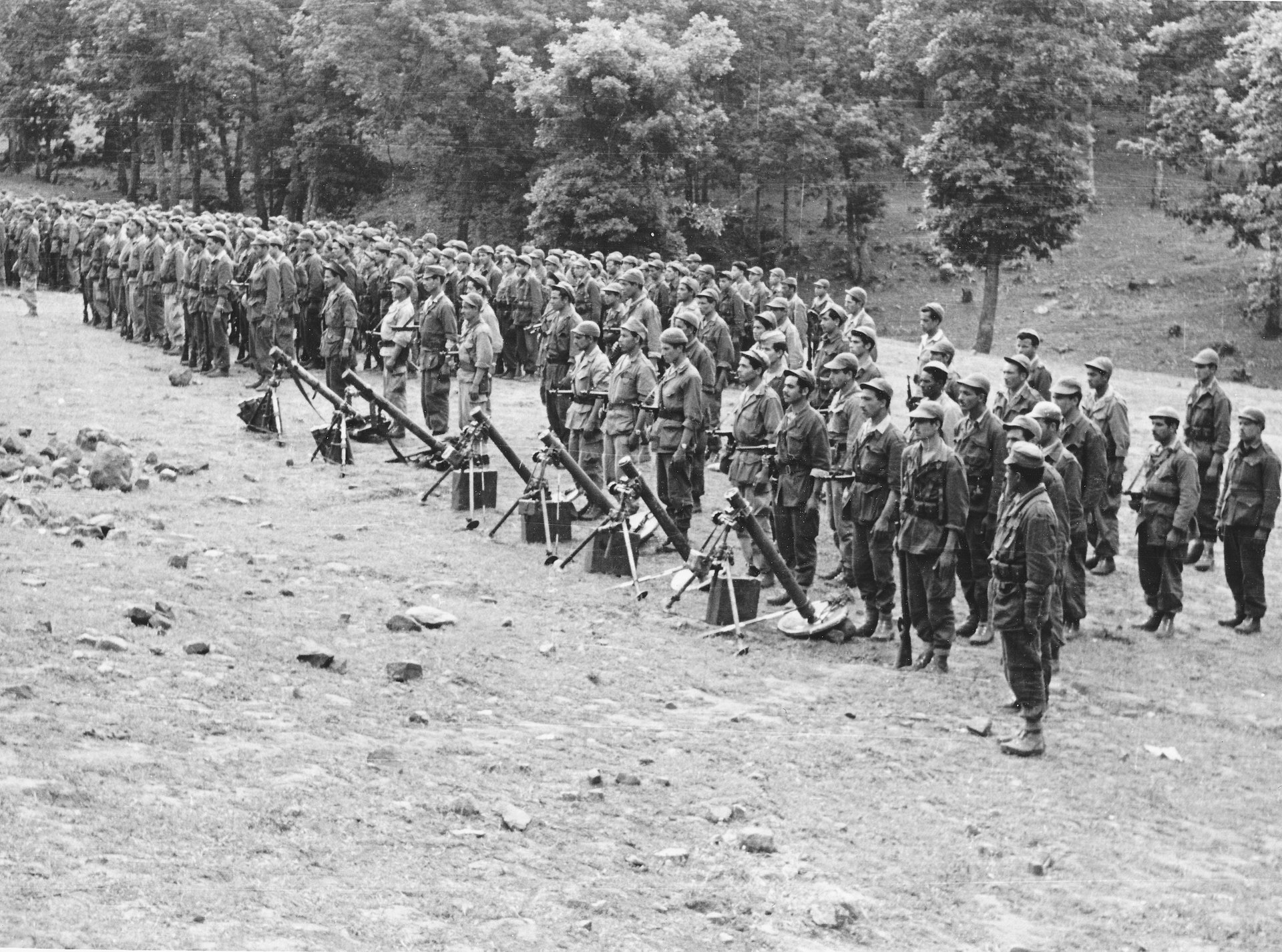

On 1 November 1954, a series of coordinated attacks across Algeria announced the birth of a new organisation and the start of a conflict that would, over the next seven and a half years, kill somewhere between three hundred thousand and a million people — the uncertainty in that figure is itself historically significant — and fundamentally transform both Algeria and France. The Front de Libération Nationale, the FLN, had struck at military installations, police posts, and infrastructure in a dozen locations simultaneously. The French government’s response, delivered by Interior Minister François Mitterrand, was categorical: “Algeria is France.” This was not merely a political statement. It was a constitutional one, and it contained within it the seed of everything that followed. A country cannot fight a war against itself; it can only police a disturbance. France’s insistence that Algeria was metropolitan France, not a colony, meant that what was actually a colonial war of independence could never be acknowledged as such — and that evasion produced consequences that deformed the Republic for a generation.
The Legal Fiction: Algeria as France
To understand why France found itself so comprehensively trapped, it is necessary to understand the peculiar constitutional status of Algeria within the French imperial system. Unlike Morocco or Tunisia, which were protectorates — foreign territories administered under French authority, with a distinct legal identity that at least left open the theoretical possibility of independence — Algeria had been divided into three French departments since 1848. Algiers, Oran, and Constantine were, in law, as French as Seine-et-Marne or the Bouches-du-Rhône. French citizens voted there; French law applied there; the territory was represented, however inadequately, in the National Assembly. When Algerian nationalists demanded independence, they were not, within the logic of the French constitution, demanding independence at all — they were demanding the dismemberment of metropolitan France itself.
The fiction worked, in the sense that it served the interests of the approximately one million European settlers — the pieds-noirs — whose political power in French domestic politics was considerable and who had no interest in acknowledging that they lived in a colony rather than a French province. It worked for the French army, which had absorbed the trauma of defeat in France in 1940, humiliation in Indochina, and now could not countenance a further retreat from empire without what many officers experienced as an existential crisis of national honour. And it worked, for a time, for the political class of the Fourth Republic, who found it easier to suppress the question of Algeria’s political status than to confront the implications of answering it honestly.
What the fiction could not do was resolve the actual conditions of life for the eight and a half million Muslim Algerians who were formally citizens of France but whose citizenship was conditional and whose equality was a systematic lie. In 1947, a Statute of Algeria had theoretically granted Algerian Muslims full French citizenship, but the electoral system that accompanied it — which gave roughly equal representation to the one million Europeans and the nine million Muslims — ensured that any expression of Muslim political will was structurally impossible within legal channels. The nationalist movement that gathered force through the late 1940s and early 1950s was responding to a reality that the official legal framework could not accommodate: that Algeria was a colony, that its Muslim population was subjected, and that the liberal promises of French Republicanism had never been extended to them in any meaningful sense.
The Context of 1954: Dien Bien Phu and the Sense of Imperial Retrenchment
The FLN chose its moment with some care. The spring of 1954 had witnessed the catastrophic French defeat at Dien Bien Phu in Indochina, where General Vo Nguyen Giap’s forces had surrounded and destroyed a French garrison in a siege that lasted fifty-six days and ended on 7 May 1954. The loss of Indochina — the Geneva Accords of July 1954 divided Vietnam and effectively ended French imperial presence in Southeast Asia — had a profound effect on both the French military and on colonial independence movements across the globe. For the FLN’s founders, who had been organising in secret for months, Dien Bien Phu demonstrated that France could be defeated, that colonial power was not irresistible, that the military and political will to sustain empire was cracking. The November attacks followed six months later.
The FLN itself was a diverse coalition rather than a monolithic organisation. Its founding members included figures from various strands of Algerian nationalism — former members of the Mouvement pour le Triomphe des Libertés Démocratiques, veterans of the wartime maquis who had fought with the Free French and returned to an Algeria unchanged by their sacrifice, younger radicals who had grown up under the experience of systematic exclusion and had concluded that legal and political methods were futile. What united them was the commitment to armed struggle and the conviction that independence, not reform, was the only acceptable goal. The moderation that the French government privately believed it could negotiate with — the Algerian politicians who wanted genuine equality within a French framework — was being marginalised by the very intransigence of French colonial policy, which had consistently refused to make the concessions that might have sustained it.
The Battle of Algiers: Terror, Torture, and the Unravelling of Principle
The conflict reached its most concentrated and revealing phase in the Battle of Algiers, which unfolded between late 1956 and the autumn of 1957. The FLN, under the direction of Saadi Yacef in the Casbah — the ancient quarter of the capital where European police did not routinely patrol — had organised a campaign of urban bombing directed primarily at European civilian targets, including cafés and dance halls. The attacks were intended to provoke, to demonstrate that the French state could not protect its citizens, and to internationalise the conflict by attracting the attention of a world press that might otherwise ignore a colonial war in North Africa. They succeeded on all three counts.
The French response was to give authority for pacification of the Casbah to General Jacques Massu and his 10th Parachute Division. Massu’s paratroopers were effective, by any military measure: they dismantled the FLN’s urban network in Algiers, arrested or killed its key operatives, and by the autumn of 1957 had achieved something that looked, on the surface, like military victory. The methods they used to achieve this — systematic torture, including the use of electrical apparatus, water-boarding, and beatings — were not secret within the military command and were known at high levels of the French government, even as the official position maintained that allegations of torture were FLN propaganda.
The denials could not hold. In 1958, Henri Alleg, a French communist journalist who had been arrested and subjected to torture by the paratroopers, published an account of his experiences. La Question was a short book — more a pamphlet in feel — but its factual, restrained tone made it more devastating than any polemic could have been. Alleg described what had been done to him with the precision of a man determined to be believed, naming the methods and the men involved. The book sold sixty thousand copies before the French government banned it — which was itself a confirmation of its substance, since governments do not typically suppress books that contain only lies. Intellectuals across France signed petitions condemning torture. Jean-Paul Sartre, Pierre Vidal-Naquet, and others organised what amounted to a sustained campaign of public witness against what was being done in France’s name.
The scandal of torture in Algeria was a scandal about something more than the acts themselves, terrible as those were. It was a scandal about the logic of the legal fiction. If Algeria was France, then torture conducted there was not colonial brutality of the kind that empires had always preferred not to examine too closely — it was the French Republic torturing people on French territory in violation of French law and French values. The cognitive dissonance was acute. France was a country that had itself been tortured under German occupation; French soldiers who had survived the Gestapo’s methods were now using those same methods on Algerians who had committed no crime beyond political organisation and armed resistance to colonial rule. The parallel was not lost on contemporaries, and it could not be suppressed.
How the War Destroyed the Fourth Republic
The political consequences of the war consumed the Fourth Republic. The governmental instability that had characterised French politics since 1946 — there were twenty-one governments in twelve years — was exacerbated and ultimately destroyed by Algeria. Ministries fell over Algerian policy with a regularity that made coherent strategy impossible. The nationalist right, which had absorbed the lessons of Indochina as a lesson in political betrayal rather than military failure, watched every hint of negotiation with the FLN as confirmation that civilian politicians could not be trusted with France’s honour. The army, which was fighting a war it did not intend to lose a second time, developed an increasingly politicised view of its own role — a view that civilian authority was legitimate only insofar as it supported the mission in Algeria.
The crisis broke in May 1958. Rumours that the newly formed government of Pierre Pflimlin intended to open negotiations with the FLN provoked a rebellion in Algiers. French army officers and pied-noir civilian militants seized control of government buildings, established a Committee of Public Safety, and signalled their willingness to use military force — paratroopers were reportedly preparing to drop on Paris — unless the Fourth Republic gave way to a government capable of keeping Algeria French. The threat was real enough that the parliamentary system, already exhausted and demoralised, capitulated. General Charles de Gaulle, who had been living in retirement at Colombey-les-Deux-Églises since 1946 and who had been careful to remain publicly ambiguous about his intentions, was invited to form a government of national unity. He accepted the conditions he had always demanded: emergency powers and a mandate to draft a new constitution.
De Gaulle was welcomed by the Algiers rebels and the pieds-noirs as the man who would save Algérie française. His famous declaration — “Je vous ai compris” (I have understood you), delivered to an ecstatic crowd in Algiers in June 1958 — was interpreted by his audience as a promise. It was, in retrospect, something rather more ambiguous. De Gaulle had understood something, but it was not necessarily what the crowd imagined. Over the following four years, he moved, with characteristic obliqueness and tactical flexibility, from the position that Algeria’s integration with France was essential to the position that Algerian self-determination was inevitable. The journey was managed through a series of proposals and referendums that kept the French public — if not the pieds-noirs and the army’s ultras — broadly on board. But it was not a journey that everyone was willing to take.
The OAS and the Logic of Settler Desperation
The Organisation de l’Armée Secrète, the OAS, was the product of the realisation, among the most committed supporters of Algérie française, that de Gaulle had deceived them. Formed in 1961 from a coalition of dissident military officers — including General Raoul Salan, who had commanded French forces in Indochina and Algeria — and pied-noir militants, the OAS conducted a campaign of violence in Algeria and metropolitan France that was simultaneously desperate and nihilistic. In Algeria, it targeted not only FLN militants and Muslim civilians but also French officials and moderate pieds-noirs who accepted the inevitability of independence. In France, it attempted to assassinate de Gaulle himself on multiple occasions, the most famous being the ambush at Petit-Clamart in August 1962, which failed because de Gaulle’s driver accelerated when he saw gunmen and the car was struck but not stopped.
The OAS’s violence in the final months of the war — the scorched-earth policy that destroyed infrastructure and murdered civilians — was the violence of people who had nowhere left to go. The pieds-noirs, whose families had lived in Algeria for three, four, or five generations, who had built farms and businesses and a recognisable culture, who had genuinely believed that Algeria was as much their home as any Frenchman’s home was theirs, faced a future that the logic of their own position had made impossible. They had insisted on remaining French, on being integrated with France — and France had decided to leave. The exodus of approximately nine hundred thousand pieds-noirs in 1962, most arriving in France as strangers in a country they had technically always been citizens of, was one of the largest and most traumatic population movements in postwar European history.
Fanon and the Global Theory of Violence
While the war was still being fought, it was generating a body of thought that would outlast it by decades. Frantz Fanon, a Martinique-born psychiatrist who had served in the French army, worked as a doctor at a psychiatric hospital in Algeria, and had thrown his intellectual and personal commitment behind the FLN, published Les Damnés de la Terre (The Wretched of the Earth) in 1961, months before the Évian Accords ended the war and a year before his own death from leukaemia at the age of thirty-six. The book was prefaced by Jean-Paul Sartre, whose introductory essay was itself a provocative intervention — arguing that violence was not merely a regrettable byproduct of decolonisation but a necessary and therapeutic dimension of liberation, a means by which the colonised subject could reconstitute themselves as a full human being after the dehumanisation of the colonial condition.
Fanon’s own argument was more nuanced than Sartre’s preface suggested. His central concern was with the psychological damage inflicted by colonialism — the internalisation of inferiority, the psychological dependency, the fracturing of identity — and with the social and political conditions that liberation movements would need to address if independence was to mean something beyond the replacement of white faces at the top of existing structures with black or brown ones. His critique of bourgeois nationalism — of independence movements that achieved formal sovereignty while leaving colonial social and economic relations intact — was prescient in ways that the subsequent history of African decolonisation would repeatedly confirm. The Wretched of the Earth was read across the colonised world as a manual and a manifesto, translated into dozens of languages, and absorbed into the intellectual formation of liberation movements from Vietnam to South Africa to the Black Power movement in the United States. Its Algerian origins were always present, but its reach was global.
The Évian Accords, the Harkis, and the Silence That Followed
The Évian Accords, signed on 18 March 1962, ended the fighting and provided for a transition to Algerian independence. A referendum in Algeria in July 1962 approved independence by an overwhelming majority; the French Republic recognised Algeria as a sovereign state on 3 July 1962, one hundred and thirty-two years after the conquest had begun. The formal ending of the war resolved the legal question it had never been able to name. Algeria was not France; it had never really been France; and the pretence that it was had cost somewhere between three hundred thousand and a million lives, had tortured an unknowable number of people, had destroyed one French Republic and created another, had driven nearly a million Europeans from their homes, and had abandoned approximately ninety thousand Algerians who had fought for France.
The harkis — Algerians who had served as auxiliaries in the French military, as interpreters, intelligence agents, and combat soldiers alongside French regular forces — were among the most catastrophically betrayed of the war’s victims. French officers had promised them protection; the Évian Accords theoretically allowed for the evacuation of those who faced reprisals; the French government in practice did almost nothing. Many were ordered by French commanders to lay down their arms and trust in the amnesty provisions that the FLN had no particular reason to honour. The estimates of harkis killed in the months following independence range from ten thousand to one hundred thousand — the uncertainty in these figures is itself an index of how thoroughly the question was suppressed. Those who managed to reach France faced decades of marginalisation, confined to camps and low-quality housing, their services unacknowledged, their French citizenship theoretically intact but their status in French society far from equal.
The silence that descended over France regarding the Algerian War lasted a generation. Unlike World War II — which generated an enormous literature, a complex politics of memory, and eventually a reckoning with French collaboration — the Algerian War was for decades barely present in French public discourse. It did not enter the school curriculum in any serious way; it was absent from official commemorations; the word “war” itself was not legally applied to the conflict until 1999, thirty-seven years after its end. Benjamin Stora, who devoted much of his scholarly career to examining this amnesia, described it as a collective act of repression that had profound consequences for French political culture, and in particular for how France thought about immigration, about its Muslim minority, and about its colonial past. The children and grandchildren of immigrants from the Maghreb grew up in a France that could not honestly account for the history that connected their families to French territory.
The Long Shadow
The Algerian War’s long shadow falls across French politics and society in ways that are still not fully resolved. The relationship between France and Algeria — between two countries connected by a century and a third of colonial history, by a catastrophic war, by the presence of millions of people of Algerian descent in France and of French cultural influence in Algeria — remains one of the most fraught bilateral relationships in the post-colonial world. Periodic French acknowledgements of colonial crimes, or the absence of such acknowledgements, generate political controversy on both sides of the Mediterranean. The debate about the nature and legacy of French colonialism in Algeria — whether it was, on balance, civilising or destructive; whether France owes Algeria an apology; whether the war’s violence should be attributed primarily to the French military or distributed more evenly between the belligerents — has never reached a stable national consensus, in France or in Algeria.
What the Algerian War revealed, at its most fundamental level, was the incompatibility of the Republican universalism that France professed and the colonial particularity that France practised. The Republic’s founding principles — liberty, equality, fraternity — had always coexisted uneasily with empire, and various intellectual and political traditions had found various ways of managing that coexistence. What Algeria made impossible to sustain was the specific fiction that had been constructed since 1848: that colonialism and Republicanism could be reconciled through the mechanism of assimilation, through the extension of French citizenship and French law to colonised peoples, as long as the extension was carefully managed to preserve European political supremacy. The legal fiction that Algeria was France was not an eccentric position; it was the logical endpoint of an assimilationist colonial ideology. When it collapsed, it took with it something deeper than a constitutional arrangement — it took a conception of what France was and what it meant to be French that the Republic had spent over a century constructing.
A state that cannot name what it is doing will eventually be forced to look at what it has done. France’s reckoning with Algeria has been slow, partial, and contested. But the war’s history — the legal evasion, the torture, the political crisis, the abandoned populations, the long silence — remains one of the most searching examinations of what liberal democracy is capable of when it is frightened, when its interests conflict with its principles, and when the price of honesty seems higher than the price of denial. The lesson is not comfortable, and it is not finished.

Leave a Reply