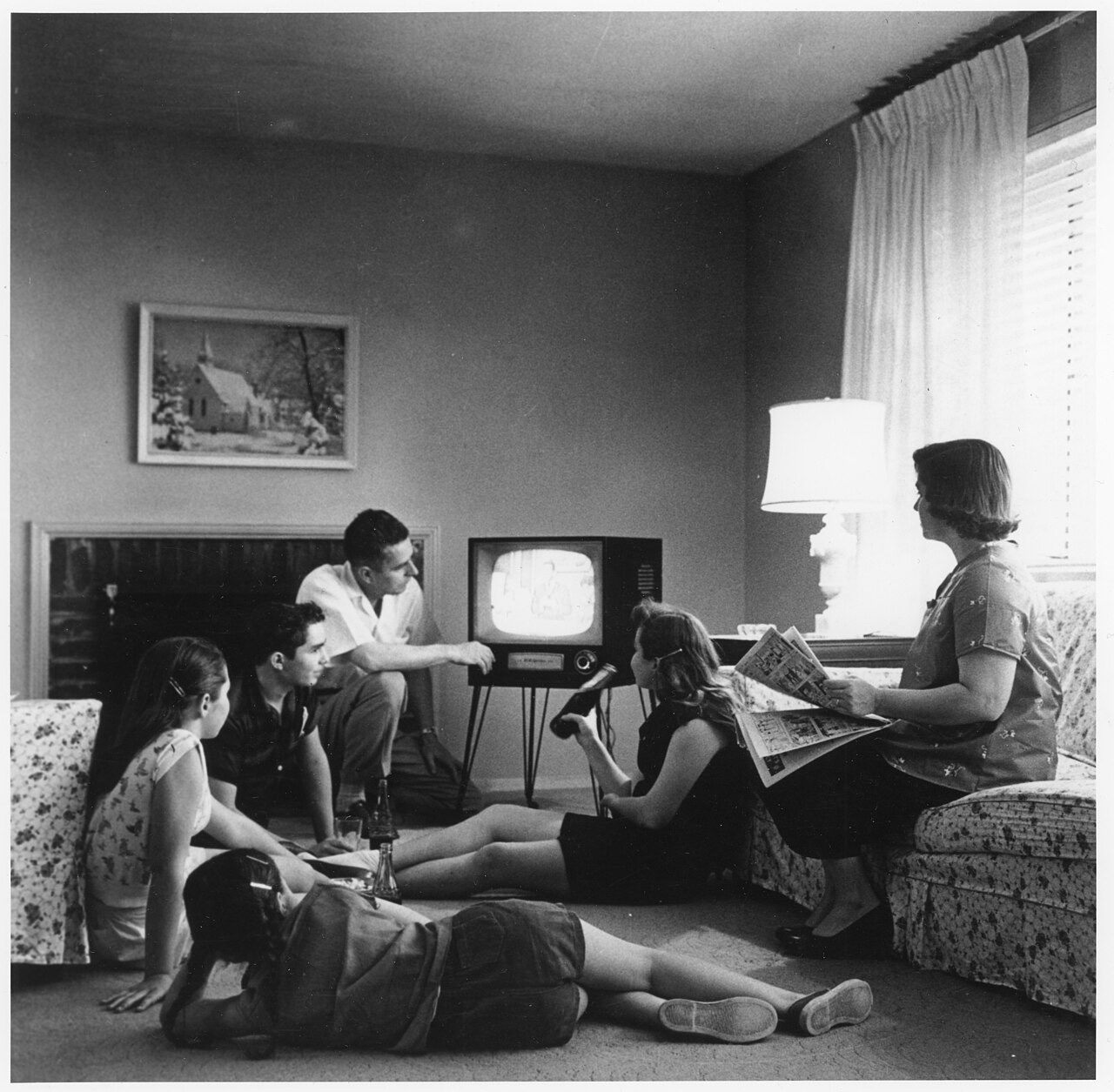

In the spring of 1939, the Radio Corporation of America unveiled a remarkable device at the New York World’s Fair. David Sarnoff, RCA’s imperious president, declared television the newest wonder of a wonder-making age. Families queued to peer into a cathode-ray screen where blurry figures moved against grey backgrounds, and the moment was recorded for posterity as the birth of an industry. What Sarnoff did not say — could not say, perhaps did not fully understand — was that the device he was unveiling would spend the next two decades being argued over, regulated, sold, sponsored, and carefully managed until it resembled nothing so much as the tamest possible version of what its inventors had imagined. The box in the corner of the living room was always a potential weapon; the story of early television is largely the story of how various powerful interests worked to make sure it was never pointed at them.
Before the Postwar Explosion: The Pre-History of Television
Television did not spring fully formed from the postwar period. Its technical history stretched back into the 1920s, when Scottish inventor John Logie Baird gave a demonstration of mechanical television to members of the Royal Institution in London in January 1926. Baird’s system, which transmitted crude moving images using spinning discs, was crude by later standards but was genuinely startling to those who saw it. The BBC, then only a few years old, watched Baird’s work with a mixture of fascination and anxiety, uncertain whether this strange technology represented an extension of radio or something else entirely. Baird began experimental television broadcasts in 1929, though they reached almost nobody — there were perhaps a few hundred homemade receivers in the whole country.
In the United States, meanwhile, the contest between mechanical and electronic television played out as a corporate battle between Baird’s backers in Britain and Philo Farnsworth, the Idaho farm boy who had conceived the all-electronic television system as a teenager and whose patents RCA spent years trying to acquire and ultimately had to license. Sarnoff and RCA had been developing their own electronic system under engineer Vladimir Zworykin, and the legal skirmishes over priority between Farnsworth and Zworykin dragged through much of the 1930s. By the time of the 1939 World’s Fair demonstration, the technology had advanced to the point where a practical broadcasting system was conceivable — but then the war intervened.
Britain’s BBC television service, which had launched in November 1936 as the world’s first regular high-definition public television service, was shut down in September 1939 — mid-programme, according to some accounts, the Mickey Mouse cartoon that was playing simply cut to black. The American networks, which had been inching toward regular broadcasts, similarly pulled back. For six years, the technology sat in suspension while the world was otherwise occupied. When it returned, it returned to a very different world — one that had learned, through total war and totalitarian propaganda, exactly how powerful a mass medium could be, and was accordingly determined to get the management of this new one right.
The American System: Networks, Advertisers, and the Shape of Television
The BBC resumed television broadcasting on 7 June 1946, in a gesture of continuity that said something important about British public service values: the first image transmitted was the same Mickey Mouse cartoon that had been cut off in 1939, resuming as though the war had been a minor interruption. In the United States, the networks had moved more quickly. The four major radio networks — NBC, CBS, ABC, and the short-lived DuMont — had all staked out television operations, and by 1948 there were roughly one million television sets in American homes. By 1952, that number was around twenty million. The speed of adoption was unlike anything the entertainment industry had previously experienced.
The structure that emerged in the United States was shaped above all by the advertising model that had defined American radio. Unlike the BBC, which was funded by a licence fee and operated as a public corporation without commercial interruption, the American networks were privately owned companies whose revenues came from selling airtime to sponsors. This was not incidental to how American television looked and sounded — it was constitutive of it. The sponsor did not merely pay for a programme; in the early years of television, the sponsor frequently owned the programme. Single-sponsor shows were the norm: Kraft Television Theatre, The Colgate Comedy Hour, Hallmark Hall of Fame. The producing advertiser determined content, casting, and tone. A cigarette company sponsoring a drama had obvious interests in how smoking was depicted. A car manufacturer had views about whether characters should be seen riding public transport. The advertising agencies that brokered these arrangements exercised editorial influence that was largely invisible to viewers.
William Paley, who had built CBS into the dominant radio network in the 1930s through a combination of programming genius and ruthless acquisition of talent, saw television clearly as radio’s successor and threw CBS’s considerable resources behind it. David Sarnoff at NBC viewed television as the logical culmination of a broadcast empire that had always been, at its heart, about technology as much as content. The rivalry between Paley and Sarnoff — between CBS and NBC — gave early American television much of its competitive energy and not a little of its character. Paley’s instinct was for popular entertainment: his network brought Jack Benny, Burns and Allen, and eventually Lucille Ball from radio to television, and the phenomenal success of I Love Lucy demonstrated that American audiences would watch situation comedies with an appetite that seemed almost inexhaustible. Sarnoff’s NBC responded by building strength in news and prestige programming, which is part of why the most celebrated television moment of the early 1950s would happen under his network’s auspices.
The emergence of television as the dominant advertising medium happened with a rapidity that alarmed the newspaper and magazine industries, and for good reason. The medium’s capacity to reach a mass audience simultaneously — to put the same image into millions of living rooms at the same moment — was qualitatively different from anything print could offer. Advertisers understood this even when they did not fully understand the implications. What they did understand was that the family gathered around the television set represented a captive audience in the most literal domestic sense: they were in their homes, in their comfortable chairs, with nowhere else to be. The advertiser’s dream of a medium that could deliver a message to a consumer in their private space, at the moment of relaxation and receptivity, had become real. The politics of that position — who controlled the message, who shaped the context, what could and could not be said around the product — would define American television for a generation.
Britain’s Uneasy Monopoly: The BBC and the Coronation
In Britain, the situation was structurally different, though the underlying anxieties about television’s power were remarkably similar. The BBC held a statutory monopoly on television broadcasting — there was no commercial competitor until Independent Television launched in September 1955 — and the Corporation approached the medium with the mixture of patrician confidence and genuine public service commitment that characterised its ethos under directors-general from John Reith onward. Television was seen as educational as well as entertaining, a window on the world that could inform and elevate as well as amuse. The BBC’s news values, its attachment to impartiality, and its sense of itself as a national institution were all transposed onto television — sometimes awkwardly, given how different the medium’s rhythms and demands were from radio.
The moment that transformed British television’s relationship with the public came on 2 June 1953, when BBC cameras broadcast the coronation of Queen Elizabeth II. This was itself the product of a political negotiation: the palace had initially resisted television coverage, on the grounds that cameras in Westminster Abbey would be intrusive and undignified. The Prime Minister, Winston Churchill, was also opposed. It was the Queen herself, reportedly, who insisted on full coverage, and the decision changed everything. An estimated twenty-seven million people watched in Britain — the population was then around fifty million — and hundreds of thousands of those were watching on sets they had acquired specifically for the occasion, or crowded into neighbours’ living rooms because the house did not yet have one. Television set sales had been climbing steadily; they accelerated dramatically in the months before and after the coronation. The medium had announced itself as a participant in national life.
What the coronation demonstrated was television’s peculiar capacity to create simultaneous shared experience. A newspaper could carry photographs the next day; radio could carry the sound; but only television could deliver the image in real time to a mass audience, collapsing the distance between Westminster Abbey and a kitchen in Sheffield or a sitting room in Glasgow. The ritual dimensions of the coronation — the ancient ceremonial forms, the anointing, the crowning — translated surprisingly well to a medium that was, in 1953, still technically crude and shot in black and white. The effect on viewers was reported as deeply emotional, something that neither film nor radio had produced in quite the same way. Television had touched something, and the nation had noticed.
The commercial challenge to the BBC’s monopoly came two years later. Independent Television, funded by advertising revenue from regional franchise holders, launched in September 1955 and quickly demonstrated that there was an audience for entertainment programming that the BBC, in its Reithian commitment to edification, had been slow to provide. ITV’s popular quiz shows, its soap operas, its variety programmes, drew audiences away from the Corporation and forced it to compete in ways that its leadership found uncomfortable. The result was a productive tension that would shape British broadcasting for decades: two models of television — public service and commercial — in permanent dialogue and competition, each shaping the other’s behaviour in ways that neither would have chosen unilaterally.
Edward R. Murrow and the Conscience That Almost Was
If there was a moment when American television briefly appeared capable of speaking truth to power, it came on the evening of 9 March 1954, when Edward R. Murrow’s programme See It Now broadcast a documentary examination of Senator Joseph McCarthy. Murrow, who had built his reputation covering the London Blitz for CBS radio, was the most celebrated journalist in American broadcasting, a man whose voice and manner carried an authority that viewers trusted. He had been cautious about McCarthy — cautious for longer than his admirers later liked to remember — but by early 1954 the Senator’s campaign of innuendo and smear had reached a pitch that Murrow judged intolerable. The See It Now broadcast used McCarthy’s own words and footage, allowing the Senator to condemn himself through his own contradictions, bullying, and falsehoods. It was television journalism as a kind of mirror, and the mirror was not flattering.
The programme’s impact was real, though historians have rightly cautioned against over-crediting it with McCarthy’s downfall — the Army-McCarthy hearings, which came later that spring and were also televised, probably mattered more, and McCarthy had already made powerful enemies within the Republican Party and the Eisenhower administration. But See It Now demonstrated something important: that the television screen could be a space for serious journalism, that the medium’s reach and authority could be deployed in the service of democratic accountability, that a journalist with camera and broadcast access could do what pamphlets and newspaper editorials sometimes could not. For a moment, it seemed that television might be a watchdog after all.
The moment did not last. CBS’s own management was deeply uncomfortable with Murrow’s political interventions — not because they approved of McCarthy, but because controversy of any kind threatened the advertising relationships on which the network depended. Murrow’s sponsor for See It Now, the Aluminum Company of America, had not been given advance notice of the McCarthy broadcast and was furious. CBS chairman William Paley, who admired Murrow personally, had less and less appetite for the liability that Murrow’s journalism represented. The programme’s time slot was moved, its budget reduced, and it was eventually cancelled in 1958. Murrow himself, in a famous speech to the Radio Television News Directors Association in October 1958, delivered a valedictory critique of what television had become: a medium that was “being used to distract, delude, amuse, and insulate” its audience, that was technically capable of illuminating the human condition but was instead occupied with game shows and celebrities. It was the lament of a man who had seen the medium’s possibilities and watched them shrink before commercial imperatives.
The Advertiser and the Living Room: Constructing the Ideal Viewer
The domestic context in which television was consumed was not incidental to how advertisers thought about the medium — it was central to their entire strategy. Lynn Spigel’s research into the discourse around television in the late 1940s and 1950s has illuminated the extent to which both the television industry and consumer culture more broadly constructed television as a domestic technology, one whose natural habitat was the family home and whose natural audience was the housewife. The postwar suburban ideal — the husband at work, the wife managing the home, the children growing up in a consumption-oriented prosperity — was both the context for television’s expansion and the image that television itself endlessly reproduced and reinforced.
The daytime schedule was designed with housewives explicitly in mind: soap operas, game shows, and domestic advice programmes occupied the hours when husbands were absent and women were presumed to be moving through household tasks while keeping one ear on the set. The sponsors of these programmes were predominantly manufacturers of domestic products — detergents, food brands, household appliances — whose interest in reaching women consumers was transparent and whose influence on the content of the programmes they sponsored was considerable. The soap opera as a genre had been invented for radio by the soap manufacturers whose sponsorship gave the form its name; television inherited both the genre and the logic. Women were addressed as consumers first and citizens second, as managers of domestic spaces whose engagement with the wider world was mediated through their purchasing choices.
The physical placement of the television set in the home was itself a matter of cultural negotiation. Early television advertising often depicted the set as a hearth-substitute, positioned in the living room where the family gathered, a focus for the kind of collective domestic attention that the fireplace had once organised. The set’s presence was simultaneously democratising — everyone in the family could watch — and surveillance-like: it shaped how rooms were arranged, how time was divided, how domestic conversation was structured. The family that watched television together was also a family that sat in a particular configuration, faces oriented toward a screen, in a ritual that bore some resemblance to the cinema but was happening in the supposedly private space of the home. This was new, and its implications for family life, for patterns of sociability, for the texture of domestic existence, were understood dimly if at all by those who brought the sets into their homes.
The Quiz Show Scandal and the Revelation of Artifice
The event that crystallised public unease about television’s honesty arrived in 1958 and 1959, when it emerged that the most popular quiz shows on American television had been systematically rigged. Twenty-One, which had attracted enormous audiences with its format of contestants isolated in soundproof booths answering progressively difficult questions, had been feeding correct answers to favoured contestants to ensure dramatic outcomes. Charles Van Doren, a Columbia University professor and member of a distinguished intellectual family, had been a particular beneficiary — and a particular liability when the deception became public. Van Doren had become a genuine celebrity, appearing on the cover of Time magazine, celebrated as a new kind of television hero: the intellectual who was also photogenic, the man who proved that Americans valued brains as well as charm. When it emerged that his performances had been scripted, the betrayal felt peculiarly acute, because the premise of the quiz show had been that it revealed authentic minds under authentic pressure.
Senate hearings followed in 1959. Van Doren confessed, lost his Columbia position, and receded from public life. The networks, facing congressional scrutiny, cancelled the affected programmes and undertook various reforms. The scandal was used — by critics who had always been suspicious of television’s relationship with its audience — as evidence of the medium’s fundamental dishonesty: its willingness to construct the appearance of reality while actually managing the outcome, to offer viewers the experience of authenticity while engineering every element behind the scenes. This, it could be argued, was not merely a failure of certain programmes but a description of how commercial television operated as a whole.
The language of the critique was given its most famous formulation by Newton Minow, appointed by President Kennedy as chairman of the Federal Communications Commission in 1961. In a speech to the National Association of Broadcasters that May, Minow invited his audience to sit and watch an entire day of their own programming, and predicted that what they would find was “a vast wasteland” — game shows, formula comedies, violence, mayhem, commercials, and more commercials. Minow’s speech became one of the most quoted in the history of American broadcasting, partly because the phrase was so memorable, partly because it articulated something that a significant portion of the educated public felt but had not had so clearly expressed. The promise of television — the medium that would bring culture, information, and democratic enlightenment to every home — had curdled into something rather different.
The Political Class Discovers Television
While journalists and cultural critics were developing their unease about what television was becoming, politicians were developing their appreciation of what it could do. The medium’s penetration of the domestic space, its intimacy, its capacity to make the distant seem close and the powerful seem human, were qualities that anyone seeking votes could not ignore. American politicians had been cautious about television in the late 1940s — it was expensive, it was new, and the conventions of its use were unclear — but by the early 1950s the calculation had changed. Eisenhower’s 1952 presidential campaign used television advertising — short, punchy spots produced with professional help — in a way that his Democratic opponent Adlai Stevenson declined to match, considering it undignified. Stevenson’s dignity did not help him.
The moment that demonstrated beyond any doubt that television had transformed the relationship between politicians and the public came in September 1960, with the first of four televised debates between Richard Nixon and John Kennedy. The story has become somewhat mythologised — the claim that radio listeners thought Nixon had won while television viewers gave the edge to Kennedy — but the underlying point is largely sound. Nixon, recovering from illness, appeared sweaty and uncomfortable under the studio lights; Kennedy appeared relaxed, attractive, and at home in the medium. The disparity was not primarily about policy or substance but about how each man inhabited the screen, how each related to the camera, how each managed the peculiar intimacy that television demands. Television, it turned out, was not simply a neutral conduit for political messages. It was a filter, and what it filtered for was a set of qualities — visual ease, personal warmth, the appearance of authenticity — that had little necessary connection with political competence or intellectual depth.
In Britain, the relationship between television and politics developed along different lines but toward similar ends. The BBC’s traditions of political impartiality made it a more cautious arena for party politics than American networks — election broadcasts were tightly regulated, and the Corporation was careful to give comparable time to the major parties. But the coming of Independent Television in 1955 added a competitive dimension, and the confrontational interview style that television encouraged — the close-up that made it difficult to avoid a question, the cutaway that registered evasion — gradually changed what British political culture expected of its leaders. The ability to perform on television became, slowly, a prerequisite for serious political ambition.
The Central Nervous System of Mass Culture
By 1960, television had become something that none of its inventors had precisely intended: the central organising medium of mass culture in the democratic world. The figures were staggering by any standard. In the United States, roughly ninety percent of homes had a television set by the end of the decade. Viewing times averaged several hours per day per household. The advertisers had found their medium, the politicians had found their platform, the networks had found their business model, and the audience had found its habit. What had been, as recently as 1946, a curiosity restricted to a handful of urban households was now a fixture of daily life so deeply embedded that it was becoming difficult to imagine social existence without it.
The domestication of television — its integration into the rhythms and spaces of everyday life — was not merely a metaphor. It was a physical and architectural reality. Houses were designed around television sets; schedules were organised around broadcast times; the evening news became a ritual that structured the transition from the working day to the domestic evening. The television aerial, bristling from rooftops across Britain and America, was the most visible index of social change in the 1950s — more visible than the motor car, though the two technologies were reshaping the landscape of modern life in related ways, both pointing toward a privatised consumption that was gradually superseding the older public cultures of street, pub, cinema, and dance hall.
What was lost in this process, and what was gained, remained contested. Cultural critics from different traditions — Frankfurt School pessimists, Leavisite literary humanists, American liberal journalists — converged on the view that something had gone wrong, that the promise of the medium had been betrayed by commercial imperatives and the logic of mass entertainment. They were not wrong, exactly, but they were partial. Television also brought events of genuine historical significance into homes that would otherwise have been reached by nothing. It was television that brought the Army-McCarthy hearings to American audiences, television that made the civil rights struggle in the American South visible to northern whites, television that carried the Kennedy assassination into homes across the world within hours of the shots being fired in Dallas. These were not trivial achievements. The medium that Minow called a vast wasteland was also, at its best, something more than that.
The tension was built in from the start. Sarnoff’s 1939 World’s Fair enthusiasm for television as a democratising force and Murrow’s 1958 lament about what the medium had become were not contradictory — they were descriptions of the same object from different angles. Television had the potential to illuminate and to anaesthetise, to inform and to distract, to empower citizens and to reduce them to consumers. The political class, the advertising industry, the network executives, and the regulatory bodies that emerged across the democratic world all understood, with varying degrees of explicitness, that these possibilities needed to be managed. The living room screen had to learn to behave. By 1960, it largely had. What remained to be seen — what the following decades would slowly reveal — was what the cost of that good behaviour might ultimately be.

Leave a Reply