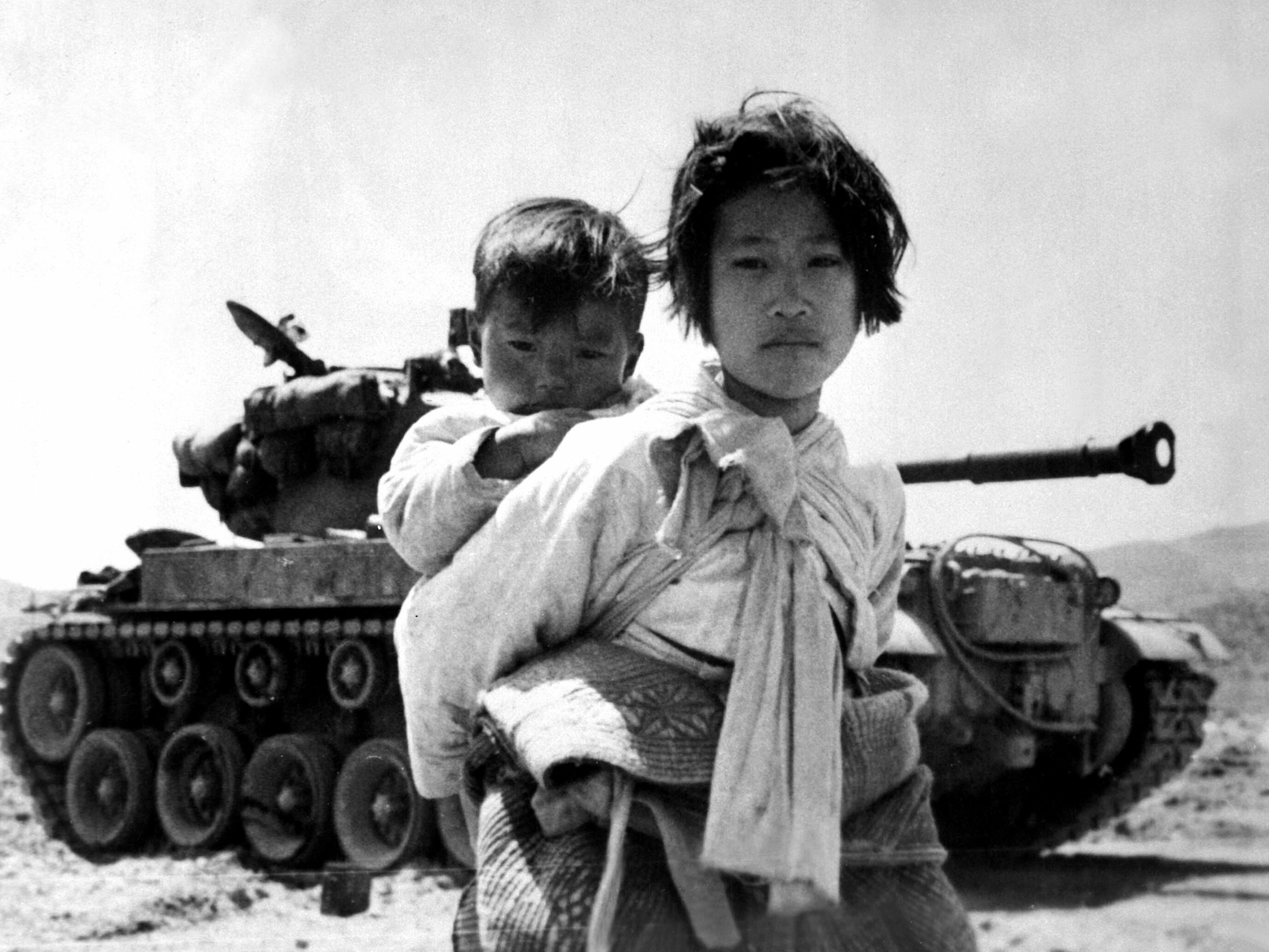

In the latest episode of the Explaining History Podcast, Paige Towers unpacks the painful history of Korean intercountry adoption – a story of good intentions, colonial attitudes, reckless systems, and the voices of adoptees finally being heard.
When Paige Towers first heard about the 2008 murder‑suicide in her hometown of Iowa City, she didn’t know it would lead her to write a book. A local bank vice president had killed his wife and children before taking his own life. It was a shocking, horrifying event – but it wasn’t until years later, when she googled the case and stumbled onto adoptee forums on Reddit, that she realised the murder was connected to a much larger story. The perpetrator had adopted children from Korea. And he was far from the first.
What They Stole is the result of that discovery: a meticulously researched exploration of Korean intercountry adoption, from its origins in the chaos of World War II to the present‑day fight for truth and reconciliation.
The Origins: From WWII to Korea
Modern intercountry adoption began with the mass displacement of children after World War II. In Germany, Italy, Greece, and Japan, orphans filled the streets. American GIs and missionaries started taking children home – often through informal, unregulated channels. It was an emergency measure, but it quickly became a solution to poverty. Eventually, European governments regulated or shut down the practice. The template, however, had been set.
When the Korean War started in 1950, Americans were again on the ground. Soldiers built orphanages, provided charity, and “rescued” children. Paige describes this as “military humanitarianism” – a term coined by scholar Soojin Pate. It was not official US policy, but the US was deeply complicit in failing to regulate or prevent what soon became a reckless adoption industry.
The Holts and the Whitening of Adoption
The face of Korean adoption was Harry and Bertha Holt, an evangelical Christian couple from Oregon. Their initial focus was on multiracial children – children of American GIs and Korean women. These children, with their “whitened” appearance, struck a powerful chord with white American audiences. Missionary groups showed photographs and gave talks, and soon thousands of families were on waiting lists.
But there were not enough multiracial children. The Holts responded in two ways. First, they began competing aggressively to acquire multiracial children – leading to coercion, kidnapping, and bribery. Second, they simply turned to Korean children. By the mid‑1950s, they had a waiting list of 10,000 families. The pipeline was full.
Baby Lifts: Flying Coffins
To move children quickly and cheaply, Harry Holt chartered old Korean military cargo planes. He removed the seats and packed up to 100 infants on each flight. The cabins were unpressurised. The planes were freezing. Infants as young as a few weeks old, weighing five or six pounds, many suffering from pneumonia or tuberculosis, were loaded aboard. When pilots flew too high, the lack of oxygen was dangerous. When they flew low to compensate, turbulence was so violent that everyone vomited. Children died on these flights – sometimes three per journey.
Social workers, doctors, and medical organisations raised alarms. But the US federal government did nothing. The Holts’ actions were viewed as an anti‑communist act, an example of American exceptionalism and benevolence following the “emasculating defeat” of the Korean War. The baby lifts continued for years.
Adoption by Proxy and the System of Silence
Even when the flights improved, the system remained reckless. Many American families adopted by proxy – they never travelled to Korea, never met their child before the adoption was finalised. An agent would complete the adoption on their behalf, and they would “re‑adopt” the child on American soil. They adopted sight unseen, guided only by a photograph.
This lack of oversight created enormous potential for abuse. Paige documents multiple cases of Korean children being murdered by their adoptive parents – cases that were often ignored by a media more interested in sentimental rescue narratives. The 2008 Iowa City murder was not an isolated incident. It was a pattern.
The European Pipelines
While Korean adoption began as an American phenomenon, by the 1980s the demand was so high that adoption agencies opened pipelines to Denmark, France, Sweden, the Netherlands, and other European countries. Thousands of Korean children were sent to Europe. Today, European adoptees have developed powerful activist groups fighting for truth and reconciliation – and, in some countries, winning governmental investigations. The United States, by contrast, has never held a public investigation into what went wrong.
The Voices of Adoptees
Paige is careful not to condemn adoptive families. Many adoptive families are loving, stable, and well‑intentioned. The problem is that good intentions do not automatically produce good systems. For decades, the media focused on the experiences of adoptive parents – the joy of rescue, the miracle of a new family. The voices of adoptees were silenced.
Only now, as adoptees write their own texts, form activist groups, and fight for their rights, are we beginning to understand the full cost. Identity loss. Cultural loss. Loss of language and food. Loss of home and family. And, in the darkest cases, loss of life itself. Adoptees were not brought up with Korean culture; they were assimilated into whiteness. Their stories of grief and dislocation were never told.
The Colonial Assumptions
Underpinning the entire system was a colonial assumption: that children from poor, non‑white countries were better off in wealthy, white American homes. That assumption has become harder to sustain as Korea has developed into a wealthy, technologically advanced nation. The argument that children were being “saved” from squalor no longer holds. But the system took decades to change – and the harm it caused will take generations to heal.
A Reckoning Still to Come
Paige hopes that What They Stole will contribute to a broader reckoning. In Europe, governments are beginning to acknowledge the harm. In the US, that reckoning has not yet come – and in the current political climate, it may be a long way off. But the adoptees are not silent any longer. Their stories are finally being heard.
What they stole was not just children. It was language, culture, identity, family, and, in too many cases, life itself. The least we can do is listen.
Paige Towers’ What They Stole is available now from the University of Iowa Press. Please consider buying from an independent bookshop or directly from the publisher.
If you enjoyed this piece, please consider supporting the Explaining History Podcast. We are migrating from Patreon to Substack – details in the show notes.
Transcript
Welcome again to the Explaining History podcast, and I am delighted today to be joined by Paige Towers, whose new book, What They Stole – a family story rooted in intercountry adoption, published by the University of Iowa Press – tells a story that weaves colonial attitudes towards adoption with the Korean War, family tragedy, and the moral complexities around adoption between first world countries and those in the Global South. Welcome, Paige. It’s a pleasure to have you today.
Hi, thank you so much for having me. I’m happy to be here.
Good, good. Okay, so to start off with, let’s talk about the book itself, about where it comes from, and the questions you were asking yourself when you began to explore it.
The book started with an event that happened in my hometown of Iowa City, Iowa, where the University of Iowa is. I grew up there. I was a student at the university in 2008 when a local bank vice president murdered his wife and children before taking his own life. I was living in a pretty small community, so this was a shocking, horrifying event. I didn’t know the family personally, but I had a hundred little social connections between them and saw them around town. So while that event always stayed in the back of my mind, it wasn’t until about 10 years later that I researched it for the first time – googled it for the first time – and somehow, I think on Reddit looking at adoptee Reddit, there were more stories that I came across than just this one horrifying event. Pretty soon I discovered that the event felt like a window into the past, because unfortunately, as I found, Korean intercountry adoption has a pretty dark, reckless history. So once I started researching, I couldn’t stop. I was buying books, reading constantly. Within weeks, I decided I’m going to try to write a book about this.
That history itself, does that really begin with the Korean War?
To me, it begins with World War Two, where you have this mass displacement of children and families. You have a huge number of orphans in Europe and Germany, Japan, Italy, Greece. They start allowing intercountry adoption, mostly by Americans. Eventually those governments shut that practice down and regulated it. But it was an unorthodox practice for people to adopt children from overseas before World War Two happened. Then the Korean War starts in 1950, American soldiers are on the ground and start interacting with Korean children, building orphanages, providing charity, food, and care. So this created a new relationship between the West and the East. So, yes, you’re right that it started with the Korean War, but we can definitely trace it back to World War Two as well.
World War Two, obviously in Europe and Asia, presents a humanitarian crisis that had never been seen before on that scale. Was it that social welfare systems completely collapsed and governments thought, well, these children will potentially die unless we allow this sort of thing?
It was definitely an emergency measure. It took the pressure off the state in crisis to provide funding for social services. But it was more complex than that, because this was happening one, two, three years after the end of the war. What started as orphans literally on the street became women having babies and not having the funds to feed and care for them, having to go back to work with no childcare services. It basically became the solution to poverty.
Were American families doing this in a kind of missionary fashion, or with a range of motivations?
It became a missionary action. There’s a term, I think it’s Soojin Pate who coined it – “military humanitarianism”. It started with American GIs and their families abroad adopting children, sometimes in Europe, sometimes in a month or less, adopting by proxy through an agent. It really wasn’t until later that it became a Christian mission. But of course, there were missionaries on the ground, though they were mostly providing funds for orphanages, support for food and clothing. So it was kind of a non‑official military act at the beginning.
None of this is state‑backed as far as America goes.
True. It was very off the books. It was not condoned even by the US military, although it was happening all the time. But I would also say that the US was deeply complicit in not regulating it, not extending or writing new laws to prevent what soon became a very reckless adoption industry. So it was a very hands‑off approach until very recently, into the 2000s.
My goal with the book was not to condemn adoptive families, because many adoptive families are loving and stable and meaningful and had good intentions. The one thing the book really challenged me on is the idea that good intentions automatically produce good systems. Intercountry adoption is compelling precisely because many people involved sincerely believed they were helping. Yet enormous loss, dislocation, and silencing still occurred alongside that humanitarian narrative.
Moving forward to look at Korea, the book talks about the beginnings of this transfer of children from Korea to America, many of them being the children of GIs who had had sex with local women, not even knowing they had children. How do we go from that to it simply being the children of Korean people in large numbers?
There was a multiracial population of Korean children born to American GIs and some European soldiers. A good estimate is maybe around 1,000 to 1,500 in 1955. This became a focal point for US media because missionary groups in Korea were coming back to the US giving talks and showing photographs of these multiracial children. Children who had been “whitened” by biological white fathers really struck a chord with Americans. They suddenly were very endeared to these children. Their plight was very real – Korea was suffering immensely economically.
While the initial goal of the Holts – Harry and Bertha Holt, who started Holt International adoption agency – was to go in and find multiracial children and send them back to American families, very soon they found there were not as many multiracial children for adoption. That caused two things: first, they started seeking much more competitively and aggressively to gain multiracial children – leading to coercion, kidnapping, and bribery. Second, they simply turned to Korean children and started fulfilling their waiting list at home. They had roughly 10,000 people on a waiting list by the mid‑1950s waiting for a Korean child. So they made that switch without any fanfare or announcement.
Was this a charitable enterprise or a for‑profit one?
Originally, Harry and Bertha Holt were an evangelical born‑again Christian couple, so their goal was a missionary one – saving the souls of Korean children by adopting them into born‑again Christian homes. It was a mission for their church, a mission for God, and it was not profitable. It actually completely destroyed their family funds, which had been immense prior to this endeavor. It was not until later years, after Harry’s death and after the adoption agency expanded out of Korea and applied its model to other post‑colonial or non‑Christian majority countries, that by the late 70s and hugely in the 80s it became a very competitive, very profitable industry.
There’s been a change in the mood music around intercountry adoption – from the 90s and 2000s, it’s suddenly seen as not an act of charity but something really quite uncomfortable, quite colonial. What brought that change of sentiment?
Before the 90s and early 2000s, US media was publishing a lot of sentimental, positive feel‑good stories about adoptive families. You had the before‑and‑after narrative – the suffering child in a “third world country”, and now look at them in an American middle‑class suburban home, thriving. That narrative shifted a bit, but the connections are still clearly there. Something I found that made me extremely uneasy was that intercountry transracial adoption became almost hip – a way to be seen as your family as multicultural. There’s a colour‑blindness happening there, and of course it’s always children of colour being adopted into white families. We’re not seeing the opposite. Adoption can become almost addicting for some families – building your family through adoption, adopting children of colour from different countries. It became romanticised by American celebrities especially.
Now we’re seeing a different viewpoint due to adoptees themselves – writing texts, reporting, forming activist groups, fighting for rights. We’re understanding that it was, in some ways, a reflection of colonialism. The children who were brought from Korea to America were not brought with their own culture intact. It’s always about white assimilation. So many adopted people have written about identity loss, cultural loss, loss of home and family, loss of language and food. That was glazed over because the media was always focused on adoptive families and their experiences. The complexities didn’t come out until a child was older – a teenager or in their early 20s – and by then, culturally, we’re not so fascinated with them. We like to tell adoptee stories when kids are babies, when they’re young. So we missed a lot of that.
Coming back to the book, you talk about the naivety and folly of the Holts leading to catastrophes – children suddenly passing away, sometimes even before they arrived in America. What did these children in transit actually experience?
In the 1950s, they started something called “baby lifts”. They found it was much slower and more expensive to fly children commercially – flying eight children at a time from Korea to America. So Harry Holt chartered an old Korean military cargo plane, removed the seats, and was able to fit around 100 children on each flight. The flights themselves were horrific. The cabins weren’t pressurised. The children – some of them only a couple of weeks old, weighing five or six pounds – many were suffering from pneumonia and tuberculosis and other ailments. As you said, a lot of children didn’t survive. The planes were freezing. There was a lack of oxygen when the pilots flew too high, but then they’d have to fly low and the turbulence would be so violent that everyone was vomiting – 100 vomiting kids on a plane. Sometimes three children perished on the long flight over.
Social workers, doctors, and medical organisations raised alarms, but there was no federal US government response. The Holts’ actions were still viewed as an anti‑communist act, an example of American exceptionalism and benevolence after the emasculating defeat of the Korean War. It fitted with what the West wanted to portray itself as. So it kept happening for years. Americans were still adopting by proxy into the 2000s – they never travelled to Korea, never met their child beforehand, adopted sight unseen, just seeing a picture.
This is essentially a US‑Korean story. Have you come across other Western or First World countries that did this on this scale?
This was originally an American phenomenon. But in the 80s, the demand was so high that they started opening adoption pipelines into Denmark, France, Sweden, the Netherlands – other countries. Very quickly, those countries adopted thousands of children from Korea. Denmark especially is seeing the consequences – adoptees there have developed incredible activist groups fighting for truth and reconciliation, fighting for their cases to be seen by the public and recognised by those governments. Europe seems to be publicly and governmentally reconciling with the harms of that decision. In the US, there is still not a public, governmental investigation at all into what went wrong.
Did you find that the more you explored it and wrote, the more you felt connected to the stories and the more you cared about it?
It was extremely emotional. I was also raising my own young child while researching and writing this book, which heightened the intensity. I wrote very specifically about certain murder cases, because as I discovered, the 2008 murders were far from the first case of Korean children being murdered by their adoptive parents. I felt extremely dedicated to turning up as much information and details as I could, and laying them out, writing those children’s names down – some for the first time as far as I can find – because I felt I owed it to them to shine a light on their deaths. It was painful. I had to take many breaks, many dog walks. It’s not easy material. But I tried to lay it out as clearly as I could. If I felt my anger or grief was coming into the writing, I went back and rewrote those sections to keep a non‑judgmental tone.
That in itself is a real service – telling the story in that way.
Thank you.
So, to give the book its plug: What They Stole, by Paige Towers, published by the University of Iowa Press – currently available?
Yes, it came out on May 26, so it’s currently available.
And as I always say, if you’re looking to get a copy, source it through your local book retailer – the smaller the better. Or if you can’t get it through your local bookstore, contact the publisher directly. Don’t go to a big online retailer for legal reasons we won’t name. They’ve got more than enough money. Go local. Buy it from your local guys because you’ll miss them when they’re gone.
Paige, it was a real honour to talk to you today. A real pleasure. And it would be great to talk to you again about this sort of thing in the future.
Thank you so much for having me. This was great. I can talk about this topic endlessly. I appreciate you having me on so much.
Well, good luck with the book, take good care, and hopefully we’ll speak again sometime.
Yeah, definitely. Thank you. Bye bye.

Leave a Reply