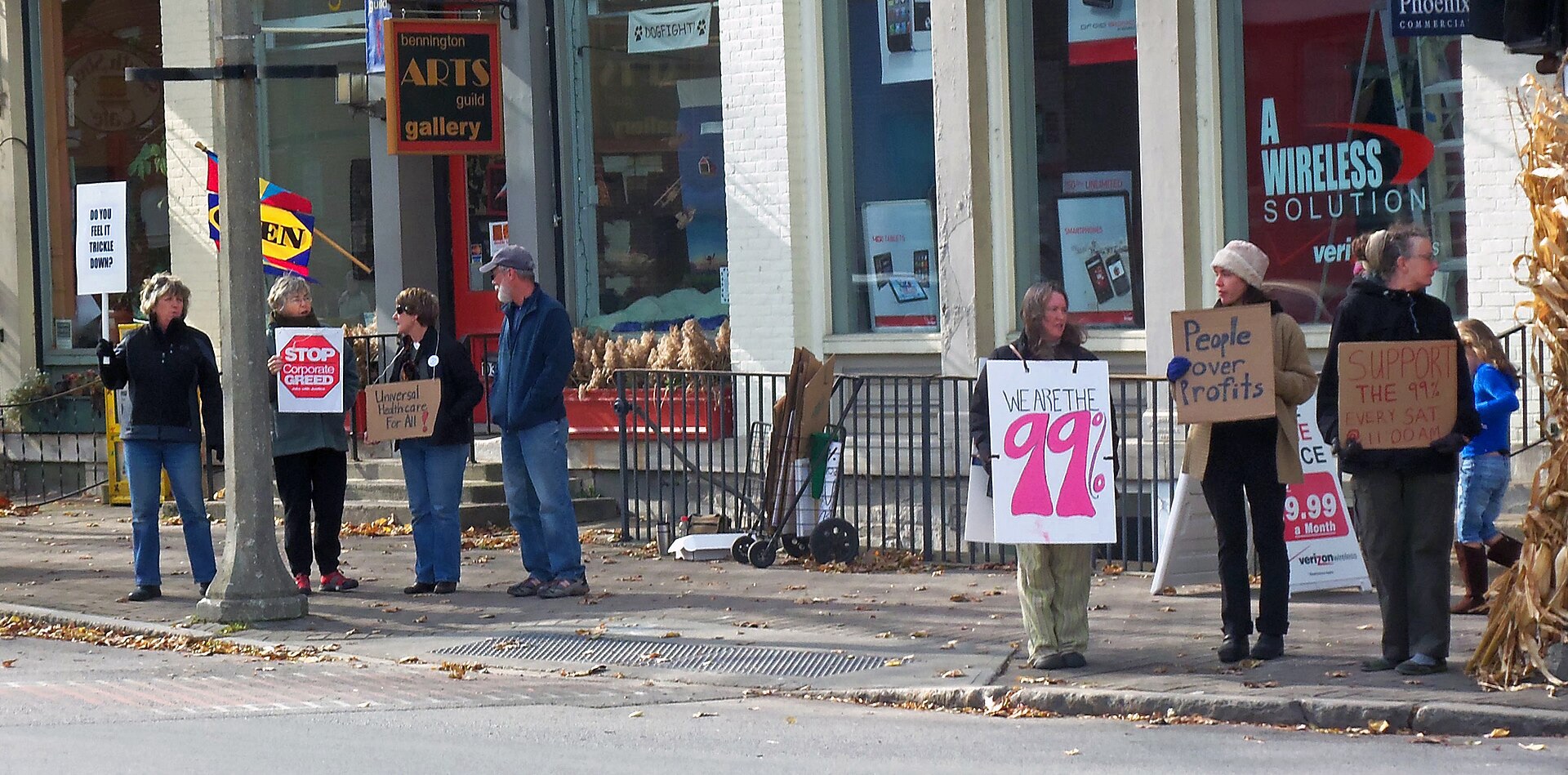

On September 17, 2011, a thousand protesters gathered in Zuccotti Park, a small plaza in New York’s financial district. They called themselves “Occupy Wall Street.” Their signs captured a diffuse but powerful rage: “We are the 99%,” “Banks got bailed out, we got sold out,” “End corporate personhood.” For weeks, they camped in the park, holding general assemblies and clashing with police. The movement spread to hundreds of cities across the United States and around the world. By November, police had cleared the camps, but the slogan “We are the 99%” had entered the political lexicon. It captured a simple truth: the recovery from the Great Recession had been wildly uneven. The top 1% had regained their losses and then some; everyone else was still struggling.
Occupy Wall Street was not the only political reaction to the crisis. On the right, the Tea Party movement had emerged in early 2009, fueled by anger at the bank bailouts, the stimulus, and the growing national debt. Its supporters donned tricorn hats and carried “Don’t Tread on Me” flags. They organized rallies, primaried moderate Republicans, and helped sweep the GOP to control of the House in the 2010 midterms. The Tea Party was not explicitly anti-capitalist; it was anti-government, anti-tax, and anti-deficit. But it shared with Occupy a deep distrust of elites—financial, political, and media. Both movements were populist uprisings against a system that seemed to serve the few at the expense of the many.
The political consequences of the 2008 crisis are still unfolding. The crisis shattered public trust in institutions—banks, corporations, government, the media, even experts. It fueled the rise of outsider candidates: Bernie Sanders on the left, Donald Trump on the right, Jeremy Corbyn in the UK, Marine Le Pen in France, and a host of populist parties across Europe. It contributed to the Brexit vote, to the election of Trump, and to the erosion of democratic norms. The Great Recession did not cause these phenomena single-handedly—globalization, technological change, and long-term trends in inequality played major roles—but it was the catalyst that turned simmering discontent into political wildfire.
This article traces the political aftermath of the 2008 financial crisis. It examines the rise of the Tea Party and Occupy Wall Street, the populist waves that followed, and the long-term erosion of trust in democratic institutions. It argues that the crisis created a legitimacy vacuum—a widespread belief that the system was rigged—that populists on both left and right have exploited with devastating effect.
The Tea Party: Anger on the Right
The Tea Party movement did not come from nowhere. It drew on decades of conservative anti-tax activism, but the spark was the bank bailouts and the stimulus. On February 19, 2009, CNBC reporter Rick Santelli delivered an on-air rant from the floor of the Chicago Board of Trade. He denounced the Obama administration’s plan to help struggling homeowners refinance their mortgages, calling it “promoting bad behavior” and suggesting a “Chicago Tea Party.” The clip went viral. Within days, protests were organized across the country. The name stuck.
What the Tea Party Wanted
The Tea Party was not a single organization but a loose confederation of local groups, united by a few core beliefs: lower taxes, less government spending, a balanced budget, and adherence to a strict reading of the Constitution. But the emotional heart of the movement was opposition to the bank bailouts. The “Bailout Nation” narrative held that Washington had rescued the very financial institutions that had caused the crisis, while ordinary Americans were left to suffer. This was not a left-wing critique; it was a populist one. The Tea Party’s heroes were the free-market economists who had warned against bailouts, such as Peter Schiff and Ron Paul.
The movement was also fueled by racial and cultural anxieties. Barack Obama’s election in November 2008 had unsettled many white Americans. The Tea Party’s rallies were overwhelmingly white, and its rhetoric about “taking back our country” carried implicit racial overtones. Critics pointed to signs depicting Obama as a witch doctor or a Kenyan socialist. Defenders argued that the movement was about fiscal responsibility, not race. But the overlap between Tea Party support and racial resentment was measurable in polling data.
Electoral Impact
The Tea Party’s electoral impact was immediate and dramatic. In the 2010 midterm elections, Republicans gained 63 seats in the House—the largest shift since 1938—and took control of the chamber. The Senate also moved to the right. The 2010 class included Tea Party favorites such as Marco Rubio (Florida), Rand Paul (Kentucky), Mike Lee (Utah), and Ted Cruz (Texas). These senators would play a major role in the fiscal confrontations of the Obama years, including the 2011 debt ceiling crisis and the 2013 government shutdown.
But the Tea Party also had a more lasting effect: it pulled the Republican Party sharply to the right. Moderate Republicans who had supported bailouts or stimulus—such as Senator Bob Bennett of Utah and Representative Mike Castle of Delaware—were defeated in primaries by Tea Party challengers. The party’s center of gravity shifted away from fiscal conservatism and toward a more confrontational, anti-establishment posture. This shift would eventually create space for Donald Trump, who was not a traditional conservative but who shared the Tea Party’s distrust of elites.
Occupy Wall Street: Anger on the Left
If the Tea Party was the right’s response to the bailouts, Occupy Wall Street was the left’s. The movement began on September 17, 2011, when about a thousand protesters gathered in Zuccotti Park. The catalyst was a call from the Canadian anti-consumerist magazine Adbusters, which proposed a “Tahrir moment” for Wall Street. The timing was not accidental; the first anniversary of the Lehman collapse had just passed, and anger at the banks was still raw.
The 99% vs. The 1%
Occupy’s central insight was framing the crisis in terms of inequality. The slogan “We are the 99%” captured the reality that the recovery had been radically unequal. Between 2009 and 2011, the top 1% captured 95% of all income gains. The bottom 99% saw their incomes fall. The top 1% of households owned 40% of the country’s wealth; the bottom 80% owned just 7%. The slogan was not just descriptive; it was organizing. It said: you may disagree about the details, but you are with us, not with them.
The movement’s tactics were deliberately unconventional. It had no formal leaders, no official spokespeople, and no list of demands. Decisions were made by “general assemblies” using a consensus process that could stretch for hours. The lack of demands frustrated the media, which could not figure out what Occupy wanted. But that was the point: the movement was a protest against the entire system, not a set of policy proposals. The process was the message.
The Police Crackdown
Occupy camps spread to hundreds of cities across the United States and around the world. London’s St. Paul’s Cathedral, Frankfurt’s Opernplatz, and Toronto’s St. James Park all saw encampments. But the movement was short-lived. City after city evicted the protesters, citing public health and safety concerns. In New York, Mayor Michael Bloomberg ordered the clearing of Zuccotti Park on November 15, 2011. Police arrested 200 protesters, many of whom had been peacefully camped. Other cities followed suit. By the spring of 2012, most Occupy camps had been dismantled.
The crackdown did not, however, erase the movement’s impact. The “99%” framing entered the political mainstream. President Obama, who had been criticized for his weak response to the foreclosure crisis, began speaking about inequality more forcefully. The Democratic Party shifted left on economic issues, embracing higher taxes on the rich, a higher minimum wage, and expanded social programs. Senator Bernie Sanders, who had been a fringe figure, became a major presidential contender in 2016 on a platform that echoed Occupy’s themes.
The Populist Wave: From Trump to Brexit to Podemos
The Tea Party and Occupy were the first stirrings of a populist wave that would sweep the Western world. The Great Recession had discredited the political establishment, which had failed to prevent the crisis and then bailed out the banks. Voters on both left and right turned to outsiders who promised to shake up the system.
Donald Trump
The most dramatic example was Donald Trump. Trump had been a reality television star and a real estate developer, but he was not a traditional politician. He had flirted with presidential runs before, but he was not taken seriously. In 2015, he announced his candidacy with a speech that attacked Mexican immigrants as rapists and criminals. The media expected a short-lived spectacle. Instead, Trump rode a wave of white working-class anger to the Republican nomination and the presidency.
Trump’s appeal was rooted in the Great Recession’s aftermath. His base consisted of voters who had been hit hardest by the crisis: non-college-educated whites, particularly men. These voters had lost jobs, lost homes, and watched their communities decline. They blamed both parties for the bailouts, for free trade agreements that shipped jobs overseas, and for immigration that they believed depressed wages. Trump promised to “drain the swamp,” to renegotiate trade deals, to build a wall on the Mexican border, and to impose tariffs on Chinese goods. His rhetoric—crude, bombastic, and often false—resonated with voters who felt that the system had lied to them. He won the presidency in 2016, despite losing the popular vote.
Bernie Sanders
On the left, Bernie Sanders emerged as a similar figure. Sanders was not a Democrat; he had spent decades as an independent socialist from Vermont. He ran against Hillary Clinton in the 2016 Democratic primary on a platform of universal health care, free college tuition, a $15 minimum wage, and breaking up the big banks. His crowds were huge; his fundraising was powered by small-dollar donations. He lost the nomination, but his movement forced Clinton to adopt more progressive positions. The Sanders coalition—young voters, working-class whites, and some minorities—was the left’s answer to Trump. Like Trump, Sanders tapped into anger at the bailouts and the rigged economy. Unlike Trump, Sanders directed that anger at billionaires, not immigrants.
Brexit
In the United Kingdom, the populist wave took the form of Brexit. On June 23, 2016, British voters narrowly approved leaving the European Union by 52% to 48%. The Leave campaign was led by populists such as Boris Johnson and Nigel Farage, who blamed the EU for immigration, lost sovereignty, and economic stagnation. The Remain campaign, led by Prime Minister David Cameron, warned of economic catastrophe. The voters who supported Leave were similar to Trump’s base: older, white, less educated, and concentrated in deindustrialized regions that had never recovered from the 2008 crisis. The shock of the referendum result—polling had predicted a Remain victory—was comparable to Trump’s election later that year.
Continental Europe
Populist parties surged across Europe. In France, Marine Le Pen’s National Front (now National Rally) won more than 30% of the vote in the 2017 presidential election, though she lost to Emmanuel Macron. In Italy, the Five Star Movement, founded by comedian Beppe Grillo as an anti-establishment protest, became the largest party in the 2018 election. In Germany, the Alternative for Germany (AfD) entered the Bundestag for the first time in 2017, capturing 13% of the vote. In Spain, the left-populist Podemos emerged from the anti-austerity protests and won 20% of the vote in 2016. In Greece, Syriza, a coalition of left-wing radicals, won power in 2015 on a platform of rejecting austerity.
All of these movements shared a common feature: they were reactions to the crisis and the subsequent austerity. The EU’s response to the sovereign debt crisis—forcing Greece, Ireland, Portugal, and Spain to implement harsh spending cuts—had fueled anti-European sentiment. The perception that German Chancellor Angela Merkel had imposed austerity on southern Europe while German banks were bailed out deepened north-south divisions. The refugee crisis of 2015 added another layer, but the foundation was economic.
The Erosion of Trust: Why Institutions Failed
Underlying all of these movements was a profound erosion of trust. In 1964, three-quarters of Americans said they trusted the federal government to do the right thing most of the time. By 2014, that figure had fallen to 19%. Trust in banks, corporations, the media, and even science followed a similar trajectory. The financial crisis was not the sole cause of this decline, but it was the decisive blow.
Trust in Finance
Before the crisis, many Americans believed that Wall Street was a source of prosperity. After the bailouts, they believed it was a source of corruption. The revelation that AIG had paid $165 million in bonuses to the same division that had nearly bankrupted the company was a public relations disaster. The fact that no senior banker went to jail—despite widespread fraud in the mortgage origination process—reinforced the belief that the system was rigged. The Dodd-Frank Act was supposed to rein in Wall Street, but it did not break up the big banks, and it did not prevent the largest banks from becoming even larger. By 2020, the six largest US banks held assets equal to more than 80% of GDP—up from 55% in 2007. The “too big to fail” subsidy remained.
Trust in Government
The bailouts also damaged trust in government. President George W. Bush signed TARP into law, but it was the Obama administration that oversaw the bailouts. The perception that Obama was a tool of Wall Street was a powerful force on both left and right. The right accused him of socialism, but also of bailing out the banks. The left accused him of selling out to Goldman Sachs. The reality—that the bailouts were necessary to prevent a second Great Depression—was lost in the fury.
Trust in Media
The media also lost trust. The mainstream press had missed the financial crisis; few journalists had exposed the subprime bubble. After the crisis, the media became a target. The Tea Party accused the press of liberal bias. Occupy accused the press of ignoring inequality. The rise of social media allowed voters to bypass traditional gatekeepers, but it also allowed misinformation to spread. The “fake news” phenomenon, which would come to full flower in the 2016 election, had its roots in the post-crisis distrust of established sources.
Trust in Experts
Perhaps most damaging was the loss of trust in experts. Economists, in particular, were discredited. They had failed to predict the crisis, had assured the public that housing prices would not fall nationwide, and had built models that assumed away systemic risk. The Nobel Prize-winning economist Robert Lucas had declared in 2003 that the “central problem of depression-prevention has been solved.” Ben Bernanke, who would later lead the Fed through the crisis, had written in 2004 that the housing boom “largely reflects strong economic fundamentals.” The collapse of expert authority opened space for populists who claimed that ordinary people—not experts—knew the truth.
The Unfinished Reckoning
The political consequences of the 2008 financial crisis are still unfolding. The populist wave has not receded; it has evolved. Donald Trump lost the 2020 election but remained the leader of the Republican Party. Bernie Sanders’s ideas—Medicare for All, free college, a wealth tax—have become mainstream in the Democratic Party. Brexit has been implemented, though its economic consequences have been negative. Marine Le Pen has normalized the far right in France. The AfD has become a permanent presence in the German parliament.
The underlying conditions that fueled the populist wave have not been addressed. Inequality remains at near-record levels. The middle class has not recovered its pre-crisis wealth. The political system remains gridlocked. The banks are bigger than ever. The bailouts are a distant memory, but the anger they generated is not.
The Great Recession did not cause the rise of populism single-handedly. Globalization, automation, immigration, and cultural change all played roles. But the crisis was the catalyst. It shattered the post-Cold War consensus that free markets, free trade, and liberal democracy were the natural end of history. It revealed that the system was fragile, that elites were fallible, and that the benefits of growth were not widely shared. It created a legitimacy vacuum that populists on both left and right have filled.
The question now is whether democracy can survive the populist challenge. The 2008 crisis showed that the financial system could be rescued. It did not show that the political system could be. The reckoning is not over. It has only just begun.
Conclusion
The 2008 financial crisis was not only an economic catastrophe; it was a political earthquake. The bailouts—necessary as they were—shattered the public’s trust in elites. The Great Recession—deep and prolonged—created a generation of economic scarring. The recovery—uneven and slow—widened inequality and fueled resentment. From this fertile ground sprouted the Tea Party, Occupy Wall Street, and a global wave of populism that has reshaped Western politics.
The populist wave did not have a single ideology. The Tea Party wanted less government; Occupy wanted more. Trump wanted to build a wall; Sanders wanted to break up the banks. But all shared a common enemy: the establishment. All claimed to speak for the forgotten man. All promised to restore power to the people. And all were products of a crisis that had shown, in stark terms, that the system was stacked against the many in favor of the few.
The consequences of the 2008 crisis will be felt for decades. The trust that was lost has not been regained. The institutions that failed have not been fully reformed. The divisions that were exposed have not been healed. The next crisis will come—perhaps a pandemic, perhaps a climate catastrophe, perhaps a financial crash. When it does, the political system will be even more fragile than it was in 2008. The lesson of the Great Recession is that crises reveal what is already broken. What was broken in 2008 has not yet been fixed.
Further Reading & Sources
· Hacker, Jacob S., and Paul Pierson. American Amnesia: How the War on Government Led Us to Forget What Made America Prosper. Simon & Schuster, 2016.
· Judis, John B. The Populist Explosion: How the Great Recession Transformed American and European Politics. Columbia Global Reports, 2016.
· Levitsky, Steven, and Daniel Ziblatt. How Democracies Die. Crown, 2018.
· Norris, Pippa, and Ronald Inglehart. Cultural Backlash: Trump, Brexit, and Authoritarian Populism. Cambridge University Press, 2019.
· Skocpol, Theda, and Vanessa Williamson. The Tea Party and the Remaking of Republican Conservatism. Oxford University Press, 2012.
· Tooze, Adam. Crashed: How a Decade of Financial Crises Changed the World. Viking, 2018.
· Van Gelder, Sarah, ed. This Changes Everything: Occupy Wall Street and the 99% Movement. Berrett-Koehler, 2011.
Image credit: Daniel Case

Leave a Reply