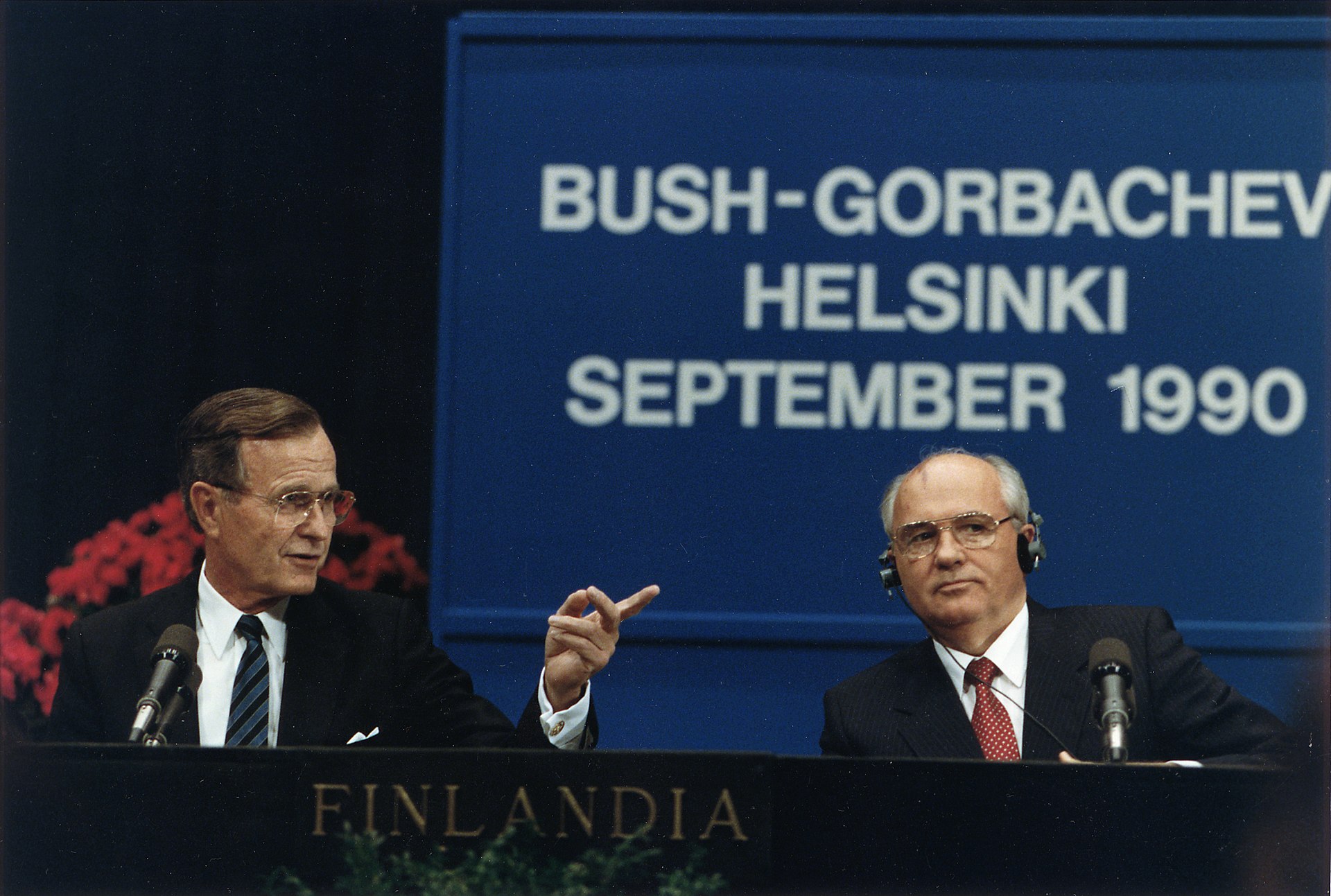

In this episode of the Explaining History Podcast, we examine the moment when the post-Cold War order was proclaimed—and trace its decline to the present crisis in the Persian Gulf.
On 29th January 1991, President George H.W. Bush addressed a joint session of Congress. America was at war with Iraq, having launched Operation Desert Storm to expel Saddam Hussein’s forces from Kuwait. Bush’s tone was sombre, measured—a contrast to the triumphalism of his State of the Union a year earlier, when he had spoken of communism crumbling and a new era for the world. Now he spoke of something grander: a “new world order.”
“What is at stake is more than one small country. It’s a big idea: a new world order where diverse nations are drawn together in common cause to achieve the universal aspirations of mankind—peace and security, freedom and the rule of law.”
Drawing on Kristina Spohr’s excellent book Postwall Post Square, we explore the context of that speech. The first Gulf War was a remarkable moment: a coalition of 28 countries from six continents, including traditional allies like Britain and Australia, prickly partners like France, and even Arab nations like Egypt, Syria, and Saudi Arabia. Most strikingly, the United States and the Soviet Union—despite Saddam being a long-time Moscow client—cooperated. Bush and Gorbachev had forged a personal accord, and the Cold War was over.
But behind the grand rhetoric, the picture was more complex. Moscow’s violent crackdown in Lithuania cast a shadow over the gleaming language of freedom. Bush struggled to balance his principled assertion of democratic values against his pragmatic need for Gorbachev’s cooperation in the Gulf. And at home, America was sliding into recession. As Democratic Majority Leader George Mitchell pointedly reminded the president: “We have a crisis abroad, but we also have a crisis here at home.”
Bush invoked the lessons of history—the long struggle against Nazi totalitarianism—to justify American leadership. “We’re the only nation on this earth that could assemble the forces of peace,” he declared. “This is the burden of leadership and the strength that has made America the beacon of freedom in a searching world.”
Yet that liberal internationalist language—always a veneer for American imperialism—has now been eviscerated. Trump has abandoned any pretence of moral leadership. His decision to attack Iran, apparently taken after a chat with Netanyahu and against the advice of his own generals, has produced the greatest strategic disaster in American history, bar none. There is no exit strategy, no route to victory, no achievable objective.
What Iran has done is fundamental. Unlike Vietnam or Afghanistan, where empires suffered humiliations but survived, America has been strategically and tactically defeated in the Persian Gulf. The petrodollar—propped up by American military power, bases, and security guarantees—is under threat. And once you show that American power is not all-conquering, it causes fragmentation in unprecedented ways.
The distance from George H.W. Bush’s “new world order” to Trump’s chaotic adventurism is less than 40 years. Trump is not the cause of American decline; he is an accelerant to an ongoing process. The empire’s days are numbered—and the world is about to become a much more dangerous place.
Topics covered:
- George H.W. Bush’s “new world order” speech (29th January 1991)
- The first Gulf War coalition and Soviet-American cooperation
- The contrast between liberal internationalism and American imperialism
- Domestic recession and the limits of presidential power
- Moscow’s crackdown in Lithuania as a challenge to the new order
- The collapse of the Soviet Union and the end of history
- Trump’s Iran disaster and the absence of strategic thinking
- The petrodollar and the foundations of American hegemony
- How Iran has achieved a strategic defeat of the United States
- Trump as an accelerant, not the cause, of decline
If you enjoy the podcast, please consider supporting us. We’re migrating from Patreon to Substack—more details soon.
Patreon Post: The New World Order – Hubris and Decline
In this week’s solo episode, I examine the moment when the post-Cold War order was proclaimed—and trace its unravelling to the present crisis in the Persian Gulf. Here, I want to expand on some of the key themes from Kristina Spohr’s Postwall Post Square and offer additional context.
The Triumphalist Moment
When the Soviet Union collapsed in 1991, American policymakers could hardly believe their luck. The end had come with remarkable speed and, from Washington’s perspective, remarkably low cost. No continental war in Europe. No nuclear exchange. Empires generally don’t dissemble themselves neatly—and the Soviet Empire certainly didn’t, as the people of Grozny, Georgia, and Ukraine would attest. But there was room for significant triumphalism.
Francis Fukuyama’s “end of history” thesis, which we’ve discussed on this podcast before, was born out of that moment. The idea that liberal democracy and capitalism had triumphed definitively, that no alternative remained, seemed plausible in the early 1990s. McDonald’s in Beijing. Pizza Hut in Moscow. American sitcoms in Mumbai. The cultural penetration of American-led globalisationGlobalisation Full Description:While Globalization can refer to cultural exchange and human interconnectedness, in the context of neoliberalism, it is an economic project designed to facilitate the frictionless movement of capital. It creates a single global market where corporations can operate without regard for national boundaries. Key Mechanisms: Capital Mobility: Money can move instantly to wherever labor is cheapest or taxes are lowest. Offshoring: Moving manufacturing and jobs to countries with fewer labor protections. Race to the Bottom: Nations compete to attract investment by lowering wages, slashing corporate taxes, and weakening environmental laws. Critical Perspective:Neoliberal globalization creates a power imbalance: capital is global, but labor and laws remain local. This allows multinational corporations to pit workers in different countries against one another, eroding the bargaining power of unions and undermining the ability of democratic governments to regulate business in the public interest. was astonishing.
Yet as Kristina Spohr shows in Postwall Post Square, the picture was always more complex than the triumphalist narrative allowed.
The First Gulf War as Blueprint
The first Gulf War was supposed to be the blueprint for the new world order. A coalition of 28 countries from six continents. Soviet-American cooperation, despite Saddam being a long-time Moscow client. Arab nations fighting alongside the United States. And a president, George H.W. Bush, who understood the importance of building international legitimacy through the UN.
Bush’s State of the Union address on 29th January 1991 was a masterclass in liberal internationalist rhetoric. “What is at stake is more than one small country,” he declared. “It’s a big idea: a new world order where diverse nations are drawn together in common cause to achieve the universal aspirations of mankind—peace and security, freedom and the rule of law.”
But behind the grand clarities, the picture was more complex. Moscow’s violent crackdown in Lithuania cast a shadow over the gleaming rhetoric of freedom. Bush was struggling to balance his principled assertion of democratic values within the USSR against his pragmatic need for Gorbachev’s cooperation in the Gulf.
At home, America was sliding into recession. As Democratic Majority Leader George Mitchell pointedly reminded the president: “We have a crisis abroad, but we also have a crisis here at home.” Bush’s inability to address the domestic recession would make him a one-term president. The power to lead abroad depended on the mobilisation of consent at home.
The Distance Travelled
The contrast with the present moment could not be starker. The liberal internationalist language that George H.W. Bush employed—always a veneer for American imperialism, but a veneer that at least acknowledged the need for legitimacy—has been eviscerated. Trump has abandoned any pretence of moral leadership.
His decision to attack Iran, apparently taken after a chat with Netanyahu and against the advice of his own generals, has produced the greatest strategic disaster in American history, bar none. There is no exit strategy. No route to victory. No achievable objective. The administration that once spoke of a “new world order” now cannot even articulate what it is trying to achieve.
The Iran Catastrophe
What Iran has done is fundamental. Unlike Vietnam or Afghanistan, where the empire was sent off with its tail between its legs after long guerrilla campaigns, what has happened in the Persian Gulf is a strategic and tactical defeat. Nothing the United States does now will succeed.
I hate to sound like a stuck record, returning again and again to the Persian Gulf. But the reason is simple: the dollar cannot remain the world’s reserve currency without warships and aircraft to back it up. The petrodollar is propped up by American military power, bases, and security guarantees. And Iran has shown that those guarantees are worthless.
Once you demonstrate that American power is not all-conquering—that it is, in fact, as vulnerable as Russian power has been shown to be in Ukraine—it causes fragmentation in unprecedented ways. We have yet to see the full consequences of the Gulf crisis. They may not be fully realised for quite some time.
An Accelerant, Not a Cause
We should not assume that the decline in American power is solely the product of Trump. Realistically, Trump is an accelerant to an ongoing process. The liberal internationalism of George H.W. Bush and the illiberal internationalism of his son, George W. Bush, presented Americans with a deep weariness and cynicism for overseas adventures. Trump has capitalised on that.
But Trump is not a carrier of the torch of Pax Americana. He has not continued the traditions of Truman, Kennedy, Eisenhower, or Johnson. His actions are far too erratic for that. He has dived into Venezuela and Iran in a bid—I don’t think he thinks things through in this way, but the effect is the same—to rip apart that Pax Americana and transform the world into something resembling the rule of the great powers in the 19th century.
Much of the ideological and geopolitical heavy lifting is done by people far more farsighted than Trump, who look at the inevitable end of Pax Americana and are trying to manage the transition. But the result is the same: the world order proclaimed in 1991 is dying.
If you’d like to support this work, please consider joining us. We’re migrating from Patreon to Substack—more details soon.
Short Blog Post
From New World Order to Strategic Catastrophe
In the latest episode of the Explaining History Podcast, I trace the arc from George H.W. Bush’s “new world order” speech in 1991 to Trump’s catastrophic misadventure in Iran. The distance is less than 40 years—and the decline is staggering.
On 29th January 1991, President George H.W. Bush addressed a nation at war. Iraq had invaded Kuwait, and America was leading a coalition of 28 countries—including Arab nations and even the Soviet Union—to expel Saddam Hussein’s forces. Bush spoke of a “new world order” where nations would unite to uphold peace, security, freedom, and the rule of law.
It was a remarkable moment. The Cold War had ended. Communism was crumbling. And the United States stood at the apex of its power.
But behind the grand rhetoric, the picture was more complex. Moscow was cracking down in Lithuania. America was sliding into recession. And the moral case for the war was, to put it mildly, far from clear—Saddam had been given a green light by the US ambassador before his invasion.
Nevertheless, Bush understood something that his successors have forgotten: the power to lead abroad depends on mobilising consent at home, and that requires a moral language, however flawed.
Fast forward to the present. Trump, after a chat with Netanyahu and against the advice of his own generals, launched an attack on Iran. There is no exit strategy. No achievable objective. No route to victory. The result is the greatest strategic disaster in American history—bar none.
Iran has achieved what Vietnam and Afghanistan could not: a tactical and strategic defeat of the United States. The petrodollar, propped up by American military power, is under threat. And once you show that American power is not all-conquering, fragmentation follows.
Trump is not the cause of American decline. He is an accelerant to an ongoing process. The liberal internationalism of George H.W. Bush has been eviscerated. And the world is about to become a much more dangerous place.
If you enjoyed this piece, please consider supporting the Explaining History Podcast. We’re migrating from Patreon to Substack—more details soon.
Tidied Up Transcript (Normal Format)
We are living through the end of a world order that has existed since 1945—or it’s existed in stages since 1945. The stage that we are living through, I believe, began in around 1991. Arguably, it was fatally undermined in 2008. It was impacted significantly in 2001, with the beginning of the war on terror and 9/11. And it has reached—after 2016, maybe an ongoing rolling crisis has now reached its kind of apogee. And we are going to see the collapse of an imperium before too long. And there will be, I believe, international chaos for a long time following that.
What I’m going to talk about today is drawn from a great book that I refer to from time to time, Postwall Post Square by Kristina Spohr. And we’re going to look at the American response to the end of the Cold War under George H.W. Bush.
Once American policy throughout the 1980s had been geared towards a final economic collapse of the Soviet Union, no American policy planners could really have anticipated the speed with which it happened. And the relative—as far as the Americans were concerned—the relative low cost of its occurrence, the fact that it didn’t end in a continental war in Europe, the fact that it didn’t end with the threat of a nuclear exchange.
Empires generally don’t tend to dissemble themselves neatly. And as we shall see, across Russia and beyond, the Soviet Empire doesn’t eventually dissemble itself neatly. The people of Grozny, the people in Georgia, and people in Ukraine will all attest to this. But in 1991, there was room for significant triumphalism. And part of the “end of history” thesis, of which we talk about quite regularly on this podcast, is kind of born out temporarily by the events of the collapse of the Soviet Union.
It is, of course, Vladimir Putin’s contention that the end of the Soviet Union was perhaps an unparalleled tragedy in Russian history and almost completely unnecessary. There was a very interesting conversation, I think it was on Novara Media a few weeks ago, in which between Aram Bastani and Tariq Ali the consensus was that, in fact, whilst some kind of reform was almost essential in the Soviet Union—because the stifling nature of the command economyCommand Economy Full Description:An economic system in which production, investment, prices, and incomes are determined centrally by the government rather than by market forces. It represents the antithesis of free-market capitalism. In a Command Economy, the “invisible hand” of the market is replaced by the “visible hand” of the state planning committee (Gosplan). The state dictates what is produced, how much is produced, and who receives it. There is no competition, and prices are set by decree to serve political goals rather than reflecting scarcity or demand.
Critical Perspective:While theoretically designed to ensure equality and prevent the boom-bust cycles of capitalism, in practice, it created a rigid, inefficient bureaucracy. Without price signals to indicate what people actually needed, the economy suffered from chronic shortages of essential goods and massive surpluses of unwanted items. It concentrated economic power in the hands of a small elite, who enjoyed special privileges while the masses endured stagnation and hardship.
Read more meant that it was virtually impossible to run any kind of economic system, whether or not you’re an ascriber to free market Hayekian ideals or broadly socially democratic Roosevelt New Deal kind of stuff, KeynesianismKeynesianism Full Description:Keynesianism emerged as a direct response to the failure of classical economics to explain or fix the depression. It posits that the “invisible hand” of the market is insufficient during a downturn because of a lack of aggregate demand. Therefore, the state must step in as the “spender of last resort,” borrowing money to fund public works and social programs.
Critical Perspective:Structurally, this represented a fundamental shift in the role of the state—from a passive observer to an active manager of capitalism. It was essentially a project to save capitalism from its own contradictions, using public funds to prevent the kind of total social collapse that often leads to revolution.—the level of bureaucratism in the Soviet Union meant that neither of those things could possibly have worked. Even a command economy can’t work—not to say the command economy in general can’t work. If you look at America and Britain during the Second World War, command economies functioned exceedingly effectively. But the nature of the Soviet Union at the end of its run was one that was being throttled by bureaucratism.
There were these stories of warehouses full of stuff. Stuff being produced—shoes—but there’s no indication as to why they should be produced. There’s no indication through any kind of market signals or any other system of allocation or distribution. Those things like central planning bureaucracies from the Brezhnev era tried to address these questions. But it’s not that the Soviet Union couldn’t produce things—it produced surpluses of things. It produced in some ways way too much stuff. But there was no—they were sometimes making shoes for people that didn’t exist. Making five million shoes when for that shoe size and that shoe colour and that shoe shape there were perhaps two and a half million people to wear them, that sort of thing.
So the end of the Soviet Union—or the reasons for the collapse of the Soviet Union—takes us slightly out of the scope of this one because we’re focusing more on America. And I think there’s an interesting line through from that moment of triumphalism to the madness that we see now, which is the madness born of a particular kind of hubris. And one where I think it seems pretty clear from the Trump regime that they know that the empire’s days are numbered, particularly if the petrodollar goes down, which he becomes increasingly likely to make happen.
Anyway, so Kristina Spohr writes. The 29th of January 1991—and she quotes George H.W. Bush. Members of the United States Congress, Bush’s tone was sombre and measured, in contrast to the triumphalism of the State of the Union message he delivered a year before when he spoke of communism crumbling and the beginning of a new era for the world. This January, however, Bush was the first president since the Vietnam era to address Americans once the country was at war.
“We stand at a defining hour. Halfway around the world, we’re engaged in a great struggle in the skies and on the seas and sands. What is at stake is more than one small country. It’s a big idea: a new world order where diverse nations are drawn together in common cause to achieve the universal aspirations of mankind—peace and security, freedom and the rule of law.”
Saddam Hussein’s Iraqi armed forces had invaded the tiny emirate of Kuwait on the 2nd of August 1990. Within 48 hours, he had brought the oil-rich sheikhdom brutally under his control. The border disputes and political rivalries between the two neighbours had a long and tortured history. But for Bush, the invasion of Kuwait was a stark and simple issue of lawless aggression. He reminded Congress in his State of the Union address: “Saddam Hussein’s unprovoked invasion, his ruthless, systematic rape of a peaceful neighbour, violated everything the community of nations holds dear. The world has said this aggression would not stand, and it will not stand. Together we’ve resisted the trap of appeasement, cynicism and isolation that gives temptation to tyrants.”
Of course, the thing that gave temptation to this particular tyrant was a green light from the US ambassador to Kuwait, and from the State Department, and from the CIA, that it probably wouldn’t be too much trouble. And it would probably be sort of all right if Saddam Hussein evened the odds with Kuwait and annexed the country to which Iraq had always laid a territorial claim—Kuwait being a carve-out from Mesopotamia and the province of Basra.
That was why Bush had not only mobilised American power but had also more laboriously pressed for months to construct an international coalition built on the UN. It was a truly remarkable alliance: 28 countries from six continents, embracing traditional US allies such as Britain and Australia, more prickly partners like France, and even Saddam’s fellow Arabs in Egypt, Syria and Saudi Arabia. The end of the Cold War, he declared, had been a victory for all humanity. Most strikingly of all was the cooperation between the United States and the Soviet Union, despite Saddam being a long-time Moscow client. The tanks that Saddam drove were Russian, he flew Hind helicopters, and his armies and his soldiers paraded with AK-47s. Much as Syria and Egypt, the Middle East aspects of the Cold War get very much understated. But the Middle East is essentially a second front in the Cold War.
This rested on the now warm personal accord between Bush and Gorbachev and on the community of universal values that they had been professing since the Malta summit of December 1989. Bush went out of his way to praise this in his address to Congress. “Our relationship to the Soviet Union is important not only to us but to the world. If it is possible, I want to continue to build a lasting basis for US-Soviet cooperation for a more peaceful future for all mankind.” If it is possible.
Behind the grand clarities of that evening on Capitol Hill, the picture was more complex. Moscow’s recent violent crackdown in Lithuania cast a shadow over the gleaming rhetoric of freedom and independence. Bush was struggling to balance his principled assertion of democratic values within the USSR against his pragmatic need for Gorbachev’s cooperation in the Gulf conflict and in building the new world order. Other tensions also contorted the simplicity of the evening. Public opinion in America clearly dreaded the prospect of war, fearing very heavy casualties. Would the post-Cold War nation be willing to “bear any burden,” as John F. Kennedy put it, for the sake of the new order?
Bush offered his answer. “Any cost in lives—any cost—is beyond our power to measure. But the cost of closing our eyes to aggression is beyond mankind’s power to imagine.” To reinforce that statement, he invoked lessons of history. “As Americans, we know that there are times when we must step forward to accept our responsibility to lead the world away from the dark chaos of dictators, towards the brighter promise of a better day. Almost 50 years ago, we began the long struggle against an aggressive totalitarianism. Now we face another defining hour for America and for the world.”
Obviously, comparisons between the military power of Nazi Germany and the Axis and the gangster state of Saddam Hussein are pretty ludicrous. There is a tendency within Western media to compare any third worldThird World Full Description: Originally a political term—not a measure of poverty—used to describe the nations unaligned with the capitalist “First World” or the communist “Second World.” It drew a parallel to the “Third Estate” of the French Revolution: the disregarded majority that sought to become something. The concept of the Third World was initially a project of hope and solidarity. It defined a bloc of nations in Latin America, Africa, and Asia that shared a common history of colonialism and a common goal of development. It was a rallying cry for the global majority to unite against imperialism and racial hierarchy. Critical Perspective:Over time, the term was stripped of its radical political meaning and reduced to a synonym for underdevelopment and destitution. This linguistic shift reflects a victory for Western narratives: instead of a rising political force challenging the global order, the “Third World” became framed as a helpless region requiring Western charity and intervention. dictator to Hitler. How many Hitler ratings are we going to give this guy? I think there was in the second Gulf War some moronic commentator—probably Lindsey Graham, somebody like that—comparing Saddam to, I think, nine Hitlers. I don’t know how you do that maths, but there you have it.
Not everyone believed that Kuwait was the defining challenge. “As critical as the Gulf conflict is, the other business of the nation won’t wait,” declared Democratic Majority Leader Senator George Mitchell. “The president says he seeks a new world order. We ask him to join us in putting our own house in order. We have a crisis abroad, but we also have a crisis here at home.” Mitchell was referring to the country’s recent slide into recession, which mattered more to the majority of Americans than faraway conflicts in the desert sands or the icy Baltic. Bush’s bluff assurance that “we will get this recession behind us and return to growth soon” did not paper over the cracks between the White House and Capitol Hill about tax rises and the budget deficit. It was his inability to do that that made him a one-term president.
The power to lead abroad depended on the mobilisation of consent at home. Like many American presidents, Bush therefore turned foreign policy into a moral issue. “Yes, the United States bears a major share of leadership in this effort. Among the nations of the world, only the United States of America has both the moral standing and the means to back it up. We’re the only nation on this earth that could assemble the forces of peace. This is the burden of leadership and the strength that has made America the beacon of freedom in a searching world.” For Bush, Soviet cooperation was a necessary but not sufficient condition for his project. Ultimately, the New World Order would hinge on sustained American power and decisive presidential leadership.
Now, it’s interesting to contrast that with the present moment. The idea that an American president would be willing to create a moral case—even though it doesn’t take an international relations professor to show that the moral case for the first Gulf War was an absolute farce; we won’t get into that, that’s shooting fish in a barrel—I don’t want to go there just yet. But I want to look at this comparison. You have now a third Gulf War in the Persian Gulf. Perhaps even a fourth Gulf War, because there was a tanker war that the Americans were involved in during the Iran-Iraq WarIran-Iraq War
Short Description (Excerpt):A brutal eight-year conflict (1980–1988) initiated by Saddam Hussein’s invasion of Iran. While devastating, the war inadvertently strengthened the Islamic Republic, allowing it to suppress internal dissent under the guise of wartime patriotism.
Full Description:The Iran-Iraq War was one of the 20th century’s bloodiest conflicts, featuring trench warfare and the use of chemical weapons. Saddam aimed to seize oil-rich territory and crush the revolutionary threat next door. Instead, Iran mobilized a massive volunteer force (“human waves”) fueled by religious fervor to defend the revolution.
Critical Perspective:Khomeini famously called the war a “divine blessing.” It allowed the regime to militarize society and label any political opposition as treason. The war forged the identity of the Islamic Revolutionary Guard Corps (IRGC) and entrenched the narrative of Iran as a besieged fortress of Islam fighting against a corrupt world, a narrative that sustains the state to this day.
Read more in the 1980s. And you have a president that, after a chat with Netanyahu, became convinced that a mission to overthrow the regime in Tehran was going to be an easy win—something that they could just have a roll of the dice on. And it has ended with Trump ensnared in an unimaginable strategic disaster, the greatest strategic disaster in American history, bar none. Self-inflicted, anyway.
The very language of liberal internationalism—which is always a veneer for American imperialism that George H.W. Bush was using—Trump has eviscerated to such an extent that to employ it now would be unthinkable. I’m very much against the idea that when Trump does something and is able to bring about these staggering, radicalised changes, it’s because of something necessarily special about him. He’s a sort of avatar of a certain form of decay. And I would argue that the liberal internationalism of George H.W. Bush and the illiberal internationalism of his son, George W. Bush, presented Americans—quite rightly so—with a deep weariness and cynicism for overseas adventures. One that Trump has capitalised on.
Trump says what he thinks people want to hear, and he has disregarded any desire to stay out of overseas troubles. Not because Trump is a carrier of the torch of a Pax Americana and has carried on the traditions of Truman, Kennedy, Eisenhower, Johnson, so on and so forth. Far from it. It’s far too erratic for that. He has dived into Venezuela, dived into Iran in a bid—I don’t think he thinks through things in that particular way—but almost to rip apart that Pax Americana and transform the world into something resembling the rule of the great powers in the 19th century. I suspect, of course, much of the ideological and geopolitical heavy lifting is done by people who are far more farsighted than Trump, who look at the inevitable end of Pax Americana.
The world that George H.W. Bush inhabited at the end of the 1980s was one where the petrodollar was all powerful. But the petrodollar was propped up by American military power, American military bases, American military security guarantees. And those things together propped up an economic and cultural hegemony that saw Pizza Huts in Moscow, McDonald’s in Beijing. It saw an Americanisation of popular culture around the world. I remember to my surprise being in India in the early 1990s and finding out that everybody watched American sitcoms in the part of Mumbai that I was in, and they understood the nuances of American popular culture. Of course, that was part of my naivety—I was about 19 at the time. But it shows you by the end of the 1980s and into the early 1990s how far American-led globalisation, cultural globalisation, had penetrated.
And none of these things are possible without the dollar as the world’s reserve currency. And the dollar cannot be the world’s reserve currency without warships and aircraft to back it up. Which is why—and I hate to sound like a stuck record here, coming all the way back to the Persian Gulf—what Iran has done is so fundamental. Iran, unlike Vietnam or Afghanistan, where the empire was sent off with its tail between its legs after a long, long guerrilla campaign with ground troops and air power—empires can survive a bit of humiliation. What has happened here is the empire has actually been strategically and tactically defeated. And nothing it does now will succeed.
So Iran has dealt America an epic blow, which is probably why most of Trump’s generals, when Netanyahu came with his pitch, advised him strongly not to go for it. Because there were no strategic objectives. There’s no exit strategy. And even if there were these two things, there’s no route to a win. There’s no way that this works at all.
Once you show that American power is like Russian power in Ukraine—nowhere near as all-conquering as we may have been led to believe—it causes fragmentation of power in unprecedented ways. We’ve yet to see the consequences of the Gulf crisis. We might not—the current Gulf crisis may not be fully realised for quite some time.
And what this moment—the moment of Iraq and Saddam Hussein and the end of the Cold War against Russia—shows us is the distance of travel. Remember, the early 1990s is under 40 years ago, and the decline in power. Again, we shouldn’t assume that that is the product of Trump. I think Trump, realistically, is an accelerant to an ongoing process.
Anyway, I’ll leave you there and hopefully hop on again tomorrow. Take care, everyone. All the best. Bye bye.

Leave a Reply