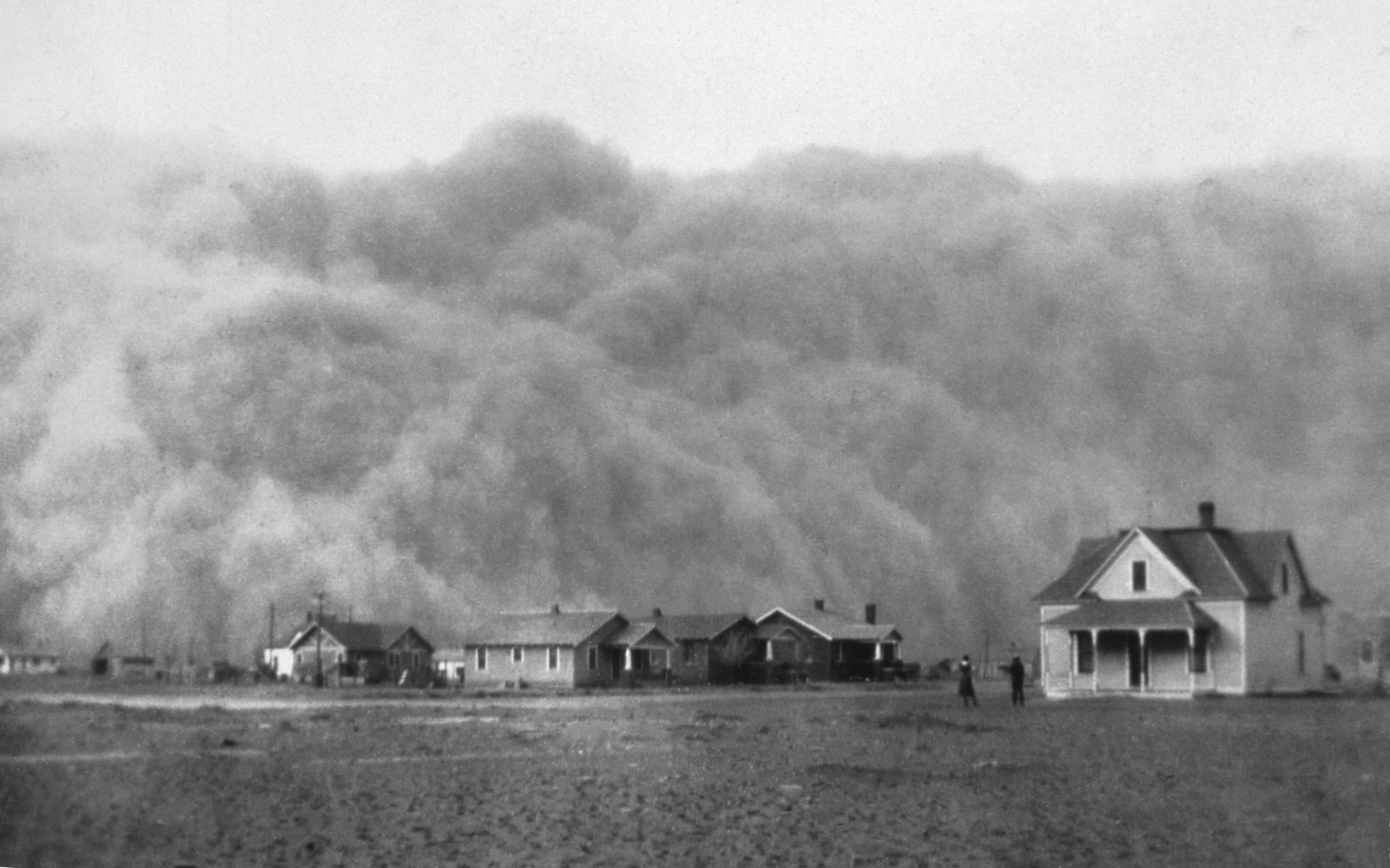

When Americans in the 1930s looked skyward, they did not always see sun or clouds. Increasingly, they saw darkness at noon—billowing walls of topsoil traveling from the Great Plains to the Atlantic Ocean, blotting out the sun and coating everything in their path with the pulverized remains of the American heartland. These “black blizzards” were not natural disasters in any simple sense. They were the product of specific historical forces: capitalist agriculture’s relentless drive for profit, federal land policies that encouraged the exploitation of marginal lands, and a cultural ideology of expansion that treated the Plains as a resource to be conquered rather than an ecosystem to be understood.
The Dust BowlDust Bowl Full Description:The Dust Bowl refers to the devastation of the Great Plains, where millions of acres of farmland were rendered useless by massive dust storms. While triggered by drought, the disaster was fundamentally man-made. Driven by high wheat prices and real estate speculation, farmers had removed the native deep-rooted grasses that held the soil together to plant monocultures.
Critical Perspective:This event illustrates the “metabolic rift”—the rupture between human economy and natural systems. The market demanded maximum yield without regard for soil health, leading to desertification. It forced the displacement of hundreds of thousands of impoverished families, creating a class of climate migrants who were exploited as cheap labor in the West of the 1930s was one of the most devastating environmental catastrophes in American history. Yet it was also profoundly social—a disaster whose origins lay in the intersection of economic imperatives, political decisions, and ecological conditions. This article examines the Dust Bowl’s causes, its unfolding, and its intimate relationship with the Great Depression. Drawing on recent scholarship and primary sources, we explore how environmental degradation compounded economic crisis, how displaced farmers became symbols of Depression-era suffering, and how the New DealThe New Deal Full Description:A comprehensive series of programs, public work projects, financial reforms, and regulations enacted by President Franklin D. Roosevelt. It represented a fundamental shift in the US government’s philosophy, moving from a passive observer to an active manager of the economy and social welfare. The New Deal was a response to the failure of the free market to self-correct. It created the modern welfare state through the “3 Rs”: Relief for the unemployed and poor, Recovery of the economy to normal levels, and Reform of the financial system to prevent a repeat depression. It introduced social security, labor rights, and massive infrastructure projects.
Critical Perspective:From a critical historical standpoint, the New Deal was not a socialist revolution, but a project to save capitalism from itself. By providing a safety net and creating jobs, the state successfully defused the revolutionary potential of the starving working class. It acknowledged that capitalism could not survive without state intervention to mitigate its inherent brutality and instability.
Read more responded to both the immediate human needs and the underlying ecological vulnerabilities that the Dust Bowl exposed.
Throughout, we engage with critical perspectives that locate the Dust Bowl within capitalism’s inherent tendency toward environmental destruction. For radical political economists, ecological crises are not external shocks to the capitalist system but internal expressions of its fundamental contradictions. The Dust Bowl, from this perspective, was not merely a drought exacerbated by poor farming practices. It was a manifestation of what David Harvey calls “the metabolic rift”—capitalism’s systematic disruption of the natural cycles that sustain human life .
The Plains Before the Plow: An Ecosystem Transformed
To understand the Dust Bowl, one must first understand what existed before it. The Great Plains were not, as nineteenth-century settlers imagined them, a barren wasteland awaiting improvement. They were a complex ecosystem dominated by deep-rooted prairie grasses that had co-evolved with the region’s climate over millennia. These grasses—bluestem, grama, buffalo grass—formed a dense mat of vegetation that held the soil in place, retained moisture, and survived periodic droughts that were a normal feature of Plains climate.
The region’s indigenous peoples had inhabited this ecosystem for thousands of years without destroying it. Plains Indian societies—the Lakota, Cheyenne, Arapaho, Comanche, and others—had developed ways of life adapted to the region’s rhythms. They hunted bison, which grazed on the grasses without destroying them. They moved with the seasons, avoiding overexploitation of any single area. Their relationship with the land, while not static or purely “harmonious,” was fundamentally sustainable .
This indigenous world was destroyed in the nineteenth century by the expansion of settler capitalism. The near-extermination of the bison, the forced removal of native peoples to reservations, and the transformation of the Plains into a commodity-producing region for global markets represented what Harvey terms “accumulation by dispossession”—the violent process by which capital seizes resources from those who had previously used them .
The Ideology of Expansion
The settlement of the Plains was driven not only by economic imperatives but by a powerful ideology. Manifest Destiny—the belief that Americans had a sacred duty to expand across the continent—provided moral justification for dispossession. Promoters of western settlement propagated the myth that “rain follows the plow”—the pseudoscientific notion that cultivation itself would alter the climate, making the semi-arid Plains more hospitable to agriculture .
As one historian notes, “Emigrants, land speculators, politicians and even some scientists believed that homesteading and agriculture would permanently affect the climate of the semi-arid Great Plains region, making it more conducive to farming” . This belief was reinforced by a series of wet years in the late nineteenth century, which created the false impression that the region’s climate had been permanently transformed.
The federal government actively promoted this worldview through legislation. The Homestead Act of 1862 provided settlers with 160 acres of public land. The Kinkaid Act of 1904 and the Enlarged Homestead Act of 1909 expanded these allotments, encouraging the settlement of increasingly marginal lands . These acts were based on the assumption that family farms could succeed anywhere—an assumption that ignored the ecological realities of the Plains.
The Capitalist Transformation of Plains Agriculture
The destruction of the Plains ecosystem accelerated dramatically in the early twentieth century. Two related developments were crucial: the mechanization of agriculture and the integration of Plains farming into global commodity markets.
World War I and the Plow-Up
The outbreak of World War I in 1914 created enormous demand for American wheat. European agriculture was devastated by the fighting, and the Allies turned to the United States for food. Wheat prices soared, reaching levels that made farming on the Plains extraordinarily profitable .
Farmers responded by plowing up millions of acres of native grassland. Between 1910 and 1920, wheat acreage in Kansas increased by 3 million acres; in Nebraska, by 2 million; in Oklahoma, by 1.5 million . This was not subsistence farming but capitalist agriculture—production for the market, driven by the profit motive. Farmers purchased expensive machinery—tractors, combines, one-way disc plows—on credit, committing themselves to ever-greater production to meet their debt payments.
The new machinery was itself environmentally destructive. The one-way disc plow, which replaced the traditional lister, was far more efficient at turning over soil. But it also destroyed the root structure that held the soil in place, leaving the land vulnerable to erosion .
When wartime demand collapsed after 1918, wheat prices fell dramatically. But farmers could not simply reduce production. They had invested in machinery, taken on debt, and committed themselves to a way of life that required continued cultivation. As prices fell, they faced an impossible choice: produce more to break even, or lose their farms.
The Contradictions of Capitalist Agriculture
This situation exemplified what Marxists have long identified as a fundamental contradiction of capitalist agriculture. Capitalism treats land as a factor of production like any other—a resource to be exploited for maximum short-term return, without regard for long-term sustainability . Yet land is not like other factors. It is a complex ecosystem whose fertility can be preserved only through careful stewardship.
The farmers of the Plains were not ignorant or evil. They were responding rationally to the incentives created by capitalist markets and federal policy. But their rational individual decisions produced collective irrationality—the systematic destruction of the ecological basis of their own livelihood.
Nancy Fraser’s analysis of capitalist crises helps illuminate this dynamic. Fraser identifies an “ecological contradiction” at the heart of capitalism: the system depends on nature as a source of inputs and a sink for wastes, yet it systematically undermines the natural conditions of its own existence . The Dust Bowl was a textbook example of this contradiction in action.
The Great Depression Intensifies the Crisis
When the Great Depression began in 1929, it compounded the problems facing Plains farmers. The collapse of agricultural prices that had begun in the 1920s accelerated dramatically. Wheat that had sold for $1.05 per bushel in 1929 fell to 67 cents in 1930, then to 39 cents in 1931, and to an astonishing 32 cents in 1932 —below the cost of production for most farmers.
Farmers responded by doing the only thing they could: they plowed up more land. “In desperation,” as the History Channel notes, “farmers tore up even more grassland in an attempt to harvest a bumper crop and break even” . This was a tragic irony: the very strategy that seemed necessary for individual survival collectively ensured ecological disaster.
The Depression also undermined the informal support networks that had helped Plains communities survive previous droughts. Bank failures wiped out savings. Foreclosures stripped farmers of their land. Unemployment meant that even those who left the land could not find work elsewhere. The crisis of capitalism and the crisis of ecology became inextricably intertwined.
The Drought Arrives
Drought began in 1930, but its effects were not immediately catastrophic. The first year of dry weather was manageable; the soil still held some moisture, and crops partially survived. But drought returned in 1931, and again in 1934, and again in 1936, and finally in 1939–40 . These were not a single event but multiple crises occurring “in such rapid succession that affected regions were not able to recover adequately before another drought began” .
By 1934, the situation had become desperate. An estimated 35 million acres of formerly cultivated land had been rendered useless for farming, while another 125 million acres—an area roughly three-quarters the size of Texas—was rapidly losing its topsoil . The deep-rooted prairie grasses that had held the soil for millennia were gone, replaced by shallow-rooted crops that died in the drought, leaving bare earth exposed to the wind.
The Black Blizzards
What followed were the most dramatic dust storms in American history. Contemporaries called them “black blizzards”—walls of blowing sand and soil that could rise two miles high and travel thousands of miles. The dust was not merely a nuisance but a lethal force. It suffocated livestock, buried farm equipment, and penetrated even sealed homes, coating food, skin, and furniture with fine particles .
People developed “dust pneumonia” from inhaling the particulate matter. Estimates of deaths from the condition range from hundreds to several thousand . Children died from “dust suffocation.” Farmers tied ropes from their houses to their barns to avoid getting lost and dying in their own fields.
The scale of these storms was almost unimaginable. On May 11, 1934, a massive dust storm two miles high traveled 2,000 miles to the East Coast, blotting out monuments such as the Statue of Liberty and the U.S. Capitol . An estimated 350 million tons of topsoil was carried eastward. Twelve million tons fell on Chicago alone—four inches for each resident of the city . Ships 300 miles off the Atlantic coast reported dust on their decks .
The worst storm occurred on April 14, 1935, a day that became known as Black Sunday. A wall of blowing sand and dust started in the Oklahoma Panhandle and spread east. As many as three million tons of topsoil are estimated to have blown off the Great Plains that single day . An Associated Press reporter covering the storm coined the term “Dust Bowl” to describe the affected region, and the name stuck .
The Human Toll: Migration and Displacement
The Dust Bowl triggered one of the largest migrations in American history. Roughly 2.5 million people left the Dust Bowl states—Texas, New Mexico, Colorado, Nebraska, Kansas, and Oklahoma—during the 1930s . Oklahoma alone lost 440,000 people, more than 15 percent of its population .
The Okies
Many of these migrants headed west, particularly to California, where they hoped to find work in the agricultural valleys. From 1935 to 1940, roughly 250,000 Oklahomans moved to California, along with hundreds of thousands from other Plains states . They were called “Okies”—originally a reference to Oklahomans, but soon applied to any poor Dust Bowl migrant, regardless of origin.
The reception they received was hostile. Californians resented the influx of impoverished outsiders competing for scarce jobs. Migrants faced discrimination, menial labor, and pitiable wages. Many lived in shantytowns and tents along irrigation ditches, their conditions little better than those they had fled . A 1937 bulletin by the Works Progress Administration reported that 21 percent of all rural families in the Great Plains were receiving federal emergency relief; in California, the percentage among migrants was even higher .
John Steinbeck’s 1939 novel The Grapes of Wrath immortalized the Okies’ struggle. The Joad family’s journey from Oklahoma to California, and their brutal reception upon arrival, became a powerful symbol of Depression-era suffering. Steinbeck’s novel was not merely fiction but documentation; he had spent time with migrant families, recording their stories and bearing witness to their condition.
Who Stayed and Who Left
The migration was not random. Research shows that those who left were not necessarily the poorest or most desperate. Migration required resources—money for transportation, connections at the destination, the physical capacity to travel. The truly destitute often could not leave; they remained in the Dust Bowl, their conditions worsening as others departed .
Those who stayed faced impossible choices. Many voluntarily deeded their farms to creditors, unable to meet mortgage payments. Others faced foreclosure by banks. Still others left temporarily to search for work, hoping to earn enough to save their farms, only to find that seasonal labor elsewhere could not compensate for the collapse of their own operations . At the peak of farm transfers in 1933–34, nearly one in ten farms changed possession, with half of those being involuntary .
New Deal Responses: Relief and Reform
The Dust Bowl presented the Roosevelt administration with a dual challenge: immediate relief for suffering families and long-term reform of the agricultural practices that had created the crisis. The New Deal addressed both, though with mixed success.
Emergency Relief
Federal aid to drought-affected states was first provided in 1932, under the Hoover administration, but the first funds specifically marked for drought relief were not released until the fall of 1933 . Under Roosevelt, relief efforts expanded dramatically. The Federal Emergency Relief Administration (FERA) provided direct assistance to destitute families. The Works Progress Administration (WPA) and Civilian Conservation Corps (CCC) employed displaced farmers on public projects. The Resettlement Administration, later renamed the Farm Security Administration, helped migrants establish new lives .
The scale of need was staggering. One estimate suggests that federal financial assistance to Dust Bowl regions may have reached $1 billion (in 1930s dollars) by the end of the drought . Yet even this massive expenditure could not fully compensate for the losses farmers had suffered.
Addressing the Ecological Crisis
More significantly, the New Deal attempted to address the underlying ecological vulnerability that the Dust Bowl had exposed. In 1935, Congress established the Soil Erosion Service (later renamed the Natural Resources Conservation Service) and the Prairie States Forestry Project .
These programs pursued multiple strategies:
· Promoting new farming techniques: contour plowing, terracing, strip cropping, and crop rotation designed to reduce soil erosion
· Planting shelter belts: millions of trees planted as windbreaks to reduce wind speed and retain soil moisture
· Retiring marginal lands: purchasing highly erodible land and returning it to permanent grassland
· Educating farmers: providing technical advice and demonstration projects to promote sustainable practices
The shelter belt project was particularly ambitious. The goal was to plant a 100-mile-wide strip of trees from Texas to the Canadian border, creating a living windbreak that would moderate the region’s climate and protect its soil. By 1942, more than 200 million trees had been planted .
The Limits of New Deal Conservation
For all its ambition, New Deal conservation had significant limitations. As critical geographers have noted, the programs operated within capitalist property relations. They sought to make farming sustainable within capitalism, not to transcend capitalism’s fundamental contradictions. Farmers were educated, incentivized, and subsidized to adopt better practices, but the underlying pressures that had driven ecological destruction—the profit motive, debt, market competition—remained intact .
Moreover, the benefits of New Deal programs were unevenly distributed. Large landowners, who had the resources to implement new techniques and the political connections to influence local program administration, often received disproportionate assistance. Tenant farmers and sharecroppers, already marginalized, were sometimes pushed off land that owners withdrew from cultivation .
These limitations were not failures of implementation but expressions of the state’s fundamental character. As Leo Panitch and Sam Gindin argue in their analysis of capitalist states, New Deal agencies were designed to stabilize capitalism, not to replace it . Conservation programs aimed to preserve the family farm as a social institution and agricultural productivity as an economic necessity, but they did not challenge the property relations or market imperatives that had produced the Dust Bowl in the first place.
The Dust Bowl in Cultural Memory
The Dust Bowl left an indelible mark on American culture. It produced some of the most enduring artistic documents of the Depression era and shaped how Americans understand the relationship between people and the land.
Documentary Photography
The Farm Security Administration’s photography project, headed by Roy Stryker, sent photographers across the country to document rural poverty. Dorothea Lange’s 1936 photograph “Migrant Mother” became the most famous image of the Depression era—a portrait of a destitute pea-picker in California, her face etched with worry, her children huddled against her . Lange’s photograph was not merely documentation but advocacy; it was intended to generate support for New Deal relief programs and to humanize the suffering of migrant families.
Other photographers—Arthur Rothstein, Walker Evans, Ben Shahn—produced equally powerful images. Rothstein’s photograph of a farmer and his sons walking through a dust storm in Cimarron County, Oklahoma, captured the epic scale of the disaster. Evans’s images of Alabama sharecroppers documented poverty in the rural South, connecting the Dust Bowl to broader patterns of agricultural crisis .
Literature and Music
John Steinbeck’s The Grapes of Wrath (1939) remains the literary masterpiece of the Dust Bowl. The novel follows the Joad family’s journey from Oklahoma to California, documenting both the ecological disaster they fled and the economic exploitation they encountered. Steinbeck was accused of exaggeration by California growers, but subsequent investigation confirmed the accuracy of his portrayal .
Woody Guthrie, an Oklahoma native who migrated to California with thousands of others, gave musical voice to the Dust Bowl experience. His 1940 album Dust Bowl Ballads told stories of economic hardship, ecological disaster, and working-class resistance. Songs like “Talking Dust Bowl Blues” and “Do Re Mi” documented both the suffering and the resilience of displaced farmers. Guthrie’s music, like Steinbeck’s novel, expressed a radical critique of capitalist agriculture: the land was abundant, but its bounty was monopolized by the few .
The Politics of Memory
The cultural memory of the Dust Bowl has been contested. For some, it represents a story of human folly overcome by human ingenuity—a cautionary tale that led to better farming practices and more responsible land management. For others, it reveals deeper truths about capitalism’s relationship to nature. As environmental historian Donald Worster argued in his classic study Dust Bowl: The Southern Plains in the 1930s, the disaster was not a failure of individual farmers but a failure of the capitalist ethos itself—a culture that treats land as a commodity and nature as a resource to be exploited .
This interpretation aligns with Harvey’s concept of “accumulation by dispossession.” The Dust Bowl dispossessed not only farmers but the land itself—stripping it of its fertility, its ecological integrity, its capacity to sustain life. And it dispossessed future generations, who inherited a landscape that would require decades to recover .
The Return of Rain
Regular rainfall returned to the Plains by the end of 1939, bringing the Dust Bowl years to a close . But the economic effects persisted. Population declines in the worst-hit counties continued well into the 1950s, as the agricultural value of the land failed to recover .
The outbreak of World War II also helped improve the economic situation. Wartime demand for agricultural products raised prices and created new markets. And perhaps most significantly, the war drew millions of Americans—including many former Dust Bowl farmers—into military service and defense work, providing an escape from rural poverty that relief programs had not matched .
Yet the underlying vulnerabilities remained. When another severe drought struck the Plains in the 1950s, its impacts were lessened due to lessons learned from the Dust Bowl years . But the fundamental structure of Plains agriculture—large-scale, capital-intensive, market-oriented—remained unchanged. The question of whether capitalism and ecological sustainability can ever be reconciled remained unanswered.
Conclusion: Capitalism and the Land
The Dust Bowl was not a natural disaster. It was a social disaster mediated through nature—a crisis produced by specific historical forces operating within a particular ecological context. The Homestead Acts that encouraged settlement of marginal lands, the profit motive that drove the plow-up of native grassland, the debt imperatives that compelled overproduction, the market forces that transmitted the Depression to the Plains—all were expressions of capitalism’s fundamental dynamics.
For radical political economy, the Dust Bowl exemplifies what Fraser calls capitalism’s “ecological contradiction.” The system depends on nature as a source of inputs and a sink for wastes, yet it systematically undermines the natural conditions of its own existence. The Plains farmers who plowed up the grassland were not acting irrationally; they were responding rationally to the incentives created by markets and state policy. But their rational individual actions produced collective irrationality—the destruction of the ecological basis of their own livelihood.
The New Deal’s response to the Dust Bowl was significant and, in many respects, effective. It provided relief to suffering families, promoted sustainable farming practices, and planted millions of trees as windbreaks. But it did not challenge the underlying structure of capitalist agriculture. The family farm remained a commodity-producing enterprise, subject to market pressures and debt imperatives. The land remained private property, available for exploitation. The profit motive remained the driving force of agricultural production.
The Dust Bowl thus offers lessons that extend beyond the 1930s. It demonstrates that environmental crises under capitalism are not aberrations but expressions of the system’s normal functioning. It shows that state intervention can mitigate the worst effects of such crises but cannot eliminate their root causes. And it suggests that genuine sustainability requires not merely better farming practices but a fundamental transformation of the relationship between people and the land—a transformation that capitalist property relations preclude.
The Dust Bowl was not a failure of farmers but a failure of a social system—a system that treats land as a commodity, labor as a cost, and nature as an externality. Until that system is transformed, the black blizzards of the 1930s remain not merely a memory but a warning.
References
Aizer, A., Early, N., Eli, S., Imbens, G., Lee, K., Lleras-Muney, A., & Strand, A. (2024). The lifetime impacts of the New Deal’s youth employment program. The Quarterly Journal of Economics, 139(4), 2579–2635.
Egan, T. (2006). The Worst Hard Time: The Untold Story of Those Who Survived the Great American Dust Bowl. Houghton Mifflin.
Fraser, N. (2014). Behind Marx’s Hidden Abode. New Left Review, 86.
Guthrie, W. (1940). Dust Bowl Ballads. Victor Records.
Harvey, D. (2010). The Enigma of Capital and the Crises of Capitalism. Oxford University Press.
Link, I., et al. (1937). Rural Families on Relief. Works Progress Administration.
Lange, D., & Taylor, P. (1939). An American Exodus: A Record of Human Erosion. Reynal & Hitchcock.
National Drought Mitigation Center. (2026). The Dust Bowl. University of Nebraska-Lincoln.
Panitch, L. & Gindin, S. (2012). The Making of Global Capitalism: The Political Economy of American Empire. Verso.
Riebsame, W.E., et al. (1991). Drought and Natural Resources Management in the United States. Westview Press.
Steinbeck, J. (1939). The Grapes of Wrath. Viking Press.
Worster, D. (1979). Dust Bowl: The Southern Plains in the 1930s. Oxford University Press.
Worster, D. (1985). Rivers of Empire: Water, Aridity, and the Growth of the American West. Pantheon Books.

Leave a Reply