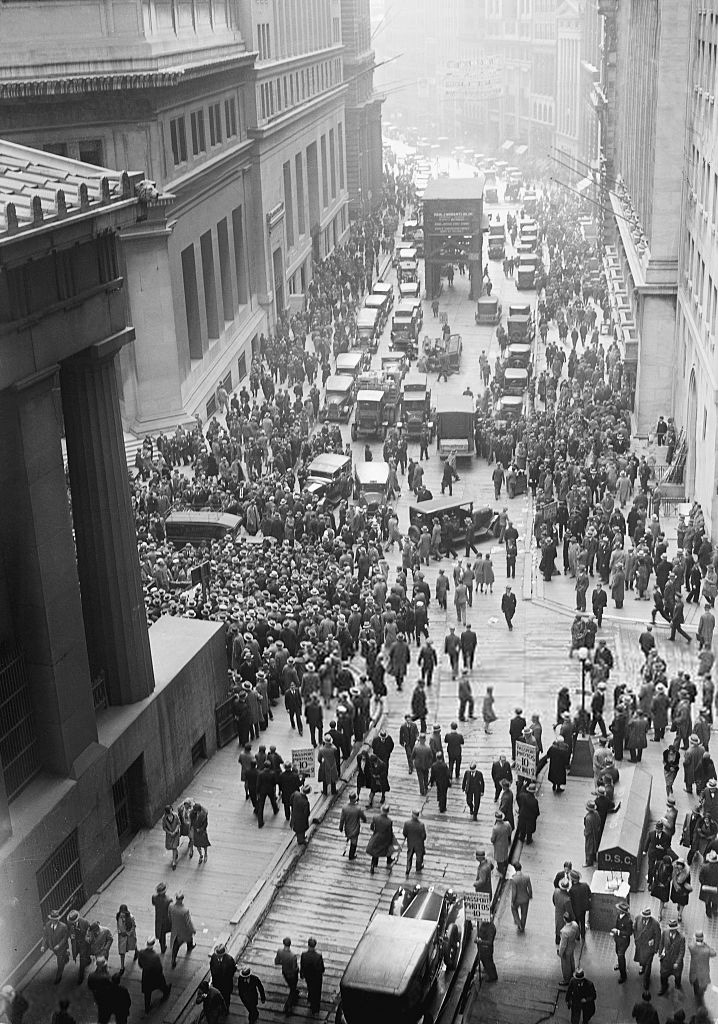

The five days between October 23 and October 29, 1929, remain the most dramatic and consequential in American financial history. In the popular imagination, the stock market crash exists as a single cataclysmic event—a moment when prosperity ended and the Great Depression began. Yet the reality is more complex, more revealing, and in many ways more instructive. The crash was not a single day but a cascade of panic, a five-act drama whose roots lay deep in the structure of 1920s capitalism and whose consequences would unfold for years to come.
This article provides a detailed day-by-day account of the crash, from the speculative frenzy that preceded it through the desperate attempts by bankers and politicians to stem the tide. Drawing on contemporary accounts, primary sources, and recent scholarship—including critical perspectives from radical political economy—we examine what actually happened during those fateful October days, why it happened, and what it reveals about the nature of financial crises under capitalism. We conclude by considering the immediate aftermath of the crash and its relationship to the broader Depression that followed.
Prelude: The Great Bull Market
To understand the crash, one must first understand the speculative bubble that preceded it. The 1920s had witnessed an unprecedented stock market boom. Between 1922 and 1929, the Dow Jones Industrial Average increased nearly fivefold, rising from 63.9 in August 1921 to 381.2 in September 1929 . This was not merely a reflection of genuine economic growth, though the 1920s economy did expand substantially. It was, in crucial respects, a speculative mania.
The Mechanics of Speculation
The bubble was fueled by several interrelated factors. Most important was the practice of buying stocks “on margin”—that is, with borrowed money. Under the margin system, an investor could purchase stock by putting down as little as 10 percent of the purchase price, borrowing the remaining 90 percent from a broker. The broker, in turn, borrowed the money from a bank, using the stock as collateral. As long as stock prices rose, the system worked brilliantly: investors could realize enormous gains on modest investments, brokers earned interest and commissions, and banks received steady returns on loans that appeared perfectly secure.
But the system contained a fatal vulnerability. If stock prices fell sharply, brokers would issue “margin calls”—demands that investors put up additional cash to cover their loans. If an investor could not meet a margin call, the broker would sell the stock to recover the loan. In a falling market, such forced selling could create a self-reinforcing downward spiral: falling prices triggered margin calls, which triggered forced selling, which drove prices down further.
By 1929, the volume of margin debt had reached staggering proportions. Hundreds of millions of shares were being carried on margin, and loans to brokers—known as “call loans”—had grown to approximately $8.5 billion, more than the entire money supply of the United States at the time . This massive pyramid of debt rested on the precarious foundation of ever-rising stock prices.
The Uneven Distribution of Prosperity
For radical political economists, the speculative frenzy of the 1920s cannot be separated from the underlying inequalities that characterized the decade. As David Harvey has argued in his analyses of financial crises, speculative bubbles typically emerge when there is a fundamental disconnect between productive capacity and purchasing power . The 1920s exemplified this dynamic.
While corporate profits increased by 62 percent between 1923 and 1929, wages and salaries increased by only 11 percent . The top 0.1 percent of families received as much income as the bottom 42 percent . With working people unable to purchase what they produced, the economy became increasingly dependent on two fragile supports: consumer credit and stock market speculation. The bull market was not merely a financial phenomenon but a symptom of deeper contradictions in American capitalism.
By the summer of 1929, some economists and financial observers were warning of danger. In March 1929, Paul M. Warburg, a prominent banker, warned that if the “orgy of unrestrained speculation” continued, there would be a “terrific crash” . In September, the economist Roger Babson predicted that “sooner or later a crash is coming, and it may be terrific” . But such warnings were drowned out by the enthusiasm of the crowd.
The Market Peaks
The market reached its all-time peak on September 3, 1929, when the Dow closed at 381.2 . For several weeks, prices fluctuated but remained near their highs. Then, in early October, they began to drift downward. At first, the decline was gradual—too gradual to cause alarm. But beneath the surface, tensions were building.
On October 19, the New York Times reported that “the market has been in an uncertain state for a fortnight” and noted that “professional traders are not optimistic” . The following day, the market dropped sharply, with the New York Herald Tribune observing that “selling of stocks was the most drastic since the March break” . Yet few anticipated what was about to unfold.
Wednesday, October 23: The First Tremors
The crash did not begin on Black Thursday but on the Wednesday before. That day, the market experienced a severe decline that wiped out many of the gains from the previous weeks. The industrial average fell 21 points in late trading—a drop of approximately 6 percent . Volume was heavy, with more than 2.6 million shares changing hands in the final hour alone.
The New York Times reported the next morning that “the market crumbled with amazing rapidity in the final hour” and noted that “the decline was featured by complete demoralization in many quarters as stocks cascaded downward on an avalanche of selling” . The ticker, which recorded stock prices, ran nearly two hours behind, leaving investors in agonizing uncertainty about the value of their holdings.
Yet even after this severe decline, many observers remained optimistic. The financial establishment, in particular, sought to project confidence. On the evening of October 23, Thomas W. Lamont of the Morgan banking house issued a statement: “There has been a little distress selling on the Stock Exchange,” he said, “and we have held a meeting of the heads of the financial institutions to see what can be done” .
That meeting would produce the most dramatic intervention of the crash period.
Thursday, October 24: Black Thursday
Thursday, October 24, 1929, began badly and grew worse. When the market opened, selling pressure was intense. Prices fell rapidly, and the ticker quickly fell behind. By noon, the situation had become critical. The industrial average would ultimately fall 33 points—a decline of approximately 9 percent .
Panic on the Floor
Contemporary accounts convey the atmosphere of near-hysteria. The New York Times described the scene:
“Roaring with the accumulated pressure of weeks, the flood of selling orders overwhelmed the buying support that from time to time appeared in various issues. The decline was the sharpest since the June panic of 1919, and at the height of the selling wave, shortly after noon, the market seemed to be crumbling” .
The Chicago Tribune reported that “tickers lagged so far behind the actual trading that tape readers had little idea of what was happening to their stocks” . In brokerage offices across the country, crowds gathered, watching the ticker tape with mounting anxiety. Many had bought on margin and were receiving urgent calls from their brokers demanding more collateral.
Thursday, October 24: Black Thursday Bankers’ Pool
Around noon, a group of the nation’s most powerful bankers assembled at 23 Wall Street, the headquarters of J.P. Morgan & Company. The group included Thomas Lamont of Morgan, Albert Wiggin of Chase National Bank, Charles Mitchell of National City Bank, and William Potter of Guaranty Trust. Their mission: to stop the panic.
After a brief meeting, they decided to pool their resources and inject a massive amount of buying power into the market. They selected Richard Whitney, vice president of the Stock Exchange and a Morgan broker, to execute the plan. Whitney strode onto the floor of the exchange and, with theatrical flair, bid for large blocks of U.S. Steel at a price above the current market. He then moved to other leading stocks, making similarly impressive bids.
The strategy worked—temporarily. The market stabilized, and prices recovered somewhat. By the end of the day, the industrial average had regained about half its losses . The press hailed the bankers’ intervention as a decisive display of leadership. The New York Times called it “the most effective support operation in the history of the exchange” .
But from a critical perspective, the bankers’ pool represented something else entirely: a demonstration of how financial elites mobilize collectively to protect their interests when the system they dominate threatens to collapse. As Leo Panitch and Sam Gindin have argued in their analysis of financial crises, such interventions reveal the deep integration of private finance and state power, even when the state itself is not formally involved . The bankers who assembled at 23 Wall Street were not acting out of public spirit but out of urgent self-interest. Their own fortunes, and those of their institutions, depended on stopping the panic.
Friday, October 25: The Calm Between Storms
Friday brought relative calm. The market was steady, and prices even improved slightly. The bankers’ pool continued its operations, though more quietly than on Thursday. President Herbert Hoover issued a statement of confidence: “The fundamental business of the country, that is, production and distribution of commodities, is on a sound and prosperous basis” .
The New York Times reported that “the financial district settled back to something approaching normal conditions today after the most tumultuous and exciting day in its history” . Volume was heavy but orderly, and the ticker kept up with trading.
Yet beneath the surface calm, the situation remained precarious. The bankers’ pool had arrested the panic, but it had not addressed its underlying causes. Millions of margin accounts remained dangerously overextended. And the broader economy was already showing signs of weakness. Industrial production had been declining since the summer, and consumer spending was softening.
For those who looked closely, the signs of continuing danger were evident. The number of margin calls remained high, and many small speculators were being forced to sell their holdings. The Wall Street Journal noted that “the position of the professional speculator is still precarious” .
Saturday, October 26: False Dawn
Saturday was a half-day of trading, as was customary at the time. The market opened strong, with prices rising in early trading. By noon, when the closing bell rang, the industrial average had gained ground, and many observers believed the worst was over.
The press was optimistic. The New York Times declared that “the rally which began in the stock market Friday continued yesterday” and noted that “the investment community is hopeful that the worst of the liquidation has been seen” . The Chicago Tribune reported that “the market appears to have weathered the storm” .
But this optimism would prove tragically misplaced. The rally was driven largely by short-covering—speculators who had bet against the market buying stocks to close out their positions—rather than by genuine investment demand. Moreover, the bankers’ pool had largely withdrawn from the market, believing that their intervention was no longer needed.
Monday, October 28: Black Monday
Monday, October 28, shattered all illusions. The market opened sharply lower and fell relentlessly throughout the day. By the closing bell, the Dow had plunged 38.33 points—a decline of nearly 13 percent . This was, at the time, the largest one-day percentage drop in the history of the market.
The selling was indiscriminate. Blue-chip stocks that had been considered invulnerable—U.S. Steel, General Electric, American Telephone & Telegraph—fell as sharply as speculative favorites. The ticker fell hours behind, and by late afternoon, investors had no idea what their stocks were worth.
The New York Times described the scene:
“The bottom simply fell out of the market. There was no visible support of any kind. The decline in the leading stocks was the most precipitous since the panic of 1907. All the gains of the past year and more were wiped out in a single day’s trading” .
Galbraith, J.K. (1954). The Great Crash, 1929. Houghton Mifflin.
The bankers’ pool met again that evening, but there was little they could do. Their resources, though substantial, were no match for the tidal wave of selling. Moreover, some of the bankers were now more concerned about protecting their own institutions than about stabilizing the market.
From a Marxist perspective, Black Monday revealed the fundamental instability of financial capitalism. The panic was not an irrational aberration but the logical culmination of a system built on exploitation and inequality. As David Harvey has argued, financial crises are not external shocks to capitalism but internal expressions of its contradictions . The crash was capitalism revealing its true nature.
Tuesday, October 29: Black Tuesday
Tuesday, October 29, 1929, was the most devastating day in stock market history. When the market opened, selling began immediately and accelerated throughout the morning. By noon, the situation was catastrophic.
The Numbers
The statistics are staggering. A record 16,410,030 shares were traded—a volume that would not be exceeded for nearly 40 years . The industrial average fell an additional 30 points, bringing the two-day decline to more than 23 percent . In the space of a single month, the market had lost approximately $16 billion in value—more than the total amount of currency in circulation at the time.
The ticker did not stop running until 7:08 that evening, more than four hours after the market closed. By then, it had recorded nearly 2,500 pages of transactions. Investors who had watched the tape all day finally learned the extent of their losses.
The Human Toll
Contemporary accounts convey the human dimension of the disaster. The Chicago Tribune reported:
“Crowds gathered outside the Stock Exchange and at brokerage offices throughout the city, watching the ticker tape with faces reflecting the tragedy of the day. Many had lost everything—life savings, homes, futures. Some stood in stunned silence. Others wept openly” .
The New York Times described “scenes of wild confusion on the floor of the exchange” and noted that “messengers were pressed into service to help handle the avalanche of orders” .
The Bankers’ Last Stand
The bankers’ pool attempted one final intervention, but it was futile. Richard Whitney again strode onto the floor and bid for U.S. Steel, but this time his bid was met with a flood of selling. Within minutes, he had exhausted his funds. The market was beyond rescue.
That evening, Thomas Lamont met with reporters. His tone was grim. “The situation has gotten out of control,” he admitted. “There is nothing more we can do” .
Aftermath: The Long Descent
The worst of the panic was over after Black Tuesday, but the market’s decline was not. Prices continued to fall for another three years, reaching their ultimate low in July 1932, when the Dow closed at 41.22—an 89 percent decline from the 1929 peak . The index would not regain its 1929 level until 1954.
The Immediate Economic Consequences
The crash’s immediate economic effects were severe. Millions of Americans who had invested in stocks—many on margin—lost everything. But the damage extended far beyond those who had speculæted. As businesses saw their customers’ purchasing power evaporate, they cut production and laid off workers. By 1930, 4 million Americans were unemployed; by 1931, that number had risen to 6 million .
The crash also devastated the banking system. Many banks had lent heavily to brokers and speculators, and when the market collapsed, those loans went bad. Bank failures, which had been running at about 500 per year in the 1920s, accelerated dramatically. By 1933, approximately 9,000 banks had failed, wiping out $2.5 billion in deposits .
The Crash and the Great Depression
The relationship between the crash and the Depression has been the subject of extensive debate among historians and economists. For many years, the crash was seen as the primary cause of the Depression. More recent scholarship has complicated this picture.
The crash alone, however devastating, need not have produced the decade-long catastrophe that followed. Previous financial panics—in 1873, 1893, 1907, and 1920—had produced severe but relatively short-lived depressions. What transformed this downturn into the Great Depression was a series of subsequent failures: the banking panics of 1930–33, the Federal Reserve’s contractionary monetary policy, the Smoot-Hawley tariff and the collapse of international trade, and the Hoover administration’s inadequate policy responses.
Yet the crash was crucial in ways that go beyond its immediate economic effects. It shattered confidence in the economy and in the future. It revealed the fragility of the financial system. And it exposed the inequalities and contradictions that had been masked by the prosperity of the 1920s.
Critical Perspectives on the Crash
For radical political economists, the crash of 1929 exemplifies the inherent instability of capitalism. As Nancy Fraser has argued in her work on capitalist crises, financial meltdowns are not aberrations but regular features of a system that subordinates social needs to the pursuit of profit . The crash was not a correctable malfunction but an expression of capitalism’s fundamental nature.
Panitch and Gindin’s analysis of financial crises emphasizes the role of the state in managing—but never transcending—these contradictions. The bankers’ pool of 1929 was a private-sector precursor to the more systematic state interventions of the New DealThe New Deal Full Description:A comprehensive series of programs, public work projects, financial reforms, and regulations enacted by President Franklin D. Roosevelt. It represented a fundamental shift in the US government’s philosophy, moving from a passive observer to an active manager of the economy and social welfare. The New Deal was a response to the failure of the free market to self-correct. It created the modern welfare state through the “3 Rs”: Relief for the unemployed and poor, Recovery of the economy to normal levels, and Reform of the financial system to prevent a repeat depression. It introduced social security, labor rights, and massive infrastructure projects.
Critical Perspective:From a critical historical standpoint, the New Deal was not a socialist revolution, but a project to save capitalism from itself. By providing a safety net and creating jobs, the state successfully defused the revolutionary potential of the starving working class. It acknowledged that capitalism could not survive without state intervention to mitigate its inherent brutality and instability.
Read more era. Both represented attempts by capitalist elites to stabilize a system that, left to its own devices, would destroy itself .
The crash also revealed the class character of financial markets. The losses were not distributed evenly across society. While wealthy speculators lost fortunes, working people who had never owned a share of stock lost their jobs, their homes, and their futures. The crash exposed what Harvey calls “the violence inherent in the system”—the way capitalism’s crises always fall most heavily on those least able to bear them .
The Crash in Historical Memory
The crash of 1929 has acquired an almost mythic status in American culture. It stands as a warning against speculation, greed, and excess. It haunts the imagination of every generation of investors, who wonder whether the next Great Crash is just around the corner.
This memory has been shaped and reshaped by subsequent events. The crash of 1987, the dot-com bubble of the late 1990s, and the financial crisis of 2008 have all been compared to 1929. Each time, commentators have asked whether the lessons of the Great Crash have been learned—and each time, it seems, they have not.
For those on the left, the crash carries additional meanings. It demonstrated, in the most dramatic possible way, the failure of capitalism to provide for human needs. It opened a space for alternative visions—socialism, communism, and social democracy—to gain a hearing. And it generated a wave of popular resistance that would shape the politics of the 1930s.
Conclusion: The Crash and Its Meanings
The five days from Black Thursday to Black Tuesday were among the most consequential in American history. In the space of less than a week, the stock market lost nearly one-third of its value, wiping out billions in wealth and shattering the confidence that had sustained the boom of the 1920s.
But the crash was not a random event or an act of God. It was the product of specific historical conditions: the massive inequality of the 1920s, the speculative mania fueled by margin buying, the fragility of a banking system built on debt, and the inability of financial elites to manage the contradictions they had created.
The bankers who gathered at 23 Wall Street on Black Thursday represented the best efforts of capitalist leadership to stabilize the system. Their failure revealed the limits of such efforts. When the system is fundamentally unstable, no amount of intervention by well-meaning insiders can save it.
For radical political economy, the crash of 1929 offers enduring lessons. It shows that capitalism’s crises are not external shocks but internal necessities. It demonstrates that financial markets, left to themselves, will generate bubbles and panics with predictable regularity. And it reminds us that the costs of these crises are always borne disproportionately by working people.
The crash did not cause the Great Depression, but it marked its beginning. It was the moment when the contradictions of 1920s capitalism became impossible to ignore. And it opened the way for the struggles and transformations of the 1930s—the New Deal, the rise of organized labor, and the mass movements that would demand a different kind of society.
In that sense, the crash was both an ending and a beginning. It ended the illusions of perpetual prosperity that had sustained the 1920s. And it began a decade of crisis, conflict, and change that would reshape American capitalism and American society.
References
Aizer, A., Early, N., Eli, S., Imbens, G., Lee, K., Lleras-Muney, A., & Strand, A. (2024). The lifetime impacts of the New Deal’s youth employment program. The Quarterly Journal of Economics, 139(4), 2579–2635.
Chicago Tribune. (1929). Various articles, October 24–30, 1929.
Fraser, N. (2014). Behind Marx’s Hidden Abode. New Left Review, 86.
Harvey, D. (2010). The Enigma of Capital and the Crises of Capitalism. Oxford University Press.
New York Herald Tribune. (1929). Various articles, October 20–30, 1929.
New York Times. (1929). Various articles, October 20–30, 1929.
Panitch, L. & Gindin, S. (2012). The Making of Global Capitalism: The Political Economy of American Empire. Verso.
Wall Street Journal. (1929). Various articles, October 24–30, 1929.

Leave a Reply