
January 6, 2026
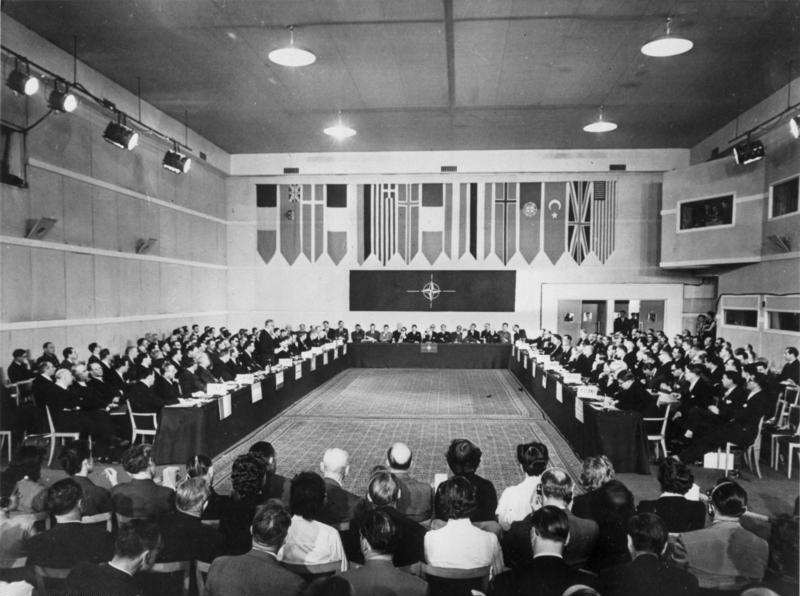
The statement issued today by twelve European leaders regarding the sovereignty of Greenland was brief, legalistic, and utterly devastating. By declaring Danish territory inviolable without explicitly naming the United States, Europe’s chancellories effectively acknowledged what historians and international relations theorists have whispered for a decade: the North Atlantic Treaty Organization (NATO), the most successful military alliance in human history, is functionally dead.
To view the current crisis merely as a product of Donald Trump’s mercurial nature or his real estate ambitions is a mistake. What we are witnessing in 2026 is the culmination of structural fissures that have been widening since the fall of the Berlin Wall. It is the final dismantling of the “Empire by Invitation,” to use Geir Lundestad’s famous phrase, and the return of a colder, harder world of raw geopolitical competition.
To understand how we arrived at this precipice—where Washington views a NATO ally not as a partner but as a target for acquisition—we must look beyond the immediate headlines. We must engage with the historiography of the Cold War, the theories of hegemonic stability, and the long, slow drift of the Atlantic plates.
The Architecture of the “West”
NATO was never inevitable. As the historian John Lewis Gaddis meticulously detailed in The Cold War: A New History, the alliance was born of a specific moment of terror. In the late 1940s, the Sovietization of Eastern Europe and the Berlin Blockade convinced Western European capitals that economic aid via the Marshall Plan was insufficient. They needed a security guarantee.
The genius of the post-1945 order, as described by G. John Ikenberry in After Victory, was its constitutional nature. The United States, emerging as the preponderant global power, agreed to bind itself within institutions. It offered security and open markets; in return, it received deference and the ability to shape the global operating system. It was a hegemony that operated, uniquely, through consent.
For seventy years, this bargain held. The United States provided the “shield,” allowing Europe to develop the “sword” of economic integration (the EU) and the luxury of the welfare state. As the historian Tony Judt argued in Postwar, the European social model was an artificial flower, blooming only because the harsh winds of security competition were blocked by the American military umbrella.
The Widening Gyre: Mars and Venus
However, the seeds of the current dissolution were sown long before the 2024 election. In his prophetic 2003 treatise Of Paradise and Power, Robert Kagan argued that the US and Europe were drifting into separate epistemological universes. “Americans are from Mars and Europeans are from Venus,” Kagan famously wrote.
While Europe moved toward a Kantian world of “perpetual peace,” engaging in multilateralism and international law, the United States remained in a Hobbesian world where military force was the ultimate arbiter. For two decades after the Cold War, the US tolerated Europe’s demilitarization because the costs were manageable, and the diplomatic cover of “The West” was useful for interventions in the Middle East.
But as the center of geopolitical gravity shifted to the Indo-Pacific, the utility of the Atlantic Alliance came into question. Paul Kennedy, in his seminal The Rise and Fall of the Great Powers, warned of “imperial overstretch”—the inevitable moment when a hegemon’s commitments exceed its resources. In 2026, we are seeing a brutal correction of that overstretch. The Trump administration has looked at the balance sheet of the Atlantic Alliance and decided, in purely transactional terms, that it is a bad deal.
Offensive Realism and the Transactional Superpower
To understand the Trump administration’s move on Greenland, we must turn to the school of Offensive Realism, championed by theorists like John Mearsheimer.
Realism dictates that states act solely to maximize their power and security in an anarchic system. There are no permanent friends, only permanent interests. For decades, Liberal Institutionalism (the belief that international organizations mitigate conflict) obscured this reality. The current US administration has stripped away the liberal veneer.
The move on Greenland is a textbook application of Classical Geopolitics. As Robert Kaplan argues in The Revenge of Geography, territory matters. The Arctic is melting, opening up new shipping lanes and revealing vast deposits of rare earth minerals—resources currently dominated by China.
From a ruthless, realist perspective, controlling Greenland gives the United States command over the “High North,” secures critical supply chains for the 21st-century economy, and denies strategic depth to Russia and China. The fact that Greenland belongs to Denmark—a loyal ally that fought alongside the US in Afghanistan—is irrelevant in this calculus. In the world of Thucydides, “the strong do what they can and the weak suffer what they must.”
By threatening the territorial integrity of a NATO member, the US has signaled that it no longer views the alliance as a community of values, but as a collection of vassal states. If a vassal holds territory the empire needs, the empire takes it. This is not the behavior of a leader of the free world; it is the behavior of a 19th-century Great Power.
The European Awakening
The statement from European leaders marks the end of what we might call “The Era of Denial.” For years, European capitals have operated on the assumption that Trumpism was an aberration—a temporary deviation from the norm of Atlanticism. They believed that if they waited long enough, the “adults in the room” would return to Washington, and the rules-based order would be restored.
That illusion shattered this week. The realization has dawned that the structural forces driving American isolationism and unilateralism are bipartisan and deep-seated. The US is becoming an autarkic island nation, insulated by two oceans and energy independence, less reliant on global trade and alliances than at any point since 1941.
This leaves Europe in a position reminiscent of 1956. The Suez Crisis was the moment Britain and France realized they could no longer act independently of the United States. The Greenland Crisis of 2026 is the inverse: the moment Europe realizes it must act independently, because the United States has become a predator rather than a protector.
However, as Niall Ferguson has often noted, empires are easier to dismantle than to replace. Europe faces a profound capabilities gap. Having outsourced its security for three generations, it lacks the command structures, the intelligence assets, and the strategic airlift capacity to defend itself. The rhetoric of “Strategic Autonomy,” championed by Emmanuel Macron, must now be converted into hard steel and logistics overnight.
The Return of the “Concert of Powers”
What replaces NATO? We are likely witnessing a return to a 19th-century style “Concert of Powers,” but on a global scale. In this system, stability is maintained not by universal laws, but by the equilibrium of strength between Great Powers who agree to respect each other’s spheres of influence.
Donald Trump’s foreign policy is an crude approximation of this. He seeks to carve up the world with Vladimir Putin and Xi Jinping. In this vision, the US dominates the Western Hemisphere (hence the moves on Venezuela and Greenland), Russia is granted a sphere in Eastern Europe (sealing the fate of Ukraine), and China is begrudgingly acknowledged as the hegemon of East Asia (leaving Taiwan exposed).
This is a world where small and medium-sized nations—the Denmarks and Ukraines of the world—lose their agency. International law, the Geneva Conventions, and the UN Charter become quaint artifacts of a bygone era.
The Ghost of 1914 or 1939?
The danger, of course, is that spheres of influence are rarely static. History is littered with the wreckage of attempts to appease rising and revisionist powers.
Christopher Clark, in The Sleepwalkers, described how the rigid alliance systems of 1914 dragged the world into war. Paradoxically, the collapse of alliances can be just as dangerous. The ambiguity created by the end of NATO creates a vacuum.
If Article 5 is a dead letter, what deters Russia from testing the resolve of the Baltic states? If the US is busy annexing Greenland, who prevents a conflict in the Balkans from spiraling? The dissolution of hegemonic stability usually leads to a period of chaotic violence as local powers settle old scores. We are entering a period akin to the 1930s, where the League of Nations collapsed, and the “law of the jungle” reasserted itself.
Conclusion: The Lonely Continent
For Britain, the collapse of NATO is a strategic catastrophe of the first order. Since 1945, British grand strategy has been predicated on the “Special Relationship” and the idea of acting as a bridge between Europe and America. That bridge has now been incinerated.
London finds itself adrift. It has severed its political ties with Europe via Brexit, and now its military patron in Washington has gone rogue. The British political class, still desperate to flatter the Emperor in the White House with state visits and gold carriages, appears frozen in the headlights of history.
As we move through 2026, the maps on the wall are being redrawn. The Atlantic, once a political lake connecting two halves of “The West,” has become a vast, cold ocean once again. The “Long Peace” presided over by American hegemony is over. In its place comes a scramble for resources, territory, and survival.
The Greenland Crisis is not a diplomatic spat. It is the tombstone of the 20th century.
Further Reading:
- John Lewis Gaddis, The Cold War: A New History (2005) – Essential for understanding the origins of the alliance system now collapsing.
- Robert Kagan, Of Paradise and Power: America and Europe in the New World Order (2003) – The foundational text on the structural divergence between the US and Europe.
- John Mearsheimer, The Tragedy of Great Power Politics (2001) – The handbook for understanding the ruthless realism driving the current administration.
- Tony Judt, Postwar: A History of Europe Since 1945 (2005) – Crucial for grasping how Europe’s stability was artificially maintained by US security.
- Paul Kennedy, The Rise and Fall of the Great Powers (1987) – A warning from history about the inevitable retrenchment of overextended empires.
- Geir Lundestad, The United States and Western Europe Since 1945 (2003) – Explores the concept of “Empire by Invitation” which has now been revoked.
This article is based on the latest episode of the Explaining History podcast. To listen to the full analysis, subscribe to our Patreon for ad-free episodes and exclusive content.

Leave a Reply