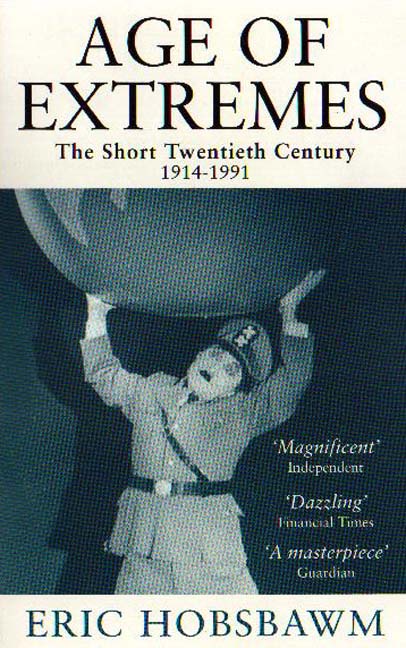

As we begin a new year, it seems fitting to return to one of the most significant historical works of the modern era: Eric Hobsbawm’s The Age of Extremes. Published in 1994, it defines the “Short Twentieth Century” as the period between the outbreak of World War I in 1914 and the collapse of the Soviet Union in 1991.
In this week’s podcast, I started what will be a year-long journey through this text. Hobsbawm’s work is masterful not just for its scope, but for its diagnosis of a peculiar malady that afflicts our time: historical amnesia.
The Destruction of the Past
Hobsbawm writes that “the destruction of the past, or rather of the social mechanisms that link one’s contemporary experience to that of earlier generations, is one of the most characteristic and eerie phenomena of the late twentieth century.”
We see this everywhere. In 1992, French President François Mitterrand visited Sarajevo on June 28th—the anniversary of the assassination of Archduke Franz Ferdinand in that very city in 1914. The symbolism was potent: a warning that political error and ethnic nationalism could once again plunge Europe into catastrophe. Yet, as Hobsbawm noted, almost no one noticed. The historical memory was dead.
Why has this happened? It isn’t a lack of information; we are drowning in content. It isn’t a lack of schooling. I argue that it stems from two structural shifts. First, urbanization destroyed the intergenerational transmission of knowledge. In peasant societies, grandparents raised children and passed down folklore and history. In modern, atomized societies, that link is broken.
Second, we live in the “endless now.” The sheer volume of distraction—TV, social media, the 24-hour news cycle—keeps us trapped in the immediate moment. The past feels less relevant because the present is so loud.
The Binary Century
Hobsbawm views the 20th century as a binary struggle: capitalism vs. socialism, fascism vs. democracy. While useful, this frame can be limiting. As I discussed in the podcast, it is a very Western way of seeing the world.
For Chinese communists, the revolution was as much about national liberation from a “century of humiliation” as it was about Marxist dogma. For nations like Indonesia, Egypt, or Vietnam, the Cold War wasn’t a choice between two economic systems, but a desperate navigation between two empires that demanded total allegiance.
We must be careful not to oversimplify. The “Good vs. Evil” narrative of the Cold War, where the West represents freedom and the East represents tyranny, obscures the messy reality of coups, proxy wars, and the support of dictatorships by both sides.
Judgment vs. Understanding
Finally, Hobsbawm grapples with the historian’s duty. He rejects the French proverb “to understand all is to forgive all.” To understand the Nazi era, he argues, is not to forgive the genocide. It is to explain how it happened so we might recognize the warning signs again.
However, he admits that for those who lived through the century, abstaining from judgment is impossible. We are all products of this history. The challenge for the historian in 2026 is to step back from the passions of the past to understand the structures that shaped it—even as those structures crumble around us.
Study Announcements:
On Monday, I will be announcing the dates for our student study days. The first session will focus on Russian History. If you are a student preparing for exams, these masterclasses will focus on exam technique, mindset, and understanding exactly what the examiner wants. Stay tuned!
Transcript
Nick: Welcome to the first Explaining History podcast of 2026. I hope you all had a nice New Year’s Eve.
I realized something crucial looking at my bookshelf today. In all the time I’ve been doing this podcast, I have never done a deep dive into Eric Hobsbawm’s seminal history, The Age of Extremes. I want to spend this year exploring Hobsbawm’s “Short Twentieth Century,” which he defines as running from 1914 to 1991.
I’m going to begin at the beginning. The first chapter, “The Century: A Bird’s Eye View,” opens with quotes from 12 key figures.
Isaiah Berlin calls it “the most terrible century in Western history.” Primo Levi, the Holocaust survivor, writes that survivors are an “anomalous minority” and that those who saw the “face of the Gorgon” did not return. William Golding describes it simply as “the most violent century in human history.”
Musician Yehudi Menuhin sums it up poignantly: “It raised the greatest hopes ever conceived by humanity and destroyed all illusions and ideals.”
Opinions on historical epochs differ. Hobsbawm sees the century ending in 1991. I see the 20th century running perhaps until 2008, with the neoliberal moment (1991–2008) being its final act. The crash of 2008 and the rise of Trump suggest we are now in a new, more unstable epoch.
Hobsbawm recounts a telling story about François Mitterrand’s visit to Sarajevo on June 28, 1992. The date was symbolic—the anniversary of the assassination of Archduke Franz Ferdinand in 1914. Mitterrand intended to highlight the danger of the Bosnian crisis spiralling into wider war. Yet, hardly anyone noticed the allusion. “The historical memory was no longer alive.”
This is a core theme of the book: the destruction of the past. Hobsbawm writes that most young men and women at the century’s end grow up in a “permanent present,” lacking any organic relation to the public past.
Why this amnesia? It isn’t a lack of books or documentaries. I think it comes down to two things. First, urbanization has broken the transmission of knowledge from grandparents to grandchildren—a staple of peasant societies. Second, the concept of the “endless now.” There is so much to consume in the present that the past has less meaning. People exist in a permanent revelry of the moment.
Hobsbawm argues that the world of the late 20th century was shaped by the Russian Revolution of 1917. We got used to thinking in binary opposites: capitalism vs. socialism. But this was an artificial construction. It lumped the USA, Japan, Sweden, and Brazil into one pigeonhole, and the Soviet bloc and China into another.
This binary view obscures the reality of the century. For example, Chinese communism was largely a national liberation struggle. Countries like Indonesia or Egypt faced the reality that they had to pick a side in the Cold War, neither of which was particularly attractive.
Hobsbawm also addresses the role of the historian. He rejects the phrase “to understand all is to forgive all.” To understand the Nazi era is not to forgive the genocide. However, he notes that for anyone who lived through this century, abstaining from judgment is impossible. “It is understanding that comes hard.”
We often oversimplify history into a struggle between good and evil. The losers of the Cold War were written out of history, just as the losers of WWII were, except in the role of villains. But understanding why people made the choices they did—even terrible choices—is the historian’s task.
I’m going to dive more into this book tomorrow. Hobsbawm seems like a great guide to kick off the year.
Announcements:
On Monday, I will be announcing the dates for our study days. The first one will focus on Russia. If you are a student, make sure you tune in. These masterclasses will be game-changing, focusing on exam psychology, mindset, and what the examiner wants to see.
Take care, folks. All the best. Bye.

Leave a Reply