

Child Labour in the Industrial Revolution – Explaining History
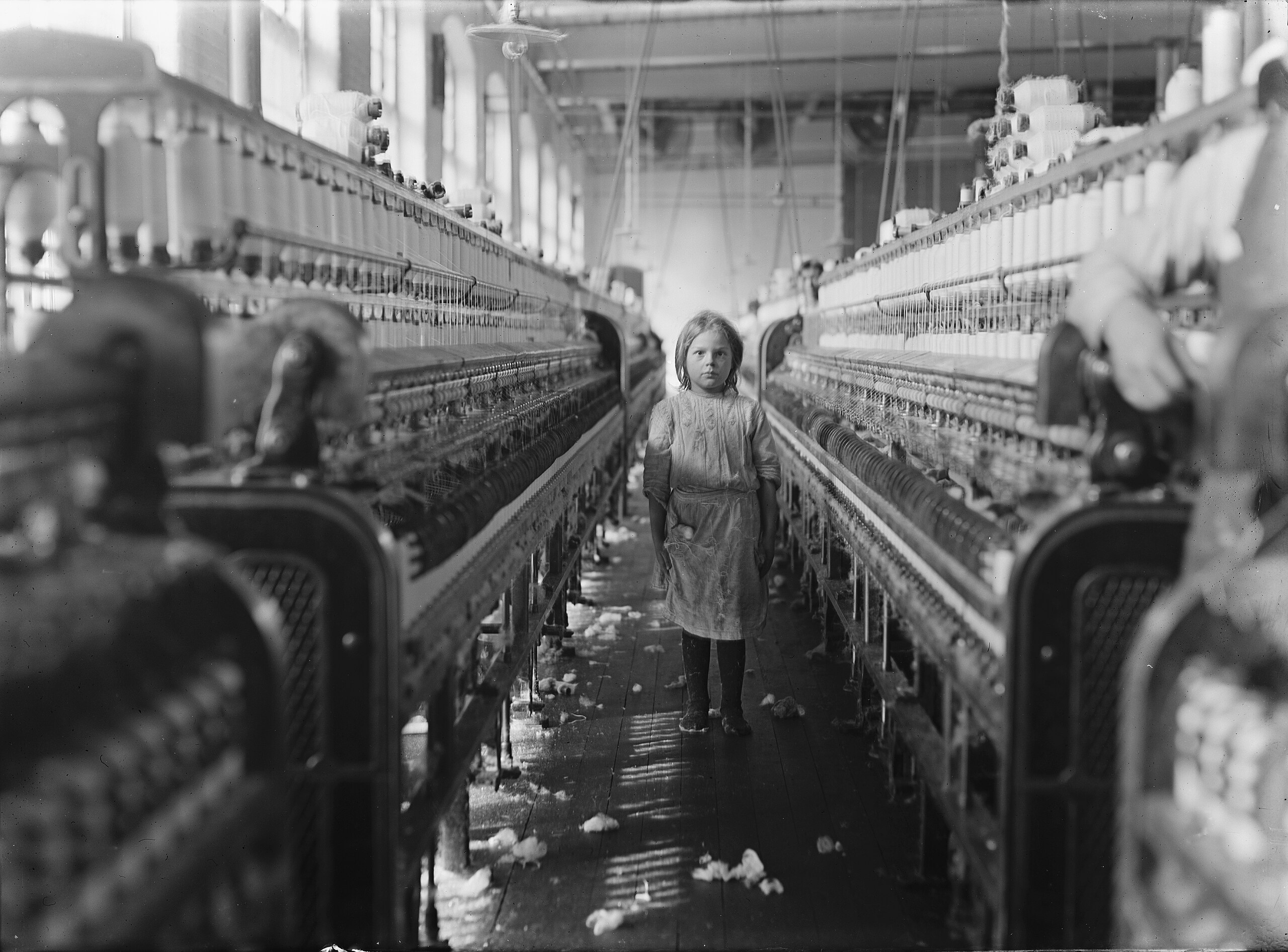
When we think of the Industrial Revolution, our minds often drift to the soot-stained pages of Charles Dickens. We picture Oliver Twist asking for more, or David Copperfield toiling in the warehouse of Murdstone and Grinby. These “doleful images,” as historian Emma Griffin calls them, have defined our understanding of the era. They present the child worker as a passive victim of a cruel, capitalist machine.
However, in this week’s podcast, I explored a different perspective. Drawing on Griffin’s excellent Liberty’s Dawn: A People’s History of the Industrial Revolution, we looked past the literature of moral reformers to the actual words of the workers themselves.
The Bell Curve of Childhood
Griffin analyzed over 350 autobiographies written by working-class people born during the Industrial Revolution. What she found challenges some of our assumptions.
The data shows a distinct pattern. The average age for a child to start full-time work was 10. There was a bell curve: a few started as young as four or five, numbers rose steadily until age 10, and then tapered off as children entered apprenticeships around age 12.
This age—10 years old—remained remarkably consistent throughout the 18th and early 19th centuries. It suggests a cultural norm or economic tipping point where a child became “useful” enough to earn a wage, yet young enough to be controlled.
The Economics of Desperation
The reasons for sending a child to work were often brutal but rational. For Edward Davies, whose father was a heavy drinker who “disliked work exceedingly,” entering the workforce at six years and eight months was a matter of survival. He became a breadwinner because his father refused to be one.
Conversely, Richard Boswell Belcher, raised by a relatively affluent grandfather, was kept in school until age 13. He studied history and geography before becoming a draper’s apprentice. This highlights a crucial divide that would shape the British working class for a century: the gap between the skilled and the unskilled.
An apprenticeship was a golden ticket. It offered a trade, a future, and entry into the “labour aristocracy” of unions like the Boilermakers. For those without such opportunities, the future lay in the “unskilled” drudgery of the docks or the mills—though, as I noted in the podcast, anyone who calls dock work “unskilled” has clearly never tried to load a ship.
Rehumanizing the Past
The power of Liberty’s Dawn lies in its refusal to treat these people merely as statistics or victims. Take George Mockford, whose father was a shepherd earning piteously low wages. The family of 12 lived on potatoes and bacon fat. Yet, despite this crushing poverty and a father who seemingly cared little for his children’s welfare, George did not start work until he was 10.
This makes him an outlier. It defies the simple economic logic that “poorer families sent children to work earlier.” It reminds us that historical actors are human beings with complex motivations, affections, and strategies for survival that don’t always fit our models.
The Industrial Revolution was built on the backs of children. That is an undeniable, horrific truth. But by listening to their voices—voices that speak of fear in foggy pastures, of the camaraderie of the factory floor, and of the pride in learning a trade—we restore their dignity. They were not just “white slaves” or literary devices; they were children trying to navigate a world that was changing at a terrifying speed.
Transcript
Nick: Welcome again to the Explaining History podcast.
There’s a book that I turn to time and time again. It’s a brilliant people’s history, drawn directly from primary sources—diaries and written extracts of life in the Industrial Revolution. It is called Liberty’s Dawn: A People’s History of the Industrial Revolution by Emma Griffin.
It’s great because it situates the British working class not entirely as victims of their circumstances, but as human beings with agency. It is very difficult to do this kind of history, which is why it’s so important. If we take any painful historical process and examine the people who experienced it firsthand, we often find that, yes, things were hard, but human beings have agency to find advantages and ways of surviving.
Today we’re looking at the question of child labour. When one thinks of the Industrial Revolution, child labour is one of the standout issues. It captures our imagination of that era. The horrible truth is that capitalism was then, and is now, often built on child labour.
Emma Griffin writes:
“The doleful image of the Victorian child forced to work long hours from a very young age is one of the first things that come to mind when we consider Britain’s industrial past. Poets, novelists, essayists and reformers have all played their part in immortalising the plight of the child worker.”
Children crowd the margins of Charles Dickens’ novels—Oliver Twist, the apprentice; David Copperfield, working in the warehouse at age ten. Later, Charles Kingsley’s The Water-Babies took up the theme of the chimney sweep. These industrial novels exposed the suffering of child workers to the middle-class reader.
There is something interesting here: the market for the Victorian novel was the middle class. They had an almost anthropological curiosity about how the poor lived. It reminds me of Charles Booth (or perhaps his brother), who essentially said, “You don’t need to go to the darkest regions of Africa to find a strange society; go to Whitechapel.”
It wasn’t just novelists who were offended. Reformers like Lord Shaftesbury took up the cause in Parliament. The Factory Act of 1833 prohibited the employment of children under nine in factories. Parliamentary select committees investigated the extent of child labour, generating mountains of documents that tell a sad tale of exploitation.
Griffin asks: Can we do more than just pile up examples of suffering?
“It was a rare autobiographer who did not devote considerable attention to his experiences from early life… In a sample of 350 autobiographies, this amounts to a very rich seam of information enabling us to put some figures to the incidence of child labour.”
This is the value of people’s history. We know child labour is horrific, but we can derive the “why”—the social and economic forces behind it. It is lazy to argue, “Didn’t people in the Middle Ages send their children to work?” Yes, but industrial child labour was different.
Griffin analyzed the ages at which children started work. The data falls into a bell curve. A few started as young as four or five; the numbers rise steadily until age 10, then fall again. The average starting age was 10 years old. This average changed very little throughout the 18th century until 1850.
“Conventional wisdom dictates that the age at which the children started work was connected to the poverty of the family… Amongst those starting work at the youngest ages were to be found some living in the most desperate poverty.”
For example, Edward Davies started work at six years and eight months because his father was a heavy drinker who “disliked work exceedingly.” Conversely, Richard Boswell Belcher was raised by an affluent grandfather and stayed in school until 13, studying history and geography before becoming a draper’s apprentice.
This highlights the divide between skilled and unskilled labour. If you got an apprenticeship, you entered the ranks of skilled labour—the “labour aristocracy.” For those who didn’t, life chances were limited to what was viewed as unskilled work, though I’d argue dock work is only “unskilled” until you try to do it.
However, there are outliers. Griffin points to George Mockford. His father was a shepherd, the family was desperately poor (subsisting on potatoes and bacon fat), and his father reportedly cared little for their welfare. Yet, George did not start full-time work until he was 10. This defies the economic model that desperation always equals early labour.
“We’ll always come across things which defy mathematical models because we’re talking about people, not numbers.”
If you are interested in the Industrial Revolution, I urge you to get Liberty’s Dawn. It rehumanises people who are often treated as statistics. It makes them three-dimensional human beings who struggled through extraordinary times.
Announcement:
I’m going to be doing a live workshop in January for students of Russian History. We are looking at January 11th. I will be putting tickets on the website soon—it will be very reasonably priced (around £10) for a two-hour session to get you exam-ready. I’ll keep you posted!
Take good care, and I’ll catch you on the next Explaining History podcast. All the best. Bye-bye.

Leave a Reply