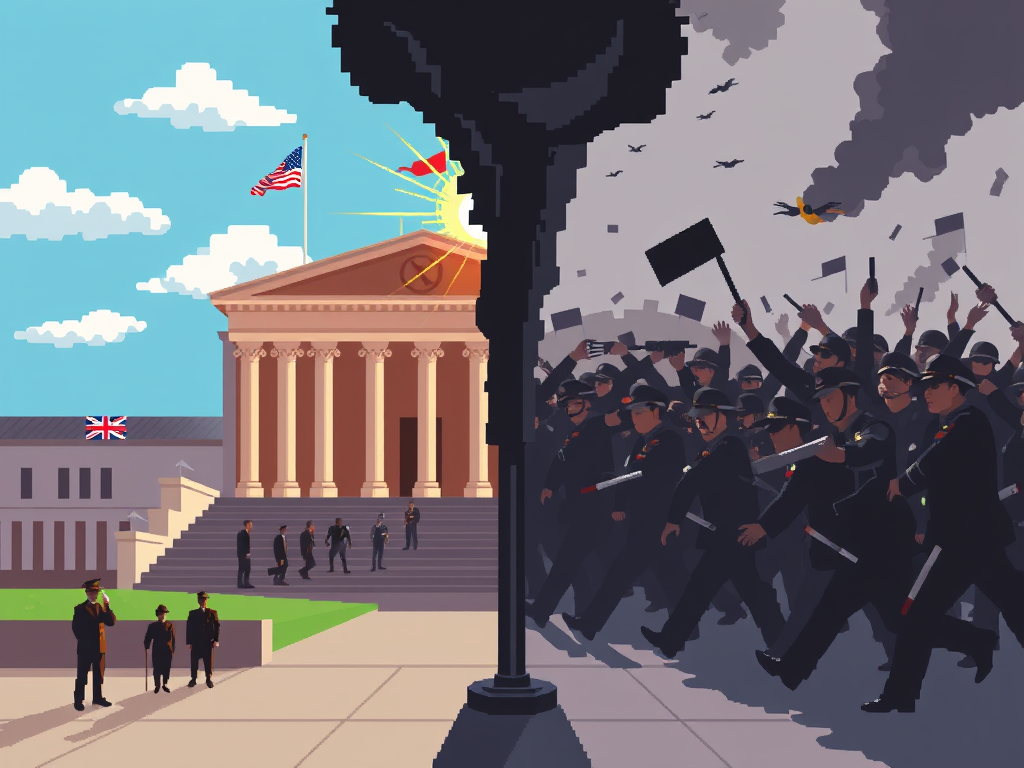


Trump's ICE brownshirts, an historical analysis – Explaining History
Comparisons between modern populists and the dictators of the 20th century are often fraught with difficulty. They can be lazy, hyperbolic, or subject to “Godwin’s Law,” which suggests that as an online discussion grows longer, the probability of a comparison involving Nazis or Hitler approaches. However, history does not offer us exact replicas; it offers us rhymes, structures, and warnings.
In this week’s podcast, we looked past the caricature of the “dictator” to examine the specific legal and bureaucratic mechanisms that allowed the Nazi Party to dismantle a functioning democracy in 1933. Specifically, we explored the concept of the “Prerogative State” and how it might help us understand the potential trajectory of a second Trump administration, particularly regarding the expansion of ICE and the threat of mass deportation.
The Dual State: Normative vs. Prerogative
To understand the collapse of the Weimar Republic, we must turn to the political scientist Ernst Fraenkel and the historian Richard J. Evans. Fraenkel, a Jewish lawyer who practiced in Berlin until 1938, coined the term “The Dual State.”
He argued that the Third Reich was not a monolith of order, but a hybrid system. On one side was the Normative State (Normenstaat): the existing bureaucracy, the civil service, the statutes, and court decisions that kept the trains running, the mail delivered, and the economy functioning. This was the Germany of rules and regulations, inherited from the efficient Prussian tradition.
On the other side was the Prerogative State (Maßnahmenstaat): the system of unlimited arbitrariness and violence exercised by the Party, the SS, and the Gestapo. In this sphere, there was no law other than the will of the Führer. The tragedy of 1933 was the rapid encroachment of the Prerogative State upon the Normative State.
As we discussed in the episode, Donald Trump’s rhetoric suggests a desire to replicate this dynamic. His explicit frustration with the “Deep State”—by which he means the normative institutions of the civil service, the judiciary, and the Department of Justice—signals an intent to bypass the rule of law in favor of executive fiat.
1933: The Year of the Auxiliary Police
One of the most terrifying specific parallels lies in the policing of the state. In February 1933, Hermann Goering, acting as the Interior Minister of Prussia (which covered two-thirds of Germany), made a fateful decision. He claimed the police were overwhelmed by the “communist threat” and authorized the creation of the Hilfspolizei—the Auxiliary Police.
Overnight, 40,000 SA men (Brownshirts) and SS members were issued white armbands and police authority. These were not trained officers of the law; they were partisan thugs, brawlers, and murderers who had spent the 1920s fighting in beer halls. Suddenly, they had the power of arrest.
This weaponization of the mob is a crucial historical lesson. When we look at the rhetoric surrounding the expansion of ICE (Immigration and Customs Enforcement) in the United States, we must be vigilant. There are proposals floating in the orbit of the incoming administration to deputize local law enforcement or even private contractors to assist in mass deportations. If the normative state (the regular police or the military) refuses to carry out unconstitutional orders, the authoritarian solution is often to create a parallel force that owes loyalty only to the leader.
The “Wild Camps” and the Logic of Chaos
In his magisterial book KL: A History of the Nazi Concentration Camps, Nikolaus Wachsmann describes the early months of 1933 as a period of chaotic violence. Before the systematized industrial horror of Auschwitz, there were the “wild camps.”
These were not state prisons. They were basements, abandoned breweries, warehouses, and sports halls commandeered by the SA to torture and hold their political enemies. This was the Prerogative State in action: arbitrary arrest, indefinite detention, and no judicial oversight.
The parallels to the proposed “staging grounds” or detention centers in the US are chilling. The logistics of deporting millions of people require infrastructure. If the existing carceral system is full—and the US system is already the largest in the world—new spaces must be created. The danger arises when these spaces operate outside the normative legal system, in a legal grey zone where detainees have no access to counsel and no habeas corpus.
The Myth of Efficiency and the Reality of Grift
There is a lingering myth that fascism, for all its evils, is efficient. “At least the trains ran on time,” the saying goes (though in Mussolini’s Italy, they often didn’t). In reality, the Nazi regime was a cesspool of corruption, incompetence, and chaos.
Hitler was not a micromanager; he was a “hands-off” leader who pitted his subordinates against one another, creating a Darwinian struggle for approval. Ian Kershaw, in his biography of Hitler, describes this as “working towards the Führer.” Officials would guess what Hitler wanted and radicalize their policies to please him.
This chaos was profitable. As noted in the podcast, the Nazi elite engaged in massive asset stripping and clientelism. This mirrors the trajectory of modern oligarchies and, frankly, the first Trump term. From the use of the presidency to steer business to personal properties, to the placement of unqualified loyalists (mediocrities) in positions of immense power, the system thrives on graft.
Authoritarianism attracts mediocrity because it values loyalty over competence. In 1933, the SA men who became police officers were often those who had failed in civil life. In a potential 2025 scenario, we must ask who will be staffing the deportation forces. Will they be professional officers, or will they be ideological volunteers and private mercenaries looking for a payout?
Conclusion: The Fragility of the Oath
Ultimately, the transition from democracy to dictatorship hinges on where loyalty lies. In 1934, the German Army swore an oath not to the Constitution, but to the person of Adolf Hitler.
The United States faces a similar constitutional stress test. The bulwark against a Prerogative State is the refusal of civil servants, soldiers, and judges to break their oaths to the Constitution. However, as history shows, institutions are only as strong as the people who staff them. When the “normative state” is hollowed out and replaced by loyalists, the road to the camps—whether in the cellars of Berlin or the swamps of the Everglades—becomes terrifyingly short.
Further Reading:
- The Dual State by Ernst Fraenkel
- The Coming of the Third Reich by Richard J. Evans
- KL: A History of the Nazi Concentration Camps by Nikolaus Wachsmann
- On Tyranny by Timothy Snyder
- The Origins of Totalitarianism by Hannah Arendt
Transcript
Nick: Hello everybody and welcome again to the Explaining History podcast.
We had a great week last week—some brilliant interviews and some lovely feedback. It is a time at the moment where there’s a real sense of community on the podcast, so I am very grateful for that. As ever, there is a heck of a lot to talk about.
I wanted to talk today about the early days of the development of the dictatorship in Nazi Germany. Now, there are all manner of very clumsy things said regarding analogies between Trump and Nazism. You have this populist figure, this rather buffoonish, clown-like populist figure. It is important to remember that for much of the 1920s, Hitler was seen in the bourgeois press as a similarly ridiculous character.
You have a desire to dismantle democracy, and Trump is certainly demonstrating that desire. There is a desire to reach over normative institutions of state—the civil service, the judiciary, and the structures of everyday politics—to connect directly with this notion of “the people.” In that sense, there are clear comparisons.
Obviously, Trump is a grotesque manifestation of excess—a man with a golden toilet, a guy who lives off cheeseburgers and is so incompetent he makes casinos go bust. If you were to get an artificial intelligence to create an avatar of end-state capitalism, it would create Donald Trump. He has the attention span of a fruit fly and struggles with basic literacy and geography. But he possesses that animal cunning he learned from his many years as a real estate huckster and from his “Richelieu figure,” Roy Cohn. He knows how to sniff out a winner.
When we look at this big legislative push that has been passed and the provisions there to fund ICE, the goal really is to create a personalized police force. It is currently focusing on immigration, but there are many American citizens who have been spirited away—mostly those who aren’t white.
Trump is doing something that Hitler did in the early days of the dictatorship in 1933. Historian Richard J. Evans describes it as the replacement of a Normative State with a Prerogative State.
What does that mean? Well, Germany prior to 1933 was one of the best-run, best-administered countries in the world. The Germany of the Weimar Republic had a very functioning civil service. It was a civil service that was very conservative and often viewed the Social Democratic governments it had to endure under sufferance. It was often quite receptive to the Nazis. But what many bureaucrats didn’t realize was the amount of chaos the Nazis would introduce—and it was chaos by design.
This is what we would think of as a Normative State, particularly its judicial system. A normative judicial system involves an apolitical police force that investigates crimes and arrests suspects. It brings them before an impartial legal system—or as impartial as people can be. The legal system decides on guilt, prosecutes, and then either acquits or punishes. The sentence is proportionate to the crime. Once the person has served the sentence, they are, in theory, a free citizen again.
Hitler begins to unpickle this in 1933. The Reichstag Fire is a key accelerating moment in the establishment of the Nazi dictatorship because it gives Hitler a justifiable reason for suspending the civil rights of German people and suspending the Constitution. There were provisions within the Constitution to hand Hitler emergency powers. President Hindenburg had all sorts of skepticisms about Hitler and viewed him as a potential dictator, yet Hindenburg felt he had little choice but to hand those powers over.
One of the reasons Hitler was able to carry out mass arbitrary arrests was because of the rapid expansion of the police using the Brownshirts (the SA). Hermann Goering was made Interior Minister for Prussia, which comprised about 70% of the territory of Germany at that time. He allowed the formation of the Hilfspolizei (Auxiliary Police).
They weren’t around for very long, and they were subordinated to the regular police, but they were basically the Brownshirts. The party thugs were given police badges. This was a terrifying moment for civil society. It boiled out of control fairly quickly, but for the first six months, the Brownshirts with police badges were essentially on the rampage.
If you read Nikolaus Wachsmann’s brilliant book KL, there is a quote where it says, “Everybody was arresting everybody.” Part of the explosion of the camp system within Germany from 1933 onwards was SA men acting on their own volition, on their own initiative, arresting people they didn’t like. Sometimes they took them to a random warehouse they had requisitioned. There was very little oversight other than leaders saying, “Chaos is good, let’s just run with this.”
So, you had the Brownshirts given police badges and the ability to arrest whoever they wanted. These were often stupid beer hall jerks—guys who had enjoyed the last few years of free beer and punch-ups. Now, they would go and arrest the people they beat up or who beat them up—normally socialists, trade unionists, and anti-Nazis. They would take them away, imprison them, and torture them in 1930s German “black sites.”
That is not to say there wasn’t centrally directed terror. In the aftermath of the Reichstag Fire, there was an official roundup of thousands of communists, socialists, and trade unionists. They were kept in camps like Dachau. The majority of them survived the experience and were released within 12 to 18 months. It was a very successful way of breaking the power of the Left in Germany. Once you’ve spent 18 months in a camp, are you too physically and mentally broken to resist? In the majority of cases, the answer is yes.
But then comes the next part of the construction of the Prerogative State: the establishment of the Gestapo. In Prussia, political policing existed long before the Nazis came into power. The Weimar state kept an eye on political undesirables, and the Nazis inherited these extensive records. One reason they could arrest people so quickly was because of the diligent efforts the Weimar state had gone to in creating lists of subversives.
The Gestapo was able to create a parallel system of justice. They could coerce people into signing their rights away—signing themselves into “Protective Custody.” This meant the Gestapo had permanent rights over that individual. You became a ward of the state. If you didn’t sign, obviously, there was dire, violent punishment waiting in the interrogation room.
This meant you could be put on trial in a civilian court and go to a civilian prison. But if, after six months, the Gestapo decided you hadn’t been punished enough or were still dangerous, they could meet you at the prison gates when you were being released and take you away to a camp. A parallel system existed at the very peripheries of legality. The Enabling Act gave Hitler such broad powers that, essentially, anything was legal.
Are we seeing this in America? Well, we are hearing about camps potentially being built in the Everglades. It is a bit of a clunky analogy purely because America already has such a massive carceral system. It has the highest concentration of prisoners in the world. I’ve done quite a few episodes on America’s carceral state, so do look back through the archives. In a for-profit prison system, do you even need “concentration camps”? Perhaps I’m not thinking big enough.
You have the development of an enormously well-funded ICE—with 200-plus billion dollars in funding. I suspect they will be encouraged to have an overriding personal loyalty to Trump.
The difficulty here—and this creates a constitutional crisis—is similar to when the Weimar Republic finally folded in 1934. That happened when the Army swore a personal oath of loyalty not to the Republic, but to Hitler himself. Will ICE officers be able to swear an oath of loyalty to Trump and not to the Constitution? You would like to think the Supreme Court would have something to say about that, but the Court is so heavily stacked by Trump that perhaps he will get away with it. If so, the Republic is over—if it isn’t already.
I suspect Trump isn’t a keen reader of history; he probably doesn’t read Ian Kershaw’s biography of Hitler. But I imagine people like Stephen Miller and others around Trump do, and they look at these things as inspirational manuals.
To make the direct connection between Trump and Nazis is to miss the point that authoritarians throughout the 20th century have seen legal structures as problems. This doesn’t just contain itself to Hitler, though he is the most explicit example. Authoritarians, totalitarians, and in this case, a plutocratic elite, are there to loot and plunder, wave the flag, and whip up culture war chaos while the state is eviscerated.
There was plenty of that in the Nazis, by the way. People forget that it was an immensely corrupt system. Hitler’s chief henchmen enriched themselves enormously by asset stripping, looting the state, and assigning lucrative government contracts to their own spheres of interest. Nazism was full of clientelism, graft, and “who you know.” The idea that they brought order to a chaotic democracy and made everything run like clockwork is a falsehood.
Hitler actually injected more chaos. And this is a very good parallel with Trump. He injects enormous amounts of chaos deliberately into a functioning bureaucratic system. He does it because it is a great way of dividing and ruling. Nazism required chaos—it was a system of endless dynamism that thrived on conflict. This was really the product of mediocrities who were incapable of aspiring to much else under normal circumstances, suddenly thrust into positions of immense power.
The mediocrity side is very telling. Look at the news next and see how much mediocrity there is—people you wouldn’t trust with a drinks trolley or a train set. Nazism was full of them—very average men who saw the party as a means of advancement.
So, the development of ICE and the potential development of Trump’s detention centers are part of an authoritarian playbook that was used by the Nazis. It will be interesting to see, if we ever find out, how many of those ICE agents are bona fide officers of the law, and how many are mercenaries, bounty hunters, or just volunteers enjoying the violence. Much like the Brownshirts.
Take good care, everybody. All the best. Bye-bye.

Leave a Reply