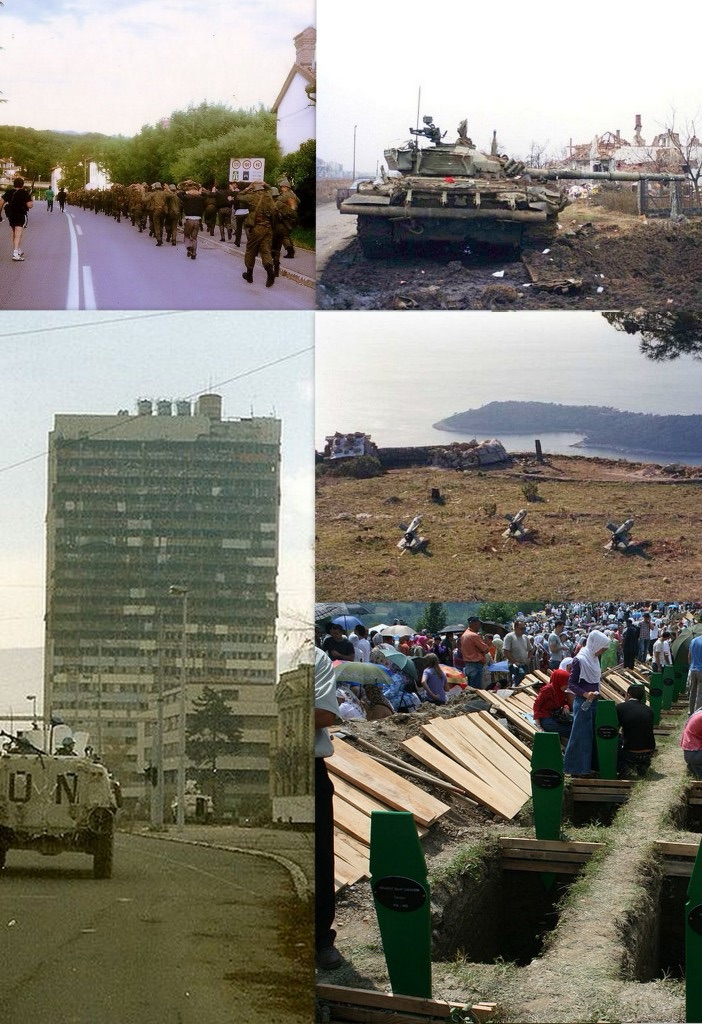

Introduction: The Paradox of Peace and War
To the casual observer in the late 1980s, the Socialist Federal Republic of Yugoslavia presented a confounding paradox. Here was a country that, for over four decades, had maintained a fragile but functioning peace among its six constituent republics and a mosaic of ethnic and religious groups: Serbs, Croats, Bosniaks (Muslims), Slovenes, Macedonians, Montenegrins, and numerous others. Its citizens travelled freely on Yugoslav passports, intermarried at significant rates (particularly in urban centres like Sarajevo, Belgrade, and Zagreb), served in a unified military (the JNA), and enjoyed a standard of living and cultural openness unique in the Eastern Bloc. The memory of the catastrophic inter-ethnic violence of the Second World War—a civil war within a war that claimed over a million Yugoslav lives—was a public spectre, a warning etched into the national consciousness by the state’s own founding myth of “Brotherhood and Unity.”
Yet, within a few short years, this society descended into a maelstrom of violence so brutal, so intimate, and so comprehensively destructive that it became synonymous with late-20th-century barbarism: sieges, concentration camps, systematic rape, and genocide. This breathtaking velocity of collapse poses the central, haunting question for historians: Why? How did neighbour turn against neighbour with such ferocity? The search for an answer has crystallized around two dominant, often diametrically opposed, explanatory frameworks: the “Ancient Hatreds” thesis and the “Elite Manipulation” thesis. This essay will argue that while the “Ancient Hatreds” narrative provides a dangerously simplistic and abistorical folklore that was weaponized by protagonists, the “Elite Manipulation” model offers a more powerful and evidence-based explanation for the timing and mechanisms of the violence. However, a complete understanding requires moving beyond this binary to a synthetic analysis that acknowledges the availability of latent ethnic tensions as a resource for elites, the role of structural economic and political crises, and the catastrophic failure of institutional safeguards.
The “Ancient Hatreds” Thesis: Primordialism and Its Appeal
The “Ancient Hatreds” thesis, also termed primordialism, posits that the conflicts of the 1990s were the inevitable eruption of deep-seated, timeless ethnic and religious animosities that had merely been suppressed, not resolved, by Tito’s communist regime. In this view, Serbs, Croats, and Bosniaks are locked in a perpetual cycle of vengeance dating back to the medieval battles of Kosovo Polje (1389) or the religious conversions imposed by the Ottoman and Habsburg empires. Ethnic identity is seen as fixed, biological, and inherently conflictual.
This narrative gained immense traction in Western media and political discourse during the wars. It was seductively simple, providing a ready-made storyline for complex events. As one commentator infamously put it, the Balkans were a region where “ancient tribal passions” forever boiled over. This framing had several consequences:
- It presented the violence as inevitable and intractable, suggesting that outside intervention was futile against the tide of history.
- It absolved specific actors of responsibility, framing atrocities as the natural, if regrettable, expression of collective ethnic character.
- It dovetailed perfectly with the nationalist mythologies being peddled by figures like Slobodan Milošević and Franjo Tudjman, who themselves resurrected historical grievances to justify contemporary political projects.
Scholarly Proponents and Their Arguments:
While few serious academics would endorse a pure, blood-and-soil primordialism, some scholars have emphasized the longevity and potency of historical memory and ethnic identity in shaping conflict.
· Branimir Anzulović’s Heavenly Serbia: From Myth to Genocide (1999) traces how Serbian national identity was constructed around the myth of Kosovo—the story of martyrdom, betrayal, and heavenly chosenness. He argues this myth, cultivated for centuries by the Orthodox Church and nationalist intellectuals, created a collective psyche predisposed to victimhood and righteous vengeance, which was then activated in the 1990s.
· Historian Ivo Banac, in his seminal The National Question in Yugoslavia (1984), meticulously detailed the development of competing national ideologies in the 19th century. While not a primordialist, his work demonstrates how these ideologies were fully formed and mutually exclusive long before the creation of Yugoslavia in 1918, creating a state built on fundamentally antagonistic national projects.
· The “Clash of Civilizations” thesis (Samuel Huntington, 1993), though not specific to Yugoslavia, provided a macro-framework that many applied to the region: a fault line between Western Catholicism (Slovenia, Croatia), Eastern Orthodoxy (Serbia, Montenegro), and Islam (Bosnia, Kosovo).
The primordialist argument points to undeniable historical facts: the brutal Četnik-Ustaša violence of WWII, in which hundreds of thousands were murdered along ethnic lines, was within living memory. Grandparents had stories of atrocities; mass graves were known. The hatreds, therefore, were not “ancient” but could be recent and traumatic. The primordialist claim is that these identities and memories were the primary driver, waiting for the lid of authoritarian control to lift.
The “Elite Manipulation” Thesis: Instrumentalism and the Mechanics of Power
In stark contrast, the “Elite Manipulation” or instrumentalist thesis argues that ethnic hatred was not the cause but the tool of the conflict. It shifts the focus from masses to elites, from passion to strategy, and from ethnicity to politics. In this model, the collapse of communism created a profound crisis of legitimacy and a scramble for power. Nationalist leaders—most notably Slobodan Milošević in Serbia, Franjo Tudjman in Croatia, and later Radovan Karadžić in Bosnia—faced a problem: how to mobilize popular support in a post-ideological vacuum and how to control key state resources (the police, army, media, economic assets).
The solution, instrumentalists argue, was the deliberate and cynical fabrication of ethnic crisis. By portraying other ethnic groups as existential threats, these elites could:
- Consolidate power internally, silencing liberal, socialist, or civic-minded opposition as “traitors” to the nation.
- Mobilize a loyal political base through fear and solidarity.
- Justify the seizure of territory and resources in the name of national survival.
- Obfuscate their own roles in the catastrophic economic decline and institutional decay of the 1980s.
Key Scholars and Evidence:
This school of thought is dominant in contemporary Western historiography and is powerfully supported by documentary evidence and insider testimonies.
· V.P. Gagnon Jr.’s The Myth of Ethnic War: Serbia and Croatia in the 1990s (2004) is the seminal instrumentalist text. Gagnon meticulously demonstrates that in both Serbia and Croatia, the populations in the late 1980s were not clamouring for ethnic war. Polls showed majorities favoured maintaining Yugoslavia. The real threat to Milošević and Tudjman came from within their republics: from cosmopolitan urbanites, striking workers, and reformist communists who sought a democratic, market-oriented future. Gagnon argues that the violence was a “conservative” strategy by threatened elites to “create, activate, and intensify” ethnic divisions as a way to demobilize this cross-ethnic, reformist challenge. War was not the goal of popular sentiment but a tool for political control.
· Sabrina Ramet’s Balkan Babel (multiple editions) and Susan Woodward’s Balkan Tragedy: Chaos and Dissolution after the Cold War (1995) provide complementary structural analyses. Woodward, in particular, focuses on the devastating impact of Yugoslavia’s foreign debt crisis and the IMF-imposed austerity measures of the 1980s. The resulting economic collapse—hyperinflation, unemployment, vanishing social services—shattered the social contract and created a pool of desperate, resentful young men, ripe for mobilization by nationalist gangs and paramilitaries. The violence, therefore, had deep economic roots that elites channelled into ethnic grievance.
· The Role of Media: The instrumentalist case is perhaps most viscerally proven by the controlled media. As scholars like Mark Thompson (Forging War: The Media in Serbia, Croatia and Bosnia-Herzegovina) have shown, state television in Belgrade and Zagreb became relentless propaganda machines. They broadcast fabricated stories of massacres, constant loops of historical atrocity footage from WWII, and hysterical rhetoric painting neighbouring groups as monsters. This was not a reflection of popular animosity; it was its factory. The siege of Vukovar and the Battle of Sarajevo were, in a sense, preceded by the siege of the mind.
The instrumentalist thesis powerfully explains the timing: why the violence exploded precisely when the old system collapsed, not before. It explains the methodology: the centralized control of militias, the planned seizures of territory (as outlined in the “RAM Plan” and other leaked documents in Serbia), and the systematic use of propaganda. It shows how a critical mass of “willing executioners” was manufactured, not born.
Beyond the Binary: A Synthetic Analysis
A truly rigorous history must move beyond the either/or dichotomy. The most compelling analysis is synthetic, acknowledging the interactive relationship between structure, agency, and historical legacy. The elites did not operate in a vacuum; they worked with the raw materials available to them.
- Latent Tensions as a Resource: The instrumentalists are correct that full-scale war was not inevitable or widely desired in 1989. However, the potential for ethnic polarization existed. Decades of communist rule had suppressed but also bureaucratically entrenched ethnic categories (one’s narodnost was on every ID card). The unresolved trauma of WWII was a subterranean river; it had not been adequately addressed by a regime that imposed a superficial “Brotherhood and Unity” from above. Elites did not create Serb or Croat identity from scratch; they selectively amplified certain historical narratives (Kosovo, the WWII Independent State of Croatia) while silencing others (Yugoslav Partisan resistance, centuries of coexistence). The hatreds were not ancient, but the fault lines were pre-existing and available for politicization.
- The Structural Crisis: Any complete explanation must incorporate the monumental structural collapse of the 1980s. Yugoslavia’s unique, decentralized system began to seize up after Tito’s death in 1980. The global debt crisis hit hard. Hyperinflation rendered salaries worthless. Unemployment soared, particularly among the young. The federal government became paralysed by inter-republican squabbles. This systemic failure created a landscape of anxiety, uncertainty, and lost futures. Nationalist elites offered a simple, emotionally satisfying explanation for this complex pain: “You are poor because ‘they’ are exploiting you. You are weak because ‘they’ threaten our nation.” Economic despair was translated into ethnic grievance.
- The Failure of Institutions and Alternatives: The violence succeeded because institutional firewalls failed. The Yugoslav People’s Army (JNA), instead of protecting the federation, was gradually purged of non-Serbs and converted into a Serbian nationalist force. The League of Communists fractured along republican lines. Civic, anti-nationalist opposition groups (like the Antiratna Kampanja in Serbia) were marginalized, intimidated, or drowned out by the media barrage. The international community, initially viewing the crisis through the “Ancient Hatreds” lens, was passive or actively unhelpful (e.g., the early recognition of Croatia). The space for a peaceful, negotiated dissolution or reconstitution was systematically closed down by those who stood to gain from violence.
Historiographical Impact and Lasting Consequences
The debate between these two theses is not merely academic; it has profound implications for how we understand responsibility, justice, and the possibility of reconciliation.
· The ICTY and Legal Responsibility: The instrumentalist view heavily influenced the prosecutorial strategy at the International Criminal Tribunal for the former Yugoslavia (ICTY). While it tried perpetrators of all ethnicities, its most significant cases aimed at proving Joint Criminal Enterprise (JCE)—specifically, that political and military leaders in Belgrade and Zagreb shared a common plan to ethnically cleanse territories. This required proving top-down coordination, not just bottom-up ethnic rage. The (incomplete) success of these cases, particularly against Milošević’s associates, lent credence to the elite manipulation model.
· Memory Politics and Denial: In the post-war states, the “Ancient Hatreds” thesis is often embraced by nationalist elites to justify the war and promote a narrative of eternal victimhood. In Serbia, the official narrative often portrays the wars as a defensive, chaotic response to inevitable secessions and historical threats, minimizing centralized planning. In Croatia, a similar narrative of a “Homeland War” for survival obscures the aggression against Bosnia. The instrumentalist narrative, by contrast, is championed by civil society groups and historians seeking a shared, fact-based history that assigns specific responsibility, thereby creating the possibility for a future not doomed to repeat the past.
· The Danger of the “Ancient Hatreds” Paradigm: Ultimately, the “Ancient Hatreds” thesis is not just inaccurate; it is pernicious. It essentializes entire peoples, condemning them to a destiny of perpetual conflict. It breeds pessimism about peacebuilding and reconciliation. It was, as we have seen, a gift to the very demagogues who fanned the flames, providing a pseudo-historical alibi for their crimes.
Conclusion: Manufactured Cataclysm
The descent of Yugoslavia into war was not the spontaneous combustion of ancient animosity. It was a manufactured cataclysm. The raw materials—historical memories of trauma, bureaucratized ethnic identities, and deep economic despair—were real and potent. But the decision to weaponize these materials, to forge them into instruments of terror and mobilization, was a political choice made by specific elites facing a crisis of their own legitimacy.
The “Elite Manipulation” thesis provides the most compelling framework for understanding the agency and mechanics behind this choice. It explains the synchronized collapse, the propaganda blitz, and the strategic use of paramilitary violence. However, to fully grasp why this manipulation was so devastatingly effective, we must integrate it with an understanding of the structural collapse that created a society in crisis and the historical legacies that provided the narrative fuel. The Yugoslav Wars were, in the final analysis, a complex tragedy of political cynicism exploiting social breakdown, using the powerful, dangerous language of blood and belonging. To remember them otherwise is to risk misunderstanding the very nature of modern ethnic conflict, and to disarm ourselves against its future practitioners.

Leave a Reply