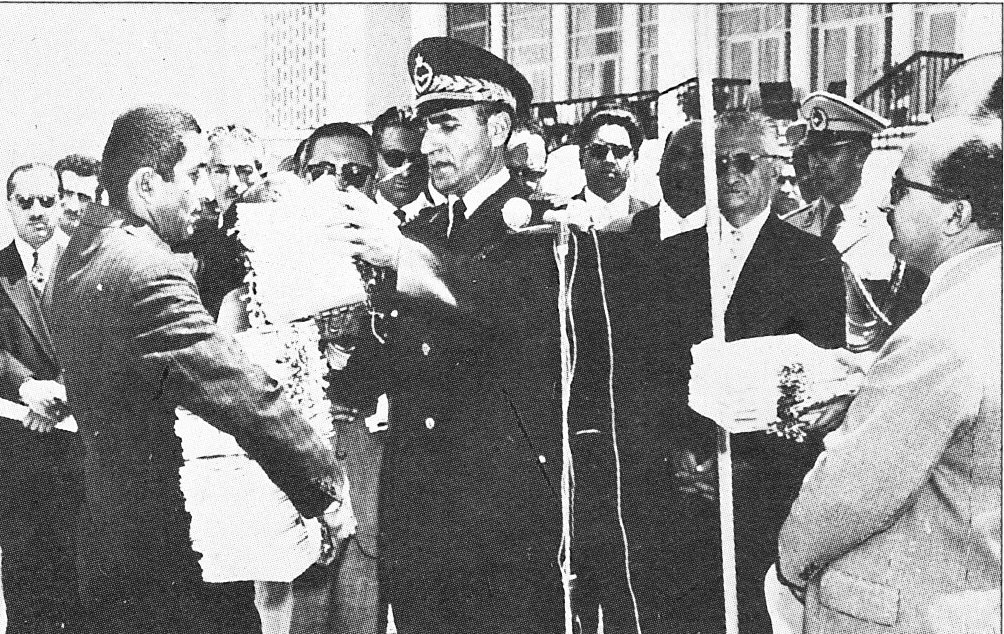

The 1960s and 1970s marked a pivotal era in Iran, dominated by an ambitious and far-reaching reform program initiated by Mohammad Reza Shah Pahlavi, known as the White RevolutionWhite Revolution Full Description:The White Revolution was a project of authoritarian modernization. It sought to break the power of traditional landlords through land redistribution and to rapidly industrialize the economy. It was billed as a bloodless (“white”) revolution to prevent a communist (“red”) one. Critical Perspective:Despite lofty goals, the reforms destabilized the social order. The land reforms often failed to provide peasants with enough resources to farm effectively, driving millions into urban slums where they became foot soldiers for the revolution. Furthermore, the rapid secularization alienated the powerful merchant class (Bazaaris) and the clergy, creating a united front of opposition against the Shah.. This comprehensive series of reforms, launched in 1963, aimed to rapidly modernize Iran, transform its socio-economic landscape, and consolidate the Shah’s power, ultimately envisioning Iran as a developed, Western-aligned nation. However, beneath the veneer of progress, these reforms generated significant social dislocation, economic grievances, and fierce political and religious resistance, inadvertently laying much of the groundwork for the Islamic Revolution of 1979.
The Pillars of Modernization: Land Reform, Education, and Women’s Enfranchisement
At the heart of the White Revolution were several key initiatives designed to restructure Iranian society. The most impactful of these was land reform, a cornerstone of the program. Prior to the White Revolution, a highly inequitable land tenure system prevailed, with a small number of absentee landlords owning vast tracts of agricultural land, while the majority of the rural population consisted of landless peasants. The Shah’s land reform sought to break this feudal structure by redistributing land to tenant farmers. This was not merely an economic policy but also a political one, intended to dismantle the power base of the traditional landed aristocracy, who often posed a challenge to the monarchy, and to create a new class of loyal peasant proprietors.
The land reform program unfolded in several stages. The first phase, beginning in 1962, limited the amount of land an individual could own and mandated the sale of surplus land to the government for redistribution. Subsequent phases introduced various forms of land consolidation and cooperative farming. While some 2 million peasant families initially received land, the implementation was complex and often fraught with challenges. Many peasants received insufficient plots of land, lacked access to credit and modern farming techniques, and struggled to make their new holdings viable. Moreover, large landowners found loopholes, often converting their agricultural lands into orchards or mechanized farms, which were exempt from the reforms, thus retaining significant wealth and influence.
Alongside land reform, the White Revolution placed a strong emphasis on education. The Shah recognized that an educated populace was crucial for modernization and industrialization. A key innovation was the establishment of the Literacy Corps (Sepah-e Danesh). This program conscripted young, educated Iranians, particularly those with university degrees, for military service, but instead of traditional combat roles, they were dispatched to rural areas to teach reading and writing. This initiative aimed to combat illiteracy, particularly among the rural poor, and to bridge the educational gap between urban and rural Iran. While the Literacy Corps made inroads in improving literacy rates, particularly for younger generations, the quality of education in remote areas often remained subpar, and the program sometimes faced resistance from traditional communities.
Another landmark reform was the enfranchisement of women. In 1963, women were granted the right to vote and to hold public office, a significant step towards gender equality in a traditionally conservative society. This move was part of the Shah’s broader push for social liberalization and secularization, aligning Iran with Western norms. Beyond suffrage, the government also promoted women’s participation in the workforce and education. While these reforms were celebrated by many Iranian women, particularly in urban centers, they were vehemently opposed by conservative religious leaders who viewed them as an affront to Islamic values and traditional family structures.
The economic dimension of the White Revolution also focused heavily on industrial growth. Leveraging Iran’s vast oil revenues, the government invested heavily in developing a modern industrial base. State-led industrialization prioritized sectors such as steel, petrochemicals, automotive manufacturing, and consumer goods. The aim was to diversify Iran’s economy away from its reliance on oil exports and to create employment opportunities for a growing population. The establishment of large factories and industrial complexes led to a significant increase in manufacturing output and the emergence of a new industrial working class.
Social Dislocation: The Unintended Consequences
While the White Revolution aimed to bring progress, its rapid and top-down implementation generated profound social dislocation. The ambitious reforms, particularly land reform and industrialization, fundamentally altered the traditional fabric of Iranian society.
Urban migration was one of the most significant consequences. The land reform, while intended to empower peasants, often led to their displacement. Many found their small plots insufficient to sustain a living, or they lacked the resources to adopt modern farming methods. Simultaneously, the burgeoning industrial sector in urban centers, particularly Tehran, offered the promise of employment and a better life. This combination triggered a massive influx of rural populations into cities. Tehran, in particular, experienced explosive growth, leading to the rapid expansion of informal settlements and slum areas on the city’s periphery. These new urban dwellers, often unaccustomed to city life and lacking proper housing, infrastructure, and social support, formed a marginalized and often discontented segment of society. Their traditional rural structures and community ties had collapsed, leaving them feeling alienated and rootless in the anonymity of the sprawling cities.
The collapse of traditional rural structures extended beyond just land ownership. The reforms eroded the power of local notables, mullahs, and village elders who had historically served as social arbiters and community leaders. While this was an intentional outcome for the Shah, who sought to centralize power, it left a void in rural governance and social cohesion. New, often state-controlled, cooperatives and administrative bodies replaced the traditional networks, but they frequently failed to gain the trust or provide the same level of support as the old systems. The rapid changes also led to a growing disparity between the increasingly wealthy urban elite, who benefited most from industrialization and government patronage, and the rural poor and urban working class. This widening gap fueled resentment and a sense of injustice among those who felt left behind by the Shah’s modernization drive.
Clerical Backlash and the Rise of Khomeini
Perhaps the most potent and enduring resistance to the White Revolution came from the Shi’a clerical establishment. For centuries, the ulema (religious scholars) had wielded considerable social, cultural, and even political influence in Iran. Their power was rooted in their control over religious endowments (waqfs), their role in education and justice, and their deep connections with the bazaar and rural communities.
The White Revolution directly challenged many of these traditional pillars of clerical power. Land reform, by seizing waqf lands, undermined a significant source of clerical income and influence. The enfranchisement of women and the broader secularizing tendencies of the regime were seen as direct attacks on Islamic morality and tradition. The Shah’s increasing authoritarianism and his perceived alignment with Western powers further alienated the religious establishment, who viewed him as a puppet of foreign interests.
It was in this climate that Ruhollah Khomeini, then a relatively obscure but influential ayatollah in Qom, emerged as the most vocal and uncompromising critic of the Shah. Khomeini vehemently condemned the White Revolution as un-Islamic and a betrayal of Iranian sovereignty. His powerful sermons at the Fayziyeh theological school in Qom became rallying cries against the Shah’s policies. He criticized the land reform as benefiting only a select few, the enfranchisement of women as a moral corruption, and the entire program as a foreign imposition designed to destroy Iran’s Islamic identity.
Khomeini’s outspoken defiance led to his arrest in June 1963, sparking widespread protests and riots across Iran, which were brutally suppressed by the Shah’s forces. This event, known as the “15 Khordad uprising,” marked a crucial turning point, solidifying Khomeini’s status as a leading opposition figure and a martyr for the cause of Islam. Following further arrests and continued criticism, Khomeini was eventually exiled in 1964, first to Turkey and then to the holy city of Najaf in Iraq, where he continued to refine his political theology of Velayat-e FaqihVelayat-e Faqih Full Description:Velayat-e Faqih represents a revolutionary reinterpretation of Shia theology. Traditionally, Shia clergy remained aloof from direct political rule. This doctrine, however, argued that religious law (Sharia) should be the law of the land, and therefore, those who know the law best (the jurists) must rule the state. Critical Perspective:This theory transformed a diverse, multi-ideological revolution into a theocratic state. It provided the legal justification for concentrating absolute power in the hands of a Supreme Leader, effectively replacing a hereditary monarchy with a clerical oligarchy. Critics argue it conflates spiritual guidance with political coercion, making dissent against the government equivalent to heresy against God. (Guardianship of the Jurist) and clandestinely communicate with his followers in Iran. His exile, far from silencing him, allowed his message to spread more widely and transform him into a potent symbol of resistance for many Iranians.
Resistance from Bazaar Merchants and Landowners
Beyond the clergy, other traditional sectors of Iranian society also resisted the White Revolution. The bazaar merchants, a powerful and historically influential class, felt increasingly marginalized by the Shah’s economic policies. The government’s emphasis on large-scale industrialization, often through state-owned enterprises or Western-backed ventures, sidelined the traditional bazaar economy. State control over imports, exports, and distribution channels threatened the livelihoods of independent merchants and traders. The merchants also had strong historical ties to the clergy, often providing financial support to religious institutions and schools. Their economic grievances thus often merged with the religious opposition to the Shah.
Many of the landowners who were dispossessed or negatively impacted by the land reform also formed a silent, but resentful, opposition. While the Shah aimed to dismantle their power, their lingering influence and dissatisfaction contributed to a broader sense of disaffection among conservative elements of society. Although they lacked the organized voice of the clergy, their grievances added to the cumulative discontent with the Shah’s heavy-handed reforms.
U.S. Support and SAVAK Repression
A critical factor in the Shah’s ability to implement the White Revolution was the unwavering U.S. support for his regime. The United States viewed the Shah as a crucial ally in the Cold War, a bulwark against Soviet influence in the Middle East, and a reliable supplier of oil. The Kennedy administration, in particular, encouraged the Shah’s reform program, seeing it as a way to preempt a communist revolution by addressing social and economic inequalities. U.S. financial aid, military assistance, and political backing were vital for the Shah, bolstering his authority and enabling him to pursue his modernization agenda. The perception of the Shah as a U.S. “puppet,” however, further fueled nationalist and anti-imperialist sentiments among his opponents.
To enforce his reforms and suppress dissent, the Shah relied heavily on his notorious secret police, SAVAK (Sazman-e Ettela’at va Amniyat-e Keshvar). Established with the help of U.S. and Israeli intelligence, SAVAK became synonymous with political repression. It infiltrated all levels of society, monitored opposition groups, arrested and tortured dissidents, and stifled freedom of expression. As the Shah’s reforms intensified and resistance mounted, SAVAK’s activities became more pervasive and brutal. This repression, far from quelling opposition, often drove it underground and intensified the grievances against the regime, hardening the resolve of those who sought its overthrow. The fear of SAVAK created an environment of pervasive distrust and silenced legitimate criticism, preventing the Shah from truly understanding the depth of popular discontent.
Historiography: Interpreting the White Revolution
The White Revolution has been the subject of extensive academic debate, with historians offering diverse interpretationsof its causes, impacts, and long-term significance.
Ervand Abrahamian, a prominent historian of modern Iran, argues that the White Revolution, despite its modernizing rhetoric, was fundamentally a means for the Shah to consolidate personal power and prevent a genuine popular revolution. He contends that the reforms were poorly executed, created significant social inequalities, and ultimately failed to address the root causes of discontent. Abrahamian emphasizes the role of the state in dismantling traditional social structures and replacing them with a more centralized, authoritarian system. He highlights how the economic benefits disproportionately favored a new capitalist class connected to the state, while the majority remained marginalized.
Nikki Keddie, another leading scholar, points to the inherent contradictions of the White Revolution. She argues that while some reforms, like those concerning women’s rights, were progressive, the overall program was deeply flawed in its implementation. Keddie emphasizes the disconnect between the Shah’s Western-oriented vision and the realities of Iranian society, particularly the disregard for religious and traditional sensibilities. She also highlights how the land reform, rather than empowering peasants, often led to their impoverishment and migration to overcrowded cities, creating a volatile urban underclass.
Said Arjomand offers a more nuanced perspective, acknowledging both the modernizing achievements and the disruptive consequences of the White Revolution. He focuses on the “institutional revolution” that transformed Iran from a patrimonial state to a more centralized, bureaucratic one. Arjomand suggests that the reforms inadvertently created a new political class and social forces that eventually challenged the Shah’s authority. He also gives significant weight to the role of the clergy in mobilizing opposition, viewing the White Revolution as a direct catalyst for the politicization of Shi’ism.
Other scholars, while acknowledging the flaws, sometimes present a more positive view of the White Revolution’s economic achievements, pointing to the impressive growth rates and infrastructure development. However, the consensus remains that the social and political costs of the reforms were ultimately too high.
Setting the Stage for the Islamic Revolution
Ultimately, the White Revolution unequivocally set the stage for the Islamic Revolution. By attempting to modernize Iran at breakneck speed and from the top down, the Shah alienated nearly every segment of Iranian society.
- The clergy, profoundly threatened by the secularizing and anti-clerical aspects of the reforms, became a well-organized and ideologically potent opposition force, led by the charismatic figure of Khomeini. The White Revolution politicized the ulema and provided them with powerful grievances to rally the masses.
- The social dislocation caused by land reform and rapid industrialization created a large, disenfranchised urban underclass and a resentful rural population. These groups, often feeling abandoned by the state and nostalgic for traditional values, became fertile ground for Khomeini’s message, which offered a vision of social justice and Islamic purity.
- The economic disparities fueled by the reforms, where a small elite prospered while many struggled, contributed to a pervasive sense of injustice and inequality. This economic resentment, combined with the perception of Western exploitation, gave the revolution a strong anti-capitalist and anti-imperialist dimension.
- SAVAK repression, while initially effective in stifling overt dissent, merely pushed opposition underground and intensified the hatred for the regime. It solidified the image of the Shah as a tyrannical ruler, paving the way for a revolutionary movement that promised freedom and dignity.
- The Shah’s authoritarianism and his disregard for democratic processes meant that there was no legitimate outlet for political grievances. This forced discontent to manifest outside the established political system, ultimately leading to revolutionary violence.
In conclusion, the White Revolution was a monumental, yet ultimately tragic, attempt to transform Iran. While it brought significant advancements in some areas, its top-down, authoritarian approach, coupled with its profound social and economic consequences, created a volatile cocktail of grievances. It inadvertently empowered the very forces it sought to suppress, most notably the politicized clergy, and created the social conditions that enabled the widespread mobilization of an alienated populace. The Shah’s “revolution from above” thus directly paved the way for the “revolution from below” that would fundamentally reshape Iran and the Middle East forever.

Leave a Reply