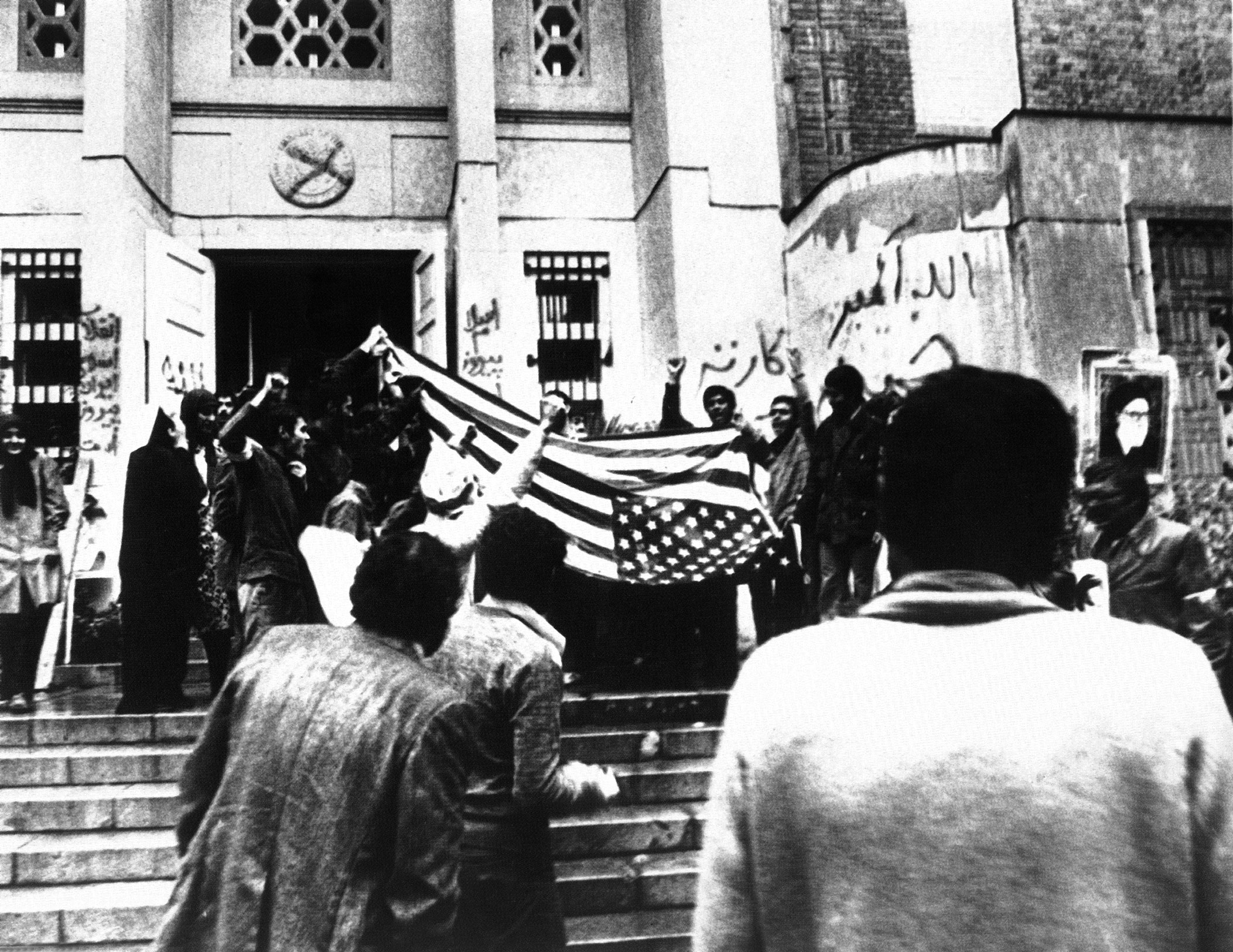

The 1979 Iranian Revolution was a watershed moment in the history of the 20th Century. In a matter of months it overthrew the Western-backed Pahlavi monarchy and installed a theocratic state. Its impact was felt far beyond Iran’s borders. It altered Cold War alignments (ending Iran’s role as a U.S. ally in the Gulf) and touched off a new oil crisis, amplifying fears of energy shortage worldwide . It gave a potent new voice to political Islam. As scholar Mehrzad notes, the revolution lent “an Islamic flavor to the anti-imperialist, anti-American sentiment” in the Middle East . In effect, it empowered Islamist groups regionally: “Islamic groups could now begin to envision themselves as rulers, rather than merely the opposition” . Meanwhile, the fall of the Shah—a key U.S. partner—shocked the Cold War status quo. The Iranian regime’s anti-Western stance and alignment with militant Islam inspired anti-imperialist movements and realigned regional loyalties . In sum, the revolution’s global significance lay in combining oil-politics turmoil (it sparked a new oil shock ) with the rise of militant Islam and a sharp new anti-imperialist challenge to U.S. influence in the Middle East.
Background (1906–1953)
Iran’s revolutionary fervor had deep roots. In the early 20th century Iran underwent its own Constitutional Revolution (1906–11). Urban merchants (the bazaar), intellectuals, and even some Shi‘a clerics (the ulama) rose up against arbitrary Qajar rule, demanding a constitution and parliament. As one study observes, the Constitutional Revolution “involved merchants, traders, intellectuals, and urban masses,” even powerful clergy and landlords, making it look like “the church and the feudal-aristocratic class” leading a bourgeois-democratic revolt . The 1906 movement won a constitution and Majles (parliament), but its reforms were repeatedly undermined by foreign meddling (from Russia and Britain) and royal intransigence.
Iran’s next major phase came with the Pahlavi dynasty. In 1921 Reza Khan seized power in a British-backed coup; by 1925 he founded the Pahlavi monarchy as Reza Shah . Reza Shah aggressively modernized: he built railroads, secular schools, and a centralized state. But he also autocraticly suppressed opposition. His regime, and that of his son Mohammad Reza Pahlavi after 1941, maintained close ties with Britain and the United States. Crucially, the Pahlavis secured full foreign control over Iran’s oil. After oil was discovered at Masjed-Soleyman in 1908, the British-backed D’Arcy Concession became the Anglo-Persian Oil Company (later Anglo-Iranian, now British Petroleum). Iran’s government had virtually no share of the profits . Reza Shah tried in 1933 to renegotiate the oil deal, but succeeded only in concessions that still favored Britain .
During World War II, the Allies ousted Reza Shah (1941) and installed his son, Mohammad Reza Shah. Postwar Iran saw growing nationalist pressure to reclaim oil control. In 1951, the nationalist Prime Minister Mohammad Mossadegh (with support from the National Front and popular cleric Ayatollah Kashani) nationalized the oil industry, ending the Anglo-Iranian Oil Company’s monopoly . This move infuriated the UK and alarmed the U.S. In 1953, British and American intelligence agencies orchestrated a coup that toppled Mossadegh and reinstated the Shah’s absolute power . As the British-supported Tehran Times recounts, “the Shah…could not stand the nationalization of the oil industry and the democratically-elected Mossadegh. For that, they overthrew his government in the 1953 coup d’état orchestrated by the intelligence agencies of the United Kingdom (MI6) and the United States (CIA)” . The aftermath was a new oil consortium favoring Western companies and a Shah firmly allied with the West. But the coup also sowed bitterness and suspicion of foreign interference among Iranians—sentiments that would be harnessed decades later.
The White RevolutionWhite Revolution Full Description:The White Revolution was a project of authoritarian modernization. It sought to break the power of traditional landlords through land redistribution and to rapidly industrialize the economy. It was billed as a bloodless (“white”) revolution to prevent a communist (“red”) one. Critical Perspective:Despite lofty goals, the reforms destabilized the social order. The land reforms often failed to provide peasants with enough resources to farm effectively, driving millions into urban slums where they became foot soldiers for the revolution. Furthermore, the rapid secularization alienated the powerful merchant class (Bazaaris) and the clergy, creating a united front of opposition against the Shah. (1963–1977)
By the 1960s the Shah had consolidated power and launched an ambitious modernization campaign known as the White Revolution (1963–1979). Through referendum, the Shah enacted sweeping reforms: land redistribution to peasant farmers, profit-sharing in industry, enfranchisement of women, and expansion of education and rural health via literacy and health corps . The Shah’s government poured oil revenues into new factories, highways and towns, and tens of thousands of young volunteers taught literacy in the countryside. The program indeed boosted Iran’s economy: per-capita income “skyrocketed” and development projects mushroomed, funded largely by a boom in oil income . In terms of raw growth the Shah’s reforms were a success.
Yet the White Revolution had major social costs. The land reforms alone gave titles to some 2.5 million peasant families , but the government failed to provide adequate credit or infrastructure for so many new farmers. Many of the redistributed farms later failed, and millions of rural people migrated to Tehran and other cities seeking jobs . The disintegration of the traditional extended family support network left migrants socially isolated in slums . Moreover, the reforms hit Iran’s traditional elites. Large landowners and waqf (religious trust) holders lost their property and influence. Importantly, the Shah’s secularizing changes alienated the Shi‘a clergy. He enfranchised women, raised marriage and inheritance rights, and further weakened religious courts. Many Shi‘a leaders protested that these “liberalization” laws (especially on women’s rights) violated Islamic norms . In effect, the White Revolution “chipped away at the traditional bases of clerical power” : secular courts replaced religious courts, and secular education broke the ulama’s monopoly on learning. One result was the rise of Ayatollah Ruhollah Khomeini. Khomeini condemned the reforms as un-Islamic, famously calling the Shah “Britain’s monkey” and accusing him of irreligion and oppression. His radio sermons and publications (smuggled from exile) fused anti-Shah politics with Islamic themes. In time he became the most notable clerical opponent of the Shah’s program .
In sum, the White Revolution modernized Iran’s economy and society but unevenly. It disrupted rural life, widened social gaps, and wounded vested interests. Clerical critics (led by Khomeini) railed against it, while growing urban dissidents (students, leftist intellectuals and merchants) began to question the regime’s legitimacy in other ways. By the 1970s the stage was set: beneath rapid modern growth lay deep dissatisfaction among peasants, workers, and the middle class.
Opposition Movements
By the late 1970s an unusually broad coalition of opposition had formed. This “rainbow” of groups was united mainly by hatred of the Shah, even as they pursued different visions for Iran’s future. Key factions included:
Shi‘a Clergy: Religious leaders formed the core of Ayatollah Khomeini’s network. Many middle-ranking clerics and seminaries were radicalized by resentment of the Shah’s secularization and US influence. Clerics in Qom, Najaf, and among the bazaar (merchant) communities increasingly aligned behind Khomeini’s message. Khomeini himself became the charismatic leader invoking Shi‘a history and anti-imperialism. Even secular intellectuals were “fascinated by the populist appeal” of Khomeini and joined the ulama in calling for the Shah’s ouster .
Leftist Guerrillas and Intellectuals: A number of Marxist and socialist groups mobilized particularly young Iranians. The Marxist-Leninist Fadaiyan-e Khalq (“People’s Sacrificers”) and the Islamic-socialist Mojahedin-e Khalq (MEK) had roots in student and worker movements. By 1978 these clandestine guerrilla groups had built followings, especially after the Shah’s security crackdown eased. As one analysis notes, the Fedayeen and Mujahedin “have been able to win a wide following among young people” even though their core cadres were small . The secular Tudeh Party (communist) also re-emerged publicly, and parties from the National Front (the 1950s nationalist coalition) resumed activity. Leftists spearheaded labor strikes, student protests, and armed actions against regime targets in 1978–79.
Students and Intellectuals: University students and liberal professionals played a major role in protests. Tehran and Shiraz University students organized demonstrations, and writers and lawyers issued public “open letters” and manifestos against the Shah. For the first time in decades many secular thinkers turned to Khomeini as a unifying figure . Even women’s groups, ethnic minorities, and mid-level military officers joined the unrest to varying degrees.
Bazaar Merchants: Iran’s bazaaris (traditional merchants and guild-owners) were a crucial social bloc. Historically allied with the clergy, the bazaar community in 1978 used its economic leverage to support protests—shutting shops during strikes and funding clergy-led rallies. According to one study, “the bazaar community played a pivotal role in facilitating the clerics’ ascent to power” in 1979 . Their financing and organization helped link economic discontent to the religious campaign against the Shah.
Together, these forces (clerical, leftist, nationalist, and popular) formed a heterogeneous opposition. Each had distinct goals: clerics wanted an Islamic state, leftists wanted social justice or socialism, nationalists wanted democracy and independence. But under the pressure of late-1978 events, they converged in overthrowing the regime. Ayatollah Khomeini’s movement ultimately prevailed, but only with the earlier, broader mobilization of workers, students, and merchants behind it .
The 1977–1979 Crisis
The final crisis erupted in 1978 after years of simmering discontent. A severe economic downturn helped spark outrage: the Shah’s rapid expansion had been financed by oil, but the mid-1970s saw volatile oil prices and extravagant government spending. By the late 1970s inflation was high and real wages stagnated . According to Britannica, “a decade of extraordinary economic growth, heavy government spending, and a boom in oil prices led to high rates of inflation and the stagnation of Iranians’ buying power and standard of living” . Meanwhile, the Shah’s autocracy had no political outlets; censorship and secret police (SAVAK) stifled dissent. Opposition parties were banned, and critics were routinely harassed or jailed .
Into this climate came an international factor: U.S. President Jimmy Carter made human rights a centerpiece of policy. In 1977–78 Carter pushed the Shah to liberalize, and his administration delayed some arms shipments, angering the regime. Although Carter ultimately tried to shore up the Shah (notably during Carter’s December 1977 Iran visit), the mixed signals emboldened Iranian dissidents. Domestically, any spark could ignite widespread protest: in January 1978 a provocative newspaper article against Khomeini triggered riots in Qom and Tabriz; in August 1978 the death of a cleric on trial in Shiraz sparked citywide fury. By late summer the unrest had spread to many cities with recurrent cycles of protest and mourning rituals.
Black Friday (8 September 1978): The turning point came that month. On 8 September 1978 thousands of demonstrators gathered in Tehran’s Jaleh (Meydan-e-Jaleh) Square for Ashura memorial rituals. The Shah’s regime, having declared martial law, ordered troops to fire on the crowd. In the ensuing massacre dozens of people were killed (estimates range from 64 up to over 100 dead) and hundreds wounded . It is widely remembered as Black Friday. The shootings “ended any ‘hope for compromise’” between the Shah and protesters : instead of cowing the opposition, the killings galvanized it. Mourning ceremonies that followed drew even larger crowds, demanding the Shah’s removal.
In late 1978 and early 1979, strikes and mass demonstrations paralyzed Iran’s infrastructure. Oil workers walked out (in November 1978, a refinery strike cut Iran’s production from 6 million barrels/day), crippling exports. Universities emptied, bazaars stayed shut, and even parts of the army began to waver. The Shah, facing unprecedented upheaval, flew abroad for medical treatment in January 1979. Shapour Bakhtiar, a nationalist politician from the banned National Front, was appointed Prime Minister in a last-ditch attempt to stabilize the government. But the Bakhtiar government could not regain control. Massive protests continued, chants against the Shah filled the streets, and the momentum of 1978 carried straight into 1979.
Collapse of the Monarchy
By early 1979 the Shah’s reign was unsustainable. Under siege at home and with his health failing, he and his family left Iran on January 16, 1979 . As he departed for exile (ostensibly to Egypt), the Shah told Prime Minister Bakhtiar, “I give Iran into your care” . In practice, this meant Bakhtiar was left with a country on the verge of revolution.
Meanwhile Ayatollah Khomeini had been signaling his return. He flew into Tehran on 1 February 1979 to an enormous welcome. Millions lined the streets in a jubilant greeting estimated at around three million people . Khomeini’s authority now eclipsed Bakhtiar’s. Within days Khomeini called for the overthrow of the remaining royal institutions. On February 10 Bakhtiar declared martial law nationwide, but Khomeini urged Iranians to disregard it and continue the uprising .
The final blow came almost immediately. On February 11, elements of the military and police declared neutrality in the conflict, refusing orders to shoot at protesters . Revolutionary forces and civilians flooded the streets. With most of the country in open revolt, the Pahlavi regime simply collapsed. President Bakhtiar fled Iran (later assassinated in exile), and by the end of the day “any remnants of the Shah’s government” had vanished . Iran was now in a revolutionary void — one which Khomeini and his allies would soon fill.
Establishment of the Islamic RepublicIslamic Republic
Short Description (Excerpt):The unique form of government established after the revolution. It is a hybrid system combining elements of a modern parliamentary democracy (elections, president, parliament) with a theocratic guardianship (Supreme Leader, Guardian Council).
Full Description:The Islamic Republic was the outcome of the referendum in 1979. While it has the trappings of a republic, ultimate power resides with the unelected religious leadership. The constitution explicitly subordinates the will of the people to the principles of Islam as interpreted by the Supreme Leader.
Critical Perspective:This dual structure creates a permanent institutional conflict. The tension between the “republican” mandate (popular sovereignty) and the “Islamic” mandate (divine sovereignty) results in a system where elected officials are often powerless to implement change if it contradicts the interests of the clerical elite. It represents an experiment in “religious democracy” that critics argue is inherently contradictory.
Read more
With the monarchy gone, Iranians rapidly moved to define the new order. In March 1979 an Islamic Republic referendum was held: voters were asked simply to approve (or reject) the creation of an Islamic Republic. The result was essentially unanimous: official returns reported that 98% of voters said “Yes” to Iran becoming an Islamic Republic . (In practice many secular moderates and leftists boycotted the vote, but the outcome was never in doubt.)
The referendum conferred formal legitimacy on Khomeini’s vision. A new constitution was drafted over the summer of 1979 and overwhelmingly ratified in a second referendum in December. This Islamic Constitution abolished the 1906 parliamentary system and enshrined Velayat-e FaqihVelayat-e Faqih Full Description:Velayat-e Faqih represents a revolutionary reinterpretation of Shia theology. Traditionally, Shia clergy remained aloof from direct political rule. This doctrine, however, argued that religious law (Sharia) should be the law of the land, and therefore, those who know the law best (the jurists) must rule the state. Critical Perspective:This theory transformed a diverse, multi-ideological revolution into a theocratic state. It provided the legal justification for concentrating absolute power in the hands of a Supreme Leader, effectively replacing a hereditary monarchy with a clerical oligarchy. Critics argue it conflates spiritual guidance with political coercion, making dissent against the government equivalent to heresy against God. (Guardianship of the Jurist) as its core principle. Under this system, ultimate political authority rested with a supreme clerical figure. Ruhollah Khomeini became the first Supreme Leader, wielding vast power over the executive, legislature, and judiciary. Other religious bodies were created: for example, a Guardian Council of jurists would vet legislation for compliance with Islam. The Islamic Revolution thus institutionalized clerical rule in place of the former monarchy. (Notably, women were still enfranchised under the new system, and modern state institutions were mostly retained – but now under clerical supervision.)
The new regime also moved quickly to safeguard itself. In April 1979 Khomeini founded the Islamic Revolutionary Guard Corps (IRGC) . Originally a collection of volunteer militias and revolutionaries, the IRGC was formalized to protect the revolution. As Britannica notes, Khomeini created the IRGC “to unify and organize paramilitary forces… that had arisen during the turmoil and were committed to the revolution,” serving as a counterweight to the old army . In practice the IRGC would become a parallel military and security organ answerable only to the Supreme Leader, and it would play a crucial role throughout the Iran–Iraq War and in internal politics.
Equally, the new government eliminated potential opposition. In late 1979 and into 1980 thousands of opponents — leftists, secular nationalists, liberal clerics and others — were rounded up. New Revolutionary Courts tried alleged “enemies of God,” leading to mass imprisonments and executions (for example, the 1980–81 wave of executions of Fedayeen, communists, and MEK members). By the end of 1979, the Islamic Republic was firmly in place: Iran had been transformed from a pro-Western monarchy into a Shi‘a theocracyTheocracy Full Description:Theocracy represents the absolute fusion of religious and political hierarchies. In this system, there is no separation between the laws of the state and the laws of God. Civil legal codes are often replaced or heavily informed by scripture, and the administration of the state is carried out by the clergy. Legitimacy is not earned through elections or inheritance, but through the interpretation of divine will. Critical Perspective:Critically, theocracies fundamentally alter the nature of political dissent. By equating the will of the state with the will of God, any opposition to the government is framed not as legitimate political disagreement, but as blasphemy or heresy. This structure places the ruling elite above human accountability, often justifying authoritarian control over the private lives, morality, and bodies of citizens under the guise of spiritual salvation..
Aftermath and Legacy
The aftermath of the revolution was immediately dramatic. In November 1979 militant student followers of Khomeini seized the U.S. Embassy in Tehran, taking 52 Americans hostage. The Hostage Crisis dragged on 444 days (until January 1981) and became a defining event. In the United States it caused a wave of national outrage and put President Carter on the defensive . As one retrospective notes, the crisis “would take down President Jimmy Carter and make Americans aware” of Iran and the broader Middle East in new ways . It also ensured that US–Iran relations would be broken and bitter for decades.
Regionally, the revolution reshaped the Gulf and beyond. In September 1980 Saddam Hussein of Iraq, fearing Iran’s revolutionary example and seizing on Iran’s internal disorder, invaded Iran. The resulting Iran–Iraq War (1980–1988) was brutal and costly, claiming perhaps a million lives. The war forged a deep enmity between Iran and Saddam’s Iraq, but it also had lasting strategic effects. According to one analysis, it gave Iran experience in organizing international proxies and mobilizing Shia communities. “In the decades since,” notes commentator Ranj Alaaldin, Iran has “developed a marked capacity to mobilize Shiite communities across the region, penetrating… previously impervious… spaces” — in Iraq, Syria, Lebanon and Yemen . During the war Iran secretly built ties with Iraqi Shiite groups and later supported Shia militias in Lebanon (creating Hezbollah in 1982) and beyond. The conflict, in effect, expanded Iran’s influence by sowing the seeds of a regional Shi‘a network and an enduring Iran–Gulf Arab rivalry .
In geopolitical terms, the Iranian Revolution signaled an era of U.S. disengagement and new alignments in the Middle East. It also inspired Islamist movements elsewhere. Khomeini’s fusion of religion and revolution influenced Sunni Islamists to look toward politics, just as it emboldened Shi‘a activists. The region’s Sunni–Shi‘a divide widened. Meanwhile, oil politics were never the same: Iran ceased to coordinate with other OPEC producers and became a U.S. foe. For anti-colonial and anti-imperialist militants around the world, Iran became a symbol. In short, the fall of the Shah reshaped Iran internally and reshuffled the entire Middle Eastern political order.
Historiography
Scholars have long debated why and how the revolution happened. Different historians emphasize different forces:
Nikki R. Keddie (a pioneering scholar of modern Iran) sees the revolution as rooted in complex social tensions and ideas. Keddie rejects simple stereotypes of Iran as “medieval,” instead showing how Shi‘a Islam interwove with class and politics. She stresses the role of intellectual and popular movements from the 1906 Constitutional era through the Pahlavi reforms . In her view, revolutionary events were driven by a mix of social grievances (landlords, bazaaris, women, workers) and ideological ferment. As one reviewer notes, Keddie “interweaves names of personalities and events with attendant social forces,” illuminating how Islamic and secular ideas combined to challenge the Shah .
Ervand Abrahamian takes a class- and conflict-oriented approach. In works like Iran Between Two Revolutions, he portrays 1979 as the outcome of popular unrest fueled by inequality. He argues that each social class had its own complaints (for example, teachers faced economic hardship, bazaar merchants opposed state control, clerics wanted sharia) . Abrahamian points out that opposition was fragmented but united in its anti-monarchy stand. He shows how historical events (like the 1953 coup) continued to shape grievances. Abrahamian views the revolution as a mass movement where leftists, clergy, and others converged — although in the end it was Khomeini’s faction, not the left, that prevailed. (In an interview he notes that working-class Fedayeen and intellectual critics played significant roles before 1978, even if Islamists stole the limelight at the climax .)
Said Amir Arjomand emphasizes ideology and world-system factors. He compares Iran’s upheaval to the “great revolutions” of history, noting the unplanned nature of its rise. Arjomand highlights the role of Shi‘i tradition and communal solidarity as reactive forces, and he finds the velayat-e faqih doctrine as central . He also locates the revolution in a global context: Iran’s Islamist ideology drew on Western revolutionary ideas, even as it responded to Iran’s place in the capitalist world system . Arjomand thus bridges structural and ideological views. He finds fault with purely Marxist accounts for ignoring religion and culture, and he shows that the Iranian uprising was shaped by both religious identity and modern state collapse .
Hamid Dabashi focuses on ideology and intellectual history. In works like Theology and Discontent, he stresses how Islamic ideas mobilized the masses. Dabashi famously argued that Islamic ideology was the “crucial mobilizing force” behind the mass demonstrations . He portrays the revolutionary leadership as primarily motivated by the goal of an Islamic order under clerics. His emphasis is on the power of Khomeinist doctrine and Shia symbolism. Critics of Dabashi point out that he relies heavily on official accounts and does not fully account for socio-economic grievances . Nevertheless, Dabashi’s view highlights that the revolution cannot be understood without attending to its religious discourse.
Fred Halliday (writing in 1979–80) offered a secular, Marxist-influenced analysis before the revolution triumphed. Halliday’s Iran: Dictatorship and Development examined Iran’s class structure and allied underdevelopment. He correctly diagnosed the Shah’s social and economic problems from 1953 onward, but he underestimated the ideological force of religion. Halliday himself later noted that in late 1978, few analysts (including him) foresaw Khomeini’s movement as the leading force . Halliday focused on economic stagnation and class tensions, arguing that the shah’s rapid growth policies were unsustainable. In effect, Halliday gave a powerful pre-revolution snapshot of Iran’s ills — but, written on the eve of 1979, it had only a limited view of the coming religious upsurge .
These scholarship strands show that the Iranian Revolution has been seen through multiple lenses: as a social revolution, an ideological revolt, a coup with Western involvement, and a religious awakening. Together they underscore the event’s complexity.
Conclusion
In just over a year, Iran’s 1979 Revolution transformed a traditional, pro-Western monarchy into an assertive Islamic republic. It shattered old alignments and planted new ones. For Iran, it meant the mobilization of Shi‘a identity and the halting of secularization – a return to a more conservative social order in many ways, even as modernization continued under new leaders. Globally, it altered U.S.–Middle East relations (for decades to come, Iran was outside the American sphere), gave oil politics a volatile shock, and demonstrated that a religious-populist movement could overthrow a major power-backed regime.
The revolution’s legacy endures. It inspired Islamist movements (both Sunni and Shi‘a) worldwide, and it colored later events—from Lebanon’s Hezbollah to Iraq’s post-Saddam Shi‘a politics. It stands as a reminder that economic growth alone does not guarantee political stability, and that ideological forces—religious, nationalist, or otherwise—can reshape societies. Today’s debates about political Islam, U.S. influence in the Middle East, and class conflict in developing states all bear the imprint of Iran 1979. In these ways, the Iranian Revolution bridges past and future, continuing to influence how people around the world think about revolution and power.

Leave a Reply