-

The Democratic People’s Republic of Korea (DPRK) shocked the world in October 2006 with its first nuclear test, announcing itself as a new nuclear-armed state. In the years since, Pyongyang has conducted a series of increasingly powerful underground tests (2006, 2009, 2013, January 2016, September 2016, and September 2017) while also developing long-range ballistic missiles . Each test drew international condemnation and tougher UN sanctions, but North Korea persisted. Regional media – for example, South Korean news – prominently covered these events (see below) as Seoul felt directly threatened. According to seismic data, the first test in 2006 yielded under…
-
The Sunshine PolicySunshine Policy Full Description:The foreign policy of South Korea towards North Korea from 1998 to 2008. Initiated by President Kim Dae-jung, it emphasized cooperation, economic aid, and engagement rather than containment, hoping to soften the North’s regime through contact. The Sunshine Policy was based on the fable of Aesop (where the sun, not the wind, forces the traveler to remove his coat). It led to historic summits, family reunions, and joint economic projects like the Kaesong Industrial Complex. The goal was to separate politics from economics, believing that economic interdependence would make war impossible. Critical Perspective:While it temporarily lowered tensions,…
-
Introduction: Two Koreas, Two Identities The 1953 armistice halted the Korean War’s open conflict but cemented the peninsula’s division into two rival states. In the decades since, North Korea (the Democratic People’s Republic of Korea) and South Korea (the Republic of Korea) have each pursued aggressive nation-building projects to shore up their legitimacy. These efforts were rooted in starkly different political ideologies – the North’s doctrine of Juche (self-reliance) versus the South’s early ethos of anti-communist nationalism – and were carried out through comprehensive propaganda, education programs, media control, monument-building, and state rituals. This article explores how each regime constructed…
-

South Korea’s postwar transformation – famously dubbed the “Miracle on the Han River” – is one of the 20th century’s most dramatic development stories. Between the end of the Korean War in 1953 and the dawn of the 1990s, South Korea vaulted from war-torn poverty to newly industrialized prosperity. This rapid economic rise was accompanied by sweeping modernization and eventually, profound political change. How did South Korea go from ruins to riches in under four decades? This article explores the foundations laid in the 1950s under Syngman Rhee, the state-driven industrial boom under Park Chung-hee, the crucial roles of U.S.…
-
Introduction: A victory of survival When the guns fell silent along the Imjin and the Yalu in July 1953, the Democratic People’s Republic of Korea (DPRK) had survived—but only just. The Korean War had levelled cities, annihilated industrial plant, uprooted millions, and killed perhaps a tenth of the peninsula’s population. From that near-ruin, Kim Il-sung and the Workers’ Party of Korea (WPK) set out to rebuild a socialist state that would be more centralized, more militarized, and more ideologically disciplined than before the war. Between the armistice and the end of the 1970s, North Korea constructed an all-encompassing party-security apparatus;…
-
Introduction The armistice signed on July 27, 1953 halted the Korean War’s open hostilities but cemented a division of the peninsula that persists to this day . In the aftermath, North and South Korea embarked on starkly divergent trajectories – politically, economically, and socially – yet their fates remained deeply intertwined. Over the ensuing decades, the Democratic People’s Republic of Korea (North Korea) and the Republic of Korea (South Korea) pursued parallel paths shaped by Cold War rivalry, internal transformations, intermittent diplomatic engagement, and recurring military tensions. This article explores the post-1953 history of the two Koreas, tracing how each…
-
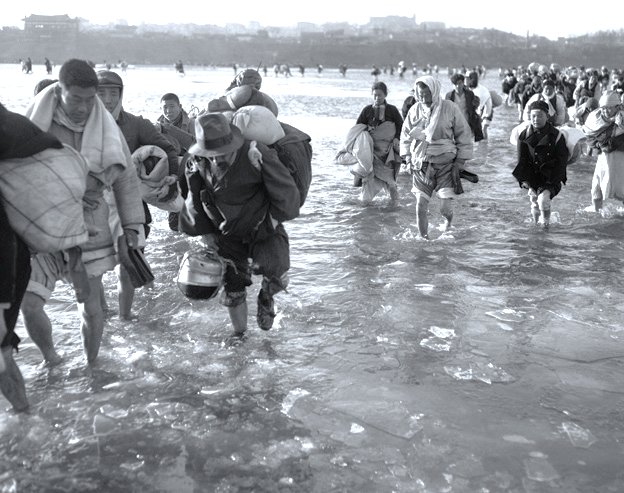
On October 19, 1950, units of the Chinese People’s Volunteer Army (PVA) quietly crossed the Yalu (Amnok) River into North Korea, dramatically altering the course of the Korean War. Only a year after its founding in 1949, the People’s Republic of ChinaRepublic of China Full Description:The state established on January 1, 1912, succeeding the Qing Dynasty. It was the first republic in Asia, but its early years were plagued by political instability, the betrayal of democratic norms by Yuan Shikai, and fragmentation into warlordism. The Republic of China was envisioned by Sun Yat-sen as a modern, democratic nation-state. It adopted a five-colored…
-
By September 1950, the Korean War appeared to be nearing a grim conclusion. The United Nations forces and the South Korean army were cornered in the Pusan PerimeterPusan Perimeter Full Description:A large-scale battle between United Nations Command and North Korean forces in 1950. It was the furthest advance of the North Korean troops and the final defensive line held by the South, preventing the total conquest of the peninsula. The Pusan Perimeter was a small pocket of land in the southeast corner of Korea. For weeks, US and South Korean troops fought a desperate defensive action to hold the port of Pusan,…
-
The dawn of June 25, 1950, was deceptively quiet along the 38th parallel38th Parallel Full Description: An arbitrary latitude line chosen by American and Soviet officials to divide the Korean peninsula into two occupation zones. It sliced through natural geography, administrative districts, and ancient communities, creating an artificial border that remains one of the most militarized frontiers in the world. The 38th Parallel represents the imposition of Cold War geopolitics upon a unified nation. Following the liberation of Korea from Japanese colonial rule, the country was not granted immediate independence but was partitioned by foreign powers without consulting the Korean people. Two…
-
When the Korean War erupted on 25 June 1950, few could have foreseen just how rapidly events would spiral. In barely a few months, the North Korean People’s Army (KPA) would drive deep into the south, consigning most of the Republic of Korea (ROK) to collapse, and forcing United Nations (UN) and South Korean forces into a barely tenable defensive “beachhead” in the southeast. This article examines that first phase in detail — how North Korea planned and executed its lightning offensive, why the South Korean military disintegrated so swiftly, how UN/ROK forces clung on at the Pusan PerimeterPusan Perimeter…