The Ba’ath Party that came to power in March 1963 was not a single coherent organisation with a unified programme. It was a coalition of military officers and civilian ideologues, of pan-Arab nationalists and social radicals, united by a common rhetoric of Arab renaissance and a shared detestation of the old order. The seven years between the March Revolution and Hafez al-Assad’s seizure of control in November 1970 were years of escalating internal violence, radical policy experiments, catastrophic military defeat, and the progressive hollowing out of the party’s ideological content until only the shell remained, filled with the personal ambitions of competing officers. It is one of the most instructive case studies in the pathology of post-colonial revolutionary politics.
What Ba’athism Actually Was
The party’s founding ideology, developed primarily by Michel Aflaq — a Syrian Christian intellectual influenced by both German Romanticism and French socialist thought — rested on three interlocking concepts: unity, freedom and socialism. Unity meant the political unification of the Arab nation, understood not as a collection of sovereign states but as a single people artificially divided by imperialism. Freedom meant liberation from foreign domination and the internal tyrannies of class and religious conservatism. Socialism meant state-led economic development, land reform, nationalisation of key industries, and the subordination of private interests to the national will. Aflaq’s Ba’athism was explicitly secular — in a region where political identity was deeply bound up with religious community, the Ba’ath proposed a nationalism that transcended sect. A Christian Arab and a Muslim Arab were equally members of the Arab nation, equally entitled to shape its destiny. This made the party so attractive to members of religious minorities: for Alawites, Druze and Christians, secular pan-Arab nationalism offered full membership of the national community without requiring subordination to the Sunni Arab establishment. The disproportionate representation of these communities in the Ba’ath’s military networks was not accidental but a structural consequence of this ideological appeal.
The fundamental tension within Ba’athism was between the civilian intellectuals who had the ideology, and the military officers who had the guns. In opposition, each needed the other. In power, the relationship rapidly became competition and eventually violent conflict.
The Military Committee and the Alawite Ascendancy
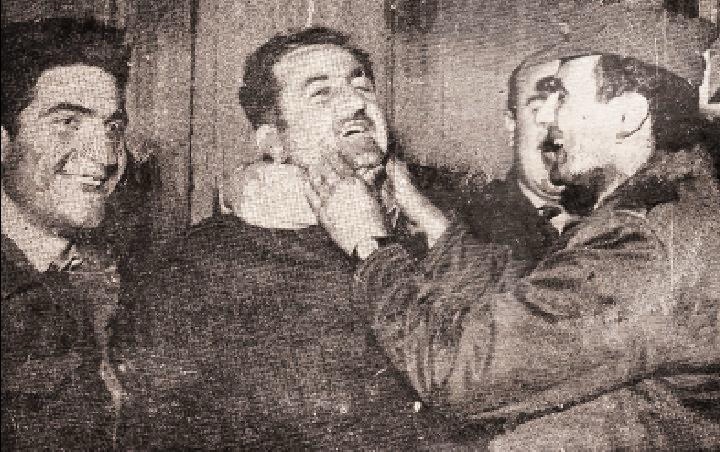
The key organisation within the Ba’ath military was the Military Committee, a clandestine body founded during the UAR period. Its core members — Hafez al-Assad, Salah Jadid, Muhammad Umran (the latter two pictured above) — were all Alawites. This was not a conspiracy of minorities against the Sunni majority; they identified primarily as Ba’athists and Arab nationalists. But the sectarian composition reflected a structural reality: Alawites were heavily over-represented in the lower and middle ranks of the Syrian army, a legacy of the French Mandate’s differential military recruitment that had funnelled minority communities into the troupes spéciales du Levant.
After March 1963, the Military Committee moved quickly to consolidate control. Hundreds of officers from Sunni backgrounds or with loyalties to rival political tendencies were retired, transferred, or purged. Their replacements were drawn overwhelmingly from Committee networks — disproportionately Alawite, disproportionately rural, disproportionately loyal to the specific officers who had shaped their careers. Within eighteen months, the Syrian army was being transformed from an institution with diverse political loyalties into a party army in which Alawite officer networks held structural dominance. The civilian Ba’ath leadership watched this process with alarm, but were powerless to stop it. The conflict came to a head in February 1966, when a coup within the party led by Salah Jadid and supported by Assad expelled Aflaq and Bitar from Syria. The founder of Ba’athism died in exile in Baghdad — welcomed by the Iraqi Ba’ath, the Syrian party’s ideological rival.
Radical Ba’athism and the Transformation of Syria, 1966–1970
The Jadid regime was more radical and more ideologically coherent than its predecessor. A land reform programme redistributed large estates, breaking the power of the old landowning class. Industry was nationalised broadly. Education expanded dramatically, particularly in rural areas. The state invested in infrastructure — roads, irrigation, electrification — that reached communities previous governments had largely ignored. For rural and minority Syrians, Ba’athist rule in the 1960s was associated with genuine material improvement and a real dismantling of old hierarchies. This was not nothing: the social transformation created a new Syrian middle class and a new officer corps whose interests and loyalties were structurally different from those of the urban establishments they had displaced.
But the economic radicalisation created powerful enemies. The merchant and business classes of Damascus and Aleppo — establishments that had dominated Syrian commerce for centuries — were targeted by nationalisation decrees and squeezed by state controls. Many fled to Lebanon or Saudi Arabia, taking capital and skills with them. The regime’s response to economic difficulty was to intensify state control, which created more capital flight, which created more difficulty: a destructive cycle that impoverished the private sector without producing a state sector capable of replacing it.
The Road to June 1967
While the domestic economy deteriorated, Ba’athist foreign policy was heading toward catastrophe. The Jadid regime’s support for Palestinian guerrilla operations against Israel was driven by a combination of ideological commitment and domestic political calculation — confronting Israel was the primary currency of Arab nationalist legitimacy. The result was an escalating spiral of cross-border raids, Israeli retaliatory strikes, and Syrian counter-escalation that brought the region to open war in June 1967.
The June War was the defining catastrophe of Arab nationalism. In six days, Israel destroyed the Egyptian, Jordanian and Syrian air forces and overran the Sinai, the West Bank, Gaza and the Golan Heights. Syria lost the Golan in the final two days, after Israeli forces breached Syrian defensive lines and advanced toward Damascus. The loss of this strategically vital plateau — which provided defensive depth and the ability to threaten the Israeli north — was a military humiliation from which the regime’s legitimacy did not recover. The Ba’ath had built its legitimacy partly on its confrontational posture toward Israel, its claim to be the vanguard of Arab resistance. That posture had produced not liberation but the permanent loss of Syrian territory. The gap between Ba’athist rhetoric and reality was impossible to bridge.
The Assad-Jadid Struggle and the Corrective Movement
The 1967 defeat deepened the conflict between Jadid and Assad. Jadid, doubling down on ideological radicalism, argued for a long-term people’s war against Israel modelled on Vietnam and Cuba. Assad, whose air force had been annihilated in the first hours of the June War, drew the opposite conclusion: Syria needed to rebuild a professional, conventionally capable military before any confrontation with Israel could be seriously contemplated. He was also drawing pragmatic conclusions about ideology and power — that doctrinal radicalism was alienating the business and religious communities whose acquiescence was necessary for stable governance.
The conflict came to a decisive head during Black September in 1970, when Jordan’s King Hussein moved to crush the PLO’s armed presence in his kingdom. Jadid ordered the Syrian army to intervene in support of the Palestinians. Assad, as minister of defence and commander of the air force, refused to provide air cover for the Syrian tank column that crossed into Jordan. Without air support, the column was vulnerable and withdrew. The intervention failed; Jadid’s authority was fatally damaged. In November 1970, Assad moved — in what he called the Corrective Movement, carefully framed as a correction of Ba’ath errors rather than a coup. He arrested Jadid and the Jadid faction, dissolved the civilian party structures, and took personal control of the Syrian state. The coup was bloodless. Jadid spent the remaining twenty-three years of his life in Mezzeh prison in Damascus, dying there in 1993 — never tried, never released, never publicly acknowledged as a former leader of the state he had helped build.
What the Ba’ath Period Had Made
The Ba’ath period of 1963–1970 left Syria with a transformed social structure, a shattered military, and a political system in which institutional authority had been replaced by personal and factional networks. The land reform, nationalisation and educational expansion had genuinely redistributed opportunity downward, creating a new Syrian middle class and a new officer corps whose loyalties and interests were different from those of the urban establishments they had displaced. For a significant portion of the Syrian population, Ba’athism had delivered on at least some of its promises.
But the price had been enormous. The old commercial classes had been impoverished or driven into exile, taking capital and commercial networks with them. The political system had been stripped of institutional legitimacy — no meaningful elections, no independent judiciary, no free press, no civil society outside party control. The security services had been expanded and politicised. The army had been rebuilt around sectarian and personal loyalty rather than professional merit.
Most consequentially, the seven years of Ba’ath rule had produced Hafez al-Assad: a man who had watched at close quarters the failure of every previous Syrian political arrangement and had drawn cold, systematic conclusions about what it would actually take to hold power permanently. He would spend the next thirty years demonstrating that he had learned those lessons more thoroughly than anyone else.


Leave a Reply
