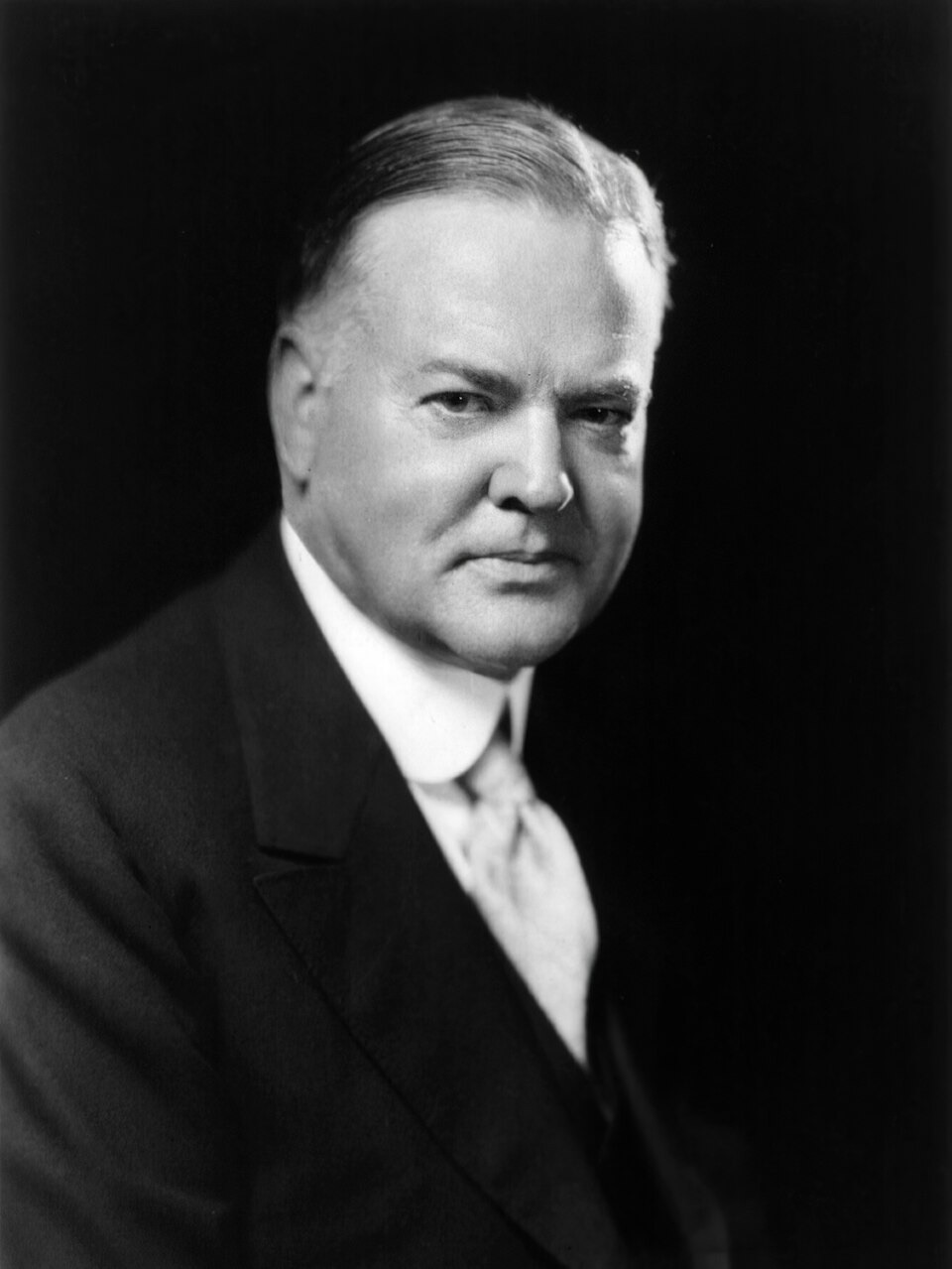

Herbert Hoover entered the White House in March 1929 with every reason for confidence. A self-made millionaire, renowned humanitarian, and skilled administrator, he embodied the American Dream. The New York Times had endorsed him as “a man of uncommon energy and executive ability.” The stock market was soaring, industry hummed, and the reigning wisdom held that prosperity had become permanent.
Twenty-one months later, Hoover was the most hated man in America. The homeless slept in shantytowns called “Hoovervilles.” Empty pockets turned inside out were “Hoover flags.” Newspapers used as blankets were “Hoover blankets.” The president who had promised “a chicken in every pot” presided over breadlines stretching block after block.
Hoover’s fall from grace was not merely personal tragedy. It revealed the bankruptcy of an entire philosophy of governance—a philosophy that placed its faith in voluntary cooperation, balanced budgets, and the self-correcting mechanisms of the market. When the Depression struck, Hoover responded within the intellectual horizons of his class and his era. Those horizons proved catastrophically narrow.
This article examines Hoover’s response to the Great Depression, from his initial optimism through his increasingly desperate interventions to his overwhelming defeat in 1932. Drawing on recent scholarship, we analyze why Hoover’s policies failed and what his failure reveals about the limits of capitalist governance in times of crisis. We argue that Hoover’s tragedy was not that he did nothing—he did a great deal—but that he could not transcend the assumptions of the system he served.
Hoover’s Philosophy
To understand Hoover’s failure, one must first understand who he was and what he believed. Hoover was not a doctrinaire conservative in the modern sense. He had built his reputation as a progressive reformer. As head of the Commission for Relief in Belgium during World War I, he had organized the feeding of millions. As Secretary of Commerce under Harding and Coolidge, he had championed industrial efficiency, public works planning, and government-business cooperation.
The Philosophy of Associationalism
Hoover’s worldview is best described as “associationalism”—the belief that government should guide and coordinate private efforts rather than impose solutions from above. In his vision, businesses, labor unions, and civic organizations would voluntarily cooperate to stabilize the economy, smooth out boom-and-bust cycles, and promote social harmony. Government’s role was to facilitate this cooperation, provide information and expertise, and step in only when voluntary efforts failed.
This philosophy reflected Hoover’s class position and his personal history. He had succeeded through talent and hard work, and he believed others could do the same. He had witnessed the horrors of state-imposed solutions in war-torn Europe, and he was determined to avoid anything resembling socialism. He trusted business leaders, with whom he had worked closely throughout his career, and distrusted politicians, whom he viewed as self-interested and incompetent.
Hoover expressed this philosophy clearly in a 1922 book, American Individualism:
“While we can list with pride the achievements of our American individualism, we must also constantly rediscover the problems that remain unsolved. We must devise solutions for them which do not destroy the fundamental initiative and creative energy of our people.”
For Hoover, the fundamental task was to solve social problems while preserving what he called “the American system”—private property, free enterprise, and limited government. He could not imagine that the system itself might be the problem.
The Election of 1928
When Hoover accepted the Republican nomination in 1928, he promised continued prosperity and gradual reform. “We in America today are nearer to the final triumph over poverty than ever before in the history of any land,” he declared. “The poorhouse is vanishing from among us.”
The election was a landslide. Hoover won 444 electoral votes to Democrat Al Smith’s 87, carrying forty states and winning 58 percent of the popular vote. Smith, a Catholic and an opponent of Prohibition, faced virulent prejudice, but Hoover’s victory also reflected genuine confidence in Republican prosperity. The Dow Jones Industrial Average had nearly quadrupled since 1921. Unemployment stood at 4 percent. The future seemed bright.
Less than eight months later, that future collapsed.
The Crash and Its Immediate Aftermath
The stock market crash of October 1929 presented Hoover with his first great test. His response revealed both his strengths and his limitations.
Initial Actions
Hoover moved quickly. Within weeks of the crash, he convened conferences of business leaders, labor representatives, and government officials at the White House. He extracted public pledges from industrialists to maintain wages and employment. He secured commitments from labor leaders to refrain from strikes. He accelerated federal public works projects and urged state and local governments to do the same.
These actions were unprecedented. No previous president had intervened so directly in the economy during a downturn. Hoover’s defenders would later argue, with some justice, that he did more than any predecessor to combat a depression. His philosophy of voluntary cooperation, whatever its ultimate limits, represented a genuine departure from nineteenth-century laissez-faire.
For a time, the strategy seemed to work. Through early 1930, employment held relatively steady. Wages did not fall precipitously. The economy showed signs of stabilizing. Hoover’s popularity remained high.
The Limits of Voluntarism
But voluntarism had inherent limits. Business leaders who pledged to maintain wages could not do so indefinitely in the face of collapsing demand. As consumers stopped buying, companies accumulated unsold inventories. By mid-1930, the pressure to cut costs—including labor costs—became irresistible. Layoffs mounted. Wage cuts followed.
Hoover had no answer for this dynamic. He could cajole and persuade, but he could not compel. His philosophy prevented him from imposing mandatory wage and price controls, which he viewed as socialism. He could not force businesses to hire workers they did not need. The voluntary cooperation on which he had staked everything proved fragile in the face of market pressures.
From a critical perspective, Hoover’s reliance on voluntarism reflected his fundamental commitment to capitalist class interests. He would ask business leaders to act responsibly, but he would not challenge their right to manage their enterprises as they saw fit. He would request cooperation, but he would not impose accountability. The system’s survival mattered more than any particular policy outcome.
The Escalation of Crisis, 1930–1931
By late 1930, it was clear that the downturn was not a normal recession. Unemployment reached 8.7 percent in 1930, then jumped to 15.9 percent in 1931. Bank failures, which had averaged about 500 per year in the 1920s, accelerated dramatically. In 1930 alone, 1,350 banks failed. The collapse of the Bank of the United States in December 1930, with $200 million in deposits, was the largest bank failure in American history to that point.
The Smoot-Hawley Tariff
In June 1930, Hoover signed the Smoot-Hawley Tariff ActSmoot-Hawley Tariff Act Full Description:A piece of US legislation that raised import duties to historically high levels in an attempt to protect domestic farmers and manufacturers. It is widely cited by economists as a disastrous policy error that triggered a global trade war. The Smoot-Hawley Tariff Act represents the height of economic nationalism. In a misguided effort to shield American jobs from foreign competition during the downturn, the US government taxed imported goods. This provoked immediate retaliatory tariffs from other nations, effectively shutting down the global trading system.
Critical Perspective:This act illustrates the danger of “beggar-thy-neighbour” policies—strategies that seek to improve a nation’s economic standing at the expense of its trading partners. Instead of protecting jobs, it destroyed the export markets that industries relied on. It serves as a historical lesson on how a lack of international cooperation and a retreat into isolationism can transform a recession into a global catastrophe.
Read more, which raised already high import duties on a range of agricultural and industrial goods by some 20 percent. The act was intended to help American farmers by raising prices of imported agricultural products, thereby increasing demand for domestic crops.
The legislation was a catastrophic error. Over 1,000 economists had petitioned Hoover to veto it, warning that it would provoke retaliation and shrink international trade. They were proved right. Foreign countries responded by raising their own tariffs, targeting American goods. Between 1929 and 1932, international trade fell by approximately 50 percent.
The tariff’s effects were compounded by the debt structure inherited from World War I. European nations owed billions to American banks, debts they could only repay by selling goods in American markets. When Smoot-Hawley closed those markets, European economies were pushed deeper into crisis, which in turn undermined their ability to repay American loans, which further destabilized American banks.
Smoot-Hawley exemplified capitalism’s tendency toward inter-imperialist rivalry in times of crisis. Unable to cooperate in managing the downturn, capitalist powers turned on one another, each seeking to protect its own market at the expense of others. The result was mutually assured destruction.
The ReconstructionReconstruction
Full Description:The period immediately following the Civil War (1865–1877) when the federal government attempted to integrate formerly enslaved people into society. Its premature end and the subsequent rollback of rights necessitated the Civil Rights Movement a century later. Reconstruction saw the passage of the 13th, 14th, and 15th Amendments and the election of Black politicians across the South. However, it ended with the withdrawal of federal troops and the rise of Jim Crow. The Civil Rights Movement is often described as the “Second Reconstruction,” an attempt to finish the work that was abandoned in 1877.
Critical Perspective:Understanding Reconstruction is essential to understanding the Civil Rights Movement. It provides the historical lesson that legal rights are fragile and temporary without federal enforcement. The “failure” of Reconstruction was not due to Black incapacity, but to a lack of national political will to defend Black rights against white violence—a dynamic that activists in the 1960s were determined not to repeat.
Read more Finance Corporation
By late 1931, even Hoover recognized that voluntarism was insufficient. In December, he proposed the creation of the Reconstruction Finance Corporation (RFC), a federal agency authorized to make emergency loans to banks, insurance companies, railroads, and other troubled institutions. The RFC began operations in February 1932 with $2 billion in capital—an enormous sum for the era.
The RFC was a significant departure from Hoover’s earlier philosophy. For the first time, the federal government was directly injecting capital into private enterprises. But the RFC’s design revealed Hoover’s continuing commitment to class interests. The agency lent to banks and corporations, not to individuals. It provided support to the institutions at the top of the economy, hoping that benefits would “trickle down” to ordinary people. When critics demanded direct relief for the unemployed, Hoover refused. “I am opposed to any direct or indirect government dole,” he declared.
The RFC stabilized some banks but could not stop the broader collapse. By late 1932, bank failures were accelerating again, and the agency’s resources were stretched thin. More fundamentally, the RFC treated symptoms rather than causes. It propped up existing institutions without addressing the underlying collapse of demand and purchasing power.
The Federal Reserve’s Contraction
Hoover also struggled with the Federal Reserve, which pursued policies that deepened the Depression. Throughout 1930 and 1931, the Fed raised interest rates and allowed the money supply to contract—the opposite of what the economy needed. The Fed’s priority was not domestic recovery but maintaining the gold standardGold Standard Full Description:The Gold Standard was the prevailing international financial architecture prior to the crisis. It required nations to hold gold reserves equivalent to the currency in circulation. While intended to provide stability and trust in trade, it acted as a “golden fetter” during the downturn. Critical Perspective:By tying the hands of policymakers, the Gold Standard turned a recession into a depression. It forced governments to implement austerity measures—cutting spending and raising interest rates—to protect their gold reserves, rather than helping the unemployed. It prioritized the assets of the wealthy creditors over the livelihoods of the working class, transmitting economic shockwaves globally as nations simultaneously contracted their money supplies.. When European central banks raised rates to protect their currencies, the Fed followed suit, attracting gold inflows but strangling American credit.
Hoover pressured the Fed to expand the money supply, but the regional Fed banks, dominated by private bankers, resisted. The Fed’s contractionary policy reflected its class character: central bankers prioritized financial stability and international obligations over domestic employment and production. Working people paid the price.
The Bonus Army
Perhaps no episode better captures Hoover’s tragedy than the Bonus Army confrontation of 1932. In May of that year, thousands of unemployed World War I veterans marched on Washington to demand early payment of a bonus they had been promised for 1945. They came from across the country—riding boxcars, hitchhiking, walking. By June, nearly 20,000 veterans and their families had established a sprawling encampment in Anacostia Flats.
The Veterans’ Demands
The veterans were not revolutionaries. They asked only for what they had been promised: a bonus for their wartime service. The bonus, originally authorized in 1924, was scheduled to be paid in 1945. With the Depression destroying their livelihoods, the veterans asked for immediate payment. They were, in the words of one observer, “the most orderly, law-abiding, and patriotic group of petitioners that ever came to Washington.”
Hoover refused to meet with them. He insisted that the government could not afford early payment and that special treatment for veterans would be unfair. More fundamentally, he feared that yielding to the Bonus Army would encourage further demands from other groups.
The Eviction
Throughout the summer, the veterans waited. Congress rejected their proposal. Most went home, but several thousand remained. In late July, Hoover ordered the encampment cleared. On July 28, police attempted to evict the veterans from several abandoned buildings near the Capitol. Fighting broke out, and two veterans were shot and killed.
Hoover then ordered the Army to intervene. General Douglas MacArthur, assisted by Major Dwight Eisenhower and Major George Patton, led cavalry, infantry, and six tanks across the Anacostia River. Soldiers with fixed bayonets and tear gas attacked the veterans and their families. They burned the shantytown to the ground. Two babies reportedly died from tear gas exposure.
MacArthur exceeded his orders, crossing the bridge and destroying the encampment despite the veterans’ peaceful withdrawal. He later claimed, falsely, that the Bonus Army was a communist conspiracy aimed at overthrowing the government.
The Political Consequences
The Bonus Army affair destroyed whatever remained of Hoover’s public standing. Photographs of soldiers attacking unarmed veterans, of burning shanties, of children fleeing tear gas, appeared in newspapers across the country. The contrast between Hoover’s willingness to use federal force against veterans and his refusal to provide direct relief to the unemployed could not have been starker.
From a critical perspective, the Bonus Army episode revealed the class violence latent in Hoover’s philosophy. When “voluntary cooperation” failed, the state’s coercive power was deployed—not against the bankers whose speculation had caused the crash, not against the industrialists who had laid off workers, but against impoverished veterans asking for what they had been promised. Hoover’s commitment to “the American system” meant preserving order at the expense of those the system had failed.
The Philosophy of Limited Government
Throughout the Depression, Hoover remained committed to a set of principles that made effective action impossible.
The Balanced Budget Imperative
Hoover believed, with near-religious conviction, that the federal budget must be balanced. Deficits, in his view, undermined confidence, discouraged investment, and led to inflation. When tax revenues collapsed with the economy, Hoover insisted on raising taxes to close the gap.
The Revenue Act of 1932 was the largest peacetime tax increase in American history. It doubled the income tax for most earners, raised the top marginal rate from 25 percent to 63 percent, and imposed new taxes on corporate income, gasoline, and other items. At the depths of the Depression, when every dollar of consumer spending was desperately needed, Hoover’s policies pulled money out of the economy.
From a Keynesian perspective, this was exactly wrong. The government should have been spending more, not less; borrowing to fund relief and public works, not raising taxes. But Keynes’s General Theory was still four years in the future, and the orthodox economics of the day insisted on balanced budgets. Hoover was trapped by the intellectual horizons of his era.
Opposition to Direct Relief
Hoover’s opposition to direct relief was equally principled and equally catastrophic. He believed that government handouts would destroy American character—the “rugged individualism” that had built the nation. The unemployed should be helped by local charities, private organizations, and family networks, not by the federal government.
This philosophy bore no relation to the scale of the crisis. Local charities were overwhelmed, their resources exhausted. State and local governments, their tax bases collapsing, could not fill the gap. Private organizations did heroic work but reached only a fraction of those in need. By 1932, perhaps 25 million Americans had no visible means of support.
Hoover’s resistance to direct relief was not absolute. He signed the Emergency Relief and Construction Act of 1932, which authorized the RFC to make loans to states for relief purposes. But these were loans, not grants, and states were already drowning in debt. The act provided too little, too late.
The Ideology of Blame
As conditions worsened, Hoover increasingly blamed forces beyond his control. The Depression, he insisted, was caused by international conditions—the legacy of World War I, European instability, global financial chaos. American fundamentals were sound; the country was the victim of external shocks.
There was some truth to this. The Depression was indeed a global crisis, and international factors played a role. But Hoover’s emphasis on external causes also served to deflect responsibility. If the crisis came from abroad, nothing could be done at home except to wait it out. This passivity, dressed up as principle, offered cold comfort to the unemployed.
More damaging was Hoover’s tendency to blame the victims. He attributed unemployment to workers’ unwillingness to accept lower wages. He saw the Bonus Army as communist agitators. He viewed protests and demonstrations as evidence of foreign subversion. A man who had built his career on humanitarianism seemed unable to extend that humanity to Americans who had lost everything.
The Election of 1932
By 1932, Hoover’s defeat was inevitable. The only questions were the scale of his loss and the meaning that would be attached to it.
The Candidates
The Democratic convention nominated Franklin Delano Roosevelt, the governor of New York. Roosevelt was in many ways Hoover’s opposite—aristocratic where Hoover was self-made, charming where Hoover was awkward, flexible where Hoover was rigid. He had campaigned on a vague platform of economic experimentation and promised “a new deal for the American people.”
Roosevelt’s running mate, John Nance Garner, balanced the ticket geographically and ideologically. But the campaign’s energy came from Roosevelt himself, whose confidence and optimism offered a stark contrast to Hoover’s deepening gloom.
The Campaign
Hoover campaigned desperately, warning that Roosevelt’s experimentation would destroy the American system. “If the New DealThe New Deal Full Description:A comprehensive series of programs, public work projects, financial reforms, and regulations enacted by President Franklin D. Roosevelt. It represented a fundamental shift in the US government’s philosophy, moving from a passive observer to an active manager of the economy and social welfare. The New Deal was a response to the failure of the free market to self-correct. It created the modern welfare state through the “3 Rs”: Relief for the unemployed and poor, Recovery of the economy to normal levels, and Reform of the financial system to prevent a repeat depression. It introduced social security, labor rights, and massive infrastructure projects.
Critical Perspective:From a critical historical standpoint, the New Deal was not a socialist revolution, but a project to save capitalism from itself. By providing a safety net and creating jobs, the state successfully defused the revolutionary potential of the starving working class. It acknowledged that capitalism could not survive without state intervention to mitigate its inherent brutality and instability.
Read more were to be tried,” he declared, “the grass will grow in the streets of a hundred cities.” He predicted that Roosevelt’s policies would lead to socialism, dictatorship, and the end of liberty.
The warnings fell on deaf ears. Americans had lived through three years of Hoover’s policies—three years of bank failures, mass unemployment, breadlines, and Hoovervilles. They were ready to try something else.
Roosevelt campaigned on hope rather than specifics. “I pledge you, I pledge myself, to a new deal for the American people,” he told the Democratic convention. The phrase captured the public imagination without committing him to any particular program. He promised experiment and action, a departure from Hoover’s principled passivity.
The Result
The election was a landslide. Roosevelt won 42 states and 472 electoral votes to Hoover’s 6 states and 59 electoral votes. The popular vote was 57 percent to 40 percent—a margin of more than 7 million votes. Democrats won control of both houses of Congress by overwhelming margins.
Hoover’s defeat was not merely personal repudiation. It was the rejection of an entire philosophy of governance—the philosophy that markets self-correct, that government should stand aside, that voluntary cooperation suffices in times of crisis. That philosophy lay in ruins, buried under the weight of its own failures.
Assessing Hoover’s Record
Historians continue to debate Hoover’s place in history. His defenders note that he did more than any previous president to combat depression. They argue that his policies—the RFC, public works acceleration, pressure on business to maintain wages—laid the groundwork for the New Deal. They suggest that no one could have prevented the Depression and that Hoover’s failure was more perceptual than substantive.
The Defense
Some revisionist historians have attempted to rehabilitate Hoover. They point to his progressive record before the presidency, his genuine concern for the unemployed, his willingness to depart from laissez-faire orthodoxy. They note that many of his policies—the RFC, federal public works, agricultural assistance—were continued and expanded under Roosevelt.
In this view, Hoover’s tragedy was not his philosophy but his temperament. He was awkward in public, unable to communicate empathy or inspire confidence. He surrounded himself with yes-men and isolated himself from criticism. He took criticism personally and responded defensively. A more flexible, more charismatic leader might have preserved the essentials of Hoover’s approach while winning public support.
The Critique
The revisionist defense has merit but misses the larger point. Hoover’s failure was not merely temperamental but structural. He could not transcend the limits of his class position and his philosophical commitments. He would lend to banks but not feed the hungry. He would support corporations but not workers. He would use federal force against veterans but not against the forces destroying the economy.
These were not personal quirks but expressions of Hoover’s fundamental worldview. He believed in the capitalist system and its leadership. When the system failed, he could not bring himself to challenge it. He could tinker at the margins—lending to banks, coordinating business responses, accelerating public works—but he could not contemplate fundamental change.
From a Marxist perspective, Hoover embodied the limits of bourgeois reformism. He would do whatever was necessary to preserve the system, but he would not question the system itself. When preserving the system required letting millions suffer, he let them suffer. When it required using force against veterans, he used force. His humanitarianism extended only as far as capitalist property relations permitted.
The Irony
There is a deep irony in Hoover’s fate. A man who had made his reputation feeding millions in Europe could not bring himself to feed Americans. A humanitarian who had organized the largest relief effort in history opposed relief at home. An engineer who believed in rational planning could not plan a response to economic collapse.
The irony was not lost on contemporaries. The same Hoover who had saved Belgium watched Americans starve. The same organizational genius who had coordinated wartime relief could not coordinate peacetime recovery. Something had gone terribly wrong—not in Hoover personally, but in the system that had elevated him and the philosophy that constrained him.
Hoover’s Legacy
Hoover lived for another thirty years, long enough to see his reputation partially restored. Roosevelt consulted him on international affairs during World War II. Truman appointed him to chair a commission on government reorganization. Eisenhower sought his advice. By the time he died in 1964, at the age of ninety, he had become an elder statesman, respected if not beloved.
But the Hoover presidency left a permanent mark on American politics. It discredited the philosophy of limited government and voluntary cooperation that had dominated the 1920s. It created the conditions—both material and psychological—for the New Deal’s transformative interventions. And it established a template for failure against which all subsequent presidents would be measured.
The Hoover Name
Hoover’s name entered the language as a synonym for failure. Hoovervilles, Hoover flags, Hoover blankets—these terms expressed popular judgment on his presidency. They were cruel but not unjust. The man who had promised prosperity presided over catastrophe. The humanitarian who had saved millions stood by while millions suffered.
The persistence of these terms testified to the depth of popular anger. Homeless Americans named their shantytowns after the president not because they blamed him personally for their condition but because he embodied a system that had failed them. The Hoover name became a symbol of capitalism’s broken promises.
Hoover’s presidency offers enduring lessons. It demonstrates that capitalism cannot be reformed from within by appealing to the goodwill of its leaders. Hoover was a moral man by any reasonable standard—intelligent, hardworking, genuinely concerned about human welfare. But this operated within limits set by the system he served. When those limits were tested, he defended the system, not the people.
This is not a failure of individual character but a structural feature of capitalist governance. Those who rise to leadership within capitalist institutions internalize capitalist values. They believe in private property, market mechanisms, and limited government not because they are corrupt but because these beliefs are the price of admission to elite circles. Hoover could not imagine transcending capitalism because his entire life had prepared him to defend it.
The lesson for the left is that reform must be won through struggle, not granted by enlightened leaders. The New Deal that followed Hoover was not Roosevelt’s gift to the American people but a response to mass pressure—to strikes, protests, and the threat of more radical change. Hoover’s failure cleared the ground for that struggle, but it could not substitute for it.
Conclusion: The End of an Era
When Franklin Roosevelt took the oath of office on March 4, 1933, the banking system had collapsed, unemployment exceeded 25 percent, and millions faced destitution. Hoover’s policies had failed—not because Hoover was incompetent or uncaring, but because the philosophy he embodied was fundamentally inadequate to the crisis.
The Hoover presidency marked the end of an era. It was the last time a president would respond to economic catastrophe with voluntary cooperation, balanced budgets, and faith in the market’s self-correcting powers. After Hoover came the New Deal—with its direct relief, its massive public works, its regulation of finance, its social insurance. After Hoover came a new understanding of government’s responsibility for economic welfare.
But the New Deal did not transcend capitalism. It saved capitalism from itself—stabilizing the system, incorporating working-class demands, preserving private property and market relations. Hoover could not do this because his worldview prevented him from seeing what was necessary. Roosevelt could because he was more flexible, more pragmatic, more attuned to political reality.
The difference between Hoover and Roosevelt was not the difference between capitalism and socialism. It was the difference between a rigid defense of capitalist orthodoxy and a flexible adaptation that preserved capitalism by reforming it. Hoover failed because he could not adapt. Roosevelt succeeded—within limits—because he could.
For those seeking more fundamental change, the Hoover years offer both warning and hope. The warning is that capitalism’s defenders will sacrifice millions rather than question the system. The hope is that crisis creates opportunities for struggle and transformation. The shantytowns called Hoovervilles were monuments to failure, but they were also sites of solidarity, resistance, and the demand for another world.
That world did not arrive with the New Deal. But the demand for it—the hunger for it—survived. And in that survival lay the possibility of future change.
References
Fraser, N. (2014). Behind Marx’s Hidden Abode. New Left Review, 86.
Harvey, D. (2010). The Enigma of Capital and the Crises of Capitalism. Oxford University Press.
Hoover, H. (1922). American Individualism. Doubleday, Page & Company.
Kennedy, D.M. (1999). Freedom from Fear: The American People in Depression and War, 1929–1945. Oxford University Press.
Lichtman, A.J. (1979). Prejudice and the Old Politics: The Presidential Election of 1928. University of North Carolina Press.
Panitch, L. & Gindin, S. (2012). The Making of Global Capitalism: The Political Economy of American Empire. Verso.
Schlesinger, A.M. Jr. (1957). The Crisis of the Old Order, 1919–1933. Houghton Mifflin.
Smith, J.S. (2006). Building New Deal Liberalism: The Political Economy of Public Works, 1933–1956. Cambridge University Press.
Yale-New Haven Teachers Institute. (1998). The Great Depression Under President Hoover. Yale University.

Leave a Reply