
Introduction
In 1949, the same year that Robert Menzies swept into power on a platform of stability and domesticity, a different kind of revolution was underway in the remote high country of New South Wales. There, in the granite peaks of the Snowy Mountains, a multinational army of workers was beginning what would become the largest engineering project ever undertaken in Australia. They drilled through mountains, diverted rivers, and carved out tunnels that would stretch from Sydney to Perth if laid end to end. When the Snowy Mountains Scheme was finally completed a quarter of a century later, it had cost 100,000 workers their labour, 121 workers their lives, and the Australian taxpayer more than $800 million—the equivalent of $10 billion today .
The Scheme was officially about water and power: diverting rivers westwards to irrigate the dry inland and generating hydroelectricity for the booming cities of the south-east. But it was always about more than that. It was a nation-building project in the most literal sense, an attempt to remake the Australian continent through the application of science, technology, and disciplined labour. And it was also, though this was less often stated, a vast experiment in social engineering: an enterprise that would bring together workers from more than thirty countries, house them in purpose-built camps and towns, and test whether the assimilationist dreams of the post-war era could survive contact with the realities of cultural difference and industrial militancy.
This article argues that the Snowy Mountains Scheme was the hidden engine of the post-war suburban dream. The electricity it generated lit the new houses of the outer suburbs; the water it diverted made possible the expansion of housing estates on the fringes of Melbourne and Adelaide; and the workers who built it became, in many cases, the very suburbanites whose lives they had helped to power. The Scheme did not simply transform the Australian landscape; it transformed Australian society, accelerating the shift from a British-oriented, rural-dependent economy to a more industrialised, urbanised, and culturally diverse nation. In splitting the atom of the mountains, it helped build the suburbs that would define Australian life for generations to come.
The Vision – Snowy as National Modernity
The idea of diverting the Snowy River had been mooted since the 1880s, but it took the conjunction of war, reconstructionReconstruction
Full Description:The period immediately following the Civil War (1865–1877) when the federal government attempted to integrate formerly enslaved people into society. Its premature end and the subsequent rollback of rights necessitated the Civil Rights Movement a century later. Reconstruction saw the passage of the 13th, 14th, and 15th Amendments and the election of Black politicians across the South. However, it ended with the withdrawal of federal troops and the rise of Jim Crow. The Civil Rights Movement is often described as the “Second Reconstruction,” an attempt to finish the work that was abandoned in 1877.
Critical Perspective:Understanding Reconstruction is essential to understanding the Civil Rights Movement. It provides the historical lesson that legal rights are fragile and temporary without federal enforcement. The “failure” of Reconstruction was not due to Black incapacity, but to a lack of national political will to defend Black rights against white violence—a dynamic that activists in the 1960s were determined not to repeat.
Read more, and Cold War anxiety to make it a reality. The Chifley government, in its final years, saw the Scheme as a triple dividend: it would generate electricity for the industrial expansion that post-war reconstruction demanded; it would provide irrigation water for the Murray and Murrumbidgee valleys, boosting agricultural production and export earnings; and it would absorb some of the hundreds of thousands of displaced persons and assisted migrants who were beginning to arrive on Australian shores .
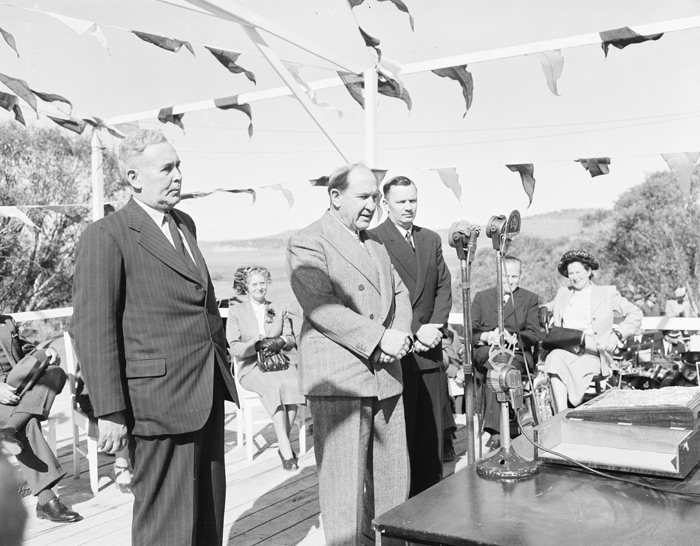
When Menzies came to power in 1949, he inherited the Scheme and made it his own. The Snowy Mountains Hydro-electric Authority, established in 1949, reported directly to the Prime Minister’s Department—a sign of the project’s national significance. Menzies understood, as few of his contemporaries did, that infrastructure was not merely a matter of pipes and turbines but a form of political communication, a way of telling Australians that they belonged to a nation capable of grand ambitions. The Scheme was his government’s answer to the great public works of the New DealThe New Deal Full Description:A comprehensive series of programs, public work projects, financial reforms, and regulations enacted by President Franklin D. Roosevelt. It represented a fundamental shift in the US government’s philosophy, moving from a passive observer to an active manager of the economy and social welfare. The New Deal was a response to the failure of the free market to self-correct. It created the modern welfare state through the “3 Rs”: Relief for the unemployed and poor, Recovery of the economy to normal levels, and Reform of the financial system to prevent a repeat depression. It introduced social security, labor rights, and massive infrastructure projects.
Critical Perspective:From a critical historical standpoint, the New Deal was not a socialist revolution, but a project to save capitalism from itself. By providing a safety net and creating jobs, the state successfully defused the revolutionary potential of the starving working class. It acknowledged that capitalism could not survive without state intervention to mitigate its inherent brutality and instability.
Read more: a demonstration that modernity could be achieved without sacrificing the liberal values of private enterprise and individual initiative .
The scale was breathtaking. The Scheme eventually comprised sixteen major dams, seven power stations, a pumping station, and 225 kilometres of tunnels and pipelines through some of the most rugged terrain on the continent. The main tunnel through the Snowy Mountains was 23.5 kilometres long—at the time, the longest water tunnel in the world. Workers drilled through granite that was so hard that drill bits wore out after a few hours, through sandstone that crumbled and collapsed, through seams of water that flooded workings and drowned the unwary .
The engineering challenges were matched by the organisational ones. The Scheme was divided into two distinct systems: the Snowy-Murray development in the south, which diverted water from the Snowy River through tunnels under Mount Kosciuszko to the Murray Valley; and the Snowy-Tumut development in the north, which sent water from the Tooma and upper Tumut rivers into the Murrumbidgee system. Each required its own workforce, its own camps, its own transport infrastructure. The Authority built 1,600 kilometres of roads, 500 kilometres of transmission lines, and entire towns—Cabramurra, Khancoban, and others—to house its workers and their families .
For a generation of Australians, the Snowy Scheme became synonymous with progress itself. Schoolchildren studied its dimensions; politicians praised its vision; visitors toured its works and marvelled at its scale. It was, as one historian has put it, “the closest Australia has ever come to building a pyramid”—a monument to the belief that human ingenuity could master nature and shape the future .
The Workers – Thirty Nations Under One Flag
The Scheme’s most lasting legacy, however, was not in concrete and steel but in the people who built it. When Australian workers proved insufficient in number and unwilling to endure the harsh conditions of the mountains, the Authority turned to the displaced persons camps of Europe. From 1949 onwards, a steady stream of migrants arrived at the Scheme’s worksites: Poles who had fought with the Allies and could not return to communist homelands; Ukrainians who had been swept up in the chaos of war and occupation; Germans and Italians and Yugoslavs and Czechs, each carrying their own histories of displacement, loss, and survival .
By the mid-1950s, the workforce was among the most cosmopolitan on earth. Official figures recorded workers from more than thirty nationalities. Poles were the largest group, followed by Italians, Germans, Yugoslavs, and Hungarians. There were Russians and Belarusians, Dutch and Norwegians, Greeks and Austrians. On any given day, a dozen languages could be heard in the tunnels and camps. The Authority’s newsletters and notices were published in multiple languages. The canteens served food that reflected the workers’ origins—sauerkraut alongside sausages, pasta alongside stew, pierogi alongside pies .
The conditions were brutal. Work proceeded around the clock, in three eight-hour shifts. In the tunnels, men drilled and blasted through rock in conditions of deafening noise and choking dust. Temperatures could reach 40 degrees Celsius at the working face, even when snow lay thick on the ground outside. Cave-ins were frequent; flooding was a constant risk. The death toll mounted: 121 men killed over the life of the project, their names recorded on plaques at the Scheme’s visitor centres, their bodies buried in local cemeteries far from the countries of their birth .
Yet for many of these men, the Snowy was also an opportunity. Wages were high by the standards of the time—higher than in the factories and farms where many migrants otherwise would have worked. Accommodation was provided, albeit in spartan barracks or tin huts. Men who saved their pay could, after a few years, leave the mountains and start new lives in the cities—buying houses, bringing out families, establishing the businesses and communities that would transform Australian suburbia .
The Authority’s management was aware that it was presiding over a vast social experiment. It promoted a vision of harmonious multiculturalism long before that term entered Australian political discourse. Official photographs showed workers of different nationalities shaking hands, sharing meals, celebrating together. The Authority’s magazine, the Snowy Mountains News, published articles about the customs and cultures of its workforce, encouraging Australians to see the migrants not as threats but as contributors to a shared national project .
This official harmony, however, masked tensions that never entirely disappeared. Australian workers, who received higher pay and better conditions than their migrant counterparts, resented what they saw as undercutting. Migrant workers, for their part, chafed at the discrimination they encountered both on and off the job. Poles and Ukrainians, many of whom had fought against communism, found themselves working alongside Yugoslavs and Russians who might, in other circumstances, have been their enemies. The camps were not always peaceful places; fights broke out, grievances festered, and the Authority’s welfare officers spent as much time mediating disputes as providing assistance .
The Suburbs They Built
The connection between the Snowy Scheme and the suburban dream was not merely metaphorical. The electricity generated by the Scheme’s power stations flowed directly into the grid that powered the great post-war housing boom. In Melbourne, where the Housing Commission was throwing up entire suburbs on the city’s fringes—Broadmeadows, Doveton, Noble Park—the lights were kept burning by Snowy hydro-power. In Sydney, where the long march westward was filling the plains with fibro cottages and brick veneers, the televisions and refrigerators and washing machines that defined the new suburban lifestyle depended on the same source .
The water was equally important. The Scheme’s diversion of the Snowy River into the Murray and Murrumbidgee systems made possible a dramatic expansion of irrigated agriculture—and irrigated agriculture, in turn, supplied the cities with the food their growing populations demanded. The fruit and vegetables that filled the new supermarkets of the 1960s, the milk and meat that stocked the refrigerators of suburban kitchens, came in significant part from farms made viable by Snowy water .
But the connection was also human. Many of the men who built the Scheme did not stay in the mountains. After their contracts ended, they moved to the cities—to Melbourne and Sydney, to Canberra and Wollongong—and became the suburbanites whose lives they had helped to power. They bought houses in the new estates, sent their children to local schools, joined churches and clubs and social organisations. They opened shops and restaurants, established community newspapers, built the ethnic associations that would become the backbone of multicultural Australia .
The story of the Snowy Scheme, then, is not separate from the story of post-war suburbanisation; it is the same story, told from a different angle. The houses that went up in the 1950s and 1960s were built, in many cases, by the same hands that had drilled the tunnels of the Snowy. The suburbs that spread across the urban fringe were populated by the same families that had lived in the camps at Cabramurra and Khancoban. The appliances that filled those houses, the lights that illuminated them, the water that flowed from their taps—all bore the imprint of the Scheme .
The Politics of Snowy Modernity
The Snowy Scheme was never merely a technical project; it was always deeply political. For the Menzies government, it served multiple purposes. It demonstrated that a Liberal administration could undertake great public works as ambitiously as any Labor government. It provided a visible symbol of national progress at a time when the Cold War made such symbols psychologically important. And it offered a practical demonstration of the virtues of the mixed economy—private contractors working under public direction, market incentives harnessed to state purposes .
The Scheme also served to manage the political challenges posed by mass migration. By dispersing migrants across dozens of worksites, often in remote locations, it reduced the likelihood of ethnic concentrations developing in the cities—concentrations that might, it was feared, resist assimilation and perpetuate alien ways. By putting migrants to work on a project of such obvious national importance, it gave them a claim on Australian identity that might otherwise have been denied. A Pole who had helped build the Snowy was, in some sense, more Australian than a Briton who had simply arrived and settled in a city suburb .
Yet the Scheme also generated political tensions that the government could not fully control. The migrant workers, despite the official rhetoric of harmony, were not always content with their conditions. They organised, agitated, and struck. In 1952, a major strike by Italian workers shut down work on the Scheme for weeks, forcing the government to intervene and negotiate a settlement. The strikers’ demands—for better pay, safer conditions, and recognition of their skills—were those of workers anywhere, but they took on added significance in a context where migrants were supposed to be grateful, compliant, and politically quiescent .
The Communist Party, despite its weakened state after the Cold War battles of the 1950s, found opportunities to organise among the Snowy workforce. Migrant workers, many of whom had experienced communist rule in Europe, were often suspicious of Party organisers, but the Party’s advocacy of better conditions and its opposition to the discriminatory treatment of non-British migrants won it a hearing in some quarters. The Snowy thus became, inadvertently, a site where the politics of class and the politics of ethnicity intersected in ways that would have lasting consequences .
The Scheme’s Legacy – From Assimilation to Multiculturalism
When the last concrete was poured and the last tunnel sealed, the Snowy Scheme left behind a transformed landscape. The rivers that had once flowed freely to the sea were now harnessed, diverted, and controlled. The mountains that had stood for millennia were pierced and hollowed. The Scheme’s dams became tourist attractions, its lakes sites for recreation, its power stations sources of pride and wonder .
But the Scheme’s most profound legacy was in the people it had brought together. The men who had drilled and blasted and built did not disappear when the work was done. They settled, married, raised children, and became part of the fabric of Australian life. The children of Snowy workers grew up speaking English with Australian accents but carrying within them the languages, memories, and traditions of their parents’ homelands. They became the first generation of a new Australia—an Australia that was no longer British in any simple sense, but something more complex, more various, more interesting .
The Scheme had been conceived in the era of assimilation, when the goal was to make migrants over into copies of the British-Australian ideal. But the Scheme itself undermined that ideal. It demonstrated that migrants could be loyal and productive Australians without ceasing to be Polish or Italian or German. It showed that cultural diversity, far from being a threat to social cohesion, could be a source of strength. It provided a reservoir of experience and imagery that later advocates of multiculturalism would draw upon .
The Snowy Mountains Scheme, existed at a crucial moment in Australian post-war history. It looks backward to the certainties of the British Empire, the rural economy, the racial hierarchies of White Australia. But it also looks forward to the uncertainties of multicultural Australia, the industrial economy, the suburban society that would define the nation for the rest of the century. In splitting the atom of the mountains, it helped build the suburbs that would house the new Australia. And in doing so, it helped create the conditions for its own forgetting—for the suburbs, once built, had no need to remember the mountains from which their power came.
Conclusion: The Power and the Light
The Snowy Mountains Scheme was the largest, most ambitious, and most consequential public work in Australian history. It transformed the nation’s geography, powered its industrial expansion, and provided the water that made possible the suburban dream of the 1950s and 1960s. It brought together workers from across the world and, in doing so, helped lay the foundations for the multicultural society that would emerge in the decades that followed.
Yet the Scheme has also been, in important ways, forgotten. The suburbs it powered do not remember the tunnels from which their electricity came. The families it helped to create do not always know the stories of the men who drilled and blasted in the mountains. The multicultural Australia it prefigured often traces its origins to later struggles, later victories, later migrations.
To recover the history of the Snowy Scheme is to recover something essential about the making of modern Australia. It is to see that the suburbs were not simply built—they were powered, watered, and populated by a project of national transformation. It is to recognise that the migrants who arrived in the 1950s and 1960s were not simply passive recipients of Australian generosity but active participants in the creation of the world they would inhabit. And it is to understand that the dream of assimilation, which the Scheme was supposed to serve, was always undermined by the very forces the Scheme itself unleashed.
Bibliography
Australian National Committee on Large Dams. Snowy Mountains Hydro-electric Scheme. Sydney: ANCOLD, 1999.
Broomham, Rosemary. Steadying the Dream: The Snowy Mountains Scheme and the Making of Modern Australia. Sydney: Allen & Unwin, 2001.
McHugh, Siobhan. The Snowy: The People Behind the Power. Sydney: HarperCollins, 1989.
National Archives of Australia. “Snowy Mountains Hydro-electric Scheme.” Fact Sheet 196. Canberra: NAA, 2008.
Newton, Bert. The Snowy: A History. Sydney: Hodder & Stoughton, 1980.
Scarlett, Ken. The Snowy Mountains Scheme: A Photographic Achievement. Sydney: Tabletop Press, 2004.
Snowy Mountains Hydro-electric Authority. The Snowy Mountains Scheme: A Pictorial Presentation of Its Development. Cooma: SMHEA, 1965.
Spearritt, Peter. The Sydney Harbour Bridge: A Life. Sydney: UNSW Press, 2007.
Wigmore, Lionel. Struggle for the Snowy: The Background of the Snowy Mountains Scheme. Melbourne: Oxford University Press, 1968.

Leave a Reply