
During the Spanish Civil War one of the most decisive forms of intervention was, paradoxically, an act of collective non-intervention. The policy of Non-Intervention, formally adopted by twenty-seven European nations in August 1936 and administered by a London-based committee until the war’s end, stands as a landmark of diplomatic failure and moral abdication. It was a policy designed not to prevent foreign interference, but to license it selectively; not to uphold international law, but to subvert it for reasons of political expediency. This essay argues that the Non-Intervention Committee (NIC) was less a neutral arbiter than an active agent in shaping the conflict’s outcome. By constructing a legal and naval framework that bound the Western democracies while being systematically flouted by Nazi Germany and Fascist Italy, the committee created a fatal asymmetry that strangled the Spanish Republic. This was not a policy of peace but one of appeasement, a conscious sacrifice of Spanish democracy on the altar of Anglo-French hopes for a general European settlement with the fascist powers. An analysis of its ideological origins, its operational farce, and its devastating consequences reveals Non-Intervention as a pivotal chapter in the diplomatic prehistory of the Second World War, demonstrating how the willful blindness of powerful bystanders can become a form of complicity in aggression.
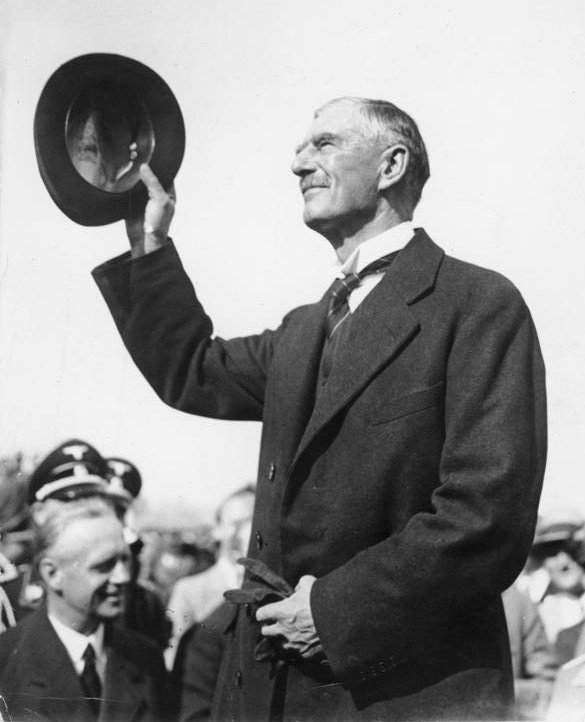
Photo attribution:
Bundesarchiv, Bild 183-H12967 / CC-BY-SA 3.0
The Origins of an Abstention: Fear, Ideology, and the Abdication of Law
The policy of Non-Intervention did not emerge from a legal or ethical vacuum. Its roots lay in a profound confluence of fear, ideological ambiguity, and realpolitik within the French and British governments. When the Spanish military rebelled in July 1936, the French Popular Front government of Léon Blum, ideologically aligned with its Spanish counterpart, initially considered aiding the Republic. This was its right under international law; the Republic was the recognized sovereign government facing an insurrection, and the 1935 Franco-Soviet pact contained clauses for mutual assistance.
However, this initial impulse was swiftly crushed by a cascade of pressures. Domestically, Blum faced vehement opposition from the French right, which portrayed any aid as a step toward a wider, communist-led war. Internationally, the British government of Stanley Baldwin made its profound opposition clear. Britain, guided by a Conservative establishment deeply suspicious of the Spanish Popular Front’s revolutionary elements and obsessed with preserving peace in Europe at almost any cost, urged extreme caution. The fear was that unilateral French aid would trigger a counter-intervention from Germany and Italy, escalating into a general European war for which neither Britain nor France felt prepared. This British stance, as historian Paul Preston meticulously documents, was underpinned by a latent sympathy for the Nationalists among senior diplomats and aristocrats, who saw Franco as a bulwark against Bolshevism and a force for traditional order.
Thus, the French initiative was stillborn. Instead, Blum proposed a European-wide agreement to abstain from intervention, a policy he hoped would contain the conflict by binding the fascist powers. On August 2, 1936, France unilaterally suspended all arms exports to Spain. Britain eagerly endorsed this stance, and by the end of August, the Non-Intervention Agreement was signed, with a committee established in London to oversee its implementation. From its inception, the policy represented a catastrophic surrender of principle to fear. It deliberately equated the legal government’s right to self-defense with the rebels’ act of insurrection, morally and legally placing them on the same plane. It elevated the goal of avoiding a European war—a legitimate concern—above the defense of a democratic ally and the norms of sovereignty, establishing a dangerous precedent that aggressors would soon exploit.
The Theatre of the Absurd: The Operation and Enforcement of a Fiction
The work of the Non-Intervention Committee in London quickly devolved into what one contemporary observer termed a “diplomatic farce.” Chaired by the British diplomat Lord Plymouth, the committee became a venue for endless procedural debate, deliberate obfuscation, and the diplomatic laundering of blatant violations. Its fundamental flaw was the complete absence of an enforcement mechanism or any will to create one. It operated on the honor system in a context of profound dishonor.
The committee’s primary tangible measure was the establishment of a naval patrol scheme in April 1937, intended to monitor and prevent arms shipments by sea to Spain. The scheme was structurally biased and operationally futile. The patrols were divided among the four main powers: Britain, France, Germany, and Italy. The Nationalist coastline was monitored by the German and Italian navies, while the Republican coast was watched by the British and French. This arrangement was tantamount to assigning foxes to guard henhouses. German and Italian warships actively facilitated the passage of their own arms shipments to Nationalist ports while occasionally intercepting Republican-bound vessels. The British and French patrols, under strict orders to avoid “incidents,” were passive and ineffective. The scheme also ignored the critical land border between Nationalist-friendly Portugal and Spain, which became a major conduit for arms, a fact the committee persistently overlooked despite Republican protests.
Within the committee’s chambers, evidence of violations was met with a ritual of cynicism. When the Republic presented irrefutable proof of Italian infantry captured at Guadalajara or German-made aircraft downed over Madrid, the Italian and German delegates would flatly deny it, attributing it to “volunteers” acting without state sanction. The British and French chairs, desperate to maintain the committee’s existence as a symbol of diplomatic engagement, accepted these transparent fictions. The committee’s focus became the preservation of its own process, not the enforcement of its principles. This diplomatic theater served a crucial function for Hitler and Mussolini: it provided a veneer of international legitimacy for their interventions while neutralizing the potential response from London and Paris. As historian Enrique Moradiellos argues, Non-Intervention acted as a “smokescreen” for aggression, allowing the fascist powers to wage a proxy war under the protective cover of a European agreement they were systematically sabotaging.
The Asymmetric Strangulation: Consequences for the Spanish Republic
The impact of Non-Intervention on the ground in Spain was not symmetric; it was catastrophically one-sided. For the Nationalists, the agreement was a minor diplomatic irritant. They received a steady, massive flow of arms and troops from Germany and Italy via secure maritime and Portuguese routes. The fiction of Non-Intervention actually benefited Franco internationally, as it framed the conflict not as an invasion in his favor, but as an internal struggle where he was somehow resisting foreign (Soviet) interference.
For the Spanish Republic, however, Non-Intervention was a death sentence. Legally entitled under international law to purchase arms for its defense, it found itself trapped. The Western democracies refused to sell, citing the agreement. The fascist powers were, of course, enemies. This left only one major supplier: the Soviet Union. The Republic’s dependency on Moscow, sealed with the shipment of the gold reserves, was thus a direct creation of the Non-Intervention policy. It handed StalinStalin Joseph Vissarionovich Stalin (18 December 1878 – 5 March 1953) was a Soviet politician, dictator and revolutionary who led the Soviet Union from 1924 until his death in 1953. Read More a monopoly on Republican supply, granting him enormous political leverage which he used to suppress the Spanish revolution and align Republican strategy with Soviet foreign policy aims, as detailed in the earlier essay on Soviet intervention.
The material consequences were dire. Republican forces faced chronic, crippling shortages of modern weapons, ammunition, and particularly aviation fuel, while facing an enemy abundantly supplied. The arrival of Soviet aid in late 1936, while vital, was never on the scale or with the consistency of Axis aid to Franco. Furthermore, the NIC’s naval control system allowed the Italian navy, in particular, to engage in a de facto blockade of Republican ports, conducting a campaign of piracy that included the sinking of neutral merchant ships. The notorious sinking of the British-flagged SS Cedarwood and other vessels transporting food and non-military supplies exemplified how the permissive environment fostered by Non-Intervention enabled the escalation of economic warfare.
Ultimately, Non-Intervention did not prevent foreign intervention; it orchestrated it. It created a controlled environment where fascist intervention could proceed with minimal risk of a wider war, while democratic intervention was outlawed. It transformed the conflict from a civil war in which the government could exercise its rights into a proxy war where one side was artificially starved of the means of self-defense. The policy did not contain the Spanish conflict; it guaranteed its prolongation and decisively shaped its outcome in favor of the aggressors.
The Prelude to Appeasement: Ideological and Strategic Continuities
Non-Intervention cannot be understood in isolation; it was the first and most consequential act of the broader policy of Appeasement that would characterize Anglo-French diplomacy until 1939. The same mindset—the fear of war, the tendency to see fascist grievances as legitimate, the deep suspicion of Soviet communism, and the willingness to sacrifice smaller states for the illusion of stability—animated both.
The architects of the policy, particularly in the British Foreign Office, viewed the Spanish conflict through a distorted lens. They often saw the Republic not as a victim of fascist aggression but as the dangerous, revolutionary side, its defense tainted by the presence of anarchists and communists. Franco, by contrast, was frequently perceived as a moderate nationalist, a restorer of order. This ideological bias, evident in diplomatic cables and press coverage, made the moral compromise of Non-Intervention psychologically easier. It was not merely a strategic calculation to avoid war; it was, for many, a reflection of a preferred outcome.
The strategic calculation itself was also flawed. The hope that accommodating Hitler and Mussolini in Spain would satisfy their ambitions or make them more amenable to a general European settlement was a profound misreading of fascist ideology, which thrived on expansion and perceived weakness. Spain became a testing ground where the democracies’ refusal to uphold the principles of the League of NationsLeague of Nations
Full Description:The first worldwide intergovernmental organisation whose principal mission was to maintain world peace. Its spectacular failure to prevent the aggression of the Axis powers provided the negative blueprint for the United Nations, influencing the decision to prioritize enforcement power over pure idealism. The League of Nations was the precursor to the UN, established after the First World War. Founded on the principle of collective security, it relied on moral persuasion and unanimous voting. It ultimately collapsed because it lacked an armed force and, crucially, the United States never joined, rendering it toothless in the face of expansionist empires.
Critical Perspective:The shadow of the League looms over the UN. The founders of the UN viewed the League as “too democratic” and ineffective because it treated all nations as relatively equal. Consequently, the UN was designed specifically to correct this “error” by empowering the Great Powers (via the Security Council) to police the world, effectively sacrificing sovereign equality for the sake of stability.
Read more or international law was starkly revealed. The successful defiance of the NIC by Germany and Italy emboldened them, convincing Hitler that the Western powers were too divided and cowardly to resist further aggression. The failure to act in Spain directly encouraged the subsequent annexations of Austria and Czechoslovakia. In this sense, the bombing of Guernica and the remilitarization of the Rhineland were linked: both were tests of democratic resolve that met with only verbal protest.
Conclusion: The Legacy of Complicit Bystanding
The Non-Intervention Committee was dissolved in April 1939, its work complete only in the sense that the war it had helped to decide was over. Its legacy is one of catastrophic diplomatic failure. It demonstrated that in the face of determined, lawless aggression, a policy of formalistic neutrality and procedural delay could function as active assistance to the aggressor.
For the Spanish Republic, it was the decisive external factor in its defeat. It transformed a military challenge into an insurmountable logistical and geopolitical chokehold. For the European democracies, it was a self-inflicted wound that eroded their moral authority, betrayed their potential allies, and encouraged the very forces that would soon threaten their own existence. It proved that the desire for peace, when divorced from the courage to defend the principles that make peace meaningful, becomes a recipe for a larger, more terrible war.
The tragedy of Non-Intervention lies in its profound cynicism. It was a policy built on the hope that the fascist powers would play by rules they openly despised, and on the belief that the sacrifice of Spanish democracy was an acceptable price to pay for a temporary and illusory continental calm. The committee’s members, sipping tea in London while compiling meaningless reports on arms flows they had no intention of stopping, became the archetypal bystanders to tragedy. Their failure was not one of capability, but of will and moral clarity. In the end, the Spanish Civil War was not just lost on the battlefields of the Ebro or in the streets of Barcelona; it was lost in the committee rooms of Whitehall and the Quai d’Orsay, where the decision was made to stand aside, and in doing so, to take a fateful step toward the abyss of a world war.

Leave a Reply