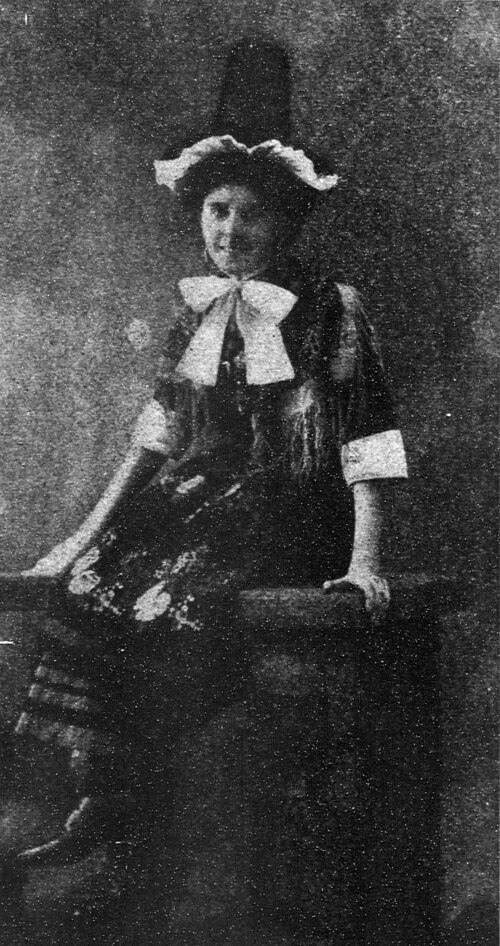

We often think of the “fake heiress” as a modern phenomenon, fueled by Instagram filters and Netflix dramas like Inventing Anna. Yet, over a century ago, a young woman named Violet Charlesworth captivated and scandalized Britain with a grift so audacious it dominated the front pages for years.
In the latest episode of the Explaining History podcast, I sat down with author Mark Bridgman to discuss his new book, Nothing for Something, which unravels the life of this extraordinary Edwardian fraudster.
The Inheritance Scam
Violet Charlesworth was born May Charlesworth to working-class parents in the Midlands. However, driven by a mother with fierce social pretensions, May reinvented herself as Violet May Gordon Charlesworth. She concocted a story that she was the goddaughter of the legendary General Gordon of Khartoum and was due to inherit £75,000 (roughly £4 million today) upon turning 21.
Using this fictitious inheritance as collateral, Violet and her mother went on a spending spree that would make modern influencers blush. They acquired jewelry, furs, and clothes on credit. As the scam grew, so did their lifestyle. They leased country estates in Wiltshire, Scotland, and North Wales, hired staff, and Violet eventually owned six motorcars at a time when there were only 3,000 on Britain’s roads.
The Crash and the Red Cloak
As Violet’s 25th birthday approached—the new date she had set for her “inheritance”—the walls began to close in. Debts were mounting, and creditors were getting impatient. In January 1909, Violet executed her most dramatic move yet: she staged her own death.
Violet’s car reportedly crashed through a wall on a cliff road in North Wales, throwing her body into the sea. However, doubts arose immediately. Her hat was found dry on the rocks, and no body was recovered. Violet had actually fled to Scotland via Ireland, sparking a national manhunt.
The public fascination was intense. Violet was known for wearing a distinctive red motor cloak. The hysteria was such that women wearing similar coats in the street were harassed by amateur detectives, leading shops to pull the fashionable item from their shelves.
Suffragettes and Silence
Violet was eventually discovered in Oban, Scotland. She and her mother were tried for fraud and sentenced to three years in prison.
One of the most fascinating aspects of Mark Bridgman’s research is the time Violet spent in Aylesbury Prison. A pampered fraudster who had never done a day’s work, she found herself incarcerated alongside Suffragettes who were being force-fed and tortured for their political beliefs. It is a stark collision of two very different sides of Edwardian womanhood.
Released in 1912, Violet had a stroke of perverse luck. Just weeks after her release, the Titanic sank, wiping her story from the headlines. The onset of the Great War further buried her notoriety.
Violet Charlesworth eventually pulled off her greatest trick: she vanished into obscurity. While we know the beginning and the middle of her story, her final years remain a mystery—a fitting end for a woman who built her life on smoke and mirrors.
Mark Bridgman’s book, Nothing for Something: The Violet Charlesworth Story, is available now from Whittles Publishing.
Tidied Transcript
Nick: Welcome again to the Explaining History podcast. I am very pleased to be joined today by writer Mark Bridgman, who is here to tell us the extraordinary story of an Edwardian fraudster, Violet Charlesworth, in his new account of her life and crimes, Nothing for Something. Welcome, Mark.
Mark: Thanks for letting me come on to talk about the amazing Violet.
Nick: It sounds like you have a complicated relationship with her, as often happens when researching complex characters.
Mark: Violet is one of those women that is difficult not to admire, despite the fact that she was a fraudster who conned everyone from wealthy businessmen to old widows. You can’t help but admire her because she had style. It’s an Edwardian style that is perhaps gone from the modern era. When you look at what she did and how she carried on, you think, “What an amazing woman, how did she get away with it?”
Nick: So, let’s start at the beginning. Who was Violet Charlesworth?
Mark: Violet Charlesworth was not her real name; she was born May Charlesworth to working-class parents in the Midlands. She was brought up in Stafford, Derby, and Wolverhampton. Her father was an engineer, and they lived in terraced houses, but Violet’s mother, Miriam, had social pretensions. She brought Violet up to have these same pretensions.
At some point, she decided she didn’t like the name May, so she became Violet May Gordon Charlesworth. The “Gordon” was meant to hint at Scottish ancestry—specifically that she was the goddaughter of General Gordon of Khartoum. She wasn’t, but she hoped this name would give her cachet.
The fraud began when her mother took her to a draper’s shop in Derby. Violet was a teenager. They ordered expensive clothes they couldn’t afford, but Miriam persuaded the draper to give them the clothes on the understanding that Violet was due to inherit money when she turned 21. They promised to pay him back with interest. It worked. They realized how easy it was and tried it again with jewelry, furs, and hats. They steadily accumulated possessions based on this vague promise of an inheritance.
It really is the beginning of the “inheritance scam” we see today, similar to the Anna Delvey story. Violet spun two stories: one was the General Gordon connection, claiming she was due to inherit £75,000. Since Gordon was dead, it was hard to disprove. The second story was that she had been engaged to a soldier, Alexander McDonald, who was lost at sea. She would borrow money claiming she needed to travel to the Bay of Biscay to lay a wreath.
Nick: And the scam grew from there?
Mark: Around 1906, the family moved to North Wales and leased a large house called Bodwy. They told people Violet’s father had changed jobs to explain the money, but it was all coming from Violet’s fraud. She acquired a car, a maid, a gardener, and a cook. But this wasn’t enough. She leased another country house in Wiltshire, bought 12 pedigree dogs, built kennels, and bought another car.
She also became engaged to a Doctor Edward Hughes Jones in North Wales. He was 21 years older than her, fell hopefully in love, and lent her the modern equivalent of £500,000 on the promise of marriage.
Nick: At this point, she must have been robbing Peter to pay Paul. A scam reaches a point where you have to keep finding dupes to pay for the things you already have.
Mark: Her appetite was insatiable. But there was a time bomb ticking: she had told everyone she would inherit at 21. As her 25th birthday approached, she changed the story, claiming the trustees had delayed the inheritance until she was 25. That gave her four more years.
She then persuaded a firm of London stockbrokers to lend her £10,000 (almost a million pounds today) to invest in stocks. She hoped to pay people back with the dividends. She invested in American railroad stock, which was booming, but then the market crashed, and she lost a huge amount of money.
She just kept going. She leased another estate in Scotland, Flowerburn House, for shooting parties. At one point, she had six motorcars and a chauffeur. In 1909, there were only 3,000 cars in Britain, so that gives you an idea of her excess.
Eventually, things began to unravel. This is the part that lifts the story above a grubby fraud: Violet decided to stage her own death.
Nick: How did she do that?
Mark: In January 1909, in North Wales, she left with her sister and chauffeur. On the way back, on a cliff road near Penmaenmawr, the car hit a wall. Violet was apparently thrown over the windscreen and down the rocks into the sea. Her sister ran for help, screaming that Violet had gone over the cliff. A huge search was organized, but they couldn’t find her.
People became suspicious quickly. Locals knew it was unlikely for a body to be thrown that far out to sea from that spot. Her hat was found on the rocks, but it was dry, indicating the water hadn’t risen that high. There was no blood in the car.
In the meantime, Violet had gone on the run. I uncovered witness statements suggesting she took a mail train and boat to Dublin, then tried to get to Cork to catch a ship to America. She missed the boat and had to return to Wales, eventually taking trains up to Scotland. She ended up on the Isle of Mull, intending to hide in a hotel in Tobermory.
Nick: And she was spotted?
Mark: An eagle-eyed baker in Tobermory recognized her because she’d been there on holiday the year before.
You have to understand, the hunt for Violet was a national sensation. In 1909 and 1910, Violet garnered more column inches in the newspapers than the King and the Prime Minister combined. She wore a distinctive red motor cloak. The public began looking for any woman wearing one. Women were being harassed in the streets, and shops actually stopped selling them because nobody wanted to be accused of being Violet Charlesworth.
Nick: What happened when she was caught?
Mark: She was found in Oban living under the name Margaret MacLeod. Even when her sister was brought to identify her, they had a ridiculous standoff where they pretended not to know each other. Eventually, she had to admit it.
She was taken to London to face bankruptcy proceedings. Remarkably, up to this point, no one had considered it a fraud; they just thought she was a spendthrift heiress. At her hearing, it was declared she owed roughly £27,000—about £4 million today.
She tried to earn money to pay creditors by starring in a West End musical playing herself. She was terrible and was booed off stage; it lasted a week. She also starred in a silent movie about the event, filmed on location. Sadly, that film no longer exists.
Eventually, she and her mother were tried for fraud. They were sentenced to three years in prison in Aylesbury.
Nick: This connects to a darker part of history, doesn’t it?
Mark: Yes. They were in prison at the same time the Suffragettes were being imprisoned in Aylesbury. Violet and her mother, who had lived these pampered, selfish lives, were side-by-side with women enduring force-feeding and torture for a political cause. It’s a very interesting contrast in the book.
They were released in 1912, largely because Violet’s sister wrote to Winston Churchill, then Home Secretary, claiming they were ill. They had a stroke of luck regarding their notoriety: the Titanic sank a few weeks after their release. That wiped every other story off the front pages. By the time the Great War finished, Violet had been forgotten.
Nick: How did you find the end of the story?
Mark: Well, Violet pulled off two main cons: the fraud and the car crash. Both were flawed. Her final con was that after prison, she disappeared. Nobody has ever conclusively found out what happened to her. I traced some of her ancestors, but it turned out I knew more than they did.
In the book, I discuss four or five options of what might have happened to her, based on evidence I’ve found. I want the reader to guess which theory is right.
Nick: It’s fascinating how class plays into this. Her mother was desperate to acquire status, yet Violet couldn’t quite fool the true “old money.”
Mark: That’s right. She attended a prestigious Highland ball shortly before her disappearance. The high society ladies saw right through her. One of them said, “No real lady talks about her money.” Violet was too showy. The Edwardian era was changing—King Edward VII encouraged more flamboyance—but the older, Victorian generation didn’t take to her.
However, she was a voracious reader and could hold a conversation. I wanted the reader to hear her voice, so I included her begging letters and newspaper articles she wrote in the book.
Nick: The book is called Nothing for Something.
Mark: Yes, it’s published by Whittles Publishing and is available now.
Nick: As always, please purchase from an independent retailer or directly from the publisher. Mark, it’s been a pleasure. Best of luck with the book.
Mark: Thank you.

Leave a Reply